

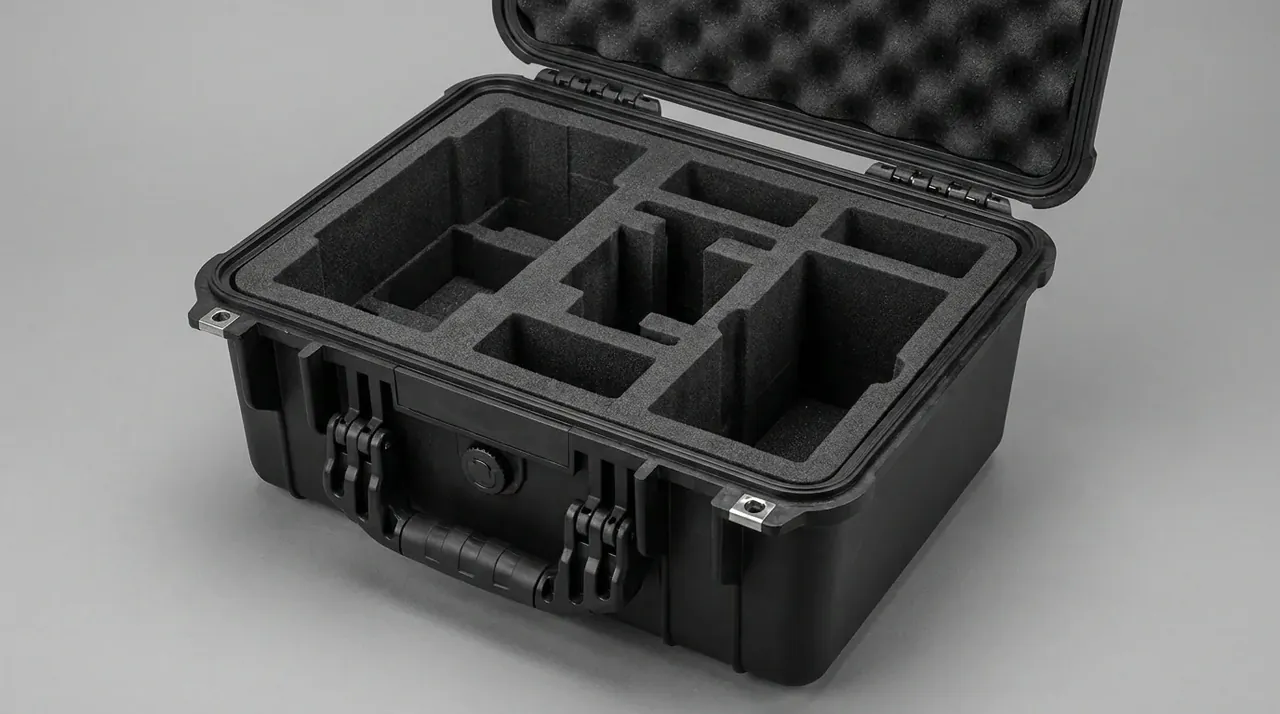
Quick answer: An Acid/alkali resistant industrial chemical box pairs a 1.2 mm inner barrier with 24% gasket compression and ≤0.8% mass change after 168 h immersion.
Table of contents
- Inner barrier layer of an Acid/alkali resistant industrial chemical box
- Compression margin at the lid gasket
- Mass change across immersion cycles
- Lid deflection checkpoints under static pressure
- Barrier thickness rejection line for corrosion lots
- FAQ
1. Inner barrier layer of an Acid/alkali resistant industrial chemical box
The outer envelope of an Acid/alkali resistant industrial chemical box measures 620×450×280 mm, the cavity 550×385×205 mm, and the nominal wall 4.6 mm. Those figures set the stiffness budget. The 1.2 mm inner barrier is not extra wall thickness; it is a functional skin bonded to the inside of the substrate. The substrate carries stacking and drop loads, while the skin keeps the medium away from the base resin.
Uniformity, not the average, is the harder target for an Acid/alkali resistant industrial chemical box. Bottom corners, the lid-side flange and the roots of moulded inserts all tend to run thin. The 1.2 mm value should be read as a floor at these points rather than a mean across the broad faces. A thickness gauge takes one reading at each risky region, then points on the four walls; no low reading is offset elsewhere. Empty mass of 6.5 kg and a 13 kg rated load are logged alongside, because a slightly flexed base changes how the probe seats.
The bond between skin and substrate also has to survive the declared −20 ℃ to 60 ℃ working band. At the cold end the skin contracts and at the hot end the substrate expands, so a weak interface blisters at corners first. Adhesion is checked by a cross-cut method on those two zones; pinhole defects are left to the immersion mass-change result.
2. Compression margin at the lid gasket
The lid opening is the only openable interface on an Acid/alkali resistant industrial chemical box, and both gaskets are set to 24% compression. Compression ratio describes how far the free section is squeezed down to its working height; compression margin describes how much rebound survives after repeated openings and stress relaxation. Deep squeeze on day one does not guarantee a tight seal later.
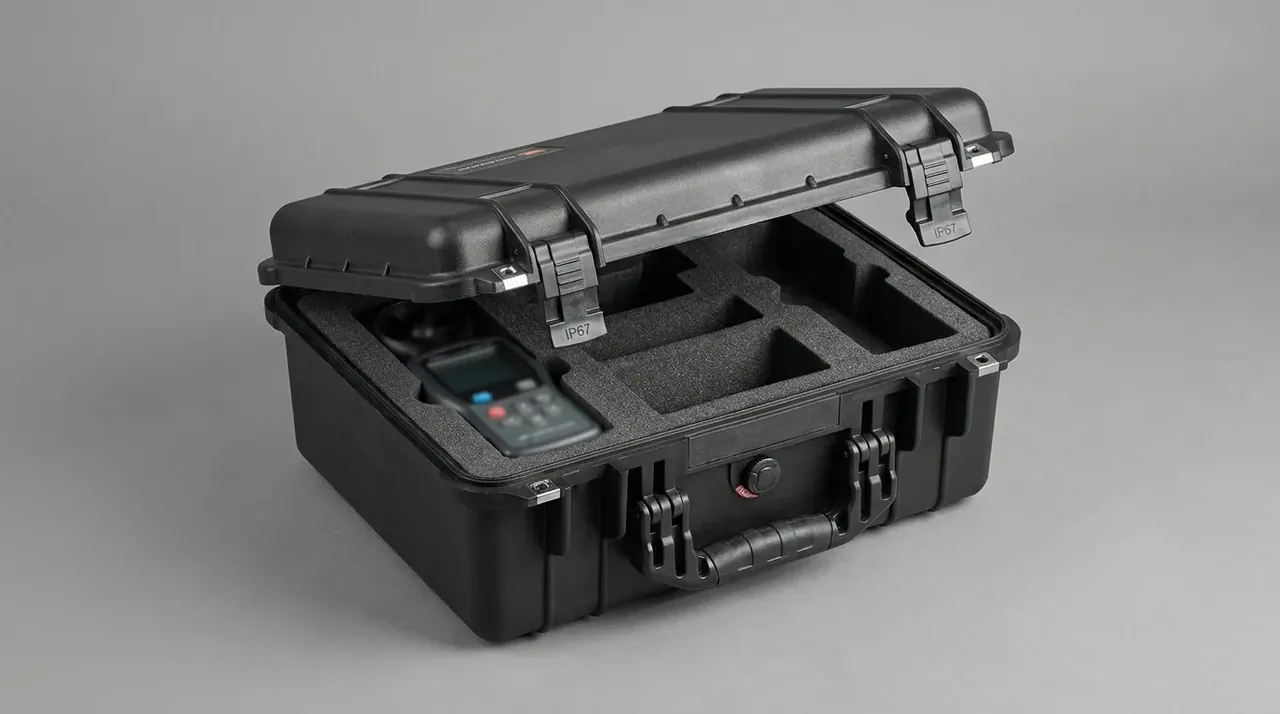
Four catches distributed around the mouth, each delivering 410 N, do not load the gasket evenly unless the closing sequence is controlled. A shallow side opens a leak path under pressure first; an over-deep side loses its margin early as permanent set builds. Diagonal alternating closing is specified, and the lid-to-rim gap is re-measured at four corners with a feeler gauge.
The two gaskets on an Acid/alkali resistant industrial chemical box split the work: the inner one is the primary seal, the outer one a redundant backup, and the cavity between them traps whatever gets past the first line. The hydrostatic hold method benchmarks the sealing behaviour associated with IP68 by confirming this double line stays closed at 0.6 MPa. After a 1.0 m drop the mouth flatness can shift, so compression is measured again.
3. Mass change across immersion cycles
The corrosion criterion for an Acid/alkali resistant industrial chemical box is ≤0.8% mass change after 168 h of immersion. Before weighing, the shell is removed, wiped dry, returned to a constant-temperature environment and placed on the same balance, with the reading normalised to the pre-immersion mass. Two effects add together: reversible surface uptake by the skin and irreversible extraction of material from it. The limit stops the second from climbing.
| Immersion stage | Sampling time | Mass change reading |
|---|---|---|
| Baseline | 0 h | zero |
| Stage one | 24 h | ≤0.2% |
| Stage two | 72 h | ≤0.5% |
| Stage three | 168 h | ≤0.8% |
On an Acid/alkali resistant industrial chemical box, the shape of the curve says more than any single point. A steep early rise that flattens usually means surface uptake has saturated; a near-linear climb across all three stages points back to pinholes and poor bonding in the skin rather than to a weighing error. Sampling at both ends of the −20 ℃ to 60 ℃ band shows whether temperature shifts uptake.
4. Lid deflection checkpoints under static pressure
The pressure side of an Acid/alkali resistant industrial chemical box is held to ≤1.2 mm lid deflection at 0.6 MPa for 30 min. The shell sits mouth-up, load is spread over the lid through a rigid plate, and the hold time starts once pressure stabilises. Five checkpoints are fixed: the lid centre and the midpoint of each of the four edges, with the largest displacement taken as the reading.
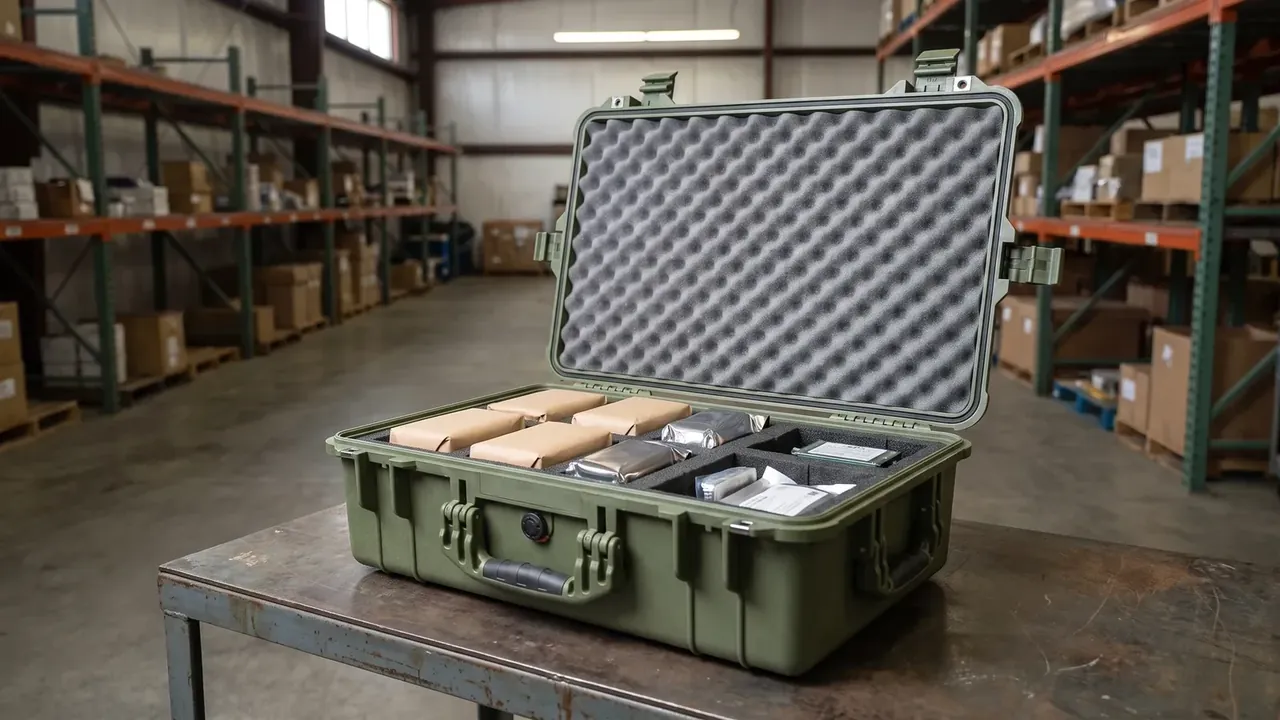
Deflection ties together lid stiffness, the 4.6 mm wall and catch preload. The centre sits farthest from any restraint and normally moves most; near a catch, where 410 N presses the lid down, the reading is smaller. An Acid/alkali resistant industrial chemical box is judged on the whole five-point pattern; one edge midpoint running high sends the check first to that catch.
| Pressure zone | Hold condition | Deflection limit |
|---|---|---|
| Lid centre | 0.6 MPa / 30 min | ≤1.2 mm |
| Long-edge midpoint | 0.6 MPa / 30 min | ≤0.8 mm |
| Short-edge midpoint | 0.6 MPa / 30 min | ≤0.6 mm |
| Near catch | 0.6 MPa / 30 min | ≤0.4 mm |
A second reading is taken 30 min after unloading to separate elastic recovery from residual set. The same hydrostatic run is repeated after a 1.0 m drop, because once flatness and preload have moved the earlier ≤1.2 mm no longer applies.
5. Barrier thickness rejection line for corrosion lots
Both criteria land on one lot record before an Acid/alkali resistant industrial chemical box ships. The thickness rejection line is tied directly to the 1.2 mm nominal floor: any corner, flange or insert-root point below it is rejected, and surplus on the broad faces is not allowed to average it out. The 168 h mass-change column and the 0.6 MPa deflection column sit next to it, and all three must pass for release.
| Deflection reading | Verdict | Action |
|---|---|---|
| ≤0.6 mm | Pass | Release directly |
| 0.6–1.2 mm | Retest | Re-run pressure and recheck thickness |
| >1.2 mm | Reject | Inspect thickness and catch preload |
The record needs at least lot number, thickness points, immersion stage, pressure zone, deflection reading and verdict; without the thickness column a failed shell cannot be traced back to a thin coat or a mis-set catch. A rejected shell is isolated rather than re-coated into the next lot, and two retest verdicts in one lot trigger a full re-measure.
Conclusion
The specification of an Acid/alkali resistant industrial chemical box reduces to two interlocked readings: ≤0.8% mass change after 168 h immersion and ≤1.2 mm lid deflection at 0.6 MPa for 30 min. The first watches the uniformity of the 1.2 mm inner barrier; the second watches the 24% compressed double gasket and the lid stiffness carried by a 4.6 mm wall. Only when both pass does the sealed, pressure-bearing behaviour verified by test method apply. JUNZHIJIA logs thickness points, immersion stages and pressure readings on one sheet before any lot is released.
Related Reading
- Salt spray corrosion test reading
- Corrosion resistant enclosure structure
- Chemical reactor parts case specifications
- Industrial oil resistant tool case sealing
Related Products
- 8 Series — Gun Cases; Military Equipment Cases; Camera Equipment Cases; Drone Cases; Watch Cases; Knife Cases; First Aid Cases; Electronics Equipment Cases
- WL8-2812 PP Gun Case — model WL8-2812
- All protective cases and toolboxes: 7 series, 158 models