

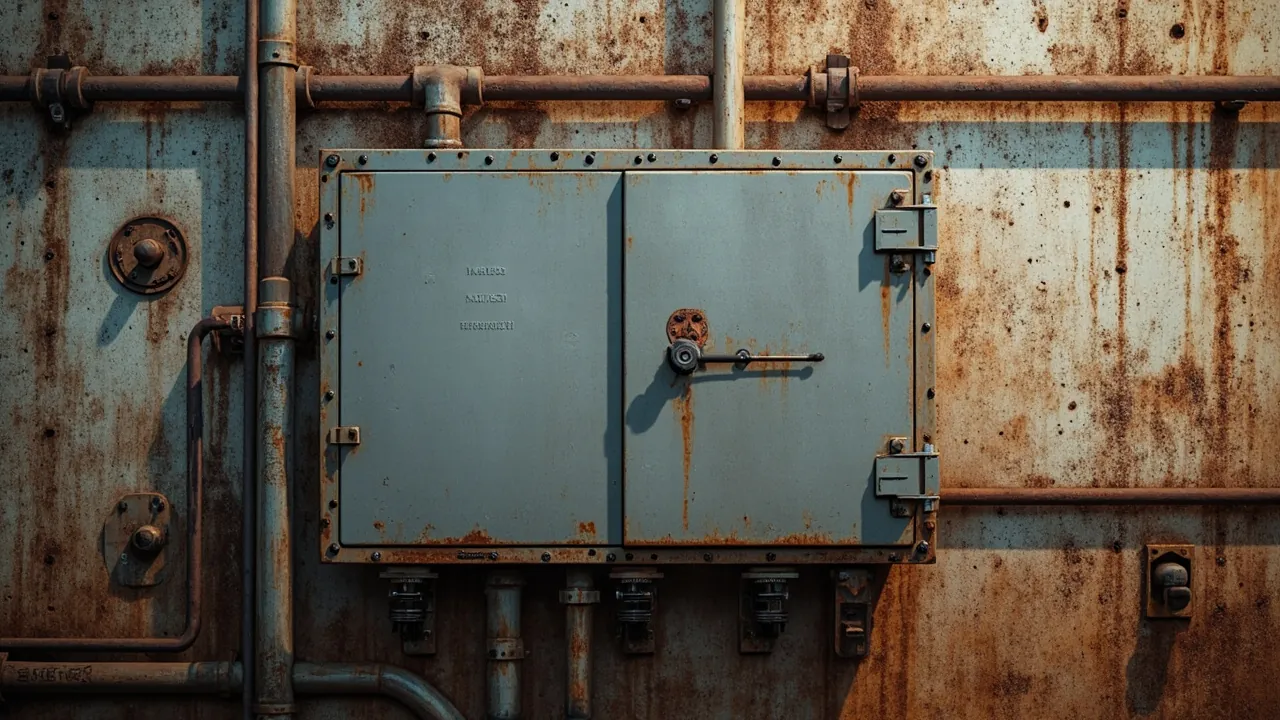
Work enough coastal projects and you meet the same repair call. An outdoor junction box installed eighteen months ago still opens, but the hinge has seized. The back plate looks fine, yet orange blisters have pushed up around the screw holes. The first reaction on site is always "this stainless steel must be fake." Then someone puts a magnet against it, the magnet does not stick, and it really is austenitic stainless. So why is it rusting?
Because the name itself is misleading. What stainless steel resists is general corrosion, not localised corrosion. In a chloride environment the thing that actually kills stainless is pitting and crevice corrosion, and an outdoor junction box is practically a catalogue of crevices: screw holes, flange joints, hinge pins. Cast aluminium is no exception either. It does not rust red; it turns into white aluminium oxide powder instead. Give it a high copper content or bolt it to a dissimilar metal and it will perforate just as surely.
This article deals with three questions: how corrosion actually starts, how long each material really lasts in service, and what to do with a box that has already corroded so the problem does not come back. Test data follows neutral salt spray to GB/T 10125 (equivalent to ISO 9227) and atmospheric corrosivity categories from ISO 9223. Figures are general industry practice, so always confirm against the manufacturer datasheet and your own measurements for a given project.
Contents
- Identify Which Kind of Rust You Are Looking At
- Four Conditions That Must Coincide for Corrosion
- Reading Salt Spray Reports: NSS, AASS and CASS
- 304 Versus 316: The Molybdenum Divide
- How Cast Aluminium Corrodes: Oxide Film, Pitting, Galvanic Attack
- Surface Treatments Compared: Powder Coating, Anodising, E-Coat, Dacromet
- Where Engineering Plastics Sit in a Corrosion Discussion
- Lifecycle Cost: One Consolidated Ledger
- A Box That Has Already Rusted: Four Steps
- Material Selection by Application
- Writing Corrosion Requirements Into a Purchase Specification
- Frequently Asked Questions (FAQ)
- Closing Thoughts and Further Reading
Identify Which Kind of Rust You Are Looking At
When a site reports "rust," it may mean any of five different things, and each needs a different response.
Orange surface staining. Common on carbon steel fasteners and hinges, but also on stainless suffering from free iron contamination - tiny particles from tools or adjacent steel work that rust first and make the stainless look like it is corroding. If it is contamination, a stainless cleaner and passivation treatment removes it and the base metal is unharmed. The test is simple: wipe with a white cloth and a mild rust remover. If the stain wipes away and sound metal is underneath, it is contamination. If it will not come off and pits remain, that is real pitting.
Pitting. Pin-head dark spots on the stainless surface, sometimes ringed with brown staining, leaving a crater when wiped. This is chloride attack on the passive film, genuine material damage. Cleaning will not fix it; grind, measure depth, and decide whether to replace.
Crevice corrosion. Occurs in narrow gaps: flange mating faces, under washers, inside screw holes, around hinge pins. Visually it often appears as blisters along the edge of a joint, and prising the joint open reveals a corrosion channel inside. Crevice corrosion has a lower critical temperature than pitting, meaning it starts earlier under the same conditions - which makes it the number one threat to an outdoor junction box.
White powder. A frost-like deposit on aluminium, being aluminium oxide or hydroxide. A light, uniform oxide film is actually protective. The real danger is filiform corrosion: hair-like raised tracks under the paint film, showing that adhesion is gone and corrosion is spreading beneath the coating.
Galvanic corrosion. Two dissimilar metals in contact through an electrolyte, with the more electronegative one consumed. Classic pairings are an aluminium box with nickel-plated brass glands, or stainless bolts threaded into an aluminium body. Tell-tale sign is heavily asymmetric corrosion product concentrated near the contact interface.
Getting these five straight is what makes the repair direction correct. Too many projects treat pitting as surface staining, wipe it down, and drill a hole six months later.
Four Conditions That Must Coincide for Corrosion
Corrosion is an electrochemical reaction. It needs four things at once, and removing any one of them stops it.
An anode and a cathode. Different areas of the same surface, or two different metals, develop a potential difference because of composition, stress, or surface condition. Standard electrode potentials run roughly minus 1.66 V for aluminium, minus 0.76 V for zinc, minus 0.44 V for iron, and around minus 0.1 V for passive 304 stainless - values against the standard hydrogen electrode, useful as a relative order rather than absolute in a given medium. The wider the gap, the faster the anodic member is consumed.
An electrolyte. A conductive liquid film. This is why dry inland air corrodes slowly and coastal or humid air corrodes fast. Above about 60% relative humidity a continuous adsorbed water film forms and corrosion rate climbs noticeably; above 80% it rises steeply. Coastal salt both raises conductivity and supplies chloride, which attacks passive films directly.
A depolariser. Usually dissolved oxygen, which accepts electrons at the cathode and forms hydroxyl ions. Moving or agitated conditions supply oxygen faster and corrode faster - which is why the splash zone, wetted then dried repeatedly, suffers more than the fully immersed zone.
An electronic path. Anode and cathode must be electrically connected, which in a metal assembly they always are. Which means breaking the electrical path breaks the corrosion, and that is exactly the physical basis for insulating washers and sleeves.
ISO 9223 classifies atmospheric corrosivity from C1 to C5, with CX as an extreme category, and splits C5 into C5-I for industrial and C5-M for marine. Outdoor junction boxes usually sit between C3, ordinary urban and light industrial, and C5-M, coastal and offshore. That classification maps roughly onto material choice: under C3, 304 stainless and powder-coated cast aluminium are both acceptable; under C5-M the risk of pitting in 304 rises sharply and you move to 316 or a heavy-duty coating system.
Reading Salt Spray Reports: NSS, AASS and CASS

Salt spray is the most widely used accelerated test for metallic corrosion resistance. It will not predict service life precisely, but it is very effective as a comparative screen and a batch consistency check. When you read a report, three things must be clear.
The three methods are not interchangeable. Neutral salt spray, NSS in GB/T 10125, uses 5% sodium chloride at pH 6.5 to 7.2, 35 C, with a collection rate of 1 to 2 mL per 80 square centimetres per hour. Acetic acid salt spray, AASS, drops the pH to 3.1 to 3.3 and is considerably more aggressive. Copper-accelerated acetic acid salt spray, CASS, adds 0.26 g per litre of copper chloride and raises the temperature to 50 C, running faster still and used mainly for screening decorative plating. The same "480 hours" means very different things in NSS and CASS, so a report that omits the method is not worth the paper.
Hours do not convert to years. The rule of thumb that 24 hours of salt spray equals one year outdoors is not defensible. Correlation between accelerated testing and outdoor exposure depends on the material system and the failure mode: reasonable for organic coatings, poor for stainless pitting, because oxygen supply and wet-dry cycling in a cabinet do not reproduce real conditions. The responsible framing is to treat salt spray as a screening and consistency criterion, not a life prediction tool.
The rating must state its basis. Common practice follows GB/T 6461, rating defects from 10 down to 0, and recording blistering, rusting, and flaking separately with their extent. A report that merely says "no abnormality after 480 hours" is thin: no criterion, no inspection interval, no sample condition - bare panel or coated, scribed or intact.
A practical acceptance reference, to be adjusted for project conditions:
| Material or finish | Typical neutral salt spray | What to judge |
|---|---|---|
| --- | --- | --- |
| Electroplated zinc, 8 micrometres | 72-200 h to white rust | Coating thickness matters more than the process name |
| Hot-dip galvanising, 60-80 micrometres | 500-1000 h | Thickness first; cut edges and threads are weakest |
| Dacromet zinc-aluminium flake | 480-1000 h | No hydrogen embrittlement; good for high-strength fasteners |
| Powder coating, polyester, 70-100 micrometres | 500-1000 h | Judge creep from a scribe, not just appearance |
| Anodised and sealed aluminium, 10-15 micrometres | 300-600 h | Sealing quality decides the outcome |
| 304 stainless | Commonly 480-1000 h without obvious rust | Edges and machined surfaces go first |
| 316 stainless | Commonly above 1000 h | The real advantage is pitting resistance with chlorides |
One more point: for stainless, sample condition dominates the result. A 2B cold-rolled surface that has been passivated performs markedly better than an untreated machined face. Insist that the report states surface finish and whether passivation was applied.
304 Versus 316: The Molybdenum Divide
Both are austenitic stainless grades. They look the same, perform similarly in strength and formability, cannot be told apart by eye, and differ by 30% to 50% in price. The difference comes down to molybdenum.
Typical composition: 304 carries about 18% chromium and 8% nickel. 316 adds 2% to 3% molybdenum, a little more nickel, and a lower carbon ceiling - 316L caps carbon at 0.03%. Molybdenum stabilises the passive film in the presence of chlorides, raising resistance to both pitting and crevice corrosion.
The industry quantifies this with the pitting resistance equivalent number:
PREN = %Cr + 3.3 x %Mo + 16 x %N
On typical compositions, 304 lands around 18 to 20, 316 around 24 to 26, 316L similar, and duplex 2205 reaches 34 to 36. Every additional PREN point raises the critical pitting temperature in chloride service by roughly 2 to 4 C. In practice that reads as: on the same seaside railing, 304 shows pitting in two years where 316 may run five or more.
| Comparison | 304 | 316 / 316L |
|---|---|---|
| --- | --- | --- |
| Typical composition | 18Cr-8Ni | 16-18Cr-10-14Ni-2-3Mo |
| PREN | 18-20 | 24-26 |
| Chloride pitting resistance | Moderate | Clearly better than 304 |
| Crevice corrosion resistance | Weak | Good |
| Typical neutral salt spray | 480-1000 h | Above 1000 h |
| Relative material cost | 1.0 | 1.3-1.6 |
| Magnetic in solution-annealed state | No | No, though cold work can induce slight magnetism |
| Suitable environments | C3-C4, inland urban and general industry | C4-C5-M, coastal, chemical plant, pool plant rooms |
Note that 316 has limits too. It is not universal: in hot chloride service, seawater above roughly 60 C, it pits and can suffer stress corrosion cracking, and sulphur-bearing environments need other alloys altogether. Genuinely severe duty calls for duplex, super-austenitic grades such as 254SMO with PREN above 40, or a non-metallic solution.
One myth worth killing outright: the magnet test does not identify stainless. Austenitic grades are essentially non-magnetic in the solution-annealed condition, but cold work - stamping, bending, drawing - induces partial martensitic transformation and slight magnetism. A stamped 304 hinge that a magnet barely grips is perfectly normal. To verify a grade, use a spectrometer for positive material identification, which is non-destructive and takes seconds, or a chemical spot test.
How Cast Aluminium Corrodes: Oxide Film, Pitting, Galvanic Attack
Aluminium is far more reactive than steel, and it survives outdoors only because of a dense, self-healing oxide film just 4 to 10 nanometres thick in its natural state, which reforms in air whenever scratched. The catch is that the film is stable only near neutral pH: below pH 4 or above pH 9 it dissolves, and corrosion accelerates sharply. That is why aluminium enclosures struggle in acid-rain industrial zones or where alkaline cleaners are used.
The second variable is alloy composition. Outdoor junction boxes commonly use ADC12 die-casting alloy, the Al-Si-Cu system, with 9.6% to 12% silicon for fluidity and 1.5% to 3.5% copper. Copper improves strength and castability but clearly reduces corrosion resistance, because copper-bearing phases form micro-cells with the aluminium matrix and act as pitting initiation sites. Aluminium-magnesium or aluminium-manganese wrought alloys such as 5052 and 6061 corrode less but cast poorly. It is an explicit trade: complex die-cast geometry is bought with some corrosion resistance.
The third variable, and the most dangerous, is galvanic corrosion. Aluminium is electronegative against almost every common metal:
| Metal in contact with aluminium | Potential relationship | Consequence |
|---|---|---|
| --- | --- | --- |
| Copper and copper alloys, including brass glands | Copper is cathodic, large gap | Severe acceleration of aluminium attack; isolation required |
| Carbon steel, stainless steel passive | Both cathodic | Aluminium accelerates; worse when area ratio is unfavourable |
| Zinc, zinc-coated steel, sacrificial | Zinc is anodic | Zinc is consumed first and protects the aluminium |
| Magnesium | More electronegative | Magnesium consumed, aluminium protected, but magnesium goes fast |
There is one rule that matters above all: small anode means danger. A large cathode - a big stainless area - against a small anode - a tiny aluminium contact point - is the worst case, because current density concentrates on a small area and local attack is rapid. Reverse the ratio and the corrosion spreads out and does far less harm. The design consequence is direct: stainless bolts in an aluminium box are usually acceptable, because the cathode is small and the anode large; aluminium bolts holding a large stainless flange are not.
Three practical rules follow: use the same metal or metals close in potential wherever possible; where that is impossible, add insulating washers and sleeves to break the electronic path; and seal the assembled joint to keep electrolyte out.
Surface Treatments Compared: Powder Coating, Anodising, E-Coat, Dacromet
For outdoor enclosures, corrosion performance is often decided by the finish rather than the substrate. The four mainstream processes compare as follows:
| Process | Film thickness | Typical neutral salt spray | Strengths | Weaknesses |
|---|---|---|---|---|
| --- | --- | --- | --- | --- |
| Powder coating, polyester | 60-120 micrometres | 500-1000 h | Colour range, uniform film, moderate cost, good weathering | Poor edge coverage; damage creeps from the scratch |
| Powder coating, epoxy | 60-120 micrometres | 400-800 h | Adhesion and chemical resistance | Chalks and loses gloss under UV; indoor only |
| Anodising plus sealing | 5-25 micrometres | 300-600 h | Integral with substrate, abrasion resistant, cannot peel | Limited colours, cost rises with thickness, sealing sensitive |
| Hard anodising | 25-50 micrometres | 500-800 h | Very hard and wear resistant | Dark colours, higher cost, brittle |
| Electrocoating | 15-30 micrometres | 300-600 h | Uniform coverage on edges and internal cavities | Modest weathering; mainly a primer |
| Dacromet zinc-aluminium flake | 5-12 micrometres | 480-1000 h | No hydrogen embrittlement, good resistance, ideal for fasteners | Single silver-grey colour, poor abrasion resistance |
Some hard-won field observations:
Pre-treatment decides everything. With identical powder, a blast plus chemical conversion coating - chromate or chrome-free passivation - can deliver three to five times the salt spray life of a simple degrease. This is especially true on aluminium. Ask a supplier to describe their pre-treatment steps; if they cannot, coating life will be inconsistent.
Edges are the weakest point. Powder coating builds thin on sharp edges because of electrostatic shielding and surface tension, sometimes only a third of the flat-panel thickness. Specify a minimum R0.5 break on all exposed edges. That requirement does more for coating life than adding 20 micrometres of film.
Creep from a scribe is the real indicator. Coatings get damaged. The one-sided creep measured from a scribe cut through to the substrate after salt spray tells you more than "hours to no change." A good system holds one-sided creep to within 2 mm after 500 hours.
Where Engineering Plastics Sit in a Corrosion Discussion
One option is easily overlooked in any metal corrosion discussion: do not use metal at all.
Engineering plastics - PC, ABS, PC/ABS blends, glass-filled PP and PA, and SMC glass-reinforced polyester - do not corrode electrochemically. In C5-M marine sites, chemical plants, wastewater treatment works, and pool plant rooms, a plastic enclosure frequently outlasts a painted metal one.
They have their own ageing mechanisms, which need equal attention:
| Ageing factor | Effect | Countermeasure |
|---|---|---|
| --- | --- | --- |
| Ultraviolet exposure | Chain scission, chalking, colour fade, loss of impact strength | UV stabilisers and carbon black, or an ASA/PMMA cap layer |
| Hydrolysis in heat and humidity | Molecular weight drop in PC and PA | Control moisture, specify hydrolysis-resistant grades |
| Environmental stress cracking | Cracking under chemical exposure plus stress | Avoid ketones and esters, reduce assembly stress |
| Thermal cycling | Mismatched expansion breaks the seal | Match materials, allow expansion clearance |
| Creep | Deformation under sustained load, loss of clamping force | Metal inserts, lower sustained stress |
A question that comes up constantly: for a coastal project, 316 stainless, powder-coated cast aluminium, or engineering plastic? A rough decision order: if there is mechanical impact, vandalism risk, or a need for heat dissipation or shielding, choose metal with 316 preferred. If the requirement is only protection and insulation with high chloride levels, engineering plastic usually wins on both life and cost. If you need both, use the hybrid that dominates outdoor low-voltage work today: plastic shell, stainless hardware, 316 fasteners.
Lifecycle Cost: One Consolidated Ledger
Unit price alone leads to bad decisions. The table below compares options qualitatively and semi-quantitatively for a moderately corrosive coastal environment, C4 to C5-M, over a ten-year service life with average maintenance, indexed to 304 stainless at 100:
| Option | Initial cost index | 10-year maintenance index | 10-year total index | Note |
|---|---|---|---|---|
| --- | --- | --- | --- | --- |
| 304 stainless, 2B plus passivation | 100 | 60 | 160 | Needs pitting inspection mid-life under C5-M |
| 316 stainless | 140 | 20 | 160 | Low maintenance, higher upfront |
| Die-cast aluminium plus polyester powder | 55 | 90 | 145 | Touch-up painting once coating is damaged |
| Die-cast aluminium plus anodising | 70 | 60 | 130 | Limited colours but wear resistant |
| PC/ABS engineering plastic | 40 | 40 | 80 | Watch UV and hydrolysis |
| SMC glass-reinforced polyester | 65 | 30 | 95 | Strong, insulating, corrosion resistant |
| Carbon steel plus heavy-duty coating | 30 | 150 | 180 | Cheapest to buy, most expensive to own |
Two caveats: these are relative magnitudes rather than quotations, and project variation is large. Also, maintenance cost includes downtime and labour. At a remote site or on a high-mounted pole, one replacement visit can cost ten times the enclosure itself, and then buying the expensive option is the thrifty one.
A Box That Has Already Rusted: Four Steps
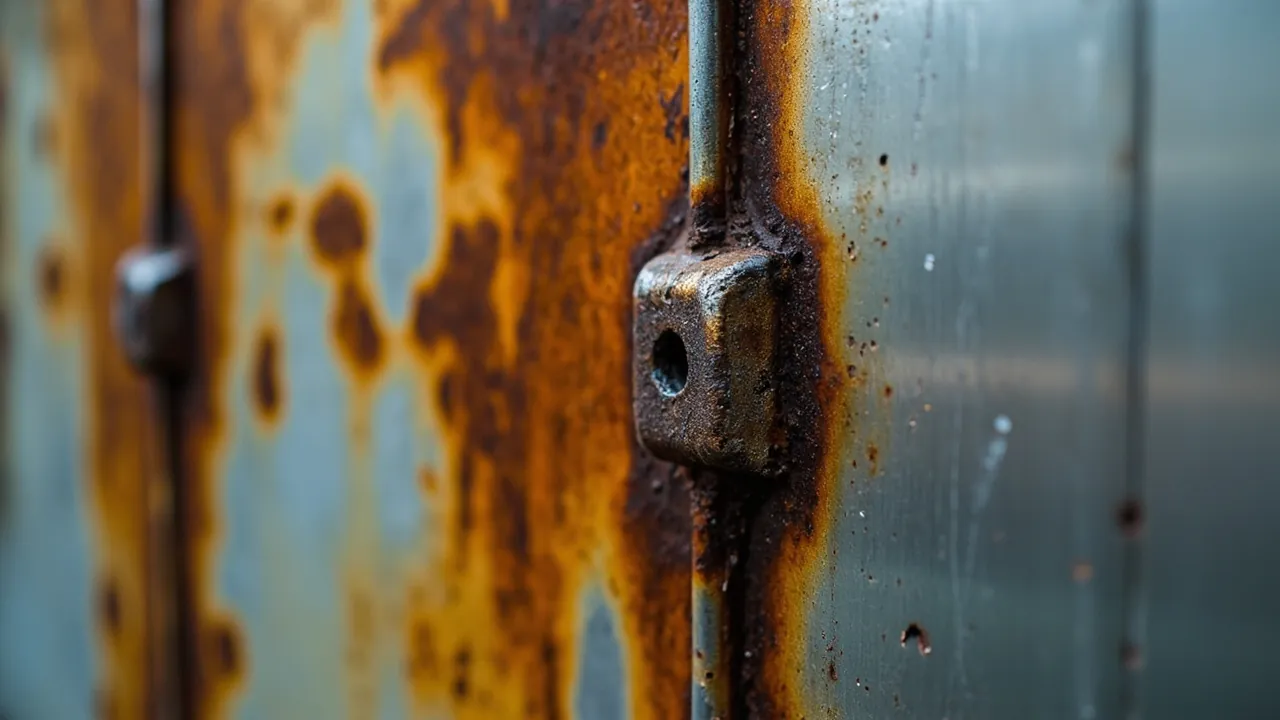
Back to the title: what to do when it has rusted.
Step one, isolate and make safe. Every task on an electrical enclosure starts with switching off, tagging, and verifying dead before work begins. A badly corroded box may have lost earthing continuity, which is a shock hazard, so confirm with instruments first.
Step two, grade the damage. Use the five types above, then grade by depth. Surface staining that wipes off with no pitting: light, repairable in place. Pitting less than 10% of plate thickness and away from sealing faces, hinge bearing areas, and bolt holes: repair and monitor. Pitting deeper than 20% of thickness, or anywhere on a sealing face, hinge bearing area, or around bolt holes: replace. Filiform corrosion under a coating: strip completely and refinish.
Step three, treat by grade.
- Light staining: mechanical polishing with a dedicated stainless flap wheel or nylon wheel - never share abrasives with carbon steel, which causes iron contamination - then degrease, passivate with a nitric or citric acid paste per the instructions, rinse, and dry.
- Moderate pitting: grind back to sound metal and measure. If acceptable, repair with a stainless-filled compound or an epoxy zinc-rich primer plus topcoat. Crevice corrosion must be dismantled, cleaned, reassembled, and sealed with joint sealant.
- Galvanic corrosion: replace the damaged part and isolate the dissimilar metals - insulating washers, sleeves, or a common material. Replace without isolating and you will be back in a year.
- Corroded fasteners: always replace. Bolts, hinge pins, and latch springs cost very little and are not worth the risk. Upgrade one grade while you are at it: carbon steel to 304, 304 to 316.
Step four, stop it recurring. The step most often skipped, and the one that decides whether the repair holds:
- Remove standing water and moisture - check bottom entry, drainage, and desiccant.
- Break the galvanic couple - insulating washers and sleeves at dissimilar metal joints.
- Restore the coating - prime plus topcoat, never topcoat alone.
- Replace seals - rust usually accompanies seal failure, so change the gasket at the same time.
- Record and re-inspect - log date, material, and treatment, then check again at six months.
Material Selection by Application
Pulling it together into a table you can use directly:
| Application | Corrosivity | Recommended enclosure | Recommended fasteners | Key watch point |
|---|---|---|---|---|
| --- | --- | --- | --- | --- |
| Inland urban low-voltage | C2-C3 | PC/ABS or powder-coated cast aluminium | 304 | Cost first; watch UV |
| General industrial area | C3-C4 | Powder-coated cast aluminium or SMC | 304 | Acid rain and sulphides |
| Within 1 km of coast | C4-C5-M | 316 body plus 316 hardware, or engineering plastic | 316 | 304 pitting risk is high |
| Offshore platform, harbour | C5-M | 316L, or SMC/engineering plastic | 316 or duplex | Insulation is mandatory |
| Chemical plant, wastewater works | C4-C5-I | SMC or PVDF-lined; assess 316 case by case | 316 | Chemical media matter more than salt |
| Pool and spa plant rooms | C4 with chlorine | Engineering plastic preferred | 316 | Chloride plus elevated temperature |
| Food and pharmaceutical | C3-C4 | 316L, surface Ra 0.8 micrometres or finer | 316L | Cleanability, no hygiene dead spots |
| Desert, intense UV | C2-C3 | UV-stabilised engineering plastic or coated aluminium | 304 | UV and thermal swing dominate |
| Cold climate | C2-C3 | Engineering plastic with good low-temperature toughness | 304 | Check the brittle temperature |
Writing Corrosion Requirements Into a Purchase Specification
Finally, the purchasing angle. An effective specification contains verifiable clauses instead of the vague phrase "stainless steel construction":
Name the grade. Write "304 (06Cr19Ni10)" or "316L (022Cr17Ni12Mo2)". Do not accept the bare word stainless. Require a material certificate to EN 10204 3.1 or equivalent, and if the project justifies it, agree a PMI spot-check ratio on delivery.
Specify surface condition and treatment. For example: "2B finish, pickled and passivated, with passivation record attached," or "aluminium, blast to Sa2.5, chrome-free conversion coating, polyester powder coat 70 to 100 micrometres, adhesion to GB/T 9286 cross-cut class 0."
Specify the test method completely. For example: "neutral salt spray to GB/T 10125 for 480 hours, rating to GB/T 6461 not below 9, one-sided creep from scribe no more than 2 mm." Method, duration, and criterion - all three, or the clause is unenforceable.
Cover fasteners separately. Most early failures start at the fastener, so require fastener material equal to or better than the enclosure and state whether insulating washers are included.
State isolation requirements for dissimilar metals. Where aluminium meets stainless or copper, require insulation and mark it on the drawing.
Add a goods-in sampling clause. Agree a ratio and a rule, for instance "sample 3% per batch, run 72 hours neutral salt spray as a quick comparison, reject the whole batch on any red rust." Seventy-two hours will not qualify a good product, but it will catch batches with badly under-thickness plating.
Frequently Asked Questions (FAQ)
Q: Why does a stainless junction box rust? Have I been sold a fake? A: Not necessarily. What stainless resists is general corrosion, not localised attack. Chlorides break down the passive film and cause pitting, and narrow gaps such as screw holes, flange joints, and hinge pins cause crevice corrosion, whose critical temperature is lower than that for pitting, so it usually appears first. There is also free iron contamination: tiny particles from tools or nearby steel work rust on the surface and make the stainless look like it is corroding, while the base metal is unharmed. Wipe with a white cloth and mild remover - if it comes off and sound metal is beneath, it is contamination; if pits remain, it is real attack. To confirm a grade, use a spectrometer for positive material identification. A magnet tells you nothing useful, since cold work makes austenitic stainless slightly magnetic.
Q: Does a magnet prove whether it is 304? A: No, that test is not valid. Austenitic stainless is essentially non-magnetic in the solution-annealed condition, but cold work such as stamping, bending, and drawing induces partial martensitic transformation and slight magnetism. A stamped 304 hinge that barely attracts a magnet is entirely normal. Conversely, some low-nickel high-manganese materials are also non-magnetic. Use a magnet only as a very rough hint. Two reliable alternatives: a handheld spectrometer for non-destructive composition analysis that returns a result in seconds, or a chemical spot test for molybdenum, which is the fastest way to separate 304 from 316 in the field, since molybdenum is the whole difference between them.
Q: How much difference is there really between 304 and 316, and is the extra thirty percent worth paying? A: The core difference is that 316 contains 2% to 3% molybdenum, lifting the pitting resistance equivalent number from roughly 18-20 for 304 to roughly 24-26. Each additional PREN point raises the critical pitting temperature in chloride service by about 2 to 4 C. In practice: inland urban environments at C3 are fine for 304 and the premium buys nothing; within a kilometre of the coast or in a chemical plant at C4 to C5-M, 304 will very likely pit within two or three years, and the extra cost pays for itself inside the first maintenance-free period; in pool plant rooms, where chloride and elevated temperature act together, even 316 may not be enough and you should assess a higher alloy or switch to engineering plastic. The decision criterion is not price but chloride concentration and temperature.
Q: How many outdoor years does 480 hours of salt spray equal? A: There is no reliable conversion factor. Neutral salt spray is a constant-wet, continuous-salt accelerated condition, while outdoors is a dynamic cycle of wetting and drying, salt deposition, and wash-off, so the failure mechanisms are not equivalent. Correlation is reasonably good for organic coating systems and poor for stainless pitting, because a cabinet cannot reproduce real dry-wet cycling, temperature swings, or pollutant composition. The correct use is as a screening and batch-consistency criterion: comparing suppliers or batches within the same system is valid; comparing hours between different systems, such as stainless against painted aluminium, means little. If you genuinely need life data, run outdoor exposure trials with racks of coupons to ISO 8565 or similar, and expect the answer to take years.
Q: Will an aluminium box corrode against stainless bolts, and what should I do? A: Yes. Aluminium is electronegative and will be consumed as the anode when coupled to passive stainless. Severity depends on area ratio. A small stainless bolt in a large aluminium body is a large anode with a small cathode, so the attack is spread thin and usually acceptable. Reverse it - an aluminium bolt in a large stainless flange, or a big stainless part pressed against aluminium - and you have a large cathode with a small anode, current density concentrates, and attack is rapid. Three safe responses: fit insulating washers and sleeves to break the electronic path, which is the most thorough; seal the joint to exclude electrolyte, since corrosion also needs a conductive liquid; or unify the material, using aluminium or suitably coated high-strength steel fasteners in an aluminium box. One combination to avoid outright is an aluminium box with brass, meaning copper alloy, cable glands - the copper-aluminium potential difference is large and isolation is mandatory.
Q: White powder has appeared on a cast aluminium box. Does it need treatment? A: First identify which kind. A uniform frost of aluminium oxide or hydroxide is aluminium's normal self-protection, dense and well adhered; light deposits can be left alone, or cleaned with a soft cloth and a neutral detergent. Do not use strong alkaline cleaners, because the oxide film dissolves above pH 9 and alkali will accelerate the attack. The real warning sign is filiform corrosion: hair-like raised tracks under the paint, meaning adhesion is lost and corrosion is spreading beneath the film. That requires stripping back to sound metal, redoing pre-treatment, blast plus chemical conversion, and repainting; a surface touch-up will recur within months. And if the white deposit appears where two metals meet, suspect galvanic corrosion, and include insulation in the repair.
Q: Can a rusted outdoor junction box keep working? A: Grade it by damage. Surface staining that wipes off without pitting can be cleaned and passivated and returned to service. Pitting less than 10% of plate thickness, away from sealing faces, hinge bearing areas, and bolt holes, can be repaired with a re-inspection at six months. Pitting deeper than 20% of thickness, or corrosion on a sealing face, hinge pin, or around bolt holes, means replacement, because thinning at those locations reduces clamping force and structural strength, and you cannot see how far a corrosion channel has progressed inside. One hard rule: any work on live equipment means switching off, verifying dead, and confirming earthing continuity first, since a badly corroded box has often lost its earth and that is a shock risk. And do not overlook fasteners - bolts and hinge pins cost very little, so replace every corroded one and consider moving up a grade.
Q: For a coastal project, is 316 stainless or engineering plastic the better buy? A: It depends whether you need what metal provides. If the project faces impact, vandalism, heat dissipation, or electromagnetic shielding, choose 316, use 316 fasteners as well, and insulate dissimilar metal joints. If the requirement is only protection and insulation with high chloride levels, engineering plastics such as PC/ABS, glass-filled PP or PA, and SMC are usually the better value, because they do not corrode electrochemically at all and may cost only forty to sixty percent of 316 with less maintenance. The mainstream answer for outdoor low-voltage enclosures is the hybrid: a plastic or coated aluminium shell for protection and insulation, 316 stainless fasteners and hinges for strength, and insulating washers at contact faces. With plastic, budget extra attention for ultraviolet ageing and high-temperature hydrolysis, and in intense tropical sun specify UV-stabilised grades or a protective cap layer.
Closing Thoughts and Further Reading
Three sentences summarise this article: stainless steel resists corrosion only under conditions, and those conditions are chloride concentration and temperature; cast aluminium is not afraid of its oxide film but of copper-bearing phases, alkaline environments, and contact with dissimilar metals; and the great majority of early rust appears on fasteners and inside crevices rather than on flat panels.
In practice: write grade, surface treatment, test method, fastener material, and isolation requirements into the specification; install with bottom entry, sealed joints, and insulating washers between dissimilar metals; inspect fasteners and joints once a year and deal with surface staining immediately rather than waiting for perforation. Do that and stretching enclosure life at a coastal site from two or three years to eight or more is entirely realistic.
JUNZHJIA enclosures are manufactured by Kexin New Materials (Guangdong) Co., Ltd. at its Zhongshan plant. Waterproof junction boxes and electrical enclosures are offered in engineering plastic, powder-coated die-cast aluminium, and 304 or 316 stainless, with fastener specification upgradeable to suit the corrosivity category. Salt spray reports can ship with the goods and third-party re-testing is supported, alongside OEM/ODM and volume supply worldwide.
Further reading
- How to select outdoor enclosure material: matching environment and load
- Performance comparison of common engineering plastics for protective cases
- Seal ageing mechanisms and replacement intervals
- Protection essentials for outdoor cases in rain and humidity
- How extreme high and low temperatures affect outdoor cases