

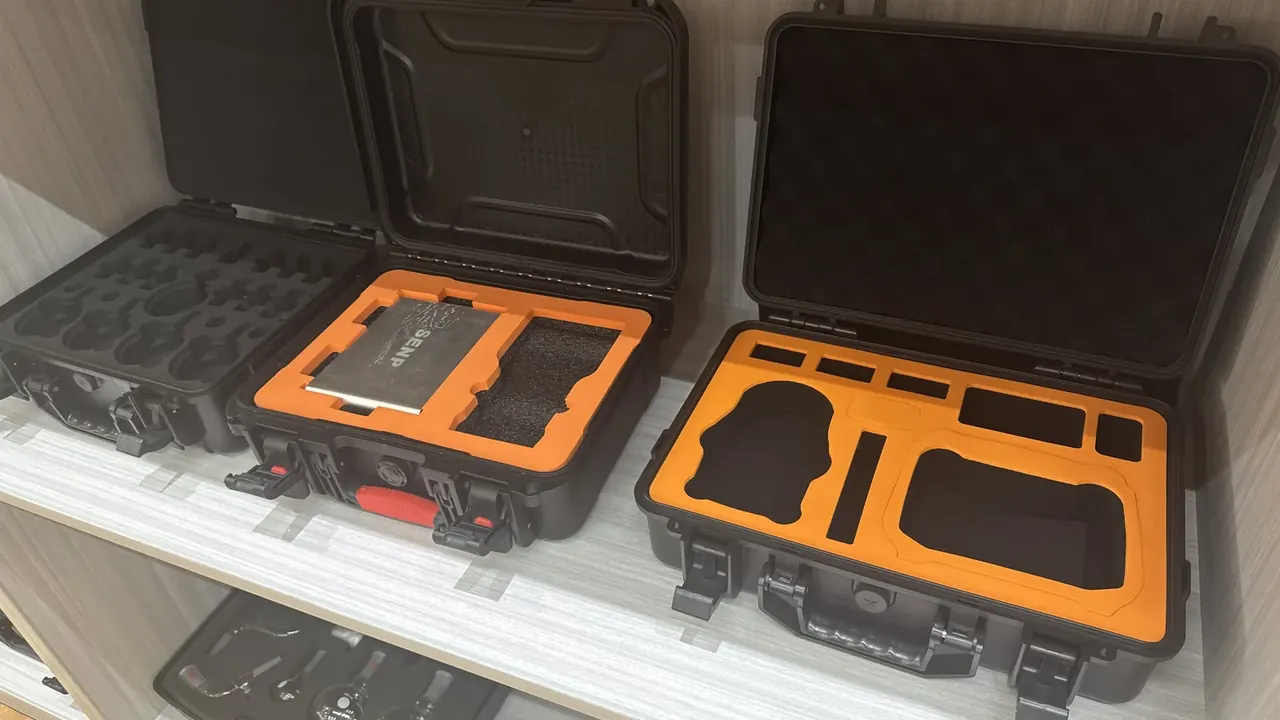
Quick answer: An industrial waterproof oil-resistant tool case measures 600×450×280 mm outside and 540×390×220 mm inside, 7.8 kg empty on a 3.2 mm wall. With 25 kg spread over the base, ribs hold deflection to 2.1 mm. A 3 mm lip stops oil; 25% compression stops water.
Table of contents
- Industrial waterproof oil-resistant tool case across three production lines
- A lip stops oil, compression stops water
- Ribs and wall thickness under 25 kg
- Latches, hinge pins and handle headroom
- Drain ports, washdown and a five-high stack
- FAQ
1. Industrial waterproof oil-resistant tool case across three production lines
A machining bay keeps the shell in coolant mist all day. The second tier of a tool trolley gives 300 mm of clear height, so an industrial waterproof oil-resistant tool case has to stop at 280 mm and sit 780 mm off the floor. Operators open it 30 times a shift, near 8000 a year, and the latch insert wears a groove first.
Moulding changes the medium: release agent rides the oil haze and sets as a waxy film, while radiant heat from a barrel 1.5 m away holds the lid near 60 ℃ and speeds compression set.
Field repair is the third line: straps hold the case to a pickup bed wall, muddy water runs down the lid to the joint, and at −10 ℃ the gasket stiffens until the pull climbs from 45 N to 70 N.
| Line | Dominant medium | Shell response |
|---|---|---|
| Machining | coolant mist, chips | 3 mm oil lip, φ8 mm drain |
| Moulding | release agent, 60 ℃ | nitrile gasket, 60 ℃ ceiling |
| Field repair | mud, −10 ℃ | 25% compression, twin dust lip |
2. A lip stops oil, compression stops water
For an industrial waterproof oil-resistant tool case, oil and water behave differently in the same gap. Water carries about 72 mN/m of surface tension, ISO VG46 hydraulic oil only 30 mN/m, so oil creeps further along a seam of equal width. The groove therefore has two lines of defence: an outer run of gasket and an inner 3 mm oil lip that oil has to climb before it reaches the rubber.
Compression is the denominator for water: nitrile at 70 Shore A is widest at 25% and breaks at the corners below 20%, so 1 m for 30 min needs every corner above 22%.
Oil also picks the compound: nitrile soaked 72 h in ISO VG46 swells 3% and loses 2 points of hardness, while EPDM swells 40% and squeezes out of its groove.
| Medium | 72 h swell | Compound that suits |
|---|---|---|
| ISO VG46 oil | nitrile +3%, EPDM +40% | nitrile |
| 0.5% hypochlorite | nitrile +12%, EPDM +5% | EPDM |
| Air at 60 ℃ | nitrile −2%, EPDM −1% | either |
3. Ribs and wall thickness under 25 kg
The base of an industrial waterproof oil-resistant tool case is sized at full load. Spreading 25 kg over 540×390 mm gives 0.12 MPa, and a flat 3.2 mm panel on a 540 mm span would sag past 5 mm before ribs are added.
Five ribs at 5 mm tall and 90 mm pitch, three across and two along, lift the section modulus enough to bring mid-span deflection back to 2.1 mm, roughly a fourfold gain in stiffness. Past 3 mm of sag the base lifts off the floor, the case stands on four corners and every drop lands there.
A 3.2 mm side wall is the floor for this size. The 600×450×280 mm shell works out to about 1.06 m², and thinning to 2.8 mm costs 20% of tensile strength at the weld line, so a 25 kg case opens a 1 mm gap at the joint when carried sideways.
4. Latches, hinge pins and handle headroom
Two latches, 350 N each. A lid and its lining weigh about 3.4 kg, and a 1.2 m drop converts to roughly 480 N of momentary pull, so 700 N total leaves a factor of 1.4; a single-latch design would need 600 N and the plastic hook seat will not carry it.
Hinge pins run φ6 mm stainless, two at 120 mm. At φ4 mm, 8000 cycles open a 0.4 mm bore gap, the lid sags 1.2 mm and water enters on the hinge side first.
The handle is 30 mm wide, which puts 7.8 kg at 0.09 MPa; loaded to 25 kg the palm sees 0.28 MPa and needs a 4 mm overmould to bring the peak under 0.2 MPa. The root is the stress raiser, and a fillet under 3 mm is where a moulded part splits.
5. Drain ports, washdown and a five-high stack
The base of an industrial waterproof oil-resistant tool case carries four φ8 mm drain ports with silicone plugs. Pull the plugs after a wash, tilt 5° and it empties from the lowest corners; left open, a 0.5 MPa jet runs straight back in.
Washdown is a different envelope. IP67 covers 1 m of still water for 30 min, while a 0.5 MPa jet belongs to IPX5 and leans on gasket compression and the lip rather than immersion. At 60 ℃ the compound softens 5 points, so compression is recalculated hot.
Five high is a loaded figure. At 25 kg each, five cases put 125 kg on the bottom lid, 0.05 MPa, and 4 mm ribs at 100 mm pitch deflect 2.4 mm; a seventh layer passes 4 mm, the lid edge lifts off the gasket and rain in a yard finds the seam.
| Load case | Value | Shell response |
|---|---|---|
| Full base load | 25 kg, 0.12 MPa | 5 mm ribs, 2.1 mm sag |
| One latch | 350 N, 700 N pair | twin hook seats, 1.4× margin |
| Five-high stack | 125 kg, 0.05 MPa | 4 mm lid ribs, 2.4 mm sag |
Conclusion
The hard part of an industrial waterproof oil-resistant tool case is separating two jobs rather than adding thickness: a 3 mm lip for oil, 25% compression for water, 5 mm ribs for 25 kg, two 350 N latches for a drop. Fix those four numbers and the shell holds across all three lines.
This article covers the container side only, meaning shell specifications and their design consequences, and does not address handling, loading or use of anything carried inside.
Related Reading
- Foam at 5, 10 and 15 mm
- Choosing case accessories in order
- Common case assembly standards
- Comparing foam materials
Related Products
- 8 Series — Gun Cases; Military Equipment Cases; Camera Equipment Cases; Drone Cases; Watch Cases; Knife Cases; First Aid Cases; Electronics Equipment Cases
- WL8-2812 PP Gun Case — model WL8-2812
- All protective cases and toolboxes: 7 series, 158 models