

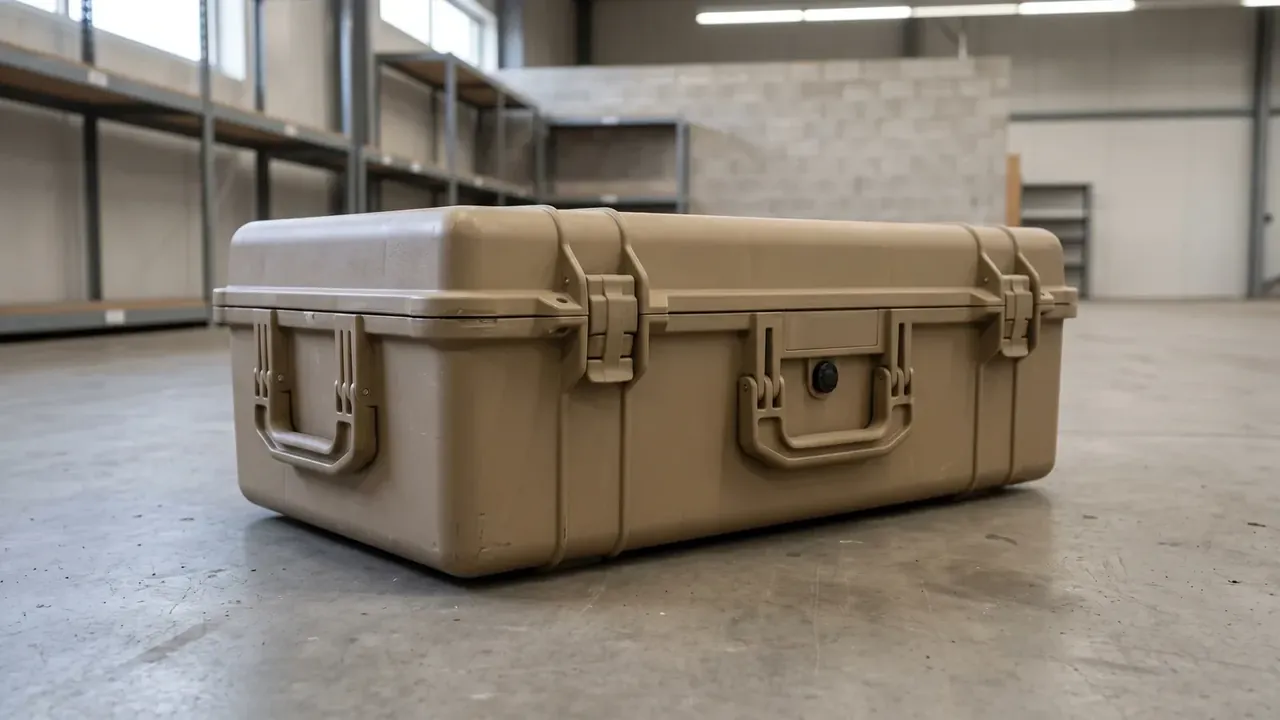
Quick answer: An action camera & accessories all-in-one case works by compartment order rather than volume: 20–35 parts, 3 mm foam gaps and an isolated battery bay.
Table of contents
- How an all-in-one layout follows shooting order
- Small parts that vanish: card bays and screw slots
- Fixing slots for quick-release mounts and suction cups
- Why the battery bay sits in its own pocket
- One case or two: what each layout costs
- FAQ
1. How an all-in-one layout follows shooting order
Accessories for an action camera go missing faster than the camera itself, and compartment order decides how quickly you find them again.
A GoPro HERO12 weighs 121 g without a battery and 154 g with one; a DJI Osmo Action 4 is about 145 g at 70.5 × 44.2 × 32.8 mm. The body is never the problem. The 20 to 35 small parts around it are: mounts, cups, adapters, screws, cards and cables.
Lay the case out in the order your hands move. Body first, mount second, battery and card third, cleaning last. Shorten that path and the open-close cycle approaches 3 s, which is the entire argument for the action camera & accessories all-in-one case.
| Accessory group | Typical count | Compartment treatment |
|---|---|---|
| Body and housing | 1–2 | Deep bay, 10 mm clearance, egg-crate lid on top |
| Batteries and charger | 2–6 | Upright slots, contacts facing up |
| Cards and reader | 2–8 | Shallow well, depth under half the card width |
| Mounts and cups | 4–10 | Vertical through-slot, mount down |
| Screws and adapters | 8–20 | One part per cell, 3 mm web |
| Cables and cloths | 2–5 | Winding post plus mesh pocket |
Those counts match ordinary kits; past 35 pieces the layout has to become adjustable.
2. Small parts that vanish: card bays and screw slots
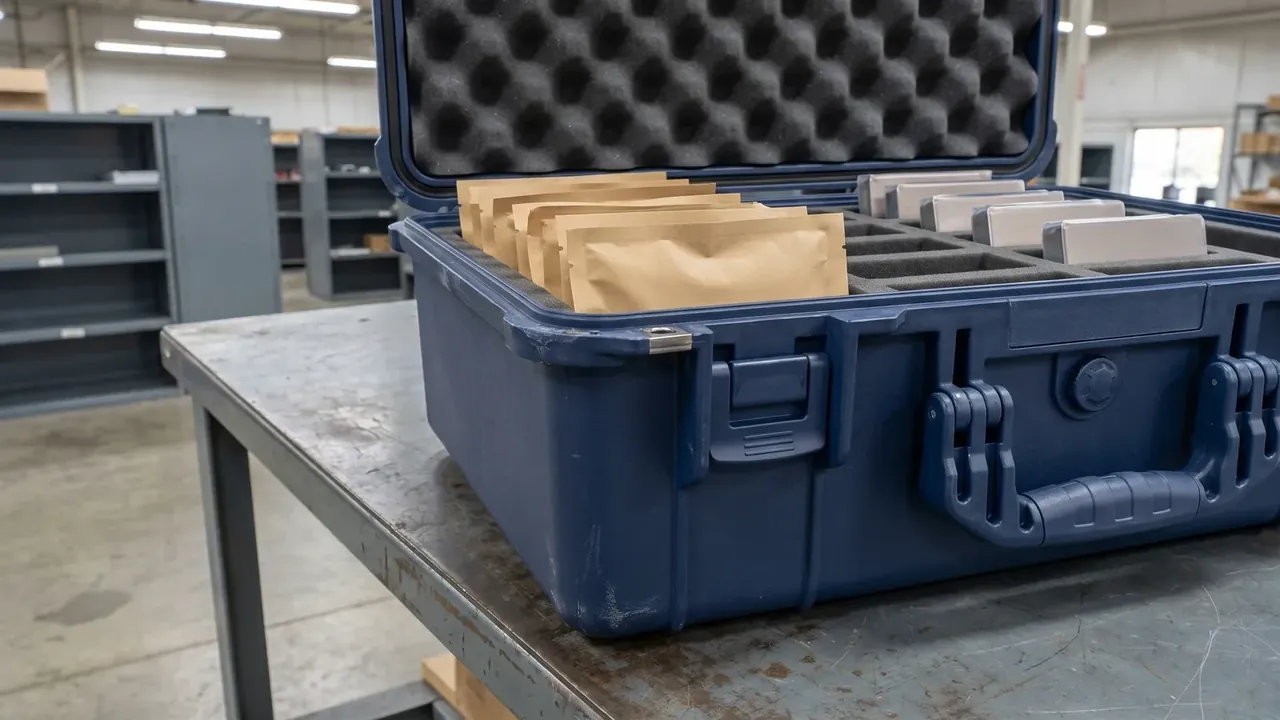
Cards and screws disappear first from an action camera & accessories all-in-one case. A 128 GB microSD looks identical to a 512 GB one, so the only reliable identification is a slot per card.
Cut the card bay as a shallow well with a finger scoop, no deeper than half the card width. A 1 mm EVA pad underneath keeps the card off bare shell.
Screws need the opposite treatment. Give each screw its own cell with a 3 mm web, so threads cannot interlock or rub smooth on a rough road, and split 1/4 inch adapters by length.
Write the acceptance line into the spec sheet: any compartment that lets a part shift more than 2 mm fails the insert. That check beats foam density or cut finish, because 2 mm is the displacement that becomes repeated impact.
Lid foam holds parts down but does not locate them sideways; the cavity walls do, so they should stand slightly taller than their contents. Press too hard in an action camera & accessories all-in-one case and small parts lift with the lid.
3. Fixing slots for quick-release mounts and suction cups
In an action camera & accessories all-in-one case, quick-release mounts carry teeth and cups carry a skirt, and neither may be stacked flat. Teeth grind each other on a rough road, and stacked cups take a permanent crease.
Mounts go into vertical through-slots cut to their narrowest section, held by sideways foam pressure, with 5 mm of clearance at the bottom so grit falls through instead of packing in.
Cups get a bay of their own, skirt up, floor curved slightly so the face is never loaded flat. Cut to the largest cup and fill the difference with loose divider strips.
A comparison run settled it: mounts stacked flat showed polished teeth after 200 km, while vertical slots left light marks only. That is why the action camera & accessories all-in-one case separates the mount slot.
Grip must stay even: too loose and the mount rotates, too tight and it can only be shaken out. Foam compression near 20 percent keeps the pull constant.
4. Why the battery bay sits in its own pocket
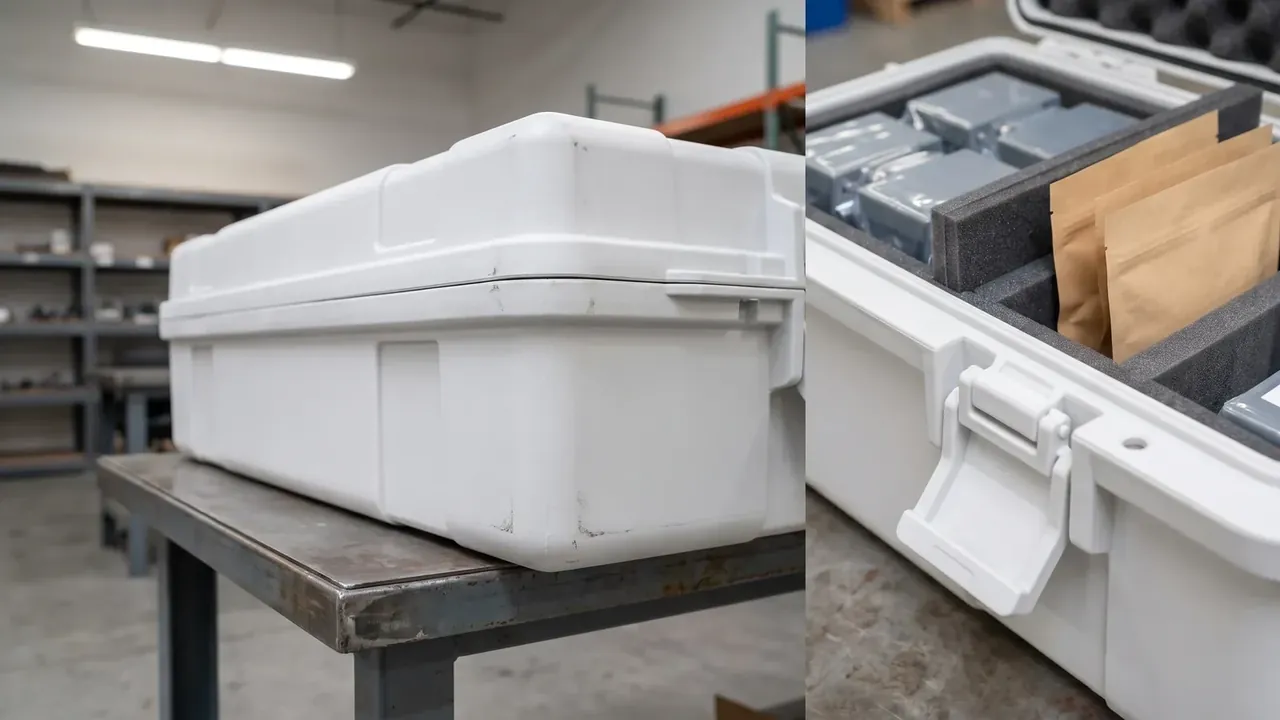
A battery is the only item here that makes heat and swells on its own. A 1720 mAh pack recording at 35 °C runs warmer than the body, and buried in foam it cools even more slowly.
A separate pocket confines swelling to one cell, keeps contacts away from metal, and puts the pack in sight when the lid opens.
In the action camera & accessories all-in-one case, build the divider from 3 mm foam, set slightly lower than the bay, and let the lid supply pressure. It is a barrier, not a seal, so leave a 2 mm vent gap at its base.
Operating ranges sit near -10 to 35 °C, and a parked car in summer passes the top figure. Place the bay near the handle, so the action camera & accessories all-in-one case opens less often for a swap.
Mind the card bay next door. Cards tolerate heat but not moisture, and a battery cycling warm and cold condenses on the shared wall. A divider costs less than a desiccant habit added later.
5. One case or two: what each layout costs
One case means lifting one item at the door, and re-cutting bays whenever the kit changes. Packed weight runs 0.6 to 1.2 kg, and above 1.2 kg a one-handed carry tires quickly.
Set against the action camera & accessories all-in-one case, a two-case split divides body from consumables: camera and mounts in one, batteries, cards and cables in the other. Weight is similar, but each box is thinner and fits a backpack side pocket.
Drops draw the other line: an empty case is verified at 1.2 m onto concrete, and a loaded case does worse; corner drops compress foam as weight rises. A 1.5 m drop suits packed freight, not a bare case.
| Layout | Who it suits | What it costs |
|---|---|---|
| Single all-in-one | One-day shoots, fixed kit list | Insert recut on every kit change; heavier |
| Body plus consumables | Teams with several bodies | One more item to carry and track |
| Body plus soft bag | Light travel built on the camera | No fixed position for small parts |
| Hard case plus drawers | Long residencies, many part types | Drawers eat volume and slide in a drop |
For an action camera & accessories all-in-one case, attendance decides it: three shoot days a week with a stable kit list favours one box, a weekly-changing kit favours the split.
Foam is the hidden cost: a single insert is discarded on a kit change, while a two-case system rebuilds half.
Related Reading
- Hard-shell transport logic for bodies and lenses
- Soft bag or hard shell: choosing by trip type
- How volume converts into usable cavity
- Impact shells for outdoor power gear
JUNZHIJIA
Related Products
- 8 Series — Gun Cases; Military Equipment Cases; Camera Equipment Cases; Drone Cases; Watch Cases; Knife Cases; First Aid Cases; Electronics Equipment Cases
- WL8-2812 PP Gun Case — model WL8-2812
- All protective cases and toolboxes: 7 series, 158 models