

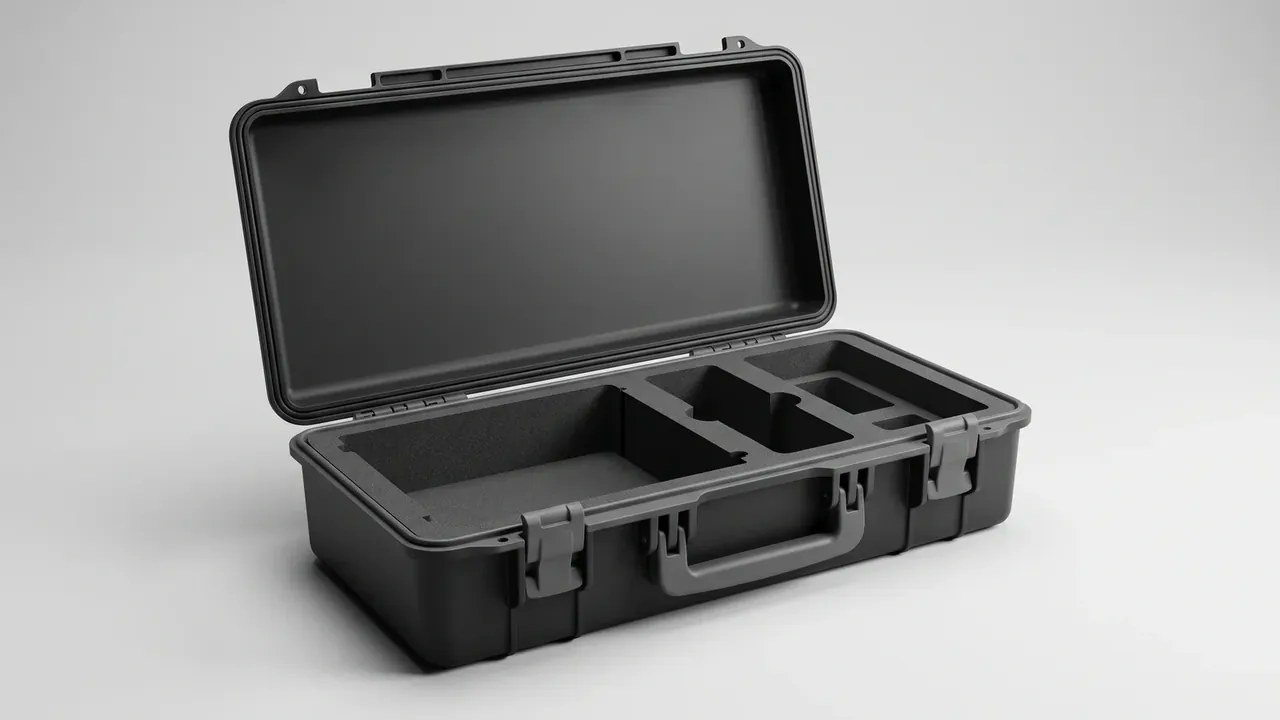
Quick answer: Lay out a camera case from the body bay outwards: the 152 × 120 × 82 mm footprint in one corner, a 12 mm gap before the first lens bay, each bay cut to diameter plus 10 mm, 45 kg/m³ EVA at 10 percent compression. Shake the loaded case for ten seconds; if nothing knocks, the layout holds.
Table of contents
- Start with the body bay
- Sizing the gaps
- Foam or rigid dividers
- Where movement comes from
- Three standard layouts
- Checks before the case ships
- FAQ
1. Start with the body bay
A camera case with a 460 × 330 × 175 mm interior takes a solid EVA block as its liner, and the first cut decides where every other bay sits.
Cut the body first. A full-frame body with a vertical grip measures 152 × 120 × 82 mm; lay it screen-up 30 mm from the left wall and 278 mm of interior remains for glass. Fix that rectangle and lens bays run along its edge, with every tolerance landing in foam rather than in the shell.
Working from the lenses backwards costs a second sheet. Glass changes, bodies rarely do, and a lens-first layout often leaves a 100 mm slot too narrow to reach into.
The bay sets carry balance: a 1.9 kg body on the handle side tips the case 4 degrees forward, enough to bang the base against a shin; move it 30 mm across and the tilt falls under 1 degree.
2. Sizing the gaps
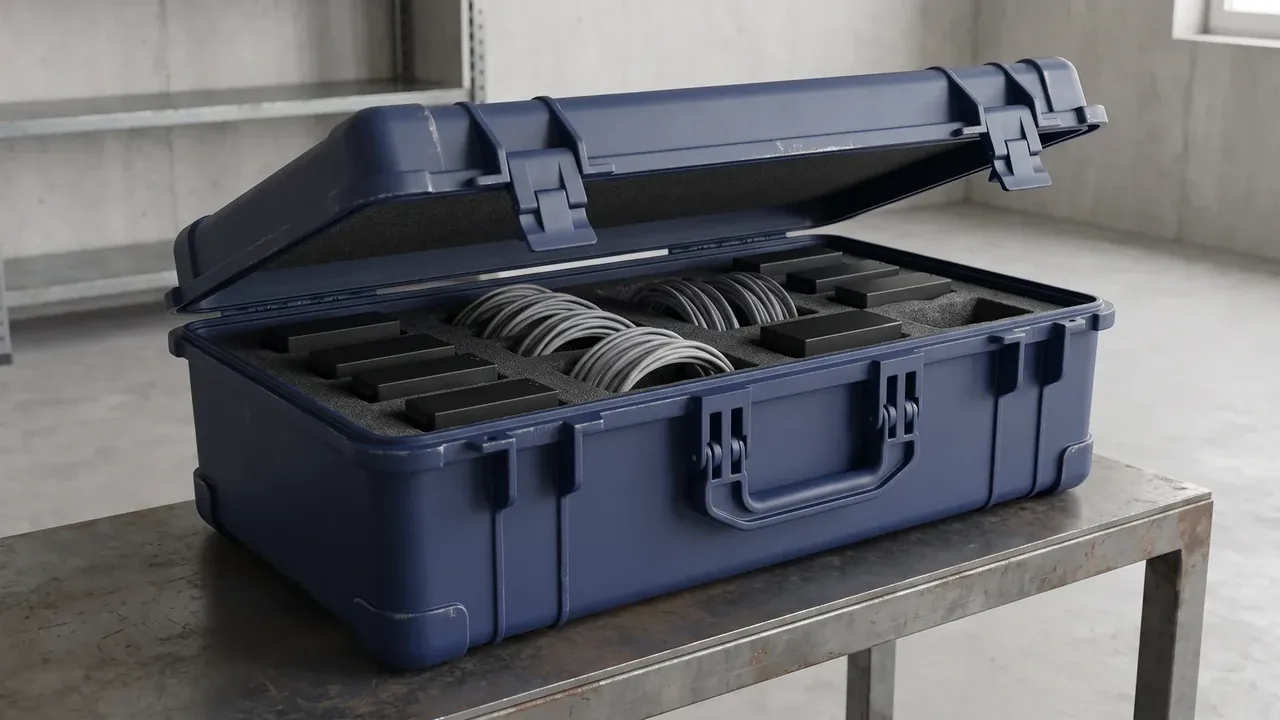
Horizontal and vertical clearances are calculated apart.
The horizontal gap must admit two fingers, so 12 mm is the floor. At 8 mm a 70-200 mm zoom scrapes its hood claws; past 18 mm the body slides, and friction will not hold it through a drop, where it shifts 6 mm.
Vertical clearance belongs to the lid liner: 8 mm of compression rests on the rear screen, 15 mm loads it.
Bays are cut to outside diameter, not filter thread. A 70-200 mm f/2.8 with its hood reversed measures 105 mm, so the bay is cut at 115 mm and closes back to 5 mm of grip; an 85 mm prime at 80 mm needs 90 mm. Depth is lens length plus 15 mm.
| Item | Value | Acceptance |
|---|---|---|
| Body bay footprint | 152 × 120 mm | Measured with grip fitted |
| Body-to-lens gap | 12 mm | Under 8 mm the hood scrapes |
| Lens bay diameter | Diameter + 10 mm | 5 mm of grip after compression |
| Lens bay depth | Lens length + 15 mm | Mount clear of the base |
| Lid compression | 8 mm | Light contact, no pressure |
3. Foam or rigid dividers
Three approaches cover most builds; choosing badly shows up after six months, not on delivery.
- Die-cut EVA: 45 kg/m³, 8 to 12 percent compression, fixed bays, suits rental sets
- Layered EPE: 25 kg/m³, removable sheets, suits weekly glass swaps
- 8 mm PP hollow sheet with foam edging: board holds shape, foam grips, suits lenses above 2 kg
EVA holds its memory: after 500 cycles compression set stays under 5 percent and the walls still grip. EPE costs a third less, but by the fifth layer the stack shifts and every lens needs a hand.
Rigid board answers another problem: a long lens presses its weight into foam, and within six months the bay floor can dish by 3 mm and load the mount in shear; an 8 mm board holds that under 1 mm.
| Method | Material and density | Compression | Best fit |
|---|---|---|---|
| Die-cut block | EVA, 45 kg/m³ | 8 to 12 percent | Rental sets |
| Layered sheets | EPE, 25 kg/m³ | 15 percent | Glass swapped often |
| Board plus foam | PP sheet, 8 mm | Set by edging | Lenses above 2 kg |
4. Where movement comes from
Movement is not the case rocking: it is gear travelling more than 2 mm in its bay until a mount and a hood grind together.
The vehicle comes first. A van crossing a speed hump at 60 km/h sees 3 g at the rear floor; a 1.5 kg lens pulls 44 N, and only 5 mm of compressed foam resists it.
Then the drop: twenty-six drops from 1.2 m push the wall 0.6 mm and the gear 0.3 mm with it, until a 5 mm gap becomes 8 mm.
Then handling: fingers lift a lens, the barrel turns 5 degrees before it clears, and the same wall takes the wear.
The vehicle is missed most: it leaves no scratches, only displacement. A two-year-old case reached the workshop with an unmarked shell, three of five bays polished and one hood claw broken. Load it, hold both ends, rock it: a dull thud means something shifts, a sharp click means a gap past 3 mm.
5. Three standard layouts
Counting bodies rather than lenses gives a stabler layout, because body dimensions vary far less than glass.
| Layout | Body bays | Lens bays | Suggested interior | Loaded weight |
|---|---|---|---|---|
| 1 body, 2 lenses | 1 | 2 (100 and 85 mm) | 400 × 300 × 160 mm | 6.8 kg |
| 2 bodies, 3 lenses | 2 | 3 (115, 90, 80 mm) | 460 × 330 × 175 mm | 9.4 kg |
| 3 bodies, 5 lenses | 3 | 5 (120 mm largest) | 560 × 420 × 200 mm | 14.2 kg |
Past 12 kg the case should be split in two. At 15 kg the handle roots take the worst of it, and a PC handle flexes about 1.2 mm under 3 g.
6. Checks before the case ships
Three checks leave the bench with every unit: shake, weigh, cycle.
Weighing confirms the loaded case sits near 6.8, 9.4 or 14.2 kg; half a kilo over usually means a bay was cut too deep. Thirty open-and-close cycles test hinge and latches, and the lid gap still has to close under 0.4 mm.
Foam has a service life. Opened twenty times a month at 25 °C, EVA reaches 8 percent compression set after two years, when a new liner costs less than a new case. Judge by touch: if a pressed wall takes longer than a second to return, the liner is done.
Humidity is the quiet item: a closed case sits near 75 percent relative humidity through a wet season, and fungus starts at week three. A 5 g desiccant sachet costs under three yuan.
Conclusion
A camera case is not a box cut into small holes. It is a body bay with everything else arranged around it: the 152 × 120 mm footprint fixed first, a 12 mm gap, bays at diameter plus 10 mm. Do that and the shake test comes back silent.
This article discusses only the container (case body) side of specifications and design intent, and does not cover any handling, loading or use of the contents.
Related Reading
- How to specify a camera equipment case
- Design rules for custom foam inserts
- Comparing foam cutting methods
- General criteria for equipment case selection
Related Products
- 8 Series — Gun Cases; Military Equipment Cases; Camera Equipment Cases; Drone Cases; Watch Cases; Knife Cases; First Aid Cases; Electronics Equipment Cases
- WL8-2812 PP Gun Case — model WL8-2812
- All protective cases and toolboxes: 7 series, 158 models