

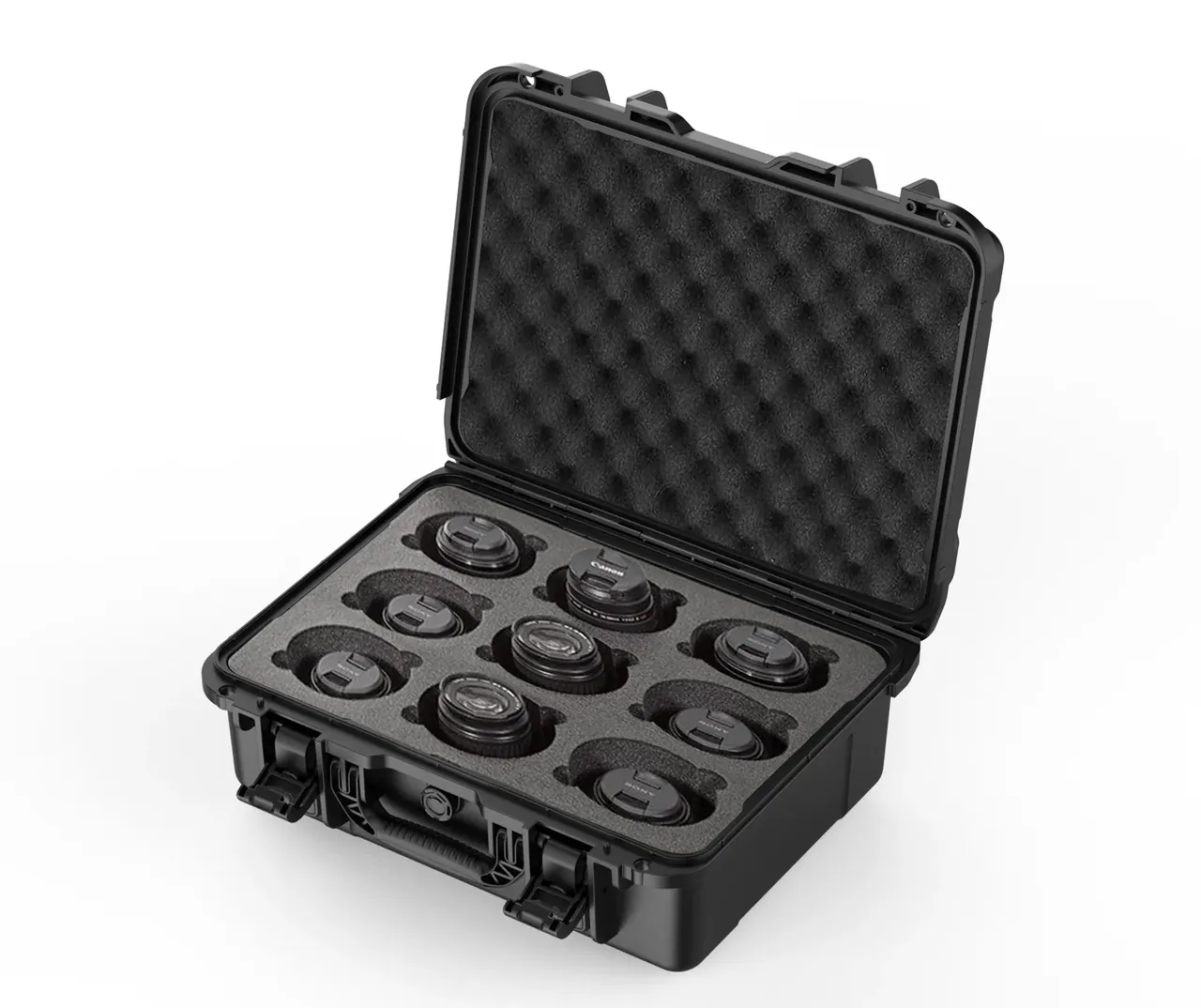
Quick answer: The camera case vs bag split comes down to two lines: IP67 sealing and a 1.5 m six-face drop decide whether the gear survives, while 12 s versus 5 s of access decides whether you get the frame.
Table of contents
- Where the split starts: sand and water
- 8 kg of two bodies and four lenses
- Four hours on the shoulder
- 12 s versus 5 s
- FAQ
1. Where the split starts: sand and water
A day on the beach ends two ways. The bag takes grit through the zip and the shutter starts to feel rough; the body kept in a hard case comes out with a salt film that wipes off with a damp cloth. Sand runs 0.2 mm to 0.5 mm, exactly the size that jams a zip tooth and exactly the size a loaded seal keeps outside.
IP67 means dust-tight grade 6 and no ingress after 30 min at 1 m. On a case that is three parts: a silicone O-ring, two latches pressing the lid to 60 N, and a 4 mm groove cut 3.2 mm deep, so the cord compresses 20%.
A bag has no loaded face. Zip, stitching and webbing anchors are all channels, and wind pushes sand through teeth and needle holes. Thirty minutes of moderate rain pushes internal humidity past 90%, and fog behind the rear element takes 48 h to clear.
In rain and dust these two forms are not degrees of one thing; one works and one does not.
| Item | Hard case | Gear bag |
|---|---|---|
| Sealing | IP67 | No loaded seal face |
| 0.3 mm sand | Stopped at the cord | Enters at zip teeth |
| 30 min rain | 45% internal humidity | 90% humidity in liner |
| 1.5 m six-face drop | Shell rebounds, 22 mm foam left | Gear takes the load |
| Empty weight | 4.8 kg | 1.6 kg |
The last row is the one buyers skip. The case is 4.8 kg, 3.2 kg more on the shoulder, and those 3.2 kg buy the four rows above. Whether that is worth paying depends on hours spent moving, not on the price of the gear.
2. 8 kg of two bodies and four lenses
Two bodies at 1.1 kg each plus four lenses between 0.6 kg and 1.8 kg, with batteries, comes to about 8 kg. Laid into 30 mm foam with 15 mm walls and 90 mm pockets, that is two body slots and four lens slots, every lens standing mount up.
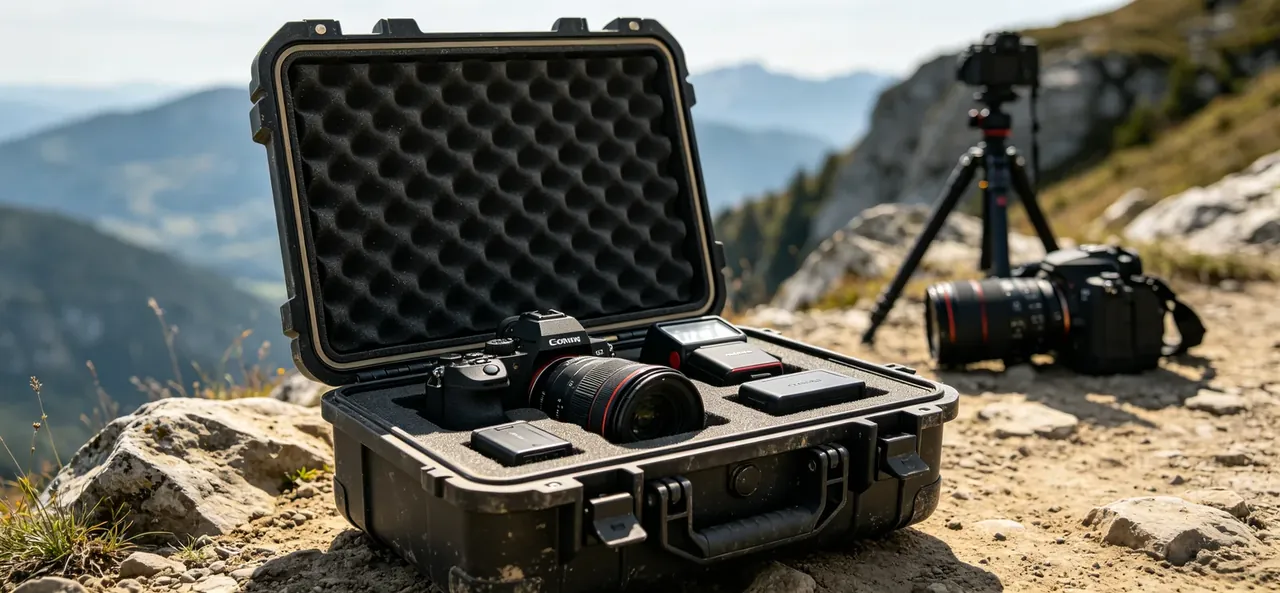
Pockets are not decoration. A 1.5 m free fall lands at 5.4 m/s, the 8 kg load compresses 30 mm foam to 22 mm and leaves 8 mm of travel, and the 15 mm walls split that load into six chambers so lenses never strike each other. A pocket 1 mm to 2 mm larger than the item is right: half a millimetre less and it will not go in, 5 mm more and the item shifts far enough to mark a mount flange.
Standing a lens up keeps its weight off the mount: with the flange up, a 1.8 kg telephoto does not hang from the body joint.
A bag divides with hook-and-loop panels. Loaded to the same 8 kg, those panels spread on impact, four lenses end up in one heap, and the load path moves out of the foam into the barrels.
3. Four hours on the shoulder
Four hours is the comfortable limit for a shoulder bag. An 8 kg load on two 50 mm straps puts about 8 kPa on the shoulder; by hour three there are pressure marks, by hour four access slows by roughly 30%.
A 22 inch trolley weighs 4.8 kg empty and 13 kg loaded, and rolls on paving with one hand and almost no effort. The cost appears on steps, rocks and sand, where the wheels stop helping and 13 kg needs three grip changes in 30 m.
Three locations a day at 6 min each adds 8 min per move for a hard case, or 24 min a day, and that cost is predictable. The bag's is not: gear has no fixed place, so finding one lens takes 20 s of rummaging, and across 60 accesses a day that search passes 15 min.
How you move decides the form. If the vehicle parks within 200 m, the trolley wins outright; if the approach is a four hour walk or needs both hands on rock, it is a burden, and the camera case vs bag question is settled at that step. Strap width scales pressure directly: 50 mm gives about 8 kPa, 38 mm gives 10.5 kPa and pulls the four hour line back to 2.5 h.
4. 12 s versus 5 s
Access time can be counted. A hard case needs two latches flipped, the lid raised to 100° and the body drawn from a standing pocket: 12 s. A bag needs one zip and one reach: 5 s. At 60 accesses a day the gap is 7 min, and in sport or wedding work one missed moment is one dead frame.
That 12 s splits further: 3 s of latches, 4 s to raise and hold the lid, 3 s to draw the body, 2 s to close. Rain adds 2 s to hold the lid one-handed, and that 2 s separates the forms more than any weight on a spec sheet.
| Situation | Access | Form | Reason |
|---|---|---|---|
| Coast, dust, snow | 12 s | Hard case | IP67 keeps 0.3 mm grit out |
| Below −10 ℃ | 12 s | Hard case | Soft dividers stiffen, cushioning stops |
| Street and event work | 5 s | Gear bag | 120 or more accesses a day |
| Solo four hour walk | 5 s | Gear bag | 13 kg fails past 40 min |
Only one of the four needs arithmetic: the value of the load. Two bodies and four lenses at 50,000 RMB against a repair quote that often passes 8,000 RMB after a 1.5 m drop is a ratio of 8 to the price of the case, and past a ratio of 3 the choice stops being a matter of taste.
The reverse holds. Below 10,000 RMB and on a city schedule, mobility is worth more, and a hard case becomes a locker opened twice a day.
The cold row needs its own note. At −10 ℃ the rebound time of a soft divider stretches from 0.2 s to 1.5 s, so it cannot return energy and cushioning is gone, while the same 30 mm foam still returns about 70%.
Conclusion
Draw protection and portability as two axes and four quadrants appear. High protection with high mobility is a hard case on a trolley frame: roll between positions, carry the last 200 m, and 8 kg still covers three locations a day. High protection with low mobility is a 22 inch case at 13 kg, right for transport legs and full days on a coast or in dust. Low protection with high mobility is the shoulder bag, 5 s to the body and 120 accesses without a missed frame. Low protection with low mobility is a soft bag stuffed to 10 kg, which carries badly and stops no sand. The camera case vs bag decision needs two tests: sand, water or a drop above 1.5 m in the schedule, and more than 80 accesses a day.
This article discusses container-side specifications and design implications only, and does not cover any handling, loading or use of the contents.
Related Reading
- How a camera hard case is built
- Humidity control inside camera cases
- Choosing cushion liner thickness
- Selecting a plastic case for photo gear
Related Products
- 8 Series — Gun Cases; Military Equipment Cases; Camera Equipment Cases; Drone Cases; Watch Cases; Knife Cases; First Aid Cases; Electronics Equipment Cases
- WL8-2812 PP Gun Case — model WL8-2812
- All protective cases and toolboxes: 7 series, 158 models