

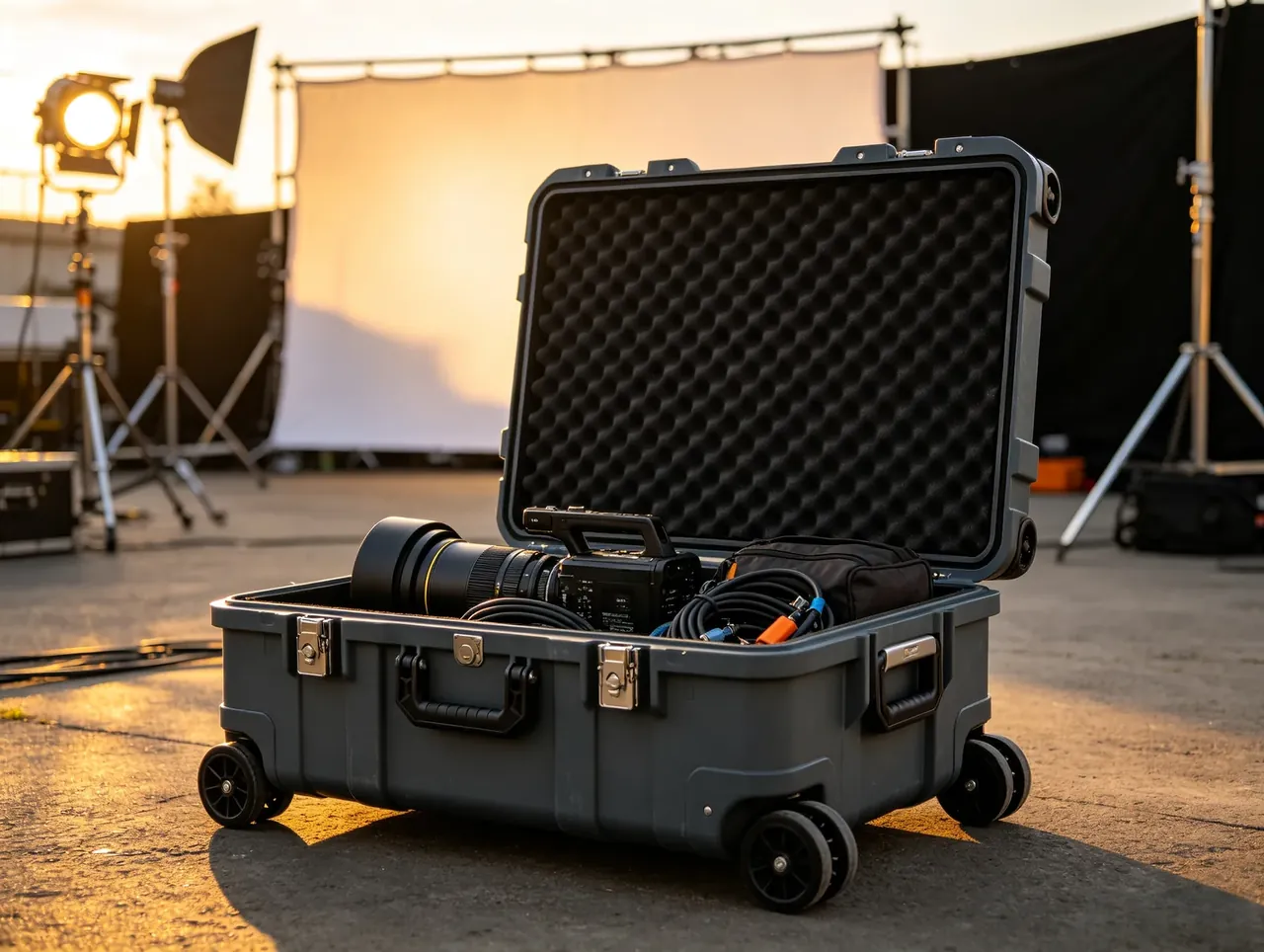
Quick answer: A camera gear case holds a 1.45 kg lens with 1.5 to 2.2 mm of foam interference and 9 to 15 N of pull, staying at 40 to 50 %RH inside.
Table of contents
- Axial clearance inside a camera gear case
- Foam interference and pull force
- Split cavities and mount load paths
- Humidity target and opening rhythm
- Desiccant mass and rehumidification
- FAQ
1. Axial clearance inside a camera gear case
A 70 to 200 mm zoom measures 200 mm and weighs 1.45 kg. Cut the cavity 1 mm larger than the barrel radius and it slides 2 mm along the axis. A 1.2 m drop at 40 g peak turns that travel into speed before the wall stops it.
Over 2 mm at 40 g it arrives at 1.25 m/s with 1.8 N·s. Five millimetres of free foam gives 226 N; foam already bottomed out at 0.2 mm gives 5650 N, a factor of 25.
| Drop (m) | Peak (g) | Arrival (m/s) | Mean stop force (N) |
|---|---|---|---|
| 0.6 | 22 | 0.93 | 125 |
| 0.8 | 28 | 1.05 | 160 |
| 1.0 | 35 | 1.17 | 199 |
| 1.2 | 40 | 1.25 | 226 |
| 1.5 | 50 | 1.40 | 285 |
Inertia runs along the axis into four mount claws, not the shell. Travel cut to 0.3 mm drops arrival to 0.48 m/s and leaves 15% of the energy, and that clearance comes from interference, not thicker foam.
2. Foam interference and pull force
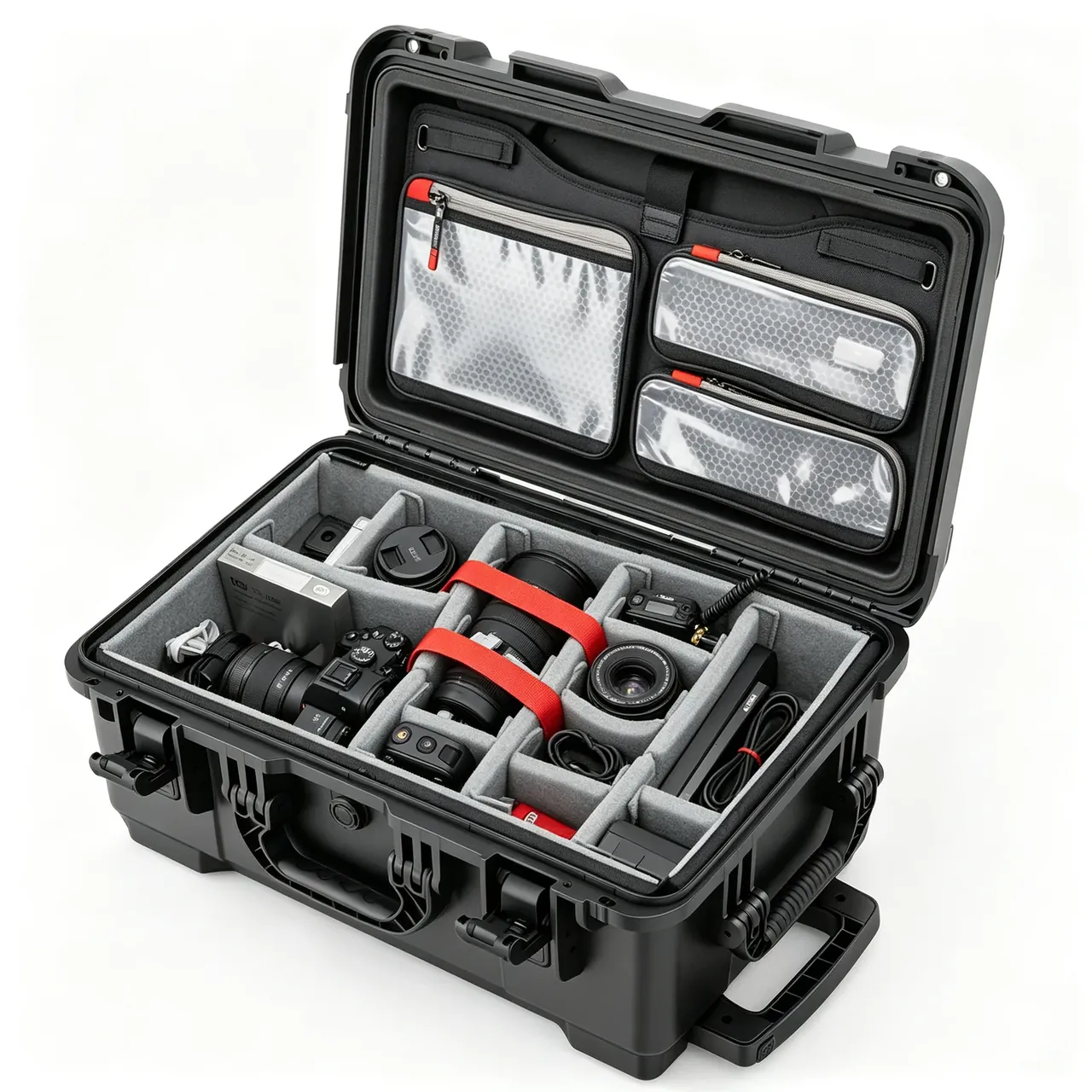
Interference is how much narrower the cavity is than the barrel. EVA at 45 kg/m³ pulls out one-handed at 9 N with a 1.5 mm gap and needs two hands at 17 N with 2.5 mm.
| Interference (mm) | Pull (N) | Verdict |
|---|---|---|
| 0.5 | 3 | Movement, strikes the wall |
| 1.0 | 6 | Short primes only |
| 1.5 | 9 | Lower limit for telephoto |
| 2.0 | 13 | Recommended, one hand |
| 2.5 | 17 | Two hands, slow recovery |
| 3.0 | 23 | 8% permanent set |
A zoom ring sits 3 mm proud, so a straight cut clamps 20 mm and leaves 180 mm loose. Cut three steps: 1.5 mm at the front group, 2.5 mm at the ring, 2.0 mm at the mount.
EVA creeps too: 25% compression at 60 °C for 72 h recovers 92%, and a year under 1.45 kg loosens the cavity 0.2 mm, so cut 0.2 mm tight. Pinch force through rubber ribs gives 25 N, which is why pull is capped at 15 N.
3. Split cavities and mount load paths
A 55 mm bayonet with four claws carries 48 mm², so 569 N becomes 11.8 MPa of shear that aluminium handles easily. Bending is the risk.
In a side drop the mass sits 90 mm ahead and 569 N of lateral inertia makes 51 N·m. A 15 mm divider plus two saddles 270 mm apart cut that to 190 N per point.
Standing a lens on its mount is the most common mistake in a camera gear case.
Upright, 1.45 kg lands on the mount face. Flat, two 60 mm saddles carry it at 1.2 N/cm and the load turns from axial to radial. A gripped body is 25 mm wider than a bare one, so cut the cavity for the grip.
4. Humidity target and opening rhythm
Hold 40 to 50 %RH. Under 35 %RH the zoom ring grease and rubber gaskets dry out; over 60 %RH the wall fogs as the case leaves air conditioning.
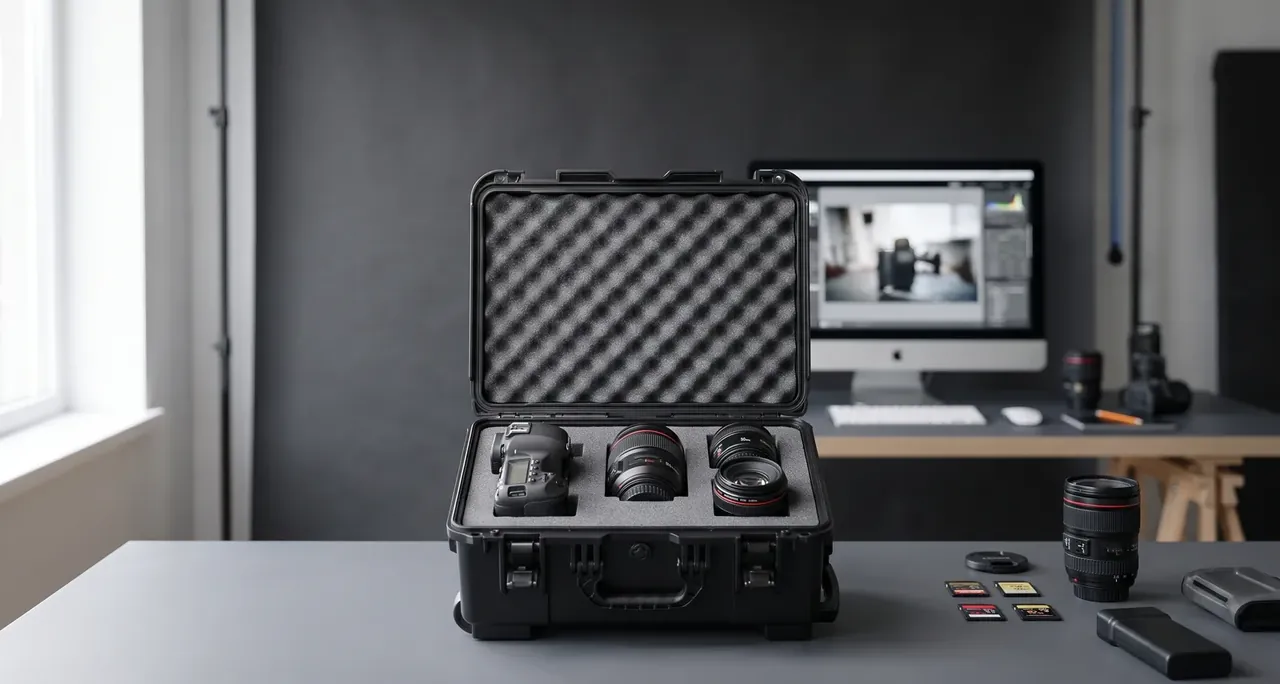
A 30 L case at 28 °C in a 65 %RH room, open 90 s, climbs 45 to 52 %RH and returns to 47 %RH in 25 min.
Gaskets are not the weak point. Silicone passes 0.4 g/(m²·d), and 1.9 m of seal at 8 mm is 0.015 m², or 0.006 g a day; moisture enters at latch gaps and the purge valve.
Cards flip at 10, 20, 30, 40, 50 and 60 %RH to ±5 %RH. A hygrometer reads ±3 %RH, sits on the cavity floor, and is calibrated every 12 months.
5. Desiccant mass and rehumidification
A 30 L case at 28 °C holds 0.82 g of water in its air, and 65 to 45 %RH removes 0.16 g.
The water lives in the foam: 0.6 kg at 1.2% equilibrium moisture holds 7.2 g, falling to 4.8 g at 0.8%, so 2.4 g must leave. With body, strap and lining the load is 4 g, twenty-five times the air figure.
Silica takes 9% of its mass at 45 %RH, so 45 g holds 4 g and 2.6 g is working capacity. Each opening nets 0.02 g; the closed case leaks 0.01 g a day.
| Volume (L) | Silica (g) | Days, 1 opening | Days, 4 openings |
|---|---|---|---|
| 20 | 30 | 58 | 19 |
| 30 | 45 | 87 | 29 |
| 45 | 70 | 98 | 33 |
| 60 | 90 | 106 | 36 |
Volume doubles without doubling silica, because seal perimeter grows with edge length; openings quadruple and life drops to a third. Fit a 30 mm × 40 mm window over colour-indicating gel and the colour dates itself.
Conclusion
Retention and humidity are two acceptance clauses and should never share a line on a drawing. The retention clause carries three numbers: cavity interference 1.5 to 2.2 mm, pull force 9 to 15 N, and telephoto lenses flat on two saddles with the mount locating only. The humidity clause carries three more: 40 to 50 %RH, 45 g of colour-indicating silica per 30 L, and a viewing window no smaller than 30 mm × 40 mm.
Then verify in order: measure cavity width at three points and hold ±0.3 mm, weigh the loaded case against the 569 N of a 1.2 m drop, and run a hygrometer in an empty case for 7 days to see whether it creeps past 50 %RH alone. Pass all three and that cavity and that bag of silica are settled.
This article discusses container-side specifications and design implications only, and does not cover any handling, loading or use of the contents.
Related Reading
- Camera equipment case layouts and fittings
- Foam cavities in a hard camera case
- How a humidor holds a narrow humidity band
- Camera case use cases and packing habits
Related Products
- 8 Series — Gun Cases; Military Equipment Cases; Camera Equipment Cases; Drone Cases; Watch Cases; Knife Cases; First Aid Cases; Electronics Equipment Cases
- WL8-2812 PP Gun Case — model WL8-2812
- All protective cases and toolboxes: 7 series, 158 models