

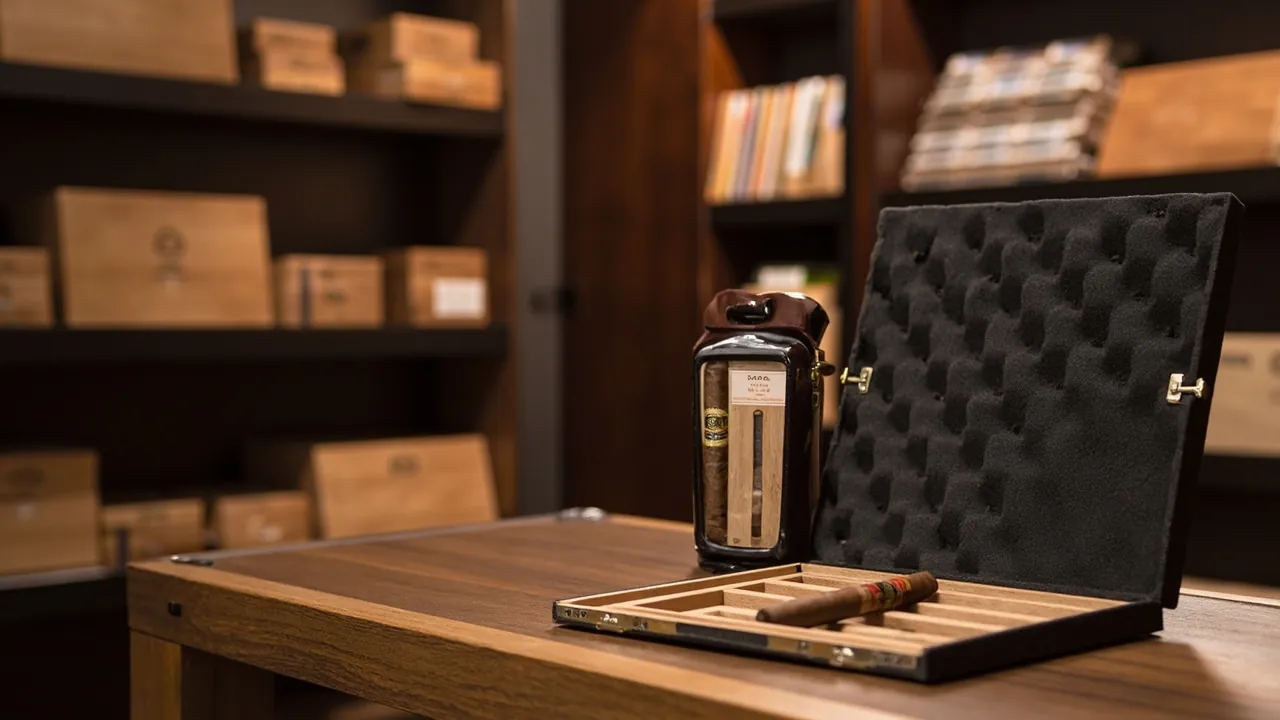
Damage to cigars in transit happens almost entirely at the molecular level, not at the visible level of knocks and dents. Cigars are strongly hygroscopic tobacco products whose moisture content continuously equilibrates with the surrounding atmosphere. In air that is too dry, water and volatile aromatic compounds leave the tobacco together: wrappers become brittle and split, and flavour is lost irreversibly. In air that is too wet, cigars swell, draw resistance rises, combustion becomes uneven, and once relative humidity sits above roughly 72-75% the risk of mould and tobacco beetle infestation climbs sharply. The primary performance metric of a cigar transport case is therefore not its crush rating but whether internal relative humidity can be held inside the 65-70% band for a sustained period, together with temperature held in the 16-21 degrees C band (typical industry ranges; the authoritative values should follow the tobacco type, maturity and the customer's process specification). A second risk class comes from pressure and mechanical stress: pressure changes in an air-freight hold create a differential across a sealed case that fatigues the gasket over repeated cycles, and because cigars are cylinders, local compression produces an irrecoverable flat spot and a cracked wrapper. JUNZHJIA supplies humidity-controlled inserts sized to case volume, cedar or acid-free lining options, pressure equalisation valves and OEM/ODM programmes for cigar humidor transport.
The second defining characteristic of cigar logistics is very high value density, non-replaceable individual units, and damage that appears late. A case of aged cigars may be worth many times the case itself; once a wrapper is torn it cannot be repaired; and humidity damage is often completely invisible on arrival - a dried wrapper may only split weeks later, and an over-humidified cigar only reveals itself when it is smoked, as a plugged draw or an uneven burn. This means liability can rarely be settled at the unpacking bench. It has to be managed through pre-packing control and an in-case record. This article is written for buyers and quality staff at cigar brands, regional distributors, specialist retail stores, duty-free and hotel channels, and collectors' and auction houses. It sets out executable engineering parameters along four lines: humidity control, temperature control, crush protection and compliance. All figures are typical industry values or rules of thumb; actual requirements should follow product technical files, destination market regulations and customer acceptance specifications.
Table of Contents
- 1. Core Risks in Cigar Logistics: RH, Temperature, Pressure and Mechanical Stress
- 2. Control Targets: The Logic of 65-70% RH and 16-21 Degrees C
- 3. Drying, Over-Humidification, Mould and Pests: Failure Comparison
- 4. Case Structure: Sealing, Insulation and Pressure Equalisation
- 5. Humidity Systems: Humidification Methods and Monitoring Compared
- 6. Lining Materials: Cedar, Acid-Free Options and Compatibility Prohibitions
- 7. Crush and Retention: Protecting Wrapper, Cap and Foot
- 8. Application-to-Case Selection Table
- 9. Sealing and IP Ratings: IEC 60529 and GB/T 4208
- 10. Temperature Control: Vehicles, Aircraft Holds and Ports
- 11. Packing SOP and Arrival Inspection
- 12. Transport Test Evidence and Regulatory Compliance
- 13. OEM/ODM Customisation and Supplier Evaluation
- Frequently Asked Questions
- Conclusion and Related Reading
1. Core Risks in Cigar Logistics: RH, Temperature, Pressure and Mechanical Stress
The protection logic for cigars is entirely different from that for machined parts or electronics, because the damage mechanism is fundamentally a mass-transfer problem.
Risk one: relative humidity drift - the slowest, least reversible and most expensive risk. Cigar leaf is hygroscopic, and its equilibrium moisture content tracks ambient relative humidity. When in-case RH falls below the appropriate band, cigars desorb moisture. The critical point is that what leaves the tobacco is not only water but also the volatile compounds that carry flavour and aroma, so drying damage cannot be reversed by re-humidifying. Conversely, when RH is too high the cigars absorb moisture and swell, the rolling tension is disturbed, and the result is higher draw resistance and uneven combustion, with wrappers splitting under the heat of smoking. What makes humidity damage so dangerous is its timescale: cigars equilibrate with their environment over weeks, so a short shipment may look perfect while the goods deteriorate noticeably only after a month in a distributor's inventory.
Risk two: temperature - both an accelerant and a biological trigger. Rising temperature does three things at once. It accelerates chemical and biochemical change (so-called "accelerated ageing", which becomes "degradation" beyond the appropriate band). It lowers relative humidity at a constant absolute moisture content, meaning cigars in a perfectly sealed case will still slowly dry as the case warms. And it increases pest risk. The tobacco beetle (*Lasioderma serricorne*) and the cacao moth (*Ephestia elutella*) are the classic stored-product pests of tobacco. Their eggs hatch markedly faster once temperature rises above a threshold (industry experience places that threshold in the 22-25 degrees C region; the authoritative figures should come from professional pest-control references). Hot transport therefore not only damages the cigars but can introduce an infestation into a downstream warehouse, a consequence far larger than one case of goods. Cold is not benign either: low temperature markedly slows or suspends ageing, and moving cigars straight out of a cold environment into a warm one readily produces surface condensation.
Risk three: pressure - a genuine structural load on a sealed case in air freight. Cargo-hold pressure in cruise is substantially below ground level. For a well-sealed case that means an internal positive differential: gaskets are pushed, the lid bows slightly. On landing the differential reverses and the case goes into slight negative pressure, producing a pronounced suction and a hiss when it is opened. Repeated differential loading is the main source of gasket fatigue, and the rapid air ingress at opening also disturbs the humidity equilibrium that has been established inside. Carry-on and checked luggage scenarios for travelling cigars multiply the number of pressure cycles. A pressure equalisation valve is therefore one of the defining differences between a cigar humidor case and an ordinary protective case; see Section 4.
Risk four: mechanical stress - cylinders are vulnerable to point compression and wrappers to rubbing. A cigar's cross-section is circular (or square in box-pressed vitolas), so the contact area under load is very small and the contact stress for a given force is far higher than for a flat part. The wrapper is the thinnest and most fragile layer on the cigar and cannot be repaired once torn. The cap and the foot are the two structurally weak zones: the cap cracks when humidity changes because of differential shrinkage, while the foot exposes incompletely wrapped filler leaf, so rubbing removes tobacco directly. On top of that, cigars rubbing against each other, bands rubbing against wrappers, and repeated manual handling all produce cumulative damage.
Five design principles follow.
Principle one: humidity control takes priority over temperature control, but both must be controlled together. Because temperature affects RH, any scheme that controls humidity without controlling temperature will fail on routes with temperature swings.
Principle two: humidity control must be two-way. One-way humidification will "soak" cigars in a humid environment; only a system that absorbs moisture when RH is high and releases it when RH is low can cover a real route.
Principle three: the case must tolerate pressure differentials while limiting vapour exchange. A valve equalises pressure, but it must also have a sufficiently low water vapour transmission rate - otherwise it is simply a permanent moisture channel drilled into the case.
Principle four: cigars must be compartmentalised. Compartments solve rubbing, compression and the movement of neighbouring cigars during handling, all at once.
Principle five: record the humidity history. Because damage appears late, only a record can settle liability and inform the re-humidification strategy on arrival.
A prohibition that must be stated plainly: never place ordinary desiccant (silica gel, montmorillonite and similar) in a cigar case as a "moisture protection" measure. Desiccant drives internal RH far below what cigars need, causing irreversible drying and flavour loss. Desiccant has exactly two legitimate uses in cigar logistics: in a separate compartment holding non-tobacco accessories such as cutters, lighters and spare hygrometer parts, and in the interlayer between the case barrier and the lining (not the cigar cavity) to suppress moisture uptake by the case material. The main cigar cavity may only use a two-way humidity system.
2. Control Targets: The Logic of 65-70% RH and 16-21 Degrees C
The best-known rule of thumb in cigar storage is the "70/70 rule" - 70 degrees F (about 21 degrees C) and 70% RH. Modern practice tends to narrow RH to the 65-70% band and temperature to 16-21 degrees C, for the following reasons.
Why the upper limit matters. Above roughly 72-75% RH, mould risk rises significantly, and cigars swell enough to produce draw resistance and uneven combustion. The effect is especially visible in aged and large ring gauge cigars. Many professional ageing rooms in fact run continuously in the 62-68% band precisely to preserve margin.
Why the lower limit matters. Below roughly 60-62% RH, wrappers become brittle quickly. Wrapper embrittlement is structural damage: once the leaf loses moisture, cell structure collapses and re-humidification cannot restore the original elasticity or appearance, while the volatile aromatic compounds have already been lost. Flavour damage is irreversible.
Why 16-21 degrees C. On the low side, below about 16 degrees C ageing slows markedly - acceptable for a short shipment but unsuitable for long-term storage - and condensation becomes likely when the cigars are later brought into a warm space. On the high side, above about 21-22 degrees C chemical change accelerates, and above 22-25 degrees C pest risk rises. The 16-21 degrees C band is the compromise that lets ageing proceed normally while keeping biological and chemical risk low.
The coupling between temperature and RH must be understood. At a constant absolute moisture content, raising the temperature lowers relative humidity, and lowering the temperature raises it (up to saturation and condensation). This means that a case moved from an 18 degrees C environment into a 30 degrees C vehicle will show a fall in internal RH even though the case is perfectly sealed and not one gram of water has left it. Conversely, moving from a 30 degrees C vehicle into an 18 degrees C air-conditioned warehouse raises internal RH, and in extreme cases can reach saturation and condense. Condensation is one of the most dangerous conditions for cigars: liquid water in direct contact causes localised over-humidification, mould and wrapper staining.
| Control Parameter | Target Band (typical industry values) | Consequence of Exceeding Upper Limit | Consequence of Exceeding Lower Limit | Control Method |
|---|---|---|---|---|
| --- | --- | --- | --- | --- |
| Relative humidity | 65-70% | Swelling, high draw resistance, mould, higher pest risk | Wrapper embrittlement and splitting, loss of aromatics, irreversible flavour loss | Two-way humidity packs, sealed case, hygrometer |
| Temperature | 16-21 degrees C | Accelerated degradation, egg hatching, RH falls automatically | Ageing stalls, condensation on removal | Insulated case, phase change material, away from heat sources |
| Temperature swing | Ideally under about plus or minus 5 degrees C per 24 h | Wet-dry cycling, condensation risk | - | Insulation, thermal mass, away from doors and heat |
| Internal pressure differential | Actively equalised by valve | Gasket fatigue, humidity equilibrium disturbed at opening | - | Pressure equalisation valve (low WVTR) |
| Internal humidity record | Fully traceable throughout | Liability cannot be settled; re-humidification strategy unknown | - | Data-logging hygrometer or indicator card |
| Mechanical load | No point compression, no mutual rubbing | Flat spots, cracked wrappers, band rub marks | - | Compartmented insert, full support, single-layer placement |
3. Drying, Over-Humidification, Mould and Pests: Failure Comparison
| Failure Type | Trigger | Appearance on Arrival | Delayed Appearance (weeks later) | Reversibility |
|---|---|---|---|---|
| --- | --- | --- | --- | --- |
| Desiccation and embrittlement | Sustained RH below 60-62%; hot, dry routing | Usually no visible anomaly | Wrapper splitting, leaf loss, harsh draw, fast burn | Irreversible (flavour and elasticity cannot be restored) |
| Over-humidification | Sustained RH above 72-75%; cold-to-hot transfer | Softer feel, reduced spring | Plugged draw, uneven burn, wrapper splitting under heat | Partly reversible (slow drying helps, but structural tension has changed) |
| Condensation staining | Temperature drop causing in-case saturation | Localised dark water marks on the wrapper | Localised mould, fixed staining | Irreversible (permanent cosmetic damage) |
| Mould growth | Locally high RH plus high temperature plus poor air movement | White or blue-green fuzzy growth (must be distinguished from bloom) | Spread, odour contamination, whole-case rejection risk | Irreversible when severe |
| Pest infestation | Temperature above the pest threshold; introduction from outside | Usually nothing visible (eggs are not visible) | Pin-hole bore marks, tobacco dust (frass) | Irreversible (requires isolation and treatment) |
| Cap cracking | Abrupt humidity change, especially rapid re-humidification | Fine cracks at the cap | Crack propagation, wrapper lifting from the head | Irreversible |
| Foot leaf loss | Rubbing, repeated handling, no compartments | Loose leaf fragments at the foot | Uneven foot, abnormal ignition point | Irreversible |
| Compression flat spots | Stacking, no compartments, cigars pressing together | Flattened section in the circular profile | Abnormal draw resistance, uneven burn | Irreversible (structural deformation) |
| Odour contamination | Off-gassing case materials (rubber, adhesive, fragrance, mouldy wood) | Odour at opening | Permanent flavour contamination | Irreversible |
| Band marks | Band shifting under humidity change and rubbing the wrapper | Band loosened or slightly displaced | Colour difference band beneath the band | Locally irreversible |
| Cellophane or tube deformation | Stacking, temperature change | Creased cellophane, dented aluminium tube | Loss of protection, tube seal compromised | Partly reversible |
| Gasket failure | Repeated differential loading, ageing, compression set | Lid closes with a lighter feel; no suction at opening | Faster humidity drift; case loses stability | Replaceable (a wear part) |
The twelve failure classes reduce to one sentence: humidity failures are irreversible, pest failures spread, mechanical failures cannot be repaired, and odour failures cannot be removed. Engineering effort in cigar logistics must therefore move upstream to the control stage, because there is very little that can be fixed afterwards.
4. Case Structure: Sealing, Insulation and Pressure Equalisation
A cigar humidor transport case must simultaneously satisfy four requirements: low water vapour transmission, tolerance of pressure differentials, thermal insulation, and mechanical load capacity. These requirements trade off against one another, so priorities must be fixed at the design stage.
Low vapour transmission comes first. The case's water vapour transmission rate determines how long internal RH can be maintained without replenishment. The main contributors are the intrinsic barrier performance of the case material, the effective contact width and compression of the gasket, the continuity of clamping force produced by latch count and distribution, and the transmission characteristics of the pressure equalisation valve. A case with excellent sealing but a high-transmission valve may deliver far less real humidity stability than expected.
The pressure equalisation valve is a functional necessity. As described above, air freight and high-altitude routing create a differential across the case. The valve's job is to pass air once the differential exceeds a set threshold, equalising pressure and protecting the gasket and lid structure. For cigar cases, three selection points matter:
- Low water vapour transmission. Valve bodies normally use a hydrophobic microporous membrane (expanded PTFE types). The lower the vapour transmission rate the better, and suppliers should be asked for membrane WVTR data rather than a simple "waterproof" claim.
- Cracking pressure matched to the route. Too high and the valve might as well not be fitted; too low and it opens repeatedly under small thermally induced differentials, increasing vapour exchange.
- No odour release. The valve body and its sealant must be free of solvent residues and volatile compounds, otherwise the valve becomes a permanent odour source. See pressure equalisation valve function and selection.
Insulation: less about keeping warm, more about damping swings. Cigars are more sensitive to temperature fluctuation than to absolute temperature, because fluctuation drives both RH swings and condensation risk. The goal of insulation is to increase the case's thermal time constant, so that internal temperature responds slowly and gently to external change. Options include composite case walls with an insulation layer, low-conductivity lining materials, and - for short high-precision routes - phase change material (PCM) panels that hold internal temperature in a narrow band around the phase transition point. PCM schemes have hard limits: their effective duration is finite, the quantity must be matched to shipment duration, and the PCM surface must not fall below the dew point or it will cause localised condensation. General temperature-controlled logistics practice is covered in cold chain case design essentials.
Case formats. Three formats dominate cigar logistics:
- Portable humidor cases (attache style): typically 20-150 cigars, used for personal carriage, distributor deliveries and store-to-store transfers; emphasis on light weight, sealing, appearance and easy opening.
- Mid-capacity transit cases: typically 150-800 cigars, used for regional distribution, exhibitions and auctions; emphasis on stacking, insulation and controlled-humidity inserts.
- High-capacity humidified cabinet cases: 800 cigars and above, used for sea freight and long-term rotation; normally fitted with a data logger and replaceable humidity modules.
Latch and hinge requirements. Cigar cases care more about the uniformity of clamping force than its absolute magnitude: local over-compression puts a permanent set into the gasket, while local under-compression creates a leak path. Latch count should therefore match lid stiffness - as a rule of thumb, a lid edge longer than 800 mm should carry at least three latches - and adjustable-clamp latches are preferable. Hinges must prevent the lid from twisting when open, so that the gasket is not sheared during closing. Hardware selection is covered in case hinges, latches and gasket selection and case seal material analysis.
Gaskets are wear parts and belong in the maintenance plan. Silicone, EPDM and TPE foam gaskets harden and take a permanent compression set under sustained compression, repeated closure, UV and ozone. The consequence is a slow decline in humidity retention - and this is the most dangerous failure mode precisely because it has no visible symptom. Set a replacement interval based on closure cycles and elapsed time, and run a simple check before every pack: close the lid, let it settle, and confirm the perimeter seats evenly with no visible gap. Replacement criteria are covered in protective case service life assessment.
5. Humidity Systems: Humidification Methods and Monitoring Compared
Humidity control is the core function of a cigar case, and the technology route directly determines reliability and maintenance cost.
| Method | Working Principle | Advantages | Drawbacks and Risks | Suitable Applications |
|---|---|---|---|---|
| --- | --- | --- | --- | --- |
| Two-way humidity pack (salt solution or polymer type) | Absorbs moisture above the set RH, releases it below | No manual judgement needed, narrow band, no liquid water, low maintenance | Finite service life; dose must be calculated from volume and duration; periodic replacement | First choice for transport, covers most routes |
| Propylene glycol (PG) solution humidifier | PG solution equilibrium vapour pressure holds about 70% RH | Reusable by topping up; controllable cost | Requires manual topping up and judgement; may spill when tilted; set point drifts as concentration changes | Fixed humidified cabinets, long-term storage |
| Distilled water with floral foam or sponge | Direct evaporation | Cheap and widely available | Evaporation rate uncontrolled, easily over-humidifies; foam and sponge are mould reservoirs; spills when tilted | Not recommended for any professional shipment |
| Silica gel desiccant | One-way absorption | Cheap and available | Drives RH far below the required band, causing irreversible drying; unsuitable for the main cavity | Only accessory compartments and case interlayers |
| Active humidity module (Peltier or heater plus humidity feedback) | Closed-loop active control of temperature and humidity | High precision, stable over long periods | Needs power, bulky and heavy, more failure points | High-value long-term storage, pre-auction staging |
| Microporous ceramic or polymer slow-release body | Gradual moisture release | Structurally stable, no spillage | Limited precision, one-way only | Supplementary buffering alongside two-way packs |
How to size the dose. Two-way pack quantity should be calculated from three variables: internal free volume (not external case volume - deduct the space taken by cigars and insert), shipment duration (including unpredictable customs and transhipment time), and the cigars' own moisture load (cigars are a large moisture buffer: dry cigars absorb a great deal of moisture from the case, over-humidified cigars release it). Where the cigars' moisture content is unknown or outside the target band, the pack dose should be significantly increased, or the cigars should be equilibrated before packing.
Selecting monitoring instruments. Every cigar case should carry at least one humidity monitoring device; high-value consignments should carry a recording solution.
| Instrument | Typical Accuracy | Advantages | Limitations | Suitable Applications |
|---|---|---|---|---|
| --- | --- | --- | --- | --- |
| Mechanical dial hygrometer | Plus or minus 3-5% RH (typical) | No power, directly readable, low cost | Drifts, needs calibration, poor shock resistance | Retail and portable cases |
| Digital hygrometer (non-logging) | Plus or minus 2-3% RH (typical) | Fast reading, small | No history, battery risk | Mid-capacity transit cases |
| Data-logging temperature and humidity logger | Plus or minus 1-3% RH (typical) | Full traceable curve for liability purposes | Higher cost, must be recovered and read | Cross-border, sea freight, auctions, high-value goods |
| Humidity indicator card | Threshold type, irreversible colour change | Extremely low cost, instantly readable | Only shows whether a limit was exceeded, no continuous curve | Per-case supplement to a logger |
Calibration and verification. All humidity instruments need a calibration record. A common field check uses a saturated salt solution to establish a reference humidity in a sealed container - for example saturated sodium chloride establishes roughly 75% RH - and compares the instrument reading against it, sending the instrument for service or replacement if the error exceeds the limit. Specific calibration methods, reference solutions and acceptance criteria should follow the instrument maker's instructions and applicable metrology rules; no metrological conclusion is drawn here.
Practical experience: it is better for cigars to be slightly dry than slightly wet. A cigar at, say, 63-65% can be improved by slow re-humidification on arrival, whereas over-humidification brings mould and pest risk that is irreversible and spreads. This is why many professional warehouses run at the lower half of the band.
6. Lining Materials: Cedar, Acid-Free Options and Compatibility Prohibitions
The lining is the part that touches the cigars directly, so its material choice affects humidity buffering, mechanical protection and odour safety at once.
**Spanish cedar (generally *Cedrela* species). This is the traditional cigar storage material, used widely for three reasons: relatively strong moisture absorption and release, making it a humidity buffer; a mild aroma that does not overpower cigars; and a degree of pest repellence associated with some species (an empirical observation that does not replace proper pest management**). Four points need attention:
- Only thoroughly dried, odour-free material should be used. Damp or musty timber becomes a permanent odour and mould source.
- Wood is itself hygroscopic and will consume case moisture. A new case should be pre-conditioned before first use, otherwise the wood competes with the cigars for moisture and produces a false equilibrium in which the packs keep supplying water, the lining keeps absorbing it, and the cigars keep drying.
- Machined faces must be free of splinters and burrs. Cigar wrappers are extremely sensitive to burrs; a single in-and-out handling can tear one.
- Provenance compliance must be verified. Some *Cedrela* species are managed under CITES appendices in international trade, so cross-border use of wooden lining requires verification of origin and compliance documentation, and adherence to destination regulations. This is a trade compliance matter that should be confirmed with customs brokers and legal advisers; no compliance conclusion is drawn here.
Acid-free materials. Where cedar is not used, lining and interleaving should be acid-free, free of residual lignin and free of optical brighteners. Acidic materials release acidic species under humidity, which over long contact can discolour cigars and damage wrappers. As an engineering reference for screening long-contact paper materials, see ISO 9706 (paper for documents - requirements for permanence) and request pH and migration data from suppliers. Paper that looks clean and white is not automatically acid-free.
Compatibility prohibitions. Cigars adsorb odours strongly, so the following must never share a cavity with them:
- Plasticiser-containing soft PVC and low-grade foam - migration and odour release.
- Sulphur-bearing rubbers and some vulcanised compounds - discolouration and off-odour.
- Adhesives and labels with solvent residues - including some pressure-sensitive labels and inks.
- Fragrances, camphor, insect repellent sheets and timber preservatives - the odour is fully absorbed by the cigars.
- Mouldy or previously damp paper, wood and textiles - spores and musty odour are persistent contaminants.
- Inserts previously used to pack other goods, especially chemicals, food or spices - cross-contamination risk is very high.
Comparing lining materials. Cushioning materials for cigar cases must be low-odour, low or controllably low in vapour transmission, non-shedding and non-migrating. Typical options include cedar lining with acid-free paper interleaving (the traditional approach) and closed-cell foam such as EVA for structural location with an acid-free barrier layer (the modern approach, with lower odour risk), plus microporous materials as humidity buffers. Note that open-cell foam such as ordinary PU not only adsorbs odours but can become a reservoir for moisture and mould, and is not recommended for the main cigar cavity. Material comparisons are covered in case foam material comparison and custom foam insert guide.
On "new case smell". Newly built cases - especially those using adhesives, sealants or coatings - release volatile compounds. A new case must be degassed before use: leave it open in a ventilated area long enough that no odour is detectable, then pre-condition it, then load it. This step costs almost nothing, and skipping it means feeding all of that case odour to the cigars.
7. Crush and Retention: Protecting Wrapper, Cap and Foot
Mechanical protection for cigars has a single objective: every cigar must avoid point loads, avoid rubbing against other cigars or hard objects, and stay in its designed attitude.
Why compartments are mandatory rather than optional. Three reasons. First, compartments convert point contact into surface contact - a cigar cradled on a curved surface in its own circular slot sees far lower contact stress. Second, compartments eliminate mutual rubbing - cigars in repeated contact under vibration are the main source of wrapper wear and band rub marks. Third, compartments restrict movement - preventing cigars from rolling together into a heap during transit and locally over-compressing each other.
The critical dimensional parameters. Cigar size is defined by ring gauge and length, where ring gauge is measured in 1/64 inch. Common ring gauges cover roughly 40-64 (about 15.9-25.4 mm in diameter) and common lengths cover about 100-230 mm (typical industry ranges). That means a single case may hold cigars whose diameters differ by nearly 10 mm. If the insert slots are cut to a single size, thin cigars rattle in their slots while thick cigars are compressed. Three workable answers:
- Cut slots in ring-gauge bands. Group slot sizes into two or three ring gauge bands, keeping the diameter variation within a band reasonable - a rule of thumb is a slot diameter 0.5-1.5 mm larger than the cigar, confirmed by measurement and trial fitting.
- Use compliant self-adjusting slots. A low-rebound, low-odour flexible material forms slot walls that deform slightly, so one slot accommodates a limited diameter range.
- Handle shaped and box-pressed cigars separately. Box-pressed cigars have a square or angled cross-section and figurados have different diameters at each end; these need dedicated slot geometry and cannot use circular slots.
Attitude and stacking. Cigars should be stored in a single horizontal layer or at a shallow angle as the default:
- Single layer first. In multiple layers, the lower layer carries load and removing upper cigars disturbs the lower ones. Where layers are unavoidable, use a stiff interlayer so that the load is carried by the divider and not by the cigars.
- Do not stand cigars upright. Vertical storage leaves both ends under sustained self-weight compression and invites collisions during handling. Short personal carriage is the only exception, and then only with a slotted upright holder that supports the base.
- Never compress. Any attempt to shrink the case so more cigars fit is directly manufacturing point loads.
- Align the caps. Uniform orientation simplifies cap inspection and reduces accidental contact during handling.
Special handling for vulnerable zones. The cap, where the wrapper closes at the head, cracks first under abrupt humidity change, so it should not touch a hard divider directly. The foot exposes filler leaf and loses tobacco to rubbing, so the slot floor should present a soft bearing surface. Cigars in cellophane or with bands should keep their existing sleeves, with sleeve openings oriented consistently for counting.
Accessories must occupy a separate cavity. Cutters, lighters, spare hygrometer parts, bands, documentation and promotional material all belong in their own compartment or cavity. There are two reasons: these items are usually hard and metal-edged and will scratch cigars in direct contact, and some of them - lighter fuel, fragranced items, printed ink - carry odour risk. See removable divider system design.
A detail worth remembering: when unpacking, smell first and inspect second. Odour anomalies - mustiness, solvent, fragrance - usually appear before visible anomalies, and once odour contamination is confirmed, the flavour assessment of the whole case is unreliable.

8. Application-to-Case Selection Table
| Application | Typical Duration | Capacity Band | Case Format | Humidity Approach | Monitoring | Key Constraint |
|---|---|---|---|---|---|---|
| --- | --- | --- | --- | --- | --- | --- |
| Store-to-store transfer | Hours | 20-100 cigars | Portable humidor | Two-way pack | Digital hygrometer | Avoid a sun-exposed car boot |
| Urban delivery and courier | 1-3 days | 20-200 cigars | Sealed portable or mid case | Two-way pack | Digital hygrometer | Drop protection, hot vehicle interiors |
| Domestic trunk haul | 3-7 days | 150-800 cigars | Insulated mid case | Two-way pack plus humidity buffer | Data logger | Crossing climatic zones |
| International air freight | 3-10 days | 150-800 cigars | Insulated sealed case | Two-way pack | Data logger | Valve mandatory, screening and compliance |
| International sea freight | 25-45 days | 800 cigars and above | Humidified cabinet case | Two-way pack plus replaceable module | Data logger plus indicator card | Container heat, humidity swings, pressure |
| Exhibitions and auctions | 1-5 days | 50-500 cigars | Display-transport combination case | Two-way pack | Digital hygrometer plus indicator card | Frequent opening, lighting heat |
| Carry-on personal | Hours | 10-50 cigars | Portable hard case | Two-way pack (small format) | Mechanical or digital hygrometer | Screening compliance, dry cabin air |
| Checked personal | Hours | 10-100 cigars | Sealed portable case | Two-way pack | Digital hygrometer | Cold hold, handling shock |
| High-value or aged collections | As required | Any | Humidified case plus insulated outer case | Two-way pack plus active control | Logger plus dual indicator cards | Full traceability, dual-person handover |
| Long-term storage rotation | Months | Any | Humidified cabinet | Active control | Logger | Periodic calibration, pest inspection |
Three rules of thumb: first, any sealed case entering air freight or high-altitude routing must have a pressure equalisation valve; second, any shipment longer than seven days or crossing two or more climatic zones must carry a data-logging temperature and humidity recorder; third, any transit case above 150 cigars must have ring-gauge-banded slots, with no mixed-size slots.
9. Sealing and IP Ratings: IEC 60529 and GB/T 4208
"Waterproof" means something quite different for a cigar case than for a tool case: it is not primarily about rain, although rain resistance follows - it is about controlling the rate of vapour exchange and tolerating pressure differentials.
What the IP code means. IEC 60529 defines the IP code as two digits: the first for solid-particle protection (0-6) and the second for liquid protection (0-9K). China's equivalent standard is GB/T 4208. Typical cigar case configurations:
- IP54: limited dust protection and splash resistance; suitable only for short transfers and indoor rotation.
- IP65: dust-tight and water-jet resistant; suitable for domestic road transport and covered platform storage.
- IP67: dust-tight and resistant to short-term immersion (typically 1 m for 30 minutes); suitable for sea freight, open transhipment and high-humidity regions.
- IP68: continuous immersion; cigar cases rarely need this level except in specialised flooding-risk scenarios.
For trade-offs see choosing the IP rating of a waterproof case and IP67 case design essentials.
Reminder one: an IP rating is not a humidity retention rating. An IP67 case tells you water will not get in; it does not tell you water vapour cannot get through. The metrics that actually matter for a cigar case are the water vapour transmission rate (WVTR) and the vapour transmission of the pressure equalisation valve. Ask for both, not just the IP digits. Reminder two: humidity inside a sealed case needs more management than humidity outside it. In a sealed case without humidity control, day-night temperature swings drive internal air circulation and localised condensation; a cigar lying against the case wall on the warm side sits at higher temperature and lower RH, producing a dry-side-wet-side gradient inside the case. The insert should therefore form a buffer layer between the cigars and the case wall, so cigars never rest directly against it. Reminder three: opening faster is not better. Opening immediately after moving from a hot environment to a cold one, or vice versa, exposes the cigars to a temperature differential and instantaneous gas exchange, which readily produces surface condensation or rapid drying. Allow the case to rest in the target environment first; the specific duration depends on case thermal mass, the size of the differential and customer process requirements.
Where flame-retardant materials apply. UL94 is a classification standard for the burning behaviour of plastics, used to rate case plastics, insert foams and gaskets themselves. It is not a fire certification for the appliance or packaging system, and the rating must always be quoted with material and thickness. Where customers in aviation or premium retail require flame retardancy, specify the material and thickness combination at the enquiry stage.
10. Temperature Control: Vehicles, Aircraft Holds and Ports
Most temperature risk in cigar logistics arises during handling and waiting, not in the steady-state operation of the transport vehicle itself.
Where the hot spots actually are. Ranked from highest to lowest risk, the most dangerous cigar scenarios are frequently not a month at sea but:
- Ground waiting and handling. Open platforms, unshaded container yards, summer vehicle bodies. The interior of a closed vehicle in direct sun can run substantially hotter than ambient (industry observations commonly show tens of degrees of rise, depending on insolation, body colour and ventilation), making this the single largest temperature shock in the chain.
- Inside sea containers. Containers experience day-night temperature swings; in daylight the upper interior can be markedly hotter than ambient, and after nightfall relative humidity approaches saturation - the well-known "container rain". A cigar case lying against the container wall or ceiling faces both the highest temperature and the most concentrated condensation risk.
- Air freight and high-altitude routing. Pressure falls and temperature drops in cruise. Hold temperature is normally controlled, but loading and ground waiting still carry risk.
- Warehousing and retail. External walls, direct sun, and heat sources such as coffee machines, display lighting and heating equipment.
Control measures.
- Insulated case and insulation layers increase the thermal time constant, the foundation for every route.
- Phase change material panels hold internal temperature in a narrow band around the transition point, suited to precision routes with a defined duration; the quantity must be calculated from shipment duration and the external temperature profile.
- Avoid wall contact. Leave an air gap between the case and the container wall, and never place a case against the container ceiling or sun-facing wall.
- Stowage position. Prefer non-top positions away from the doors.
- Away from doors, windows and heat sources in warehousing and retail - the cheapest and most effective measure available.
- Never take cigars out of cold storage for immediate use. Allow the temperature to recover to the target band before opening, to avoid condensation.
On putting cigars in a refrigerator. This is a common but high-risk practice. A refrigerator interior is very dry and unstable in humidity, causing rapid moisture loss; the temperature differential on removal produces surface condensation; and food odours are strongly adsorbed by cigars. A refrigerator is therefore neither a storage nor a transport solution. Where the intent is short-term pest suppression, use a professional pest treatment process (industry practice includes low-temperature treatment; the specific temperature, duration and acceptance criteria should follow professional pest control references and applicable regulations) rather than a domestic refrigerator.
11. Packing SOP and Arrival Inspection
Confirming condition before packing. Cigar condition sets the ceiling on what any transport scheme can achieve. Four items should be confirmed:
- Cigar moisture content and RH state. Ideally the cigars have already been equilibrated in the target RH environment. If they have come straight out of a very dry or very humid environment, equilibrate them before packing, otherwise they become the largest humidity disturbance inside the case.
- The lining has been pre-conditioned and degassed. New cases, especially cedar-lined ones, must be ventilated to degas and then pre-conditioned to a stable state before use.
- Accessories complete and in their cavities. Humidity packs, hygrometer, logger, indicator cards, checklist and accessory box all verified.
- Gaskets in acceptable condition. Visually check for debris, deformation and cracking, and confirm normal clamping feel on closing.
Standard operating procedure (SOP).
- Clean and inspect. Wipe the case interior and lining with a clean, odour-free cloth; confirm no debris, splinters, mould spots or residual odour; confirm the gasket groove is clear.
- Pre-condition. Place humidity packs sized to case volume and lining material, and allow internal RH to reach target before loading (allow longer on first use of a cedar lining).
- Group the cigars. Sort by ring gauge and length, keeping each band on the same layer where possible, and record the quantity and position of each band.
- Place the cigars. Insert one by one into the slots, single layer preferred, caps aligned, with no forced compression, no contact with hard objects and no cross-slot placement.
- Position instruments. Place the hygrometer or logger in the same cavity as the cigars (not in a decorative lid recess or the accessory cavity), confirming it does not consume cigar space or touch the cigars.
- Segregate accessories. Cutters, lighters, bands and documentation go into their own compartment or cavity; confirm no odorous items share the cigar cavity.
- Fit the humidity components. Add two-way packs in the calculated quantity, and confirm that no ordinary desiccant has been placed anywhere in the cigar cavity.
- Close and clamp. Before closing, confirm the gasket is correctly seated with nothing trapped; close the latches in a diagonal sequence and confirm even compression all round; check that the seal around the pressure equalisation valve is intact.
- Mark and record. Apply this-way-up, keep-dry, no-sun-exposure and do-not-invert marks; photograph the packing (compartment layout, instrument readings, humidity pack positions) and record the packing time, ambient conditions and initial instrument readings.
Arrival inspection (unpacking check).
- Data first. Read the logger curve or humidity indicator card and assess whether limits were exceeded and whether a condensation window existed.
- Then the case. Check gaskets for damage, compression marks and displacement; check the pressure equalisation valve; check for water marks and mould spots inside.
- Smell. The odour at opening is the most valuable single indicator. Mustiness, acidity, solvent or fragrance odours should be recorded immediately and the consignment isolated.
- Inspect appearance. Examine each cigar for wrapper cracks (head and mid-body especially), water staining, flat spots, foot leaf loss and band displacement; look for pin-hole bore marks and tobacco dust.
- Check condition. Take samples for a tactile check (gentle squeeze to judge spring and moisture state), using moisture measurement where available. Sample from several positions in the case to detect humidity gradients.
- Isolation decision. On any sign of mould or pests, isolate the suspect cigars immediately and follow the pest control and quality disposition procedure; do not store them with normal inventory. Specific disposition should follow company quality procedures and applicable regulations.
Re-humidification principles. If the cigars arrive dry, they must be re-humidified slowly. Putting dry cigars straight into a high-humidity environment causes the wrapper to absorb moisture and swell while the core lags, creating differential stress and splitting the wrapper. The correct approach raises RH in steps, allowing sufficient equilibration time at each step. Specific rates and step durations should follow tobacco process specifications and customer requirements; no numerical conclusion is drawn here.
Re-packing and reuse. Reuse criteria for cigar cases should cover six items: case cracks or deformation; gasket replacement need; condition and vapour transmission of the pressure equalisation valve; lining deformation, splinters, mould spots and odour; slot deformation that allows cigars to move; and humidity pack and hygrometer replacement or calibration. Before reuse the case must be thoroughly ventilated and cleaned, with no residual odour. Cleaning methods are covered in protective case cleaning and maintenance.
12. Transport Test Evidence and Regulatory Compliance
Test references. Verification of cigar cases usually draws on four families of standards. These sit at a different level from the sensory and quality evaluation methods for the tobacco product itself and should not be confused with them.
ISTA series. The International Safe Transit Association grades procedures by package format and weight. Cigar transit commonly uses ISTA 2A (single package) and ISTA 3A (parcel delivery); unitised loads follow ISTA 3E. Their value lies in sequencing: preconditioning, then shock and drop, then vibration, then re-inspection. See ISTA transport test procedures explained.
GB/T 4857 series. China's basic test methods for transport packages cover vibration, shock, stacking and drop, and are heavily cited in domestic tenders and acceptance. See applying GB/T 4857 to transport packaging.
ASTM D4169. This assigns test intensity by distribution cycle and is widely used for North American market packaging validation. See ASTM D4169 distribution cycle testing.
MIL-STD-810H. Frequently cited for vibration (Method 514), shock (Method 516), temperature-humidity (Method 507) and salt fog (Method 509). It must be stated clearly: MIL-STD-810H is used as a source of environmental test methods and does not mean the product holds any military certification. See MIL-STD-810H environmental test compliance note.
| Test Type | Common Standards | Example Parameters | What It Verifies for Cigar Cases |
|---|---|---|---|
| --- | --- | --- | --- |
| Random vibration | ISTA 3A/3E, ASTM D4169, IEC 60068-2-64 | PSD, RMS acceleration, duration | Movement control in the insert and cigar-to-cigar rubbing |
| Shock / drop | ISTA, GB/T 4857 | Drop height, peak acceleration, cycles | Case impact resistance and insert protection |
| Stacking | GB/T 4857.3 | Load, duration, temperature-humidity | Case crush resistance and multi-layer compression risk |
| Temperature-humidity cycling | MIL-STD-810H Method 507 | Temperature range, cycle count | RH stability, condensation risk and lining buffering |
| Low pressure (air freight simulation) | MIL-STD-810H Method 500 series (as applicable) | Pressure, duration, rate of change | Valve and gasket reliability under differential |
| Salt fog | ISO 9227 / ASTM B117 | Concentration, duration | Hardware, latches and valve body |
| Dust and water | IEC 60529 / GB/T 4208 | IP rating, test duration | Effectiveness of case sealing |
| Water vapour transmission (material and assembly) | Per ISO or ASTM WVTR test methods | g/(m2 x 24 h) and similar | The single most important humidity retention metric |
| Flammability (material) | UL94 | Rating at material and thickness | Case plastics and insert materials |
Regulatory compliance points for tobacco products. Cigars are tobacco products, and their production, transport, sale and import-export are specifically regulated in most jurisdictions, covering licensing, permits, labelling, taxation and advertising restrictions. The following are signposts only, not compliance conclusions; the applicable rules are the destination country or region's current regulations and professional advice:
- Transport permits or authorisations. Several countries impose permit or notification requirements on the movement of tax-controlled tobacco products across regions; confirm documentation before carriage. Within China, the transport of monopoly tobacco products requires the corresponding transport permit under the tobacco monopoly regime.
- Import-export licensing and duties. Confirm the destination's import licensing, quotas, duties and inspection and quarantine requirements.
- Labelling and health warnings. Most markets mandate packaging labels, health warnings and language versions; this matters especially where goods ship in retail packaging.
- Sales and age restrictions. Most markets prohibit sales to minors, and B2B channels must likewise implement channel compliance and age verification.
- Wood packaging quarantine. Where wooden packaging is used (cases, pallets), export requires compliance with ISPM 15 (International Standards for Phytosanitary Measures No. 15) heat treatment or fumigation with the corresponding mark; a plastic case avoids this requirement, but any accompanying timber pallet still requires it.
- Timber lining provenance. Some *Cedrela* species are managed under CITES appendices, so cross-border use of wooden lining requires verified origin and compliance documents.
- Pest management. Cross-border shipments should consider destination quarantine interest in stored-product pests such as the tobacco beetle, and complete any necessary treatment before export.
- Consult specialists. These matters are best confirmed jointly by customs brokerage, legal and quality functions; no compliance conclusion is drawn here.
13. OEM/ODM Customisation and Supplier Evaluation
The customisation strategy: standardised case, ring-gauge-specific inserts, modular humidity components. Cigar sizes combine many ring gauges and lengths, and tooling an insert for every size is unaffordable. The workable approach is to grade case bodies by capacity (for example 25, 50, 100, 200 and 400 cigar formats), to cut inserts into replaceable modules banded by ring gauge, and to standardise humidity and monitoring components selected per route. This covers many sizes while spreading tooling cost; see case mould cost analysis and removable divider system design.
JUNZHJIA's normal workflow for cigar humidor applications is: take the cigar specification list (ring gauge, length, quantity) and route description; produce a humidity-controlled insert and compartment proposal; match a low-transmission pressure equalisation valve and gasket specification; confirm with a first-article trial fit including measured RH drift; move to volume production with sampling; and supply gasket specifications plus test and inspection documentation. For export projects, gaskets can be matched to the model and corresponding test records issued.
Six dimensions for evaluating a supplier.
- Humidity engineering capability. Can they calculate humidity pack dosage from case volume and route duration? Can they explain the boundary between two-way humidity control and one-way desiccant? This is the single most effective question for distinguishing a specialist from a general supplier. Can they provide measured RH drift curves?
- Vapour transmission and sealing data. Can they provide assembly-level WVTR data and valve vapour transmission data, not just an IP rating?
- Materials and lining process. Dryness, odour performance and machined surface finish of cedar or alternative linings; pH and migration data for acid-free materials; slot-to-ring-gauge fit accuracy.
- Test capability. Vibration, drop, stacking, temperature-humidity cycling and salt fog records, and low-pressure simulation capability.
- Lead time and capacity. Cigar demand is markedly seasonal around festivals, so schedule flexibility is a core metric.
- Quality system. Sampling rules and non-conforming product handling; see custom case acceptance and AQL sampling.
Enquiry checklist. A practical enquiry should include: the cigar specification list (ring gauge, length, quantity, whether box-pressed or shaped); the unit value range and total consignment value; target case capacity and external dimension limits; transport modes and route (including air freight, sea freight and transhipment); expected shipment and waiting durations; destination climatic characteristics; target RH and temperature bands; whether full temperature and humidity recording is required; whether a pressure equalisation valve is required; lining material preference (cedar, acid-free or other) and compliance requirements; whether a display function is required (exhibitions and auctions); whether repeated rotation is required; test and inspection requirements; marking and checklist requirements; and project quantity with delivery milestones. The more complete the input, the closer the supplier's proposal will be to a production-ready design. Supplier selection methods are covered in how to choose a protective case OEM factory.
Frequently Asked Questions
Q: Why is cigar transport held at 65-70% RH rather than something wetter, which would seem safer?
A: Because the risk is asymmetric: over-humidification costs far more than slight dryness. Once RH sits above roughly 72-75% for a sustained period, three problems appear together. Mould risk rises sharply, and once mould forms it irreversibly damages both appearance and flavour and can spread through the case. Cigars swell and the rolling tension is disturbed, producing higher draw resistance, uneven and canoeing burns, and wrappers that split more easily under the heat of smoking. And high humidity combined with elevated temperature markedly increases the risk of the tobacco beetle and the cacao moth - and pests spread, potentially contaminating an entire downstream warehouse. By comparison, a cigar that arrives slightly dry, at say 63-65%, can be improved by slow re-humidification and represents a manageable deviation. Industry practice therefore tends to run at the lower half of the 65-70% band, preferring slight dryness to wetness. Note that "slightly dry" here means a mild deviation: sustained RH below 60-62% causes wrapper embrittlement and the loss of volatile aromatic compounds, and that damage is irreversible. Target values should follow the tobacco type, maturity, ageing strategy and customer process specification.
Q: Why must ordinary desiccant never be placed inside a cigar case?
A: Because desiccant works in exactly the opposite direction to what cigars need, and the resulting damage is irreversible. Common desiccants such as silica gel and montmorillonite are one-way absorbers: they continually pull relative humidity in a sealed cavity down to 20-40%, far below the 65-70% cigars require. In that environment cigars desorb rapidly, and what leaves them is not only water: the volatile compounds that carry flavour and aroma escape with the moisture, so the flavour loss from over-drying cannot be recovered by re-humidifying. Cell structure also collapses, leaving the wrapper brittle and prone to splitting during handling and smoking. That said, desiccant is not useless in cigar logistics - it has two legitimate uses: in a separate compartment holding non-tobacco accessories such as cutters, lighters and spare hygrometer parts, and in the interlayer between the case insulation and the lining (isolated from the cigar cavity) to suppress moisture uptake by the case material itself. The key is separate cavities; desiccant must never share the cigar cavity. The correct approach for the main cavity is two-way humidity control - absorbing when RH is high and releasing when it is low - not one-way drying.
Q: Why does a cigar case need a pressure equalisation valve, and does it not compromise humidity retention?
A: It is necessary because a sealed case in air freight and high-altitude routing experiences a genuine differential. Cargo-hold pressure in cruise is substantially below ground level, so a well-sealed case develops an internal positive differential: gaskets are pushed and the lid bows slightly. After landing the differential reverses into negative pressure, producing a pronounced suction and a hiss when the case is opened. Repeated differential loading is the main cause of gasket fatigue and failure, and once the gasket takes a permanent set the case has lost any ability to hold humidity stable. The valve's function is to pass air once the differential exceeds a set threshold, taking the load off the gasket. As to whether it compromises humidity retention - yes, but the effect can be bounded through selection. Two parameters matter: the vapour transmission of the internal membrane (lower is better; hydrophobic microporous membranes are typical) and the cracking pressure (too high is equivalent to no valve at all; too low means it opens repeatedly under small thermally driven differentials and increases vapour exchange). The valve body and sealant must also be free of solvent residues and volatile compounds, otherwise the valve becomes a permanent odour source that contaminates the cigars. Ask suppliers for vapour transmission figures and the actual cracking pressure range, rather than relying on a "waterproof" or IP claim.
Q: Should cigars lie flat or stand upright in the case, and can different ring gauges be mixed?
A: The default should be a single horizontal layer or a shallow angle. Upright storage leaves both ends under sustained self-weight compression and invites collisions during handling that damage caps and wrappers; it is acceptable only as an exception for short personal carriage, and then only in a slotted holder with base support. Mixing ring gauges is something to avoid outright. Cigar size is defined by ring gauge and length, with ring gauge measured in 1/64 inch and common sizes covering roughly 40-64 (about 15.9-25.4 mm in diameter), so a single case may hold cigars whose diameters differ by nearly 10 mm. If the insert slots are cut to one size, thinner cigars rattle and rub repeatedly against their neighbours - producing wrapper wear and band rub marks - while thicker cigars are forced and develop irrecoverable flat spots. Three workable approaches: band the slots by ring gauge, with a slot diameter about 0.5-1.5 mm larger than the cigar and confirmed by measurement and trial fitting; use low-rebound, low-odour compliant slot walls for a limited self-adjusting range; and commission dedicated slot geometry for box-pressed and figurado cigars rather than using circular slots. In addition, never place different ring gauges in the same slot, and never stack an accessory box on top of the cigars.
Q: Why can a newly purchased humidor case not be loaded straight away?
A: Because a new case brings two problems at once: odour and humidity imbalance. On odour, newly built cases - especially those using adhesives, sealants, coatings or freshly sawn timber - release volatile compounds continuously. Cigars are extremely strong odour adsorbers, so anything loaded into that case will absorb the odour completely, producing flavour contamination that cannot be removed. On humidity, a wooden lining such as cedar is itself a significant moisture absorber. If it has not been pre-conditioned it competes with the cigars for case moisture, producing the false equilibrium in which the humidity packs keep supplying water, the lining keeps absorbing it, and the cigars keep drying - so that in practice the cigars travel at lower humidity than intended. The correct commissioning sequence is therefore: leave the case open in a ventilated area until no odour is detectable (degassing), then place two-way humidity packs sized to the case volume to complete pre-conditioning, and only load cigars once internal RH is stable within the target band. Cedar-lined cases usually need longer pre-conditioning than other linings. Before first use, also check that the gasket and pressure equalisation valve are correctly installed, and run a simple retention or pressure observation to confirm the case itself does not leak abnormally.
Q: Can cigars be opened and used immediately on arrival, and what should be done if they arrive dry?
A: Immediate opening is not advisable, and immediate humidification is not either - both need to follow a sequence. On timing, a cigar case undergoes temperature change in transit, so opening it immediately after moving from a hot environment to a cold one, or the reverse, exposes the cigars to a differential and instantaneous gas exchange that readily produces surface condensation or rapid moisture loss. Let the case rest in the target environment until the case and contents are close to ambient temperature before opening; the exact duration depends on case thermal mass, the size of the differential and customer process requirements. On re-humidification, if the cigars are dry on arrival they must be re-humidified slowly - never place dry cigars straight into a high-humidity environment. Cigar moisture uptake proceeds from the surface inward, so rapid humidification swells the wrapper while the core lags, creating differential stress whose direct consequence is a split wrapper - the most common injury during re-humidification. The correct method raises RH in steps, allowing sufficient equilibration time at each step so that the cigars recover from the outside in. Retain the pre-opening temperature and humidity record and the unpacking photographs as evidence for quality traceability and liability. Specific re-humidification rates, step divisions and target moisture contents should follow tobacco process specifications and customer requirements.
Q: How do you tell "bloom" from mould on a cigar?
A: The two look similar but are entirely different in nature; the distinguishing criteria are morphology, distribution and odour. Bloom (plume) is the crystallisation of oils and waxes that slowly migrate to the surface during long, well-managed ageing. It appears as a fine white powder, evenly distributed, granular or frost-like, and it can be wiped off easily with a finger, leaving the wrapper surface intact underneath, with a normal tobacco aroma. Mould is fungal growth, characterised by a fuzzy, three-dimensional texture, typically white, blue-green or grey-black, and it usually appears first in the wettest and least ventilated spots - against the case wall, at the bottom of the case, or where cigars touch each other. Wiping it leaves marks or staining, and it spreads to neighbouring cigars; mould is normally accompanied by a musty or earthy odour. The most reliable test is to scrape lightly with a fingernail and smell: bloom is dry and powdery, comes away immediately and leaves no trace, whereas mould is fuzzy, adheres, and may leave a stain. Critically, once mould is confirmed the whole case should be isolated immediately, because spores have already dispersed into the case air and onto neighbouring cigars, whereas bloomed cigars can be processed normally and left to continue ageing. The appearance of mould also means that RH or temperature control during transport or storage has failed, so the logger curve should be reviewed to establish the cause and correct the scheme.
Q: Why is a cigar case gasket a wear part, and how often should it be replaced?
A: Because a gasket works by elastic compression, and elasticity degrades over time - and the degradation has no visible symptom. Silicone, EPDM and TPE foam gaskets take a permanent compression set under sustained load, meaning the compressed portion no longer fully recovers and retains a flattened footprint; repeated opening and closing accelerates this, and UV, ozone, heat and some cleaning agent residues harden and crack the material. The result is a slow rise in case vapour transmission and a gradual decline in humidity retention, while the case may look perfectly normal - which makes this the most insidious failure mode in cigar cases. Replacement intervals should be driven by three factors together: number of closures (every cycle is a compression cycle), elapsed time (natural material ageing), and storage environment (heat, humidity and strong UV all accelerate degradation). In practice, keep a log recording case number, closure count and service hours, set a scheduled replacement interval, and run a simple check before every pack: confirm the lid seats evenly all round with no visible gap and that the feel is neither loose nor locally slack. Replace immediately - not at the next interval - on any sign of hardening, cracking, adhesive failure, local loss or permanent compression set. Gasket material selection and replacement criteria are covered in case seal material analysis and protective case service life assessment.
Q: Can cigars be shipped by air, and how does the protection scheme differ from sea freight?
A: Yes, but air and sea freight impose different requirements on the case and the designs should differ. Air freight is defined by pressure and duration. Cargo-hold pressure in cruise is substantially below ground level, so a sealed case experiences a significant differential, making a pressure equalisation valve mandatory rather than optional. Air transit is short in duration - usually a few days - but includes ground waiting and handling, so the number of temperature shocks is often higher (cold hold, hot freight terminal, truck transfer), making insulation and fast thermal response more important. Sea freight is defined by duration and thermal environment. Voyages commonly run 25-45 days, and even a well-sealed case will drift slowly through material vapour transmission, so humidity pack dosing should be calculated for the longest expected duration with margin. Containers undergo severe day-night swings, with the upper interior markedly hotter than ambient during the day, and relative humidity approaching saturation after nightfall - the "container rain" effect. Stowage position (away from the top and the doors) and an air gap between the case and the container wall therefore matter a great deal. Because humidity swings are large at sea, the case's overall water vapour transmission rate becomes the decisive metric. Both modes share one requirement: use a data-logging temperature and humidity recorder for full traceability, because cigar damage is delayed and without a record it is very difficult to settle liability. Finally, note that whichever mode is used, the transport and import-export of tobacco products are subject to specific regulation covering licensing, permits and labelling; the applicable rules are the destination country's current regulations and professional advice.
Conclusion and Related Reading
Designing a cigar transport case is fundamentally a question of mass transfer and time. The core issue is not how strong the case is, but whether the small gas volume inside it can hold relative humidity within 65-70%, keep temperature within 16-21 degrees C, withstand pressure differentials and mechanical loads, and leave a traceable record - over a period of days to weeks. Half of the four main risk classes - desiccation, over-humidification, pest invasion and mechanical damage - are invisible at the moment of unpacking, and the humidity and pest classes are both irreversible and capable of spreading. That is precisely why cigar logistics must move its engineering effort upstream into control and recording.
The path to implementation compresses into six steps: first establish the cigar specification list and the target RH and temperature bands; then calculate two-way humidity pack dosage from case volume and route duration (never use one-way desiccant); then design ring-gauge-banded compartmented inserts with single-layer placement; then fit a low-transmission pressure equalisation valve and replaceable gaskets; then use insulation and phase change materials to damp temperature swings; and finally achieve full traceability with a data-logging recorder and indicator cards. Where a humidity-controlled insert and compartment design is needed for a specific cigar specification, case capacity and transport route, supply the specification list and route information to JUNZHJIA and we will produce the design and arrange a first-article trial fit with measured RH drift confirmation.
Related Reading