

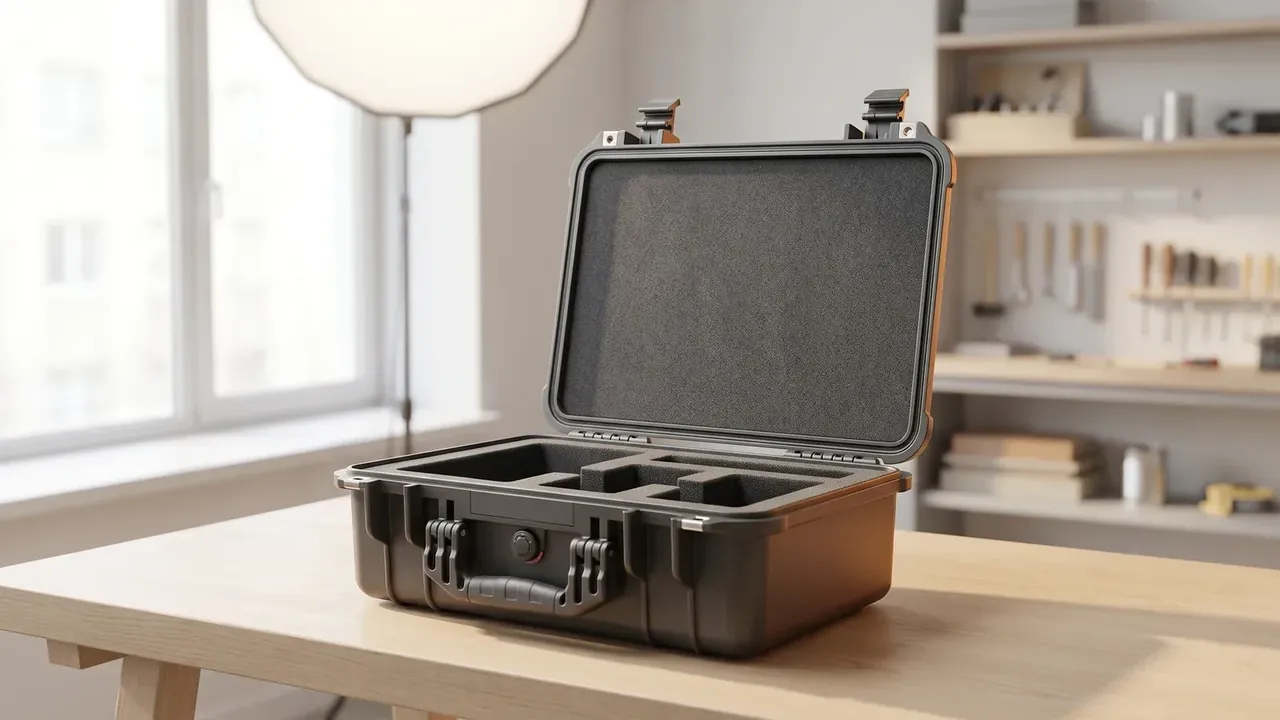
Quick answer: An Agricultural Drone Accessories Case sorts spares by swap frequency: nozzles every flight, filters weekly, blades by season.
Table of contents
- Nozzles: per flight or per hour
- Filter mesh decides how many slots
- Why residue cannot ride along
- Blades laid flat learn that bend
- How long before the lid closes
- FAQ
1. Nozzles: per flight or per hour
The fastest-wearing spray part is rarely the most expensive one. Spray work is counted in sorties, not hours. One sortie covers ten mu or so at 1–2 L per mu, with each nozzle running 0.8–2.0 L/min. Refilling, swapping batteries and glancing at the nozzles all happen in the same stop, which is why the nozzle is the part touched most often. Anyone counting hours usually finds a collapsed pattern on the third sortie.
Replacement follows flow deviation, not calendar time. Meter a nozzle on clean water, fit it, meter it again; a gap under 5% keeps it in service, anything wider retires it. Do not reach for a needle: it deforms the orifice, the fan turns into a streak, and the leaf gets a wet line instead of a mist.
Inside an Agricultural Drone Accessories Case the nozzles stand upright in holes 30 mm deep. Upright is a practical choice: the nozzle face is the part that cannot take load, and stacked flat, the weight of the top unit lands exactly on the orifice of the one below. Six to eight spares cover two sorties of rotation and one field blockage.
| Swap cycle | Parts involved | How it sits | Spares kept |
|---|---|---|---|
| Every sortie | Nozzles, O-rings | Upright holes, chamfered rim | 6–8 units |
| Weekly | Filters, pump diaphragms | Flat tray, split by mesh | 3–5 pieces |
| Seasonal | Blades, nozzle bodies | Long channel, upright | 1 set |
2. Filter mesh decides how many slots
The finer the mesh, the smaller the opening, the more spares a week consumes. An 80-mesh screen stops coarse grit and crystals for a working week; a 120-mesh screen sits ahead of the nozzle, blocks sooner, and needs two or three pieces a week. Finer is not better by default: mesh has to match the orifice, and suspension concentrate particles run 1–10 μm.
Slot width follows piece count, not mesh number. Two 80-mesh screens stack with room to spare, so the slot runs 60 mm. A 120-mesh screen is thin and plentiful, and 40 mm holds three. The dividers in an Agricultural Drone Accessories Case lift out as one plate, which lets the whole set be rinsed at once and dropped back against the silkscreen marks.
| Mesh | What it catches | Slot width | Weekly stock |
|---|---|---|---|
| 80 | Coarse grit, dried crystals | 60 mm | 2 screens |
| 100 | Fine particles in suspension | 50 mm | 3 screens |
| 120 | Last barrier before the nozzle | 40 mm | 2 screens |
One hundred mesh is the dividing line in most spraying work. Below it, fine particles reach the swirl core, settle in the angled groove, and the symptom is a slow drop in flow that operators blame on the pump. An Agricultural Drone Accessories Case gives that grade its own slot so nobody has to think about which screen goes where.
3. Why residue cannot ride along
Dried spray crystallises, draws moisture, then turns into a tacky film. In the divider grooves it stops a plate from seating, and every slot width changes. In the gasket channel it holds the lid off its seat, and the next wash pushes water into the wall. Residue is a dimensional problem, and an Agricultural Drone Accessories Case is cleared of it at every seasonal change.
The shell has to survive the wash. PP and ABS both tolerate a neutral detergent at pH 6–8 for half an hour, but solvents bloom ABS white and raise fine cracks, so petrol and thinner never enter the box. Water stays under 40 °C; above that, moulded-in stress in thin walls releases and the corners lift first.
Lift-out dividers are what make a wash complete. Fixed dividers leave a seam that no brush reaches. The plates in an Agricultural Drone Accessories Case are 2 mm PP with rounded edges: pull them out, scrub them flat on the ground, stand them to dry, and the job takes a fraction of the time spent digging at a fixed groove.
4. Blades laid flat learn that bend
Blades are composite parts, and the lay-up sets a stiffness direction that dislikes sustained one-way load. Stack them flat and the upper units press on the lowest one; leave that for a season and the blade remembers the curve. Fitted back to the machine it vibrates on the first spin, and balancing never quite catches up.
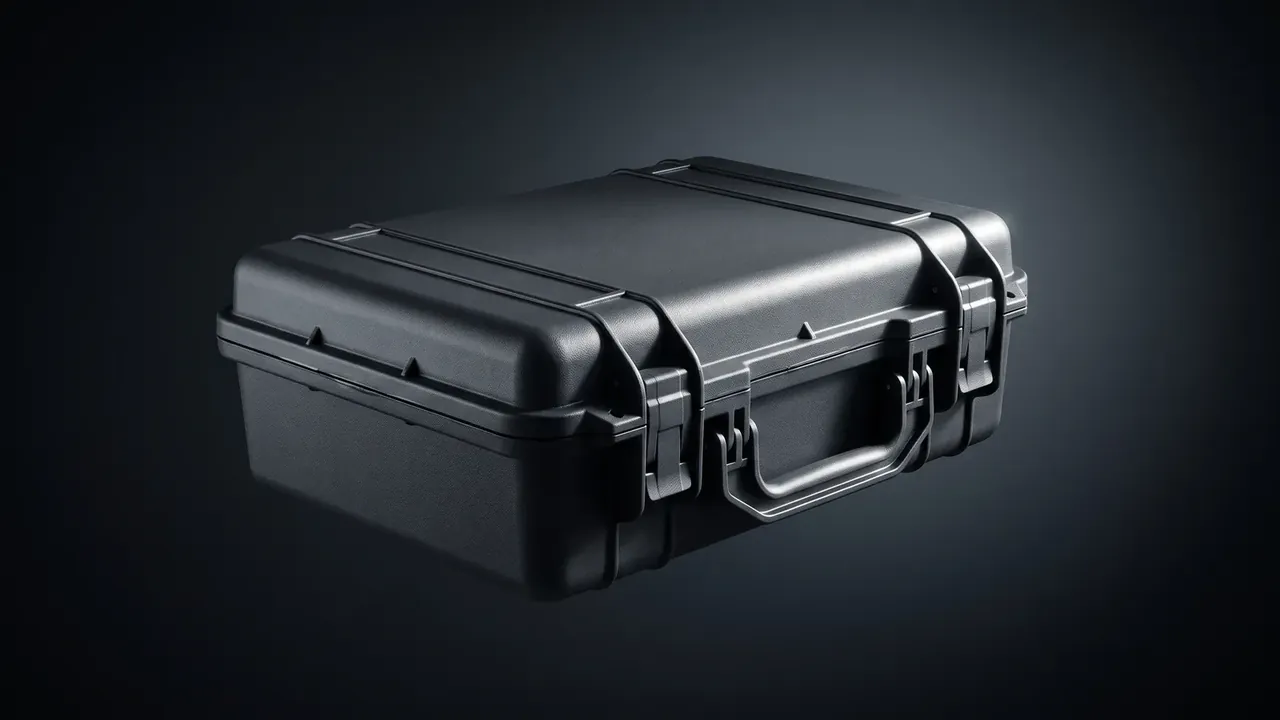
So the blade position is a long channel, each blade upright or leaning, 10 mm apart. A 20 mm EVA base at 60–120 kg/m³ supports the root and keeps the tip off the wall. An Agricultural Drone Accessories Case leaves 30 mm of margin beyond the largest blade diameter, so nothing wedges or rattles.
Temperature is the second variable. A van in summer reaches 60 °C, the resin softens, and a straight blade sags under its own weight. The case can only refuse stacking and stay out of a sun-baked van.
5. How long before the lid closes
An Agricultural Drone Accessories Case is washed in three passes: a pre-rinse, a detergent wash and a dry. The pre-rinse runs 3 min on tap water to carry out grit; the wash runs 5–10 min at 40 °C or below with neutral detergent, aimed at divider grooves and the gasket channel; drying happens in moving air, never in sun, which ages the gasket.
Closing is decided by three spots, not by a clock: no droplets in the gasket channel, no standing water at the bottom of a divider groove, and a corner that does not feel cool to the touch. All three pass, then the lid goes down.
| Pass | Water and time | Check before closing |
|---|---|---|
| Pre-rinse | Tap water, 3 min | Runoff carries no grit |
| Wash | 40 °C or below, 5–10 min | Runoff clear, no foam |
| Dry | Moving air, 30 min | Gasket channel dry |
The slot layout of an Agricultural Drone Accessories Case is a drawing of swap frequency. Nozzles take a slot per sortie, filters a slot per week, blades a long channel per season. Once the positions are fixed, a missing part shows at a glance, and an extra one will not fit.
Related Reading
- Spray equipment case for agriculture
- Dividers or foam: which insert to choose
- Plastic case versus wooden crate
- How usable interior volume is calculated
Related Products
- 8 Series — Gun Cases; Military Equipment Cases; Camera Equipment Cases; Drone Cases; Watch Cases; Knife Cases; First Aid Cases; Electronics Equipment Cases
- WL8-2812 PP Gun Case — model WL8-2812
- All protective cases and toolboxes: 7 series, 158 models