

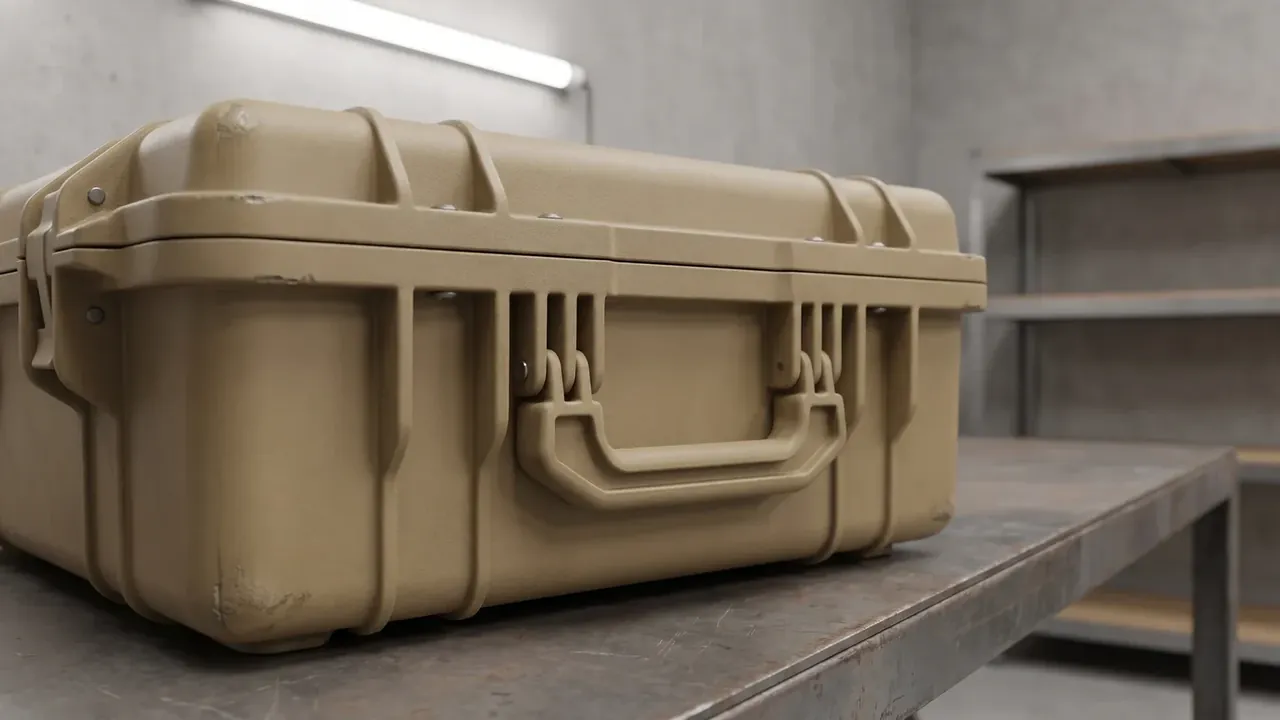
Quick answer: Write the flight profile, derive outer size from the cargo door, match the relief valve to the pressure swing, prove strength at the weakest corner, then make the paperwork agree.
Table of contents
- Start With the Flight Segments
- Size and Weight Come From the Cargo Door
- Pressure Equalisation and Temperature Swing
- Drop and Stack Against the Worst Leg
- Documents, Markings and Batch Consistency
- FAQ
1. Start With the Flight Segments
An air transport protective case is judged by the journey, not the shell. In one day it may be forklifted onto a pallet, wait forty minutes on the apron, fly three hours in a pressurised hold, then be lifted onto a truck.
Crushing and side impact arrive on the ground, temperature extremes and rain on the apron, low pressure and cold in the cruise, a drop at unloading. The quiet legs set the limits, because that is where repair logs cluster.
| Leg | Condition | Requirement |
|---|---|---|
| Warehouse to pallet | Fork pockets, single lifting | 100 mm fork clearance, gravity line on shell |
| Apron wait | Minus 20 to 55 degrees Celsius, rain | Seals rated both ends, latches cold-tough |
| Pressurised cruise | About 55 kPa across the wall | Vent path that bleeds air first |
| Unloading | Drops near 1.2 m, second stack | Corners that absorb energy |
2. Size and Weight Come From the Cargo Door
An air transport protective case is sized from the door opening, not the cavity. Narrow-body belly doors sit near 1.2 m by 0.9 m, a wide-body LD3 door closer to 2.6 m by 1.7 m. Keep 50 mm on the long edge and 80 mm in height, or handlers tilt it and loading doubles.
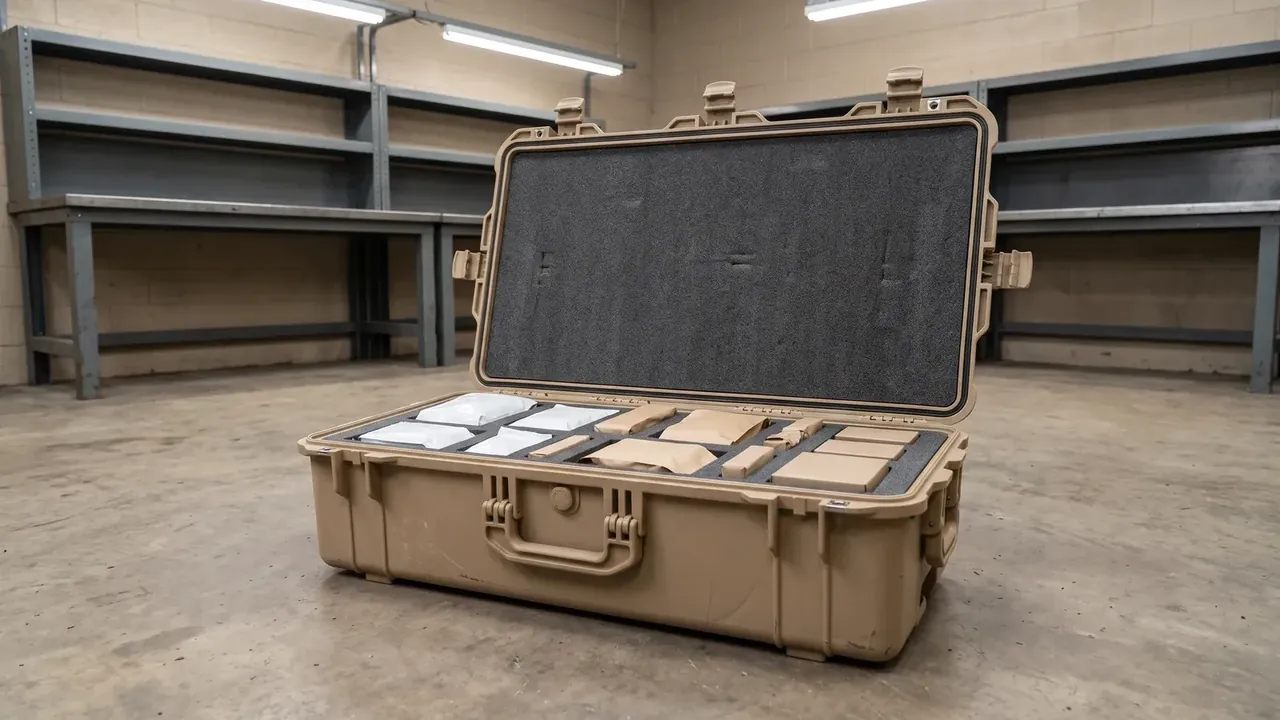
Foam takes 25 to 40 mm and the valve and hinges protrude 8 to 12 mm, so the envelope of an air transport protective case is never cavity plus wall. Above 32 kg crews reach for a forklift, so fork clearance is mandatory. Above 500 kg, straps are rechecked against pallet tie-downs, and a gravity offset past 100 mm doubles the load on one tine.
3. Pressure Equalisation and Temperature Swing
Cruise differential reaches about 55 kPa, so a case closed on the ground is pushed outward at altitude, the seal rolls out of its groove, and it looks latched after landing although it has failed.
Cracking pressure near 4 kPa sits just under the seal force, and 1.2 litres per minute equalises a 50 litre cavity within an hour. Mount the valve high on the wall, not in the lid centre. Silicone holds from minus 20 to 55 degrees Celsius where nitrile stiffens, and groove compression of 25% to 30% keeps contact after contraction.
4. Drop and Stack Against the Worst Leg
Drop testing is about the weakest corner. Unloading usually ends with the case on an edge, so force lands on a corner, a latch edge or the handle side. At 1.2 m, an air transport protective case spreads that energy into two ribs.
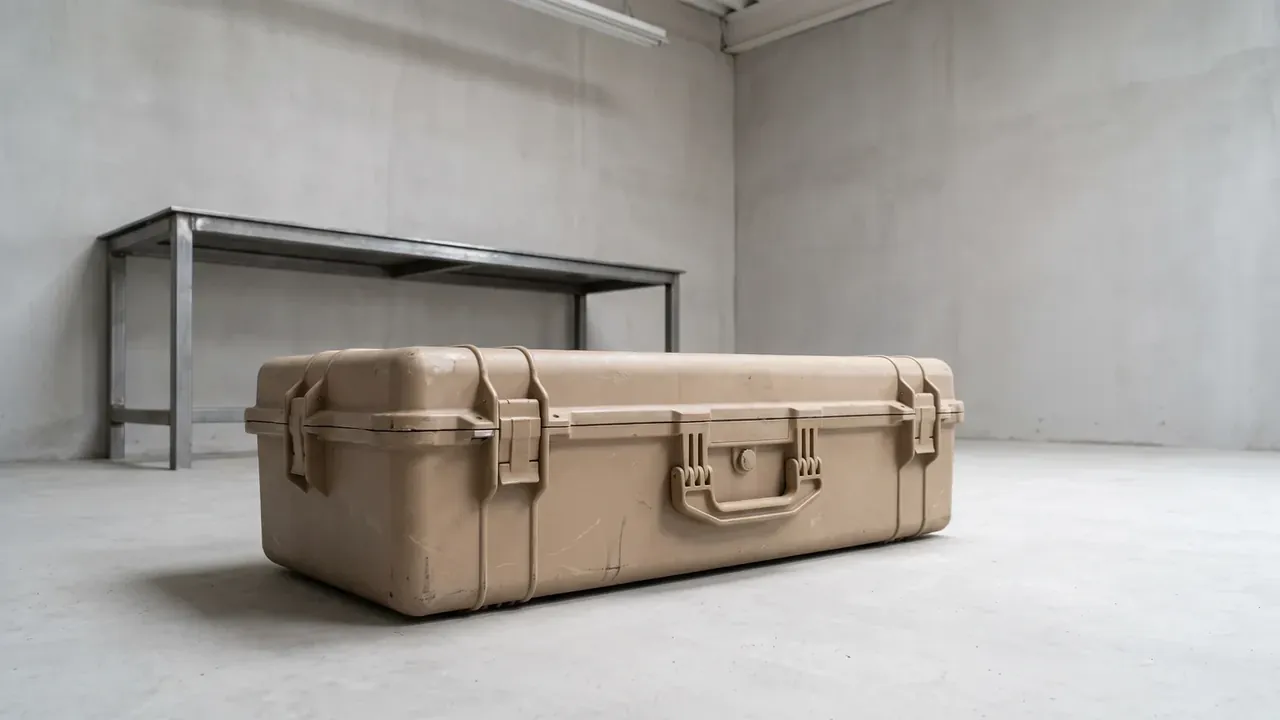
Rib spacing beats wall thickness. At 120 mm, corner drop deflection stays under 3 mm; at 180 mm it roughly doubles and the lid joint shifts enough to push the seal out. Three tiers at 80 kg hold 160 kg on the bottom case for 24 hours with deflection under 3 mm, and four latches at 300 N each need a metal keeper insert.
5. Documents, Markings and Batch Consistency
Acceptance turns on whether the documents agree. Outline drawing, resin grade, valve datasheet, drop and stack report and sealing report must carry one model and batch string.
| Document | Must show | Common gap |
|---|---|---|
| Outline drawing | Outer dimensions, valve protrusion | Cavity only |
| Material and batch | Resin grade, colour, batch | Family name only |
| Relief valve | Cracking pressure, flow, position | Model, no figures |
| Strength report | Drop attitude, stack tiers | Empty-case stack |
| Sealing report | Method, specimens, verdict | Claim, no report |
The air transport protective case passes on batch sampling. Colour deviation stays under Delta E 2; latch pull on five cases per batch must fall inside plus or minus 10% of nominal.
Conclusion
Selecting an air transport protective case is a sequence, not a specification sheet: fix the profile, size from the door, match the valve to the pressure swing, prove strength at the weakest corner, then make the documents agree. Each step can veto the next; skipped steps return as rework. What separates two suppliers is rarely wall thickness, but whether the apron wait and unloading leg were counted in the air transport protective case.
This article discusses only the container (case body) side of specifications and design intent, and does not cover any handling, loading or use of the contents.
Related Reading
- Military air transport case acceptance
- Airdrop case strength and tests
- Reading protective case size ranges
- Seals in waterproof hard cases
Related Products
- 8 Series — Gun Cases; Military Equipment Cases; Camera Equipment Cases; Drone Cases; Watch Cases; Knife Cases; First Aid Cases; Electronics Equipment Cases
- WL8-2812 PP Gun Case — model WL8-2812
- All protective cases and toolboxes: 7 series, 158 models