

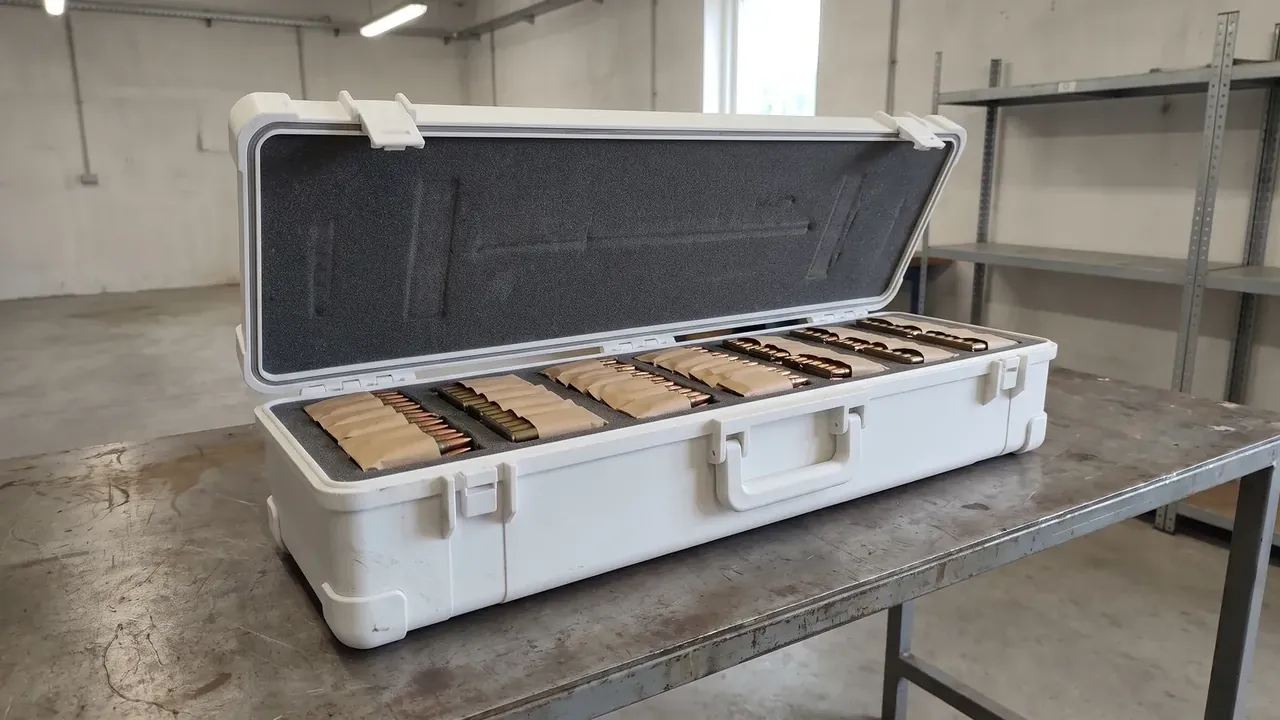
Quick answer: The same ammunition box is configured by setting: automated storage wants top recesses and four-side marking, pallet transport base feet and strap slots, field storage a relief valve and UV stabiliser, a range a lid stop, an equipment room two lock points.
Table of contents
- Configuration follows the scenario
- Automated warehouse storage: bay height sets the case
- Pallet transport: base and strap slots
- Field storage: sealing and UV resistance
- Firing range and police store: open cycles and lock points
- FAQ
1. Configuration follows the scenario
The setting separates one configuration of an ammunition box from the next: top recesses in a store, base feet on pallets, a relief valve outdoors, twin locks in an equipment room.
| Setting | Length | Tiers | Key feature |
|---|---|---|---|
| Automated store | 780 | 4 | top recess |
| Pallet transport | 560 | 3 | base feet |
| Field storage | 420 | 2 | relief valve |
| Firing range | 560 | 1 | lid stop |
| Equipment room | 420 | 3 | twin locks |
Wall thickness follows too: a body that never leaves a rack drops to three point five millimetres, one forked every trip needs five at the base.
2. Automated warehouse storage: bay height sets the case
In an automated store the case is derived backwards from the bay. Bays commonly stand one thousand eight hundred and fifty millimetres high, so four tiers cap the loaded case at four hundred and twenty millimetres and leave a body of about three hundred and twenty.
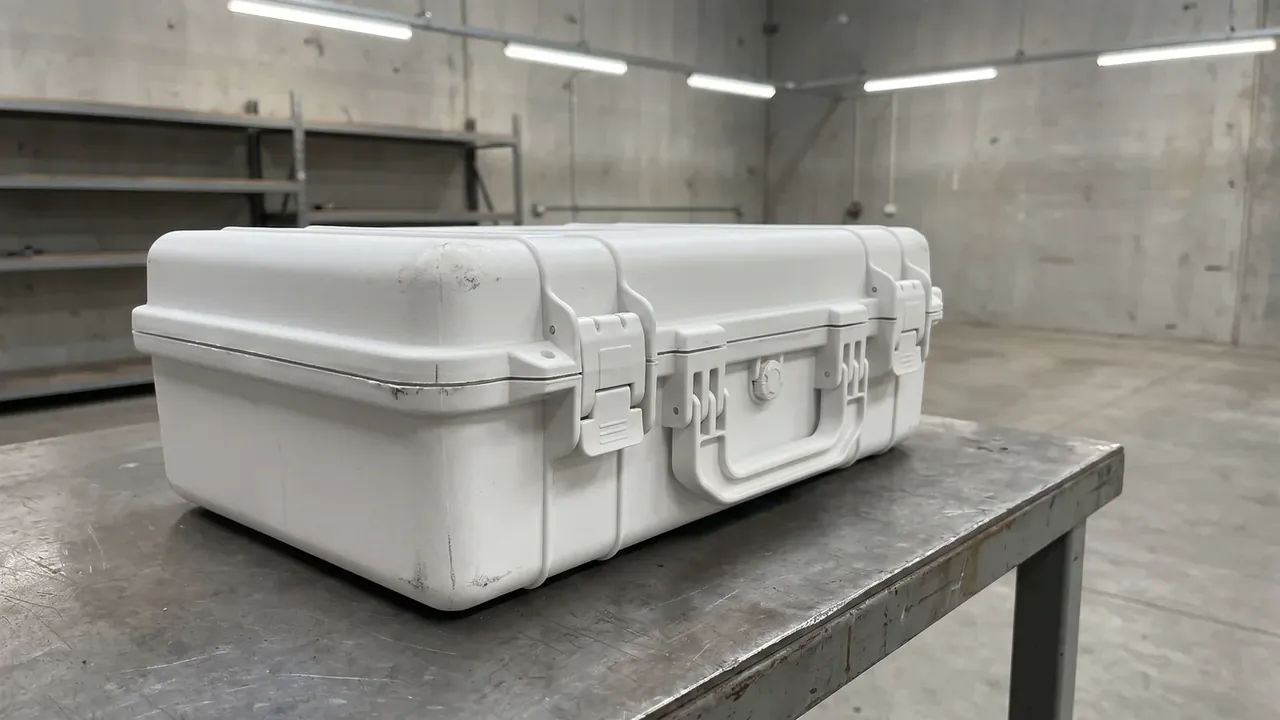
Top recesses are not optional, because a stacker crane does not look before it sets a load down; without them a four-tier stack offsets visibly by the second month. Marking follows the aisle, so all four faces carry it.
3. Pallet transport: base and strap slots
For pallet work the base matters more than the lid. On a common one-thousand-two-hundred by one-thousand-millimetre pallet, six cases of five hundred and sixty sit two by three, total height under one thousand six hundred.
| Pallet | Pattern | Cases | Total height |
|---|---|---|---|
| 1200 x 1000 | 2 x 3 | 6 | 1560 |
| 1200 x 800 | 2 x 2 | 4 | 1480 |
| 1100 x 1100 | 2 x 2 | 4 | 1620 |
Base feet must line up with the gaps between deck boards: ten millimetres high and forty wide, they drop in and stop lateral creep, while a continuous skirt rides up on uneven deck and leaves corners hanging. Strap slots sit on the lower long edge, twenty-five millimetres wide and eight deep.
4. Field storage: sealing and UV resistance
Field storage tests the environment. Ground temperature runs from fifty-five degrees in summer to minus twenty-five in winter, so the pressure differential reverses twice a day and a body without a relief valve deforms its gasket within three months.
| Condition | Sealing | Body treatment | Extra |
|---|---|---|---|
| swing over 15 degrees | twin gasket, valved | UV stabiliser | valve membrane |
| rain and snow | twin gasket, valved | base raised 100 mm | two-degree slope |
Raising the base is most often dropped: a hundred millimetres of clearance cuts the capillary path, while a case set on the ground blisters within a season even at IP67.
UV resistance is not a colour: polyethylene loses twenty percent of its tensile strength after eighteen months outdoors, and carbon black pushes that past five years.
5. Firing range and police store: open cycles and lock points
On a range the open cycle sets the hinge. Forty openings a day is fourteen thousand a year, and a plain pin shows play by the third month, so the hinge is bushed and the lid stop moulded at one hundred degrees.
A police equipment room is about lock points: twelve bays is a common fit, each case with two lock points and a number moulded at four positions, height under three hundred millimetres.
| Setting | Opens per day | Hinge | Locking |
|---|---|---|---|
| Firing range | 40 | bushed pin, 100-degree stop | single latch with safety |
| Equipment room | 4 | concealed pin | two locks, four numbers |
Both keep the case still and move people around it, so corners take a fifteen-millimetre radius.
Conclusion
Setting first, configuration second: automated storage reads bay height, pallet work reads base feet and strap slots, field storage reads the valve and UV package. The types do not interchange, but the method repeats — ask where the case lives and how often it opens, and the configuration of an ammunition box writes itself.
This article discusses only the container (case body) side of specifications and design intent, and does not cover any handling, loading or use of the contents.
Related Reading
- What warehouse storage demands of a case body
- Applications for air-transport ammunition cases
- Marking rules for palletised cases
- Maintenance points for ammunition storage cases
Related Products
- 8 Series — Gun Cases; Military Equipment Cases; Camera Equipment Cases; Drone Cases; Watch Cases; Knife Cases; First Aid Cases; Electronics Equipment Cases
- WL8-2812 PP Gun Case — model WL8-2812
- All protective cases and toolboxes: 7 series, 158 models