

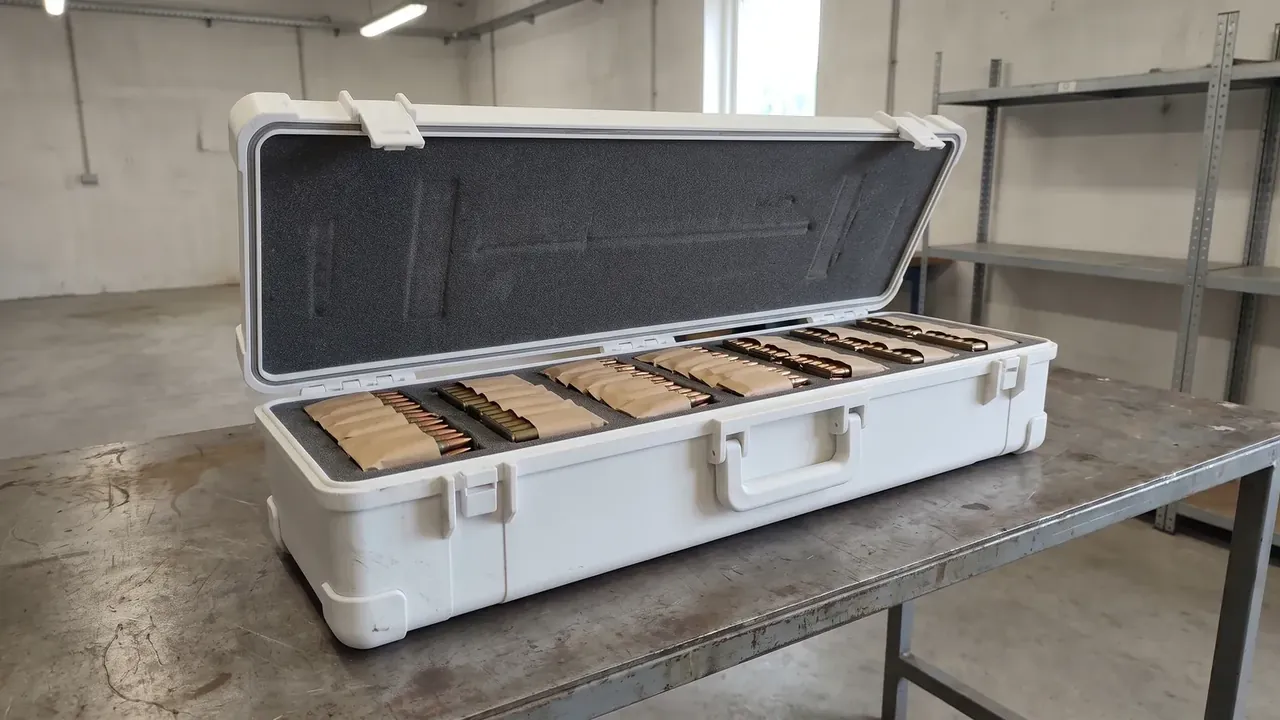
Quick answer: Six numbers separate an ammunition box from a steel case, a plastic crate, a wooden crate and a composite case: empty weight, safe stack height, humidity at 72 hours, a 1.2 m drop, service life and cost per cycle. Weight varies 3.6 times, cost per cycle only 3.
Table of contents
- Six Numbers That Separate an Ammunition Box from Its Rivals
- Weight and Stack Height: Where the Gap Comes From
- Moisture and Impact: Two Failure Modes Measured
- Service Life and Cost per Cycle
- When the Box Is the Wrong Choice
- FAQ
1. Six Numbers That Separate an Ammunition Box from Its Rivals
Five options side by side usually become a price argument, and price covers one purchase, not five years.
Failure cost, not weight, separates them: a damp crate scraps a batch, a plastic crate splits at −20 °C, a rusted steel case costs 30% of its price.
| Option | Empty weight | Safe stack | Outdoor life | Lid seal |
|---|---|---|---|---|
| Rotomoulded | 5.8 kg | 6 layers | 8–10 years | Perimeter gasket |
| Steel | 11.5 kg | 8 layers | 12 years | Gasket, latches |
| Crate | 3.2 kg | 3 layers | 3 years | Flat rim |
| Wood | 6.5 kg | 4 layers | 2 years | None |
| Composite | 6.9 kg | 5 layers | 10 years | Double seal |
Stack figures are safe loaded values at 1.5 times rated load.
2. Weight and Stack Height: Where the Gap Comes From
Weight is really a stacking question. At 3.2 m clear height, six layers put 24 units on a pallet position and three put 12; the extra 25 positions cost 27,000 yuan over five years.
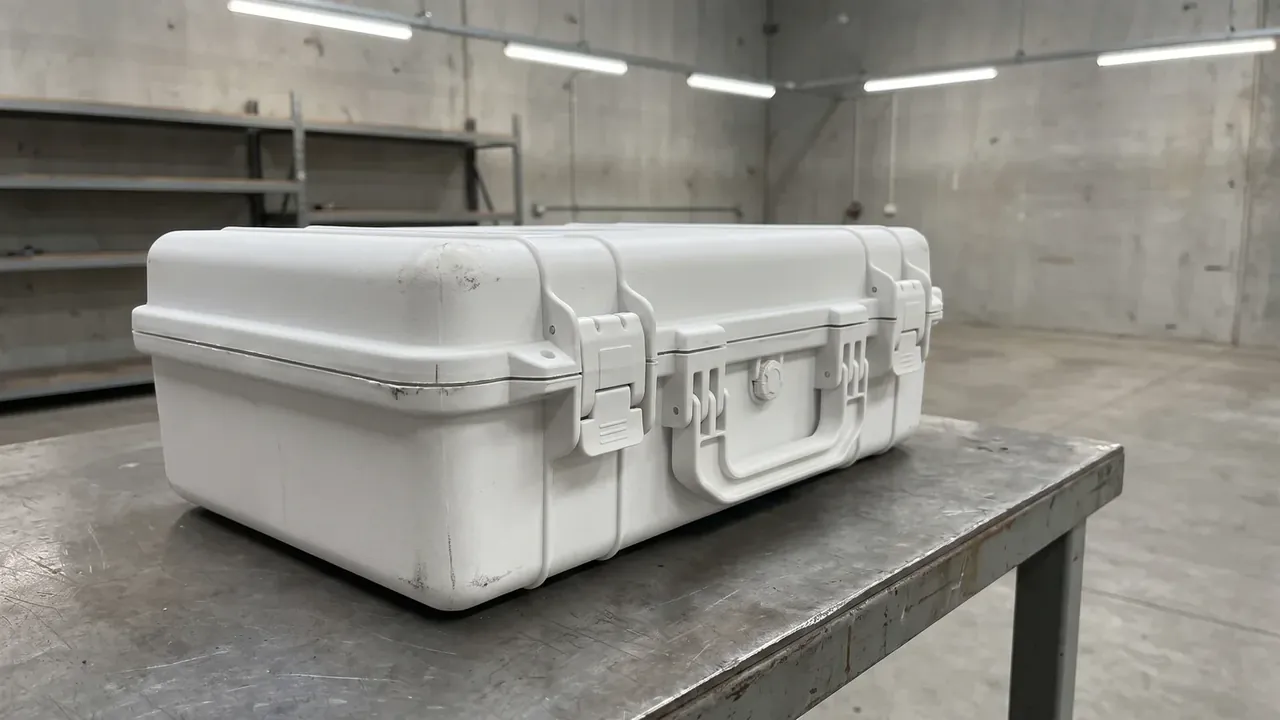
Height has a price. With 25 kg per unit the bottom box carries 125 kg on its lid, against a 150 kg rating that leaves 20% margin. Steel is rated 300 kg, but eight layers weigh 92 kg and sway at 3 m.
Base geometry sets the ceiling: bosses interlock with the recessed lid, wooden crates rely on film, plastic crates walk at three layers.
3. Moisture and Impact: Two Failure Modes Measured
A chamber at 28 °C and 85% relative humidity, 100 g of silica gel, a reading at 72 hours: ammunition box 42%, steel case 48%, composite 39%, crate 79%, wood 78%. A flat rim leaves 12 mm² of wall open.
A 1.2 m drop at −20 °C: steel dents 2 mm, composite may delaminate, the ammunition box shows no crack, the crate splits 30 mm.
| Item | Rotomoulded | Steel | Crate | Composite |
|---|---|---|---|---|
| Humidity, 72 h | 42% | 48% | 79% | 39% |
| 1.2 m drop | No crack | 2 mm dent | 30 mm split | Intact, needs NDT |
4. Service Life and Cost per Cycle
Cost per cycle is price plus upkeep divided by lifetime turns, at 20 turns a year.
| Option | Price | Life | Upkeep | Cost per cycle |
|---|---|---|---|---|
| Rotomoulded | 320 yuan | 8 years | 40 yuan | 2.25 yuan |
| Steel | 480 yuan | 12 years | 120 yuan | 2.50 yuan |
| Crate | 90 yuan | 3 years | 5 yuan | 1.58 yuan |
| Wood | 65 yuan | 2 years | 8 yuan | 1.83 yuan |
| Composite | 900 yuan | 10 years | 60 yuan | 4.80 yuan |
The crate wins at 1.58 yuan, but only indoors; at sea, salt spray cuts life below a year and pushes cost past 4 yuan.
Wood is the quieter trap: 65 yuan looks cheapest, yet it is single-use. Six batches of 120 crates cost 46,800 yuan against 38,400 yuan for the same number of boxes.
5. When the Box Is the Wrong Choice
For an in-plant line turning stock three times a day, the seal on an ammunition box is dead weight. For a one-way export, a lined crate is cheaper. For five years of storage, steel wins on cost per cubic metre.
Three cases have almost no substitute: a damp store, a rack above five layers, a chain crossing sea and road.
Conclusion
Line the five up and the widest gap is failure mode, not price: wood absorbs, crates split, steel rusts, composites delaminate. The plastic ammunition box sits in the middle — 5.8 kg, six layers, 42% humidity — first in nothing, last in nothing, yet predictable.
This article discusses only the container (case body) side of specifications and design intent, and does not cover any handling, loading or use of the contents.
Related Reading
- How an ammunition box differs from a transit case
- The evolution of ammunition box forms
- Steel, aluminium, rotomoulded and composite compared
- Reading the specification sheet of a case body
Related Products
- 8 Series — Gun Cases; Military Equipment Cases; Camera Equipment Cases; Drone Cases; Watch Cases; Knife Cases; First Aid Cases; Electronics Equipment Cases
- WL8-2812 PP Gun Case — model WL8-2812
- All protective cases and toolboxes: 7 series, 158 models