

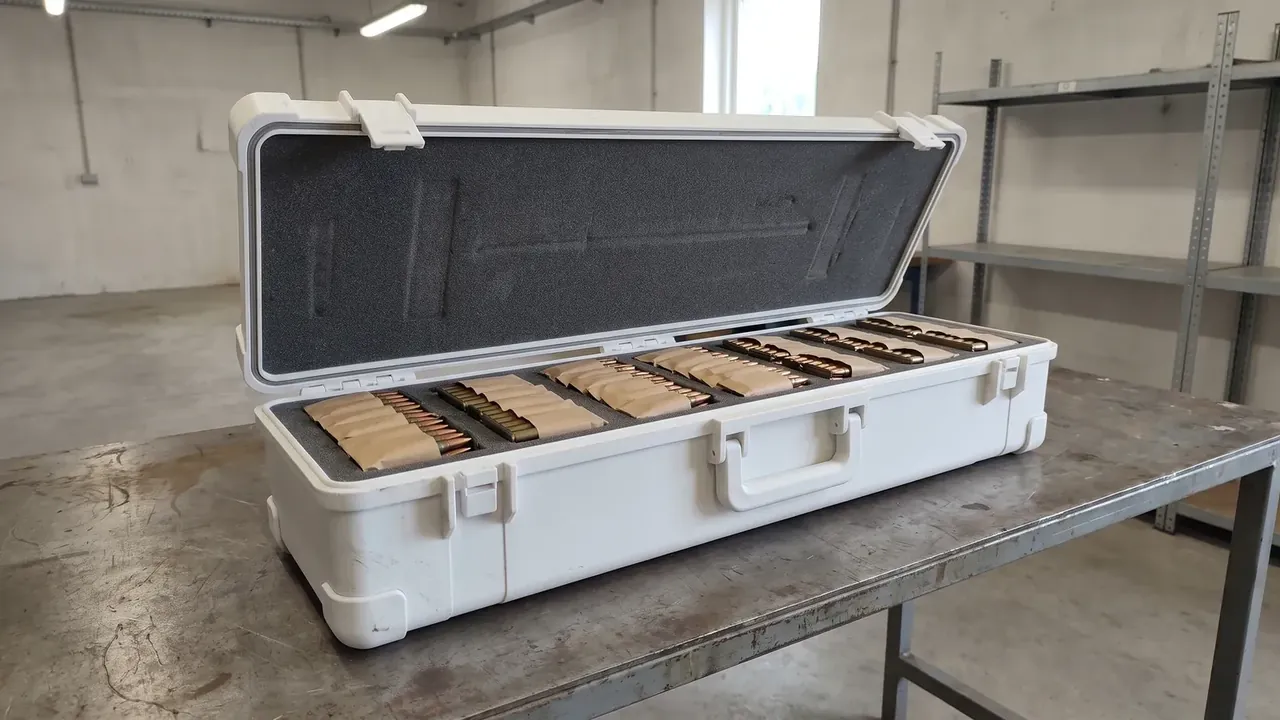
Quick answer: An Ammunition Box specification reduces to four numbers: cavity 560 × 340 × 180 mm with 3 mm compression between pockets, 3.0 mm walls over 1.8 mm ribs, gasket at 25 to 30 percent, and a base carrying 34 kg for 24 hours with under 2 mm deflection.
Table of contents
- How the Ammunition Box Dimension Chain Is Built
- Wall Thickness, Ribs and Lid Gap Tolerances
- Gasket Compression and IP Rating Matching
- Stacking Load and Total Weight Budget
- Operating Temperature and the Spec Sheet
- FAQ
1. How the Ammunition Box Dimension Chain Is Built
An Ammunition Box is not drawn outside in: the chain runs outward from the cavity. Reverse it and the parts collide inside a shell that already looks right. In the 560 × 340 × 180 mm tier, four columns of three 68 × 52 mm pockets sit with 3 mm of compression and 8 mm of rim cushion, and the 45 mm lid over a 135 mm base keeps the open lid standing.
| Chain element | Value | Tolerance | Drives |
|---|---|---|---|
| Cavity | 560 × 340 × 180 mm | ±1.2 mm | Pocket count |
| Compression | 3 mm | ±0.5 mm | Rattle margin |
| Envelope | 604 × 384 × 232 mm | ±1.5 mm | Stacking |
2. Wall Thickness, Ribs and Lid Gap Tolerances
Wall thickness is given per zone; one figure guarantees trouble. Sides 3.0 mm, base 4.5 mm, lid 3.2 mm: the base carries the stack, the lid arch does the work. Ribs run 1.8 mm thick, 12 mm tall and 60 mm apart, and any rib over four times the wall needs 1.5 degrees of draft.
The lid gap sits at 0.6 to 1.0 mm. Below 0.6 mm the tool wears into interference; above 1.0 mm the gasket never reaches design compression. Parting-line mismatch stays under 0.3 mm and hinge coaxiality under 0.4 mm, or the lid binds.
3. Gasket Compression and IP Rating Matching
The gasket is the only moving seal on an Ammunition Box, so compression governs it. Under 20 percent it never closes; over 35 percent lid force climbs past 180 N and the cord takes a permanent set. A 7.0 mm silicone cord in a 5.2 mm groove 4.8 mm deep flattens to 5.0 to 5.3 mm, or 25 to 29 percent.
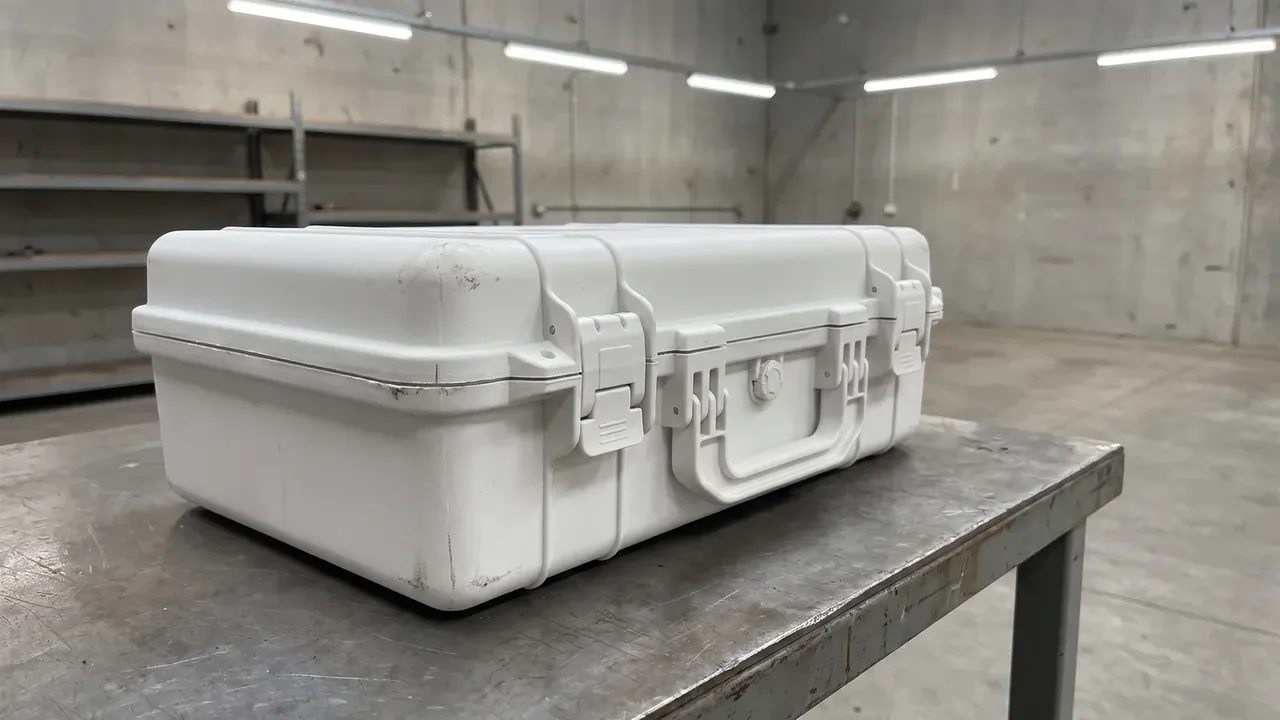
An IP rating means nothing without conditions: IP67 is one metre for 30 minutes, IP65 a 6.3 mm nozzle at 12.5 litres per minute. A case marked IP67 that only saw a rain spray is a common overclaim; at 18 percent compression it drops to IP54.
4. Stacking Load and Total Weight Budget
Stacking is counted at the bottom case. At 6.8 kg empty and five tiers, the lowest unit holds 27.2 kg above it, 33.9 kg with its own weight, rounded to 34 kg for 24 hours with base flatness moving under 2 mm. At −40 °C the same Ammunition Box sags 3.5 mm in twelve hours, double the ambient figure, so cold needs a drop test beside the stack.
Weight follows developed area: a 3 mm wall at 0.91 g/cm³ runs about 25 g per square decimetre, so 0.62 m² of shell gives 5.6 kg, and hardware plus foam brings it to 6.8 kg. State 6.8 kg ±3 percent.
5. Operating Temperature and the Spec Sheet
Temperature belongs on the drawing as a range: minus 40 to 60 °C, four hours at 60 °C with under 0.5 percent dimensional change, then two hours at −40 °C and a 1 kg ball from 1 m with no crack.
A specification earns the name only if each line is decidable: what is measured, how, and what passes. Resistant to low temperature is not a line; a 1 m ball drop at −40 °C is.
| Item | How to write it | How to judge |
|---|---|---|
| Cavity | 560 × 340 × 180 mm, ±1.2 mm | CMM, three points |
| Seal | 25 to 30 percent | Feeler gauge at joint |
| Ingress | IP67, 1 m for 30 min | Immersion |
Conclusion
An Ammunition Box specification is a chain of numbers that hold each other: cavity sets the array, wall sets stiffness, compression sets ingress protection, load sets the base. Push the chain outward from the cavity, tolerance each zone, and keep six decidable lines on the sheet, so quotation and inspection start from one page. Five tiers, half an hour under water and a −40 °C drop all belong to the same Ammunition Box.
This article discusses only the container (case body) side of specifications and design intent, and does not cover any handling, loading or use of the contents.
Related Reading
- How an Ammunition Box is built
- Lining up container specification figures
- Metal and plastic ammunition case materials
- Packing standards and inspection
Related Products
- 8 Series — Gun Cases; Military Equipment Cases; Camera Equipment Cases; Drone Cases; Watch Cases; Knife Cases; First Aid Cases; Electronics Equipment Cases
- WL8-2812 PP Gun Case — model WL8-2812
- All protective cases and toolboxes: 7 series, 158 models