

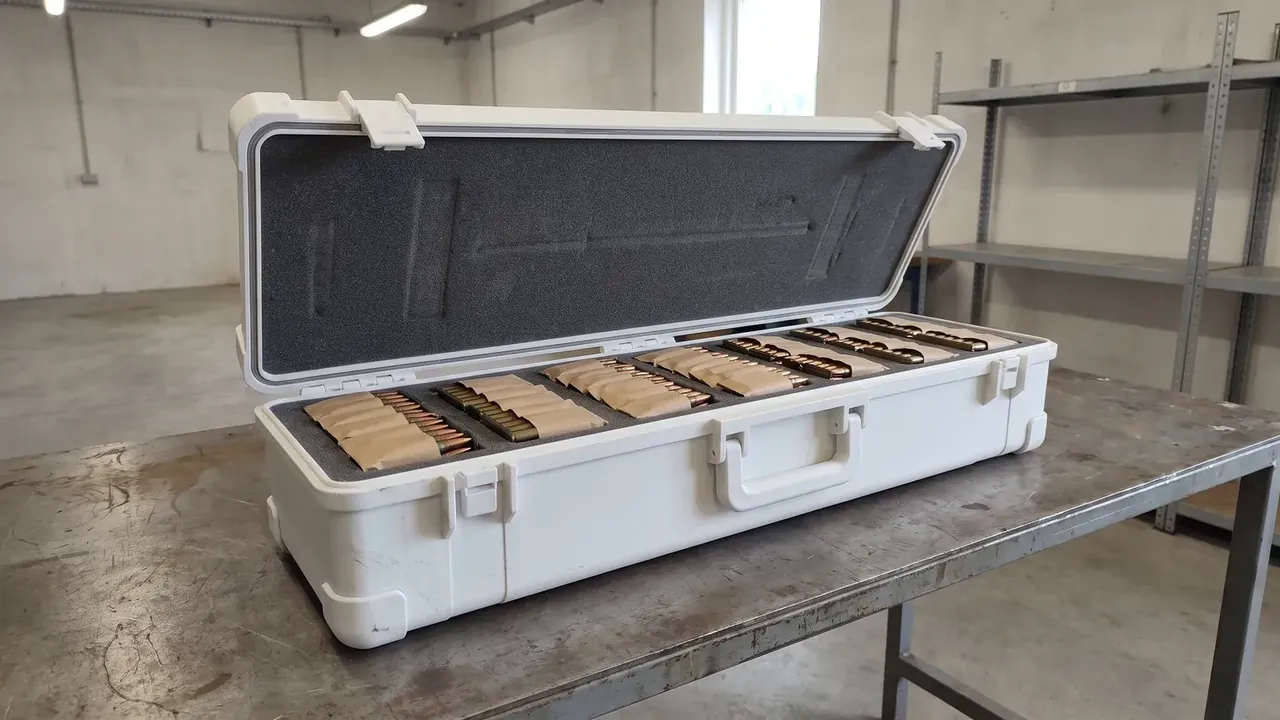
Quick answer: Ammunition Box acceptance rests on defect tiers, sampling plans, test methods and numeric verdicts. Class A is zero-tolerance, class B runs at AQL 1.0 and class C at AQL 2.5; air tightness passes with a 1.5 kPa drop held 60 seconds from 20 kPa, water at IP67 with under 1 g of paper gain.
Table of contents
- How Ammunition Box Acceptance Is Tiered
- Cosmetic Defects and Dimensional Tolerances
- Wall Sampling, Air and Water Testing
- Drop, Vibration and Salt Spray Limit
- Markings, Lot Traceability and AQL Rules
- FAQ
1. How Ammunition Box Acceptance Is Tiered
Tier the Ammunition Box acceptance standard before choosing a sampling plan, or a 10 mm scratch and a cracked latch boss take the same approval route. Class A is outright failure such as a missing seal, a cracked boss or walls under 2.5 mm; class B is fit and service life, such as cavity oversize or corrosion; class C is appearance.
Tiering sets the sampling: A in full, B at AQL 1.0, C at AQL 2.5 on inspection level II, so a 500-unit lot samples 50 with Ac 1 Re 2 for B and Ac 3 Re 4 for C.
| Class | Items | Verdict |
|---|---|---|
| A | missing seal, cracked boss, thin walls | zero tolerance |
| B | cavity oversize, uneven gap, corrosion | Ac 1 Re 2 |
| C | scratches, colour drift, flash | Ac 3 Re 4 |
2. Cosmetic Defects and Dimensional Tolerances
Appearance clauses fail when written as no obvious defects. Write limits: scratches under 15 mm, at most two per face, sink marks under 0.3 mm, flash under 0.2 mm and not sharp, flow marks invisible at 500 mm under 300 lux. Colour is judged apart: five cases side by side within ΔE 1.5.
Dimensions rest on four readings: cavity ±1.2 mm, diagonal difference 1.5 mm, lid gap 0.6 to 1.0 mm, base flatness 0.8 mm. A twisted body shows up in the diagonal long before it leaks.
3. Wall Sampling, Air and Water Testing
Wall thickness is sampled: ten cases per lot, five points each on both side walls, the base centre, lid centre and latch boss root. The minimum stays above 2.7 mm and the mean above 2.85 mm, since the mean hides thinning and the minimum lets one outlier decide.
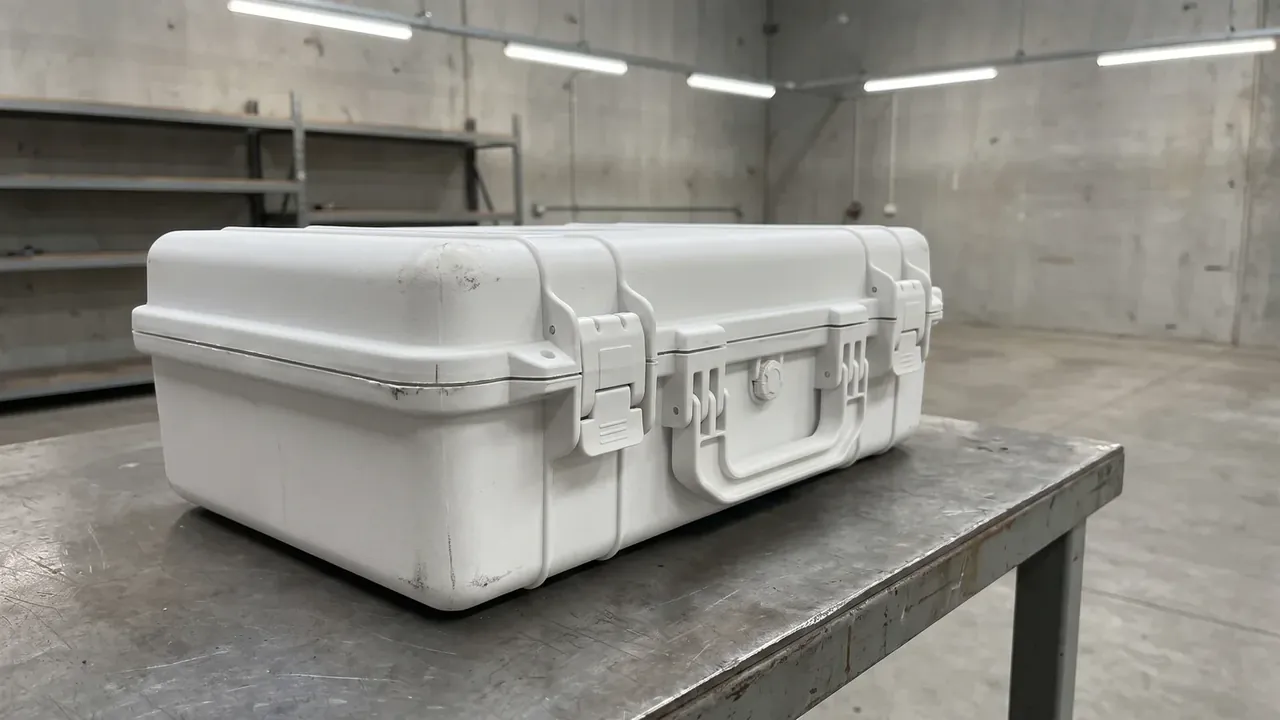
Air tightness fixes its conditions in the clause: plug the vent, charge to 20 kPa, hold 60 seconds, accept a drop of 1.5 kPa. Over that, check gasket first, latch preload second, lid flatness last.
Water follows IP67, one metre for 30 minutes with weighed paper inside and a gain under 1 g. A rain spray is not a water test; immersion failures sit at latch and hinge penetrations.
4. Drop, Vibration and Salt Spray Limit
Drop is the costliest and most useful clause: 1.2 m, ten drops on six faces, three edges and a corner, from four hours at −18 °C. A pass means no crack, no latch release, no seal shift, and opening force still between 60 N and 140 N.
Vibration runs 10 to 500 Hz at 1.5 g for 30 minutes per axis, finding hinge pins and latch springs that no static check reveals. Salt spray judges hardware only: 48 hours neutral with grade 9 or better, and 96 hours on the body with no blistering.
| Test | Condition | Pass line |
|---|---|---|
| Air | 20 kPa held 60 s | drop ≤1.5 kPa |
| Water | 1 m for 30 min | gain ≤1 g |
| Drop | 1.2 m at −18 °C | no crack |
5. Markings, Lot Traceability and AQL Rules
Each Ammunition Box carries a moulded lot code, the material grade and the ingress rating. The code is eight digits, four for year and month, four for press and shift, and it survives 50 wipes with ethanol.
The code traces back to press, shot, compound batch and inspector, and rework takes a suffix. At 500 units with 50 samples, class A rejects on a single failure, B is Ac 1 Re 2, C is Ac 3 Re 4. Double the lot and the sample comes from the level II table.
Conclusion
An Ammunition Box acceptance standard turns good or bad into pass or fail: three defect classes, AQL sampling, conditions fixed in the clause and verdicts given as numbers. Tiering tells an inspector what cannot be released, and written conditions end the argument between buyer and maker. Pressure drop, immersion gain and drop cracks are settled on the bench before any Ammunition Box ships.
This article discusses only the container (case body) side of specifications and design intent, and does not cover any handling, loading or use of the contents.
Related Reading
- Reading the standards family for ordnance boxes
- Acceptance items for small arms boxes
- How an Ammunition Box is built
- Re-inspection rhythm in storage
Related Products
- 8 Series — Gun Cases; Military Equipment Cases; Camera Equipment Cases; Drone Cases; Watch Cases; Knife Cases; First Aid Cases; Electronics Equipment Cases
- WL8-2812 PP Gun Case — model WL8-2812
- All protective cases and toolboxes: 7 series, 158 models