

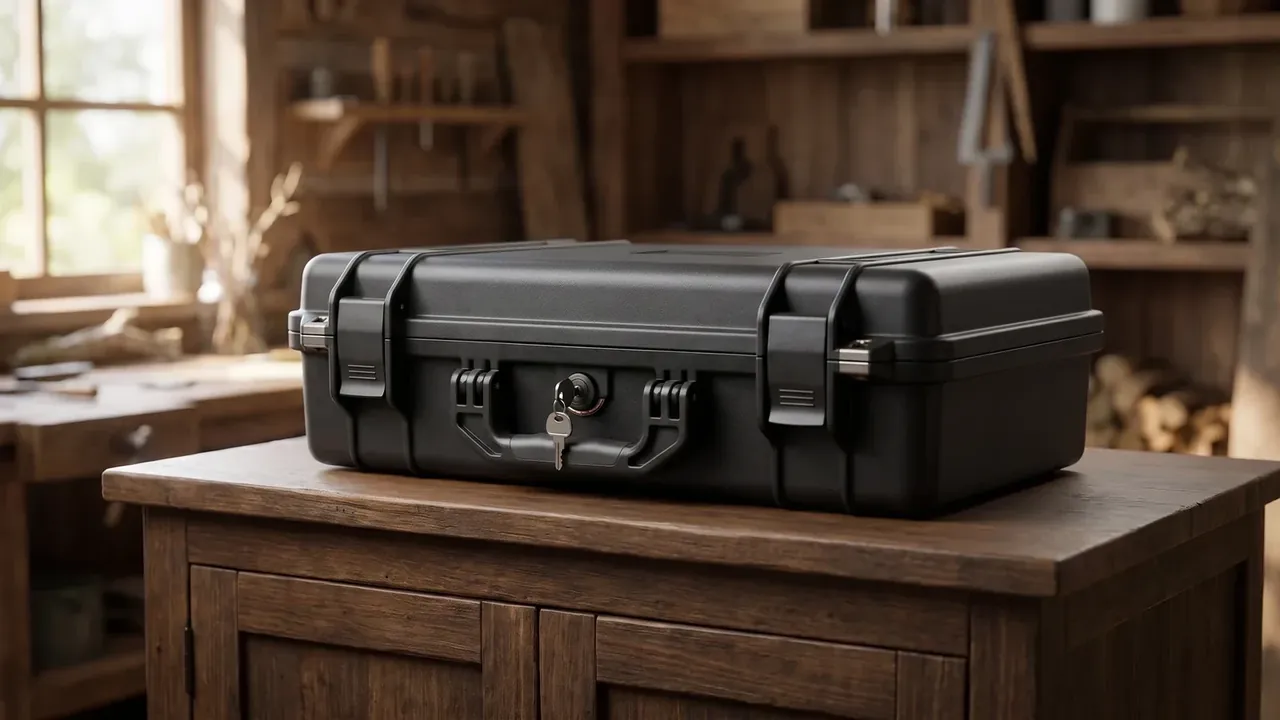
Quick answer: Choosing an ammunition container means turning the job into five measurable criteria: interior size and dividers, wall thickness against stack height, sealing and pressure relief, latches and seal holes, handling and certification. Work them in that order and the quotation finally matches the job.
Table of contents
- Five Criteria That Decide an Ammunition Container Spec
- Setting Interior Dimensions and Dividers
- Wall Thickness and Stack Height
- Sealing Class and Pressure Relief
- Latches, Seal Holes and Handling
- FAQ
1. Five Criteria That Decide an Ammunition Container Spec
An ammunition container spec is written from the job outward, not the catalogue inward. Interior size fixes the format, wall thickness fixes the load, sealing fixes storage life, latches fix inspection, handling and certification fix movement. Get the order wrong and every later choice is a guess.
One buyer chose on unit price. At loading, the rack opening measured 1450 mm against a 1520 mm case height, so the order became a side-opening variant and delivery slipped six weeks.
| Criterion | Weight | Pass line | Verify by |
|---|---|---|---|
| Interior and dividers | 25 | Cell clearance 3 mm or less | Trial load |
| Wall and stacking | 20 | No set at four high, 72 hours | Stack test |
| Sealing and relief | 20 | Under 5 kPa drop in 10 min | Pressure bench |
| Latches and seal holes | 20 | 400 N pull per latch | Pull gauge |
| Handling and certification | 15 | 90 kg static on handle | Hanging load |
Shift weights per project: long-term storage lifts sealing and stacking, field use lifts handling. Above 75 earns a sample.
2. Setting Interior Dimensions and Dividers
Interior space is not the outside size minus two walls; ribs, corner bosses and the lid recess all take a bite. A 600×400×250 mm body with 4.5 mm walls gives 586×386×232 mm inside, height losing most because the lid carries seal compression.
Dividers follow the item layout. Twelve cells at 88×88×200 mm, with 4 mm plates and 1.5 mm clearance, suit uniform items; a raised rim or lifting loop needs 3 mm or it scrapes. Slotted plates beat moulded cells when the item mix changes.
3. Wall Thickness and Stack Height
Derive the wall of an ammunition container from the stack. A 600×400 mm footprint at 45 kg loaded, stacked four high, puts 135 kg on the bottom lid. Over a 400 mm span, 4.5 mm walls on a rib grid hold deflection to 1.2 mm; 3.8 mm gives 2.4 mm and the next case will not seat.
Thermoplastics creep: 72 hours at 23 °C sets about 1.6 times as much as 8 hours, so a one-hour press proves nothing. At 35 °C a four-high stack deflects 40 percent more; at minus 20 °C it deflects less but cracks instead.
4. Sealing Class and Pressure Relief
Sealing needs two numbers, differential and leak rate, not the word waterproof. Store-room duty runs 30 kPa for 10 minutes with no more than 5 kPa drop; humidity-sensitive contents need 2 kPa plus a 20 g sieve pack.
EPDM returns best near 25 percent compression and sets permanently past 40, when the second closure fails. Corners leak first, so the groove must be spliced rather than butted.
A relief valve is not an accessory. A 60 litre ammunition container cooling to minus 20 °C can lose over 15 kPa and hold the lid shut, so fit a valve opening at 35 kPa and reseating at 25 kPa, port down or capped.
5. Latches, Seal Holes and Handling
Latch count follows length: two below 600 mm, three to 900 mm, four above, the middle one on the handle axis. Specify 400 N static pull, not the usual 300 N, since a compressed lid needs more.
Seal holes sit where the latch base overlaps the body boss, 6.5 mm across for a 2.5 mm wire seal. Half a millimetre off and the wire will not pass.
| Check | Basis | Acceptance |
|---|---|---|
| Air freight | 15 kPa differential | 10 min, no leak |
| Sea export | UN mark, 4H series | Not below packing category |
| Road | 1.2 m drop, six faces | No crack, latch closed |
| Storage | Four high, 30 days | 2 mm deflection or less |
| Hardware | 240 h salt spray | No red rust |
Handling hardware is forgotten most often: 90 kg static and 45 kg dynamic on the handle, two 50 mm webbing loops to spread forklift pull, and castors above 40 kg.
Conclusion
Choosing an ammunition container runs in a fixed order: interior against contents, wall against stack height, seal against storage duration, latch against inspection, handling against site equipment. Each has a measurable pass line, and in a scorecard the decision stops being a price argument. Follow the five and the specification of an ammunition container has something to stand on.
This article discusses only the container (case body) side of specifications and design intent, and does not cover any handling, loading or use of the contents.
Related Reading
- Ammunition container specifications
- Ammunition container material comparison
- Choosing an ammunition storage container
- Acceptance standards for munitions containers
Related Products
- 8 Series — Gun Cases; Military Equipment Cases; Camera Equipment Cases; Drone Cases; Watch Cases; Knife Cases; First Aid Cases; Electronics Equipment Cases
- WL8-2812 PP Gun Case — model WL8-2812
- All protective cases and toolboxes: 7 series, 158 models