

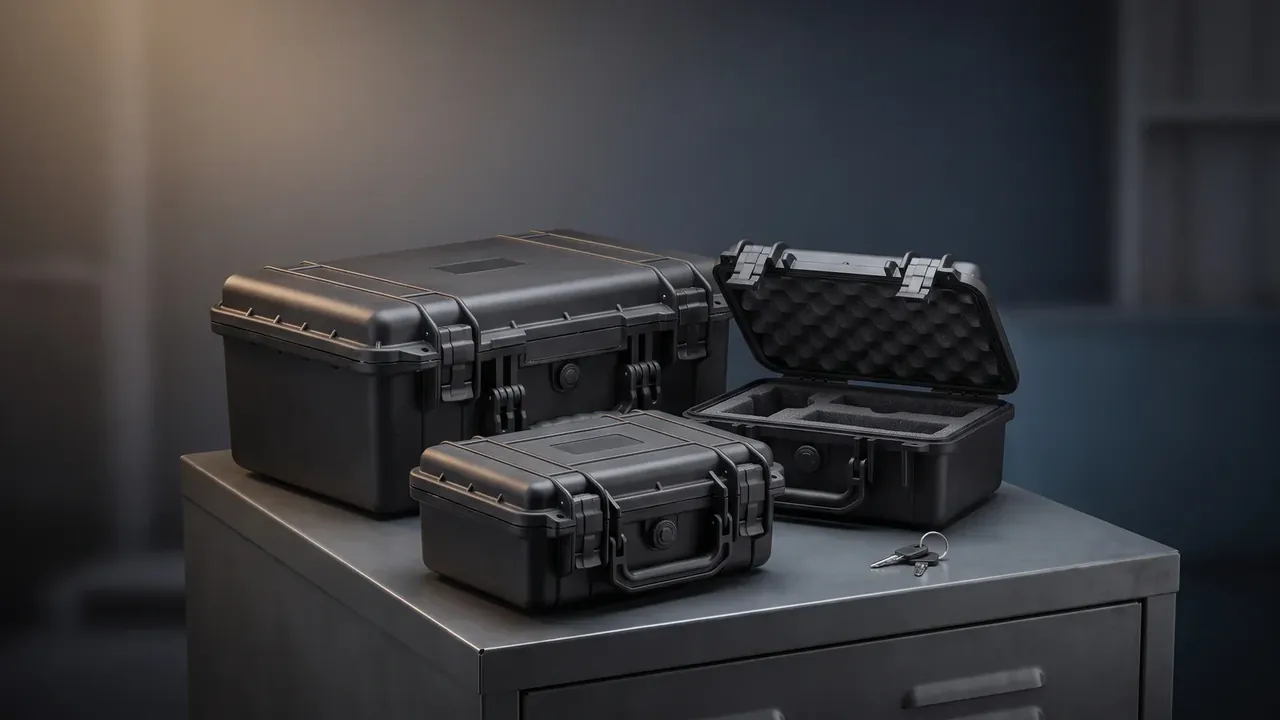
Quick answer: Ten minutes, a table and a key ring are enough to screen out most bad units: feel three load points, measure two dimensions, weigh once. Every item on the sheet below ends in a number you can read on the spot.
Table of contents
- Start Here: Three Touch Points
- Latches and Hinges: Count Less, Flex More
- Thickness, Weight and Sealing With Three Tools
- Three Minutes Inside: Cavity and Foam
- FAQ
1. Start Here: Three Touch Points
An inspection usually gets ten minutes, a table and whatever is in your pocket, enough if your hands know where to go.
The first is behind the latch boss. Push up from inside with a thumb and look for a dull hollow; that means the thick zone cooled slowly and a crack will start there.
The second is the gasket groove. A fingernail along the bottom should trace one continuous straight edge; a step leaves a short section of gasket unpressed.
The third is the hinge ear. Open the lid to 90 degrees and rock it; a sound case moves only elastically, a worn one knocks.
| Point | How to feel it | Passes | Fails |
|---|---|---|---|
| Behind latch boss | Thumb from inside | Flat, springs back | Dull hollow, soft |
| Gasket groove | Fingernail along base | Continuous straight edge | Step, flash, white patch |
| Hinge ear | Rock at 90 degrees | Elastic movement only | Knock along the pin |
Feel arrives before measurement. A feeler gauge finds 0.5 mm of misalignment; a sink mark is often 0.2 mm deep, and a thumb finds it first.
2. Latches and Hinges: Count Less, Flex More
An ammunition transit case may carry two latches or six; the number alone says nothing.
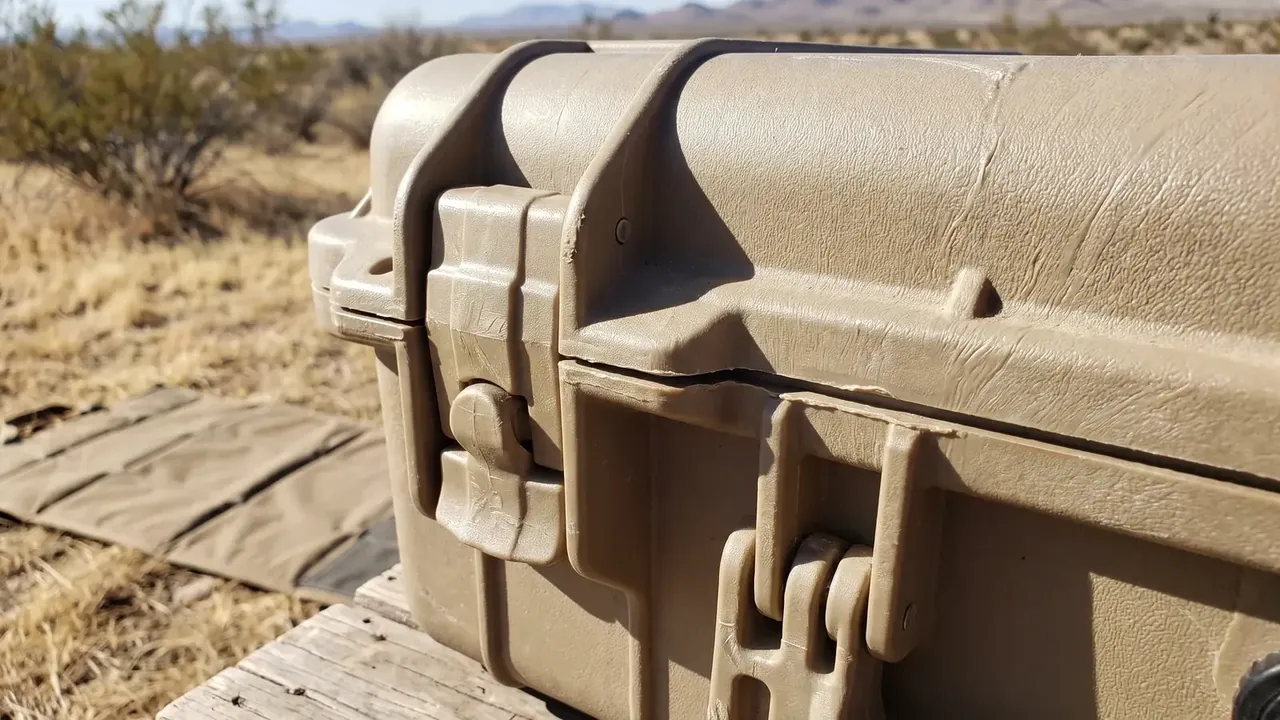
Open and close an ammunition transit case twenty times. A good latch still snaps home on the twentieth; a poor one binds around the eighth and needs a palm on the lid, which means the plastic has passed its elastic limit. Once closed, pull the hook sideways with a force gauge; below 220 N it fails. Hinge pin diameter gets overlooked. A 4 mm stainless pin in a 4.2 mm hole, 0.2 mm clearance, gives the steadiest lid; a 3 mm pin in the same hole rocks and wears a bevel into the gasket. The case in the photo fails at the boss root, with fine radial cracks spreading from the screw hole. That is not drop damage: the boss is too thin and the screw torque too high. Rake light across the surface; straight on, it disappears.
3. Thickness, Weight and Sealing With Three Tools
Three tools travel well for an ammunition transit case: a 0.5 mm feeler gauge, a tape measure, a scale. An ultrasonic gauge is a fourth, if available.
| Item | Tool | Passing reading |
|---|---|---|
| Rim flatness | 0.5 mm feeler | Will not enter anywhere around the rim |
| Cavity diagonals | Tape measure | Two diagonals within 2 mm |
| Empty weight | Scale | 5.6 kg, tolerance ±0.2 kg |
| Latch retention | Force gauge | Not below 220 N |
| Same-face thickness | Ultrasonic gauge | Five points, spread within 0.25 mm |
Sealing is easier: close an A4 sheet in the lid and pull it around the rim. Where it slides out, the gasket is not pressing; where it takes force, compression is enough. At 0.1 mm thick, the paper shows continuity of contact, not compression.
The diagonal check catches a cavity moulded out of square: within 2 mm the box is true, at 5 mm cut foam fits one end and refuses the other.
4. Three Minutes Inside: Cavity and Foam
The first three minutes after the lid opens decide whether this ammunition transit case is fit to ship.
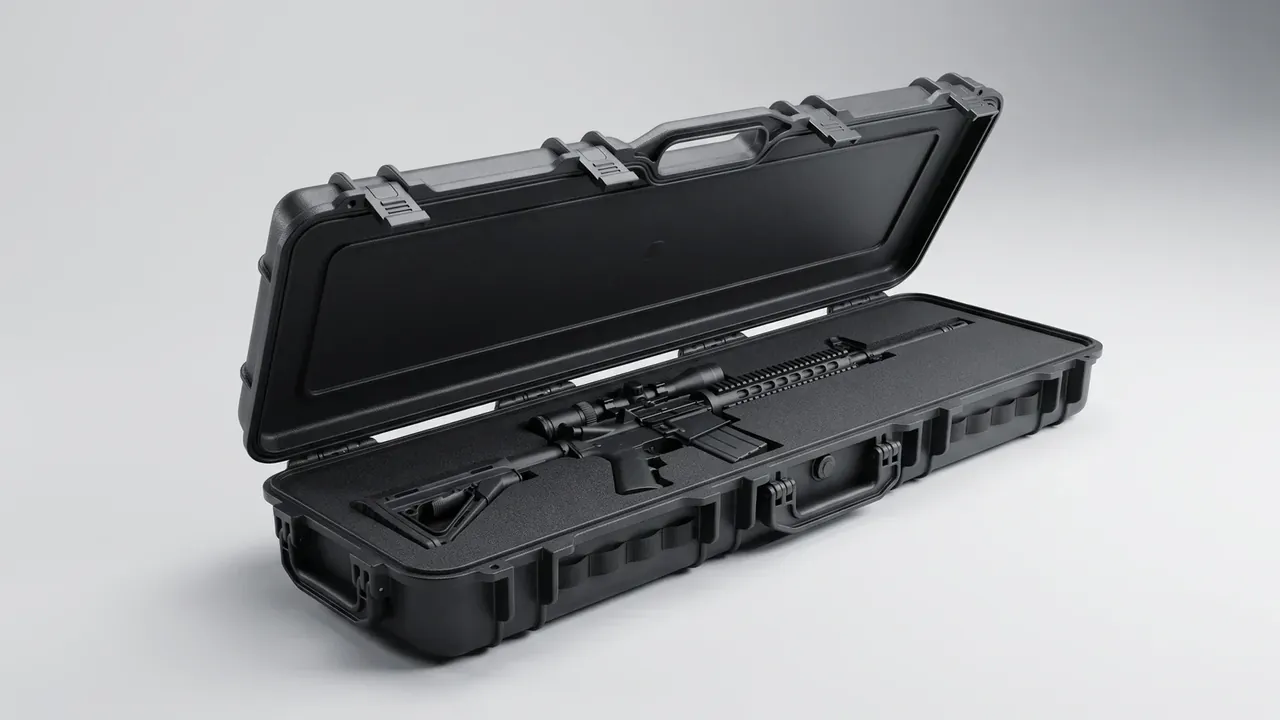
Start with how foam meets the walls. Foam cut smaller than the cavity shifts as a block and the cut-outs stop lining up; correct foam is slightly larger, held by wall pressure, and takes a tug to lift.
Then check cut-out depth: 2–3 mm below the item height, so the lid foam preloads it and nothing bounces. Depth equal to or more than the item means no restraint.
Finally the foam inside this ammunition transit case. Press a dent with a finger: back to 90 percent of original thickness within ten seconds means the density is right. Slow foam stiffens in the cold and collapses after handling.
Condensed onto one sheet, the inspection looks like this:
- Press behind the latch boss: no hollow, quick spring-back
- Feeler gauge stays out of the rim; no step in the groove
- Twenty open-close cycles, still snapping home on the twentieth
- Hook pulled sideways, not below 220 N
- Empty case on the scale, 5.6 kg within ±0.2
- Cavity diagonals within 2 mm
- Foam larger than the cavity, 90 percent recovery in ten seconds
- Serial number moulded where the ledger expects it
Six of the eight need no tool, and the whole run takes about twelve minutes.
Conclusion
Grading an ammunition transit case needs no laboratory: three points by hand, two dimensions, one weighing. What separates good from bad is ending every check in a number you can read.
This article discusses only the container (case body) side of specifications and design intent, and does not cover any handling, loading or use of the contents.
Related Reading
- Transit cases in depot transfer and forward delivery
- Common damage and how to reinforce against it
- Choosing an ammunition chest: capacity and locking
Related Products
- 8 Series — Gun Cases; Military Equipment Cases; Camera Equipment Cases; Drone Cases; Watch Cases; Knife Cases; First Aid Cases; Electronics Equipment Cases
- WL8-2812 PP Gun Case — model WL8-2812
- All protective cases and toolboxes: 7 series, 158 models