

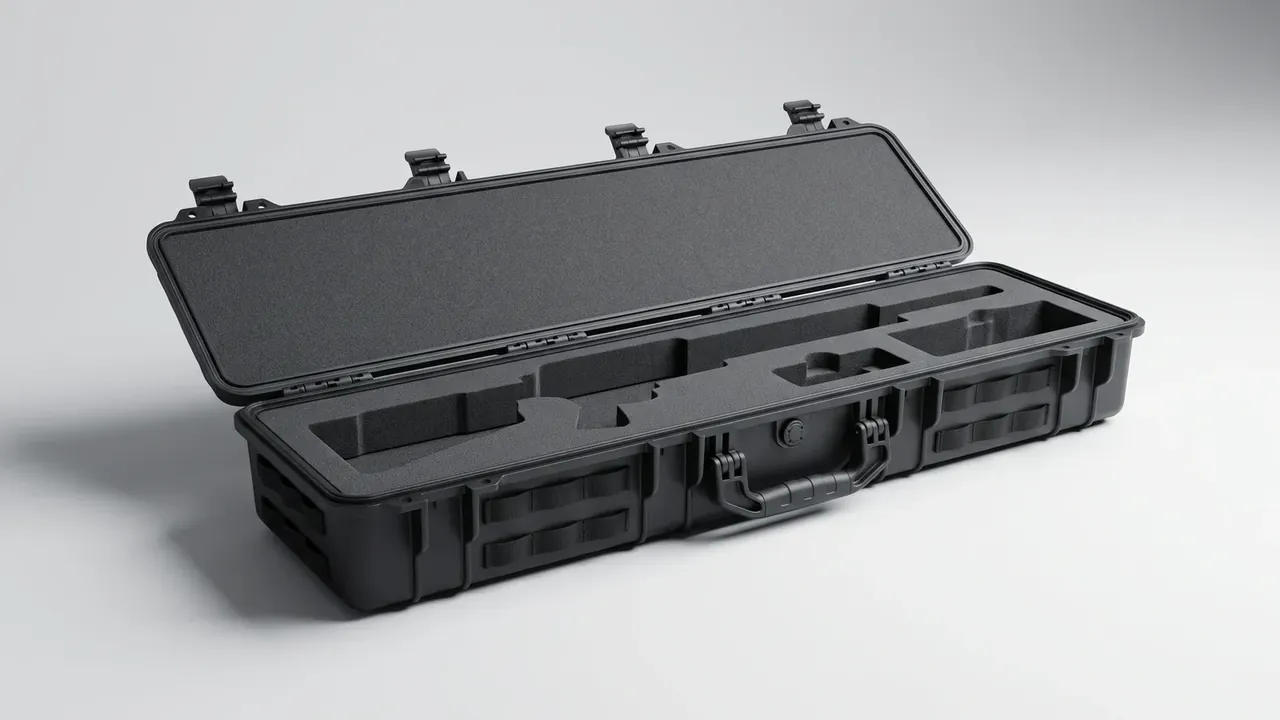
Quick answer: Ammunition Transit Case dimensions come from duty, not from a catalogue. Loading at minus twenty, unloading at plus forty-five and a three-high stack set the cavity, the wall thickness, then the latches and gasket.
Table of contents
- How one winter loading day writes the spec sheet
- Sizing the cavity backwards from the load
- Wall thickness and ribs from a three-high stack
- Latches, gasket and handle move together
- FAQ
1. How one winter loading day writes the spec sheet
Six in the morning, minus twenty outside the depot, a forklift brings six Ammunition Transit Case units to the tailgate. This is when the shell is weakest: polypropylene keeps about sixty percent of its room-temperature impact strength, and a knock on an inner corner leaves a white stress mark for good.
Seven hours later the truck interior sits at plus forty-five, the gasket softens and the lid gap widens.
What sets the specification is those three conditions pressing on each other. Cold pushes thickness up, thickness pushes weight up, and weight forces the handle and latches to be re-rated. Heat softens the gasket, and a softer gasket needs a longer latch stroke. Write the duty list first, then let the dimensions fall out of it.
| Duty input | Specification it moves | Pass line |
|---|---|---|
| Minus twenty at loading | Low-temperature impact | No cracking when bent |
| Plus forty-five in the truck | Gasket hardness, lid gap | Gap does not grow |
| Three-high full stack | Wall thickness, top ribs | Bottom lid takes no set |
| Two load and two unload cycles | Handle and latch retention | Full load lifts clean |
The table is only the entry point. The chain starts at the cavity.
2. Sizing the cavity backwards from the load
The cavity of an Ammunition Transit Case follows how the loading units stack, not the phrase it fits. One standard carton measures 320 by 160 by 120 mm; three across and two high, with 20 mm of foam per side and 30 mm of cushion above, lands the cavity at roughly 1000 by 360 by 300 mm.
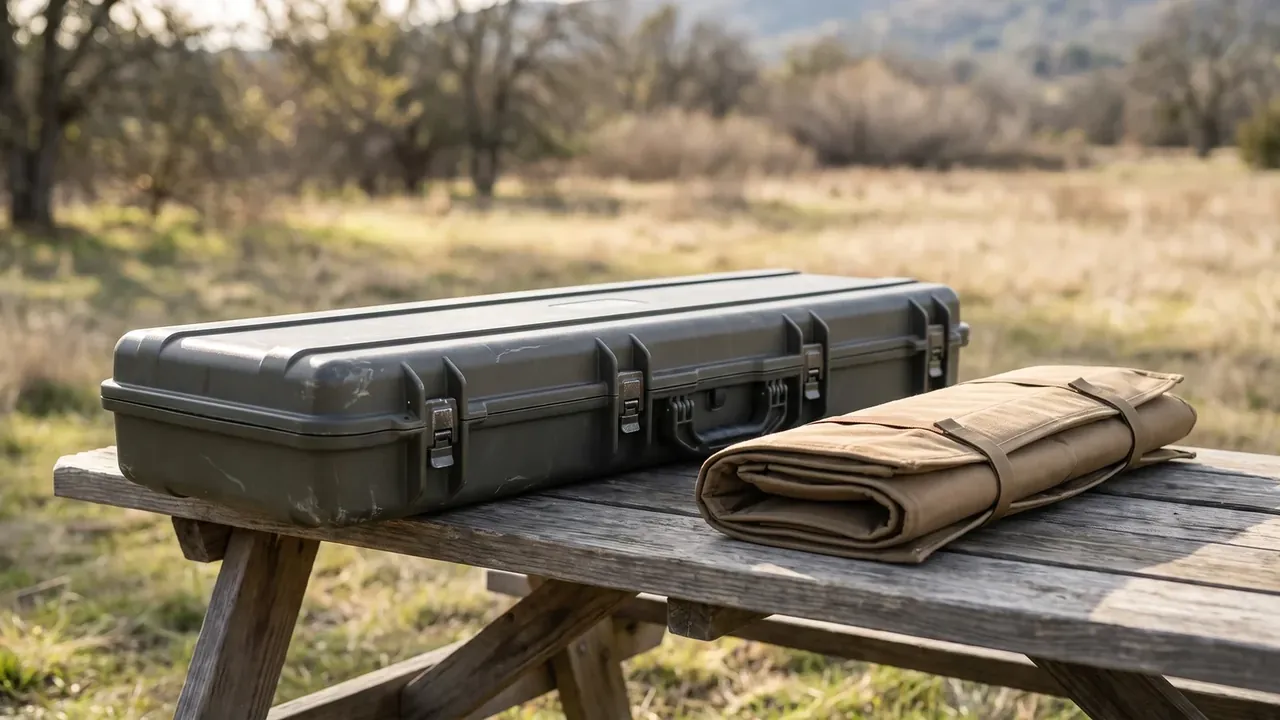
| Loading unit and array | Cavity L x W x H | Loaded weight | Usual wall |
|---|---|---|---|
| Three across, two high | 1000 x 360 x 300 mm | 32 kg | 6 mm |
| Four across, three high | 1300 x 380 x 420 mm | 48 kg | 8 mm |
| Single layer crates | 700 x 340 x 260 mm | 22 kg | 6 mm |
| Long items, mixed | 1150 x 300 x 240 mm | 26 kg | 6 mm |
Empty weight is the row most people skip. Going from 9 kg to 12.5 kg looks trivial, yet in a three-high stack the bottom unit carries an extra 21 kg.
Height also needs clearance: a gloved hand wants 25 mm of side gap.
3. Wall thickness and ribs from a three-high stack
Wall thickness on an Ammunition Transit Case is squeezed between the bending moment from the stack above and the long-term deflection the material will tolerate.
- The bottom lid carries both units above it, 64 kg across roughly 0.36 square metres at 32 kg per unit;
- Top ribs sit no wider than 180 mm apart, 12 mm tall, 8 mm wide; open them to 250 mm and a dip shows within two weeks;
- Above 30 kg loaded, or beyond three high, the wall goes from 6 mm to 8 mm, and the gain is in creep rather than ultimate strength;
- The side-to-base radius stays at R8 or gentler, because a sharp corner is where a cold-weather crack starts;
- Four feet 15 mm tall give the forks room and keep the base off standing water.
Ribs stiffen locally, thickness stiffens globally; mixing both adds weight without removing deflection.
A one-week static test hides creep. A summer under three-high stacking does not.
4. Latches, gasket and handle move together
None of these three is chosen freely. Each follows wall thickness and loaded weight. An 8 mm shell has a rim stiff enough for two latches to press the whole gasket evenly; a 6 mm shell over one metre of cavity bows at mid-span, so the count rises to four at 300 mm spacing or less.
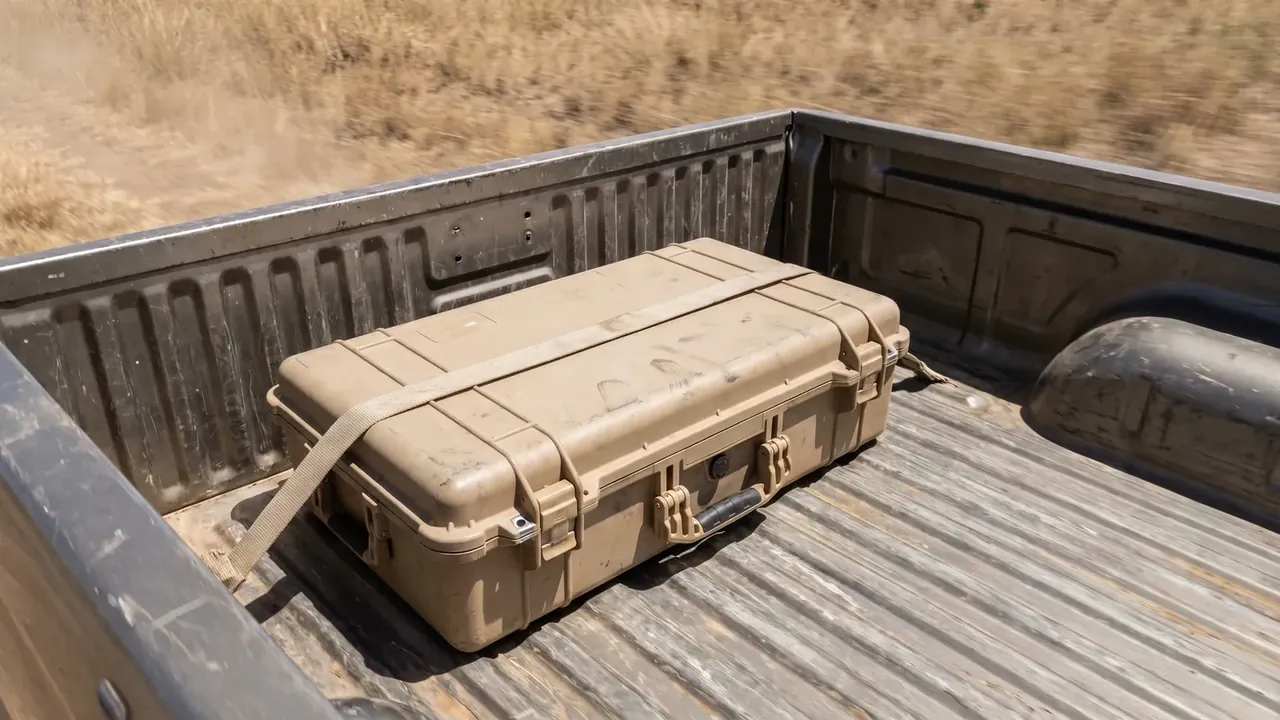
Gasket hardness sits at 55 plus or minus 5 Shore A, about 30 percent compression. A harder cord resists flattening but needs more closing force.
| Part | Specification | Tied to |
|---|---|---|
| Latches | Four, 300 mm apart | Rim stiffness, compression |
| Gasket | Shore A 55, 30 percent | Latch stroke |
| Handle | M6 bolts, 60 kg static | 32 kg loaded weight |
| Pressure valve | Opens at 10 kPa | Temperature and altitude |
The handle is the most under-specified part on the sheet. At 32 kg, a single carrier puts more than twice the dynamic load into the root; M6 bolts with metal inserts are the floor.
Conclusion
Write the duty list down and the Ammunition Transit Case specification becomes arithmetic: cavity from the loading array, wall from the stack height, latches and gasket from wall and weight. A case that survives winter runs is the one whose derivation was never cut short.
This article discusses only the container (case body) side of specifications and design intent, and does not cover any handling, loading or use of the contents.
Related Reading
- Ammunition Transit Case setup for depot transfer and forward delivery
- Common Ammunition Transit Case faults and how to handle them
- How a transit case is built and what each part does
Related Products
- 8 Series — Gun Cases; Military Equipment Cases; Camera Equipment Cases; Drone Cases; Watch Cases; Knife Cases; First Aid Cases; Electronics Equipment Cases
- WL8-2812 PP Gun Case — model WL8-2812
- All protective cases and toolboxes: 7 series, 158 models