

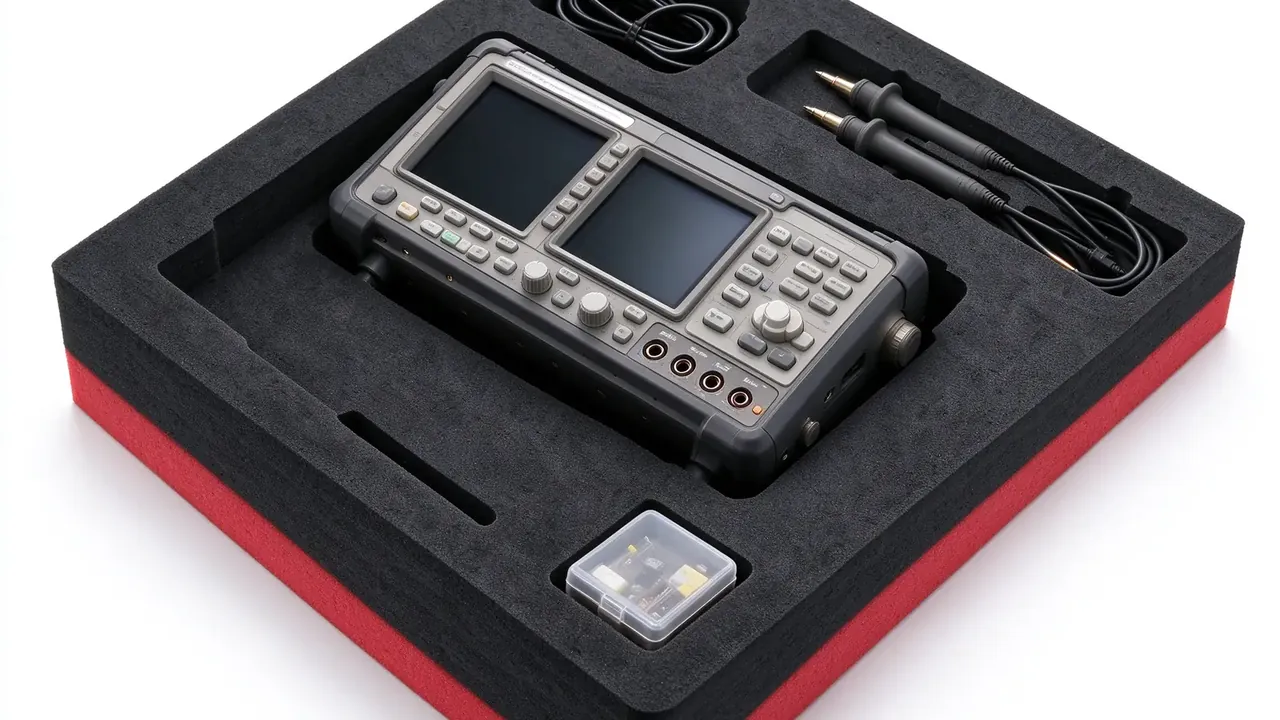
Quick answer: An automotive electronics protective case must control static, moisture and thermal cycling, at 10⁶ to 10⁹ Ω surface resistance and a 30 min IPX7 seal.
Table of contents
- Two Gates: Static and Moisture
- Matching Shell Material to Shielding Needs
- Panel Cutouts and Cable Routing
- How the Gasket Behaves Under Thermal Cycling
- Securing Modules Inside the Case
- FAQ
1. Two Gates: Static and Moisture
Static, not impact, kills a module first. A person walking across a workshop floor reaches 3 kV easily; one touch on a connector finger punctures the gate oxide and leaves no mark. The fault appears months later as an intermittent code.
An automotive electronics protective case states its resistance bands: dissipative liner at 10⁶ to 10⁹ Ω, conductive cavity at 10³ to 10⁵ Ω, nothing above 10¹² Ω except trim. Read it at 500 V DC after 5 s, with the room at 23 °C and 12% relative humidity.
Moisture is the other gate. A sealed cavity holds the air trapped at closing; at 35 °C by day and 15 °C at night, that vapour condenses inside. A water film bridging two solder rows drops surface insulation by two orders of magnitude, and the code blames a sensor.
The gates do not conflict. A dissipative liner bleeds charge and takes up little water; PP absorbs under 0.03% in 24 h. What fails is a desiccant sachet packed beside the foam: once saturated, it becomes the water source.
| Band | Surface resistance | Typical build | Fitment |
|---|---|---|---|
| Conductive | 10³ to 10⁵ Ω | Carbon-loaded foam | Bonding face on metal |
| Dissipative | 10⁶ to 10⁹ Ω | Pink PE foam | Board cavities |
| Insulating | Above 10¹² Ω | Plain EPE | Trim and documents |
2. Matching Shell Material to Shielding Needs
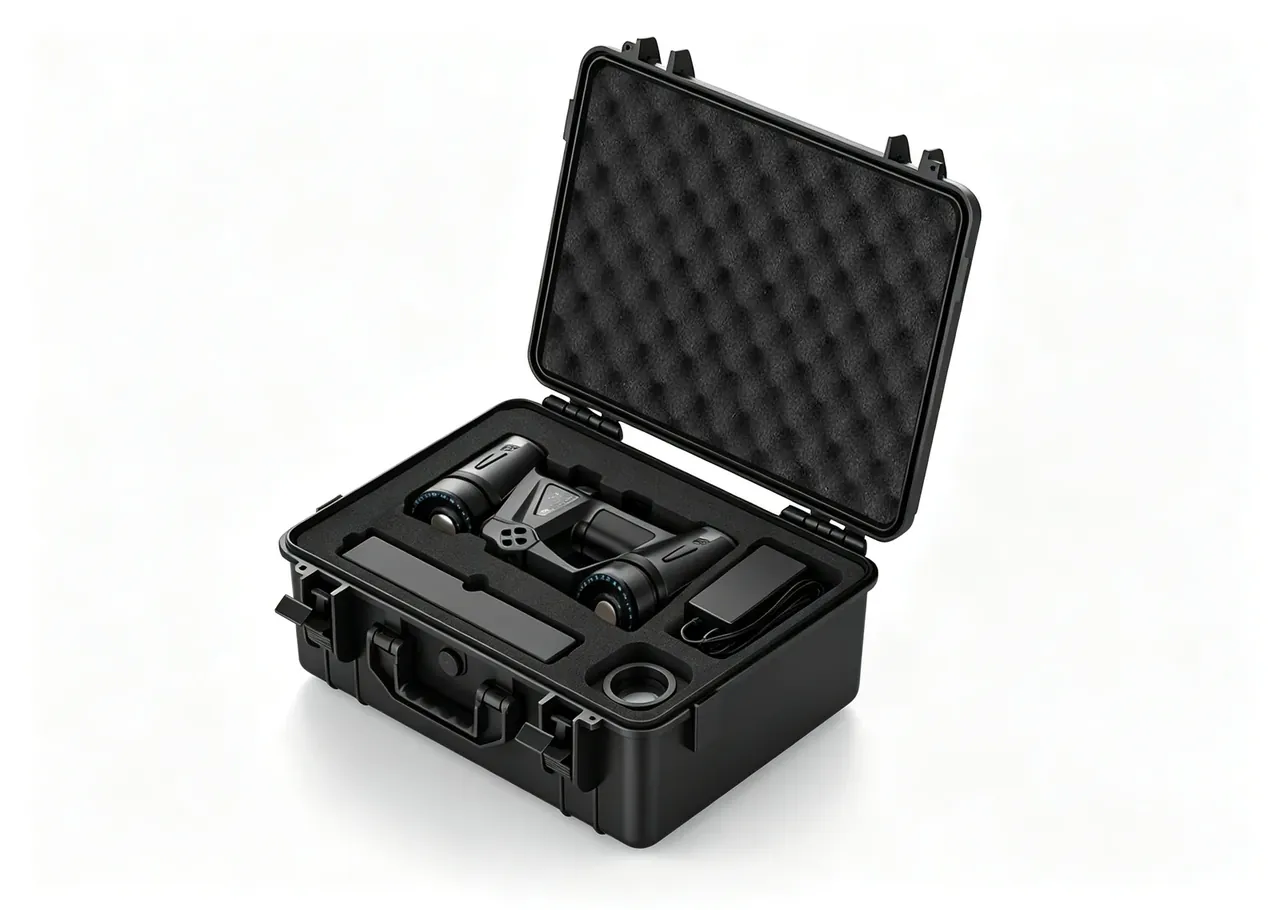
An automotive electronics protective case starts on one of three routes: injection PP, injection ABS or rotomoulded PE. PP runs 0.90 to 0.91 g/cm³ at 1.0% to 2.5% shrinkage; ABS runs 1.04 to 1.06 g/cm³ at 0.4% to 0.7%; HDPE runs 0.94 to 0.96 g/cm³ at 1.5% to 3.0%, toughest and softest.
Shrinkage drives mould compensation. One tool serving two automotive electronics protective case shells, 2.5% against 0.6% offsets the tongue and groove by over 1 mm, the gasket loads unevenly and the offset side leaks first.
Shielding decides the finish. Plastic does not conduct, so a nickel-graphite coating at 50 to 80 μm dry film and under 1 Ω per square turns the shell into part of the shield. Leave a 5 mm bare margin at each screw contact, or the shield floats.
No shielding, no coating: diagnostic interface and harness adaptor boxes carry low-voltage signals, where a dissipative shell suffices.
3. Panel Cutouts and Cable Routing
A 300 mm × 220 mm × 120 mm automotive electronics protective case often carries 2 to 4 side openings: power, CAN, Ethernet, antenna. Cut 16.2 mm for an M16 gland and 20.2 mm for M20, held to ±0.1 mm.
Bend radius governs routing: 6 times diameter for shielded pair, 4 times for plain cable, R5 at internal corners, and a 30 mm loop.
Shield continuity needs a 360° clamp. The gland ring must bite the braid, transfer impedance stays under 10 mΩ on a four-wire check, and a conductive gasket at 20 N joins a D-SUB shell to the panel.
Blank holes leak more than cut ones. Plug spares with a blind plug and O-ring at 2.5 N·m, then sample IPX7 at 0.15 to 1 m for 30 min. Washdown calls for IPX5 and IPX6, nozzles of 6.3 mm and 12.5 mm at 2.5 to 3 m; IP67 has no jet test, so an automotive electronics protective case contract should not stop at that one line.
| Opening | Size | Sealing | Check |
|---|---|---|---|
| Power inlet | M16 gland, 16.2 mm | O-ring, 2.5 N·m | Immersion, 30 min |
| Data port | M12 socket | Flat washer | Air decay, 20 kPa |
4. How the Gasket Behaves Under Thermal Cycling
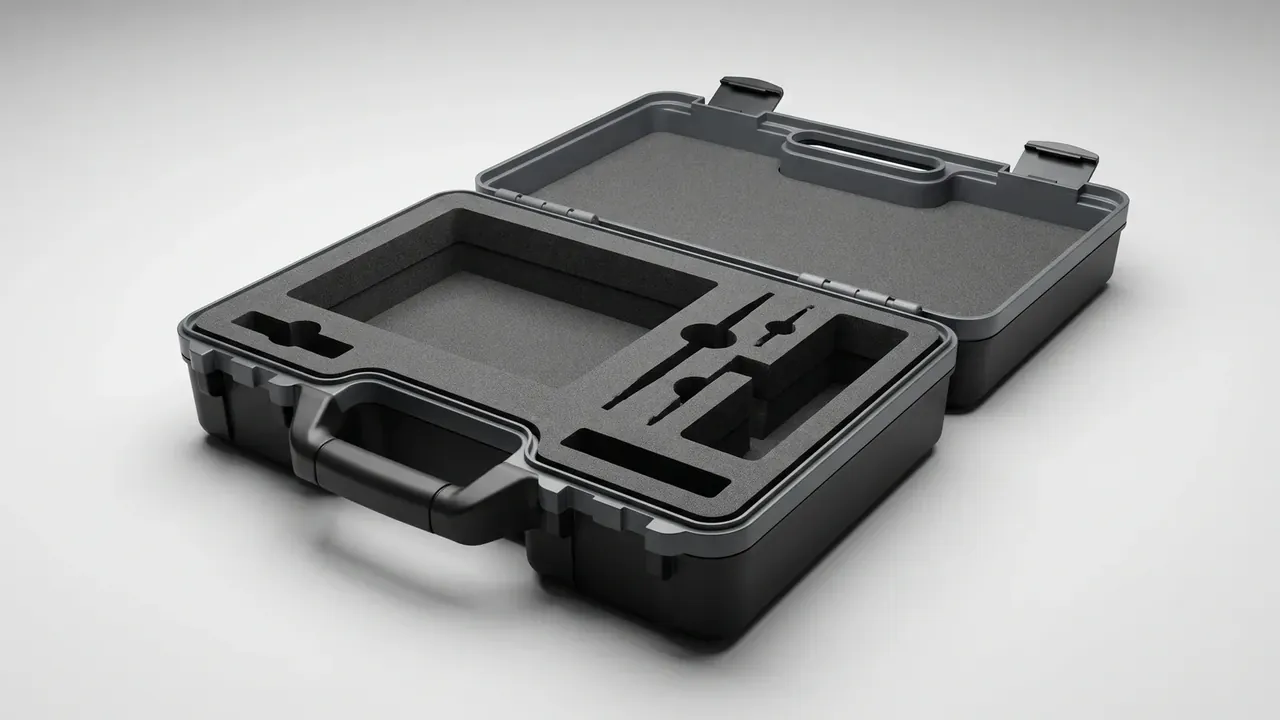
Treat the gasket as a consumable. TPE cord at Shore A 50 to 60 fits at 25% to 30% compression; below 20% it never seats, above 35% it has no travel left. Cut the groove half a millimetre wide of the cord.
AEC-Q100 steps from Grade 0 to Grade 3 at −40 to 150 °C, −40 to 125 °C, −40 to 105 °C and −40 to 85 °C. An engine-bay ECU sits on Grade 1, a cabin domain controller on Grade 2, and an automotive electronics protective case should never run hotter inside than its grade allows.
Cold stiffens the cord first: at −40 °C recovery slows and the seal forms later after the latch closes. At 105 °C the compound softens and compression set accumulates. Real failure is a cord that no longer springs back, not a tear.
Design life is 15 years or 300,000 km, tens of thousands of lid cycles. Solder fatigue comes from CTE mismatch and appears after thousands of thermal cycles; the gasket ages slower, but once hardened, condensation finds the gap.
5. Securing Modules Inside the Case
Weight splits the method: under 200 g on foam preload, 200 g to 1 kg with a locating rib, above 1 kg on a stud or strap. A bracketed domain controller near 600 g lands in the middle band, the bulk of what an automotive electronics protective case carries.
Measure preload. Make the cavity 2 to 3 mm shallower than the module so the lid will not slide by hand and rebound stays under 1 mm. Excess preload distorts connector housings; too little lets the module walk under the three-axis sweep of method 514.8.
An M4 screw with a nylon washer at 1.2 N·m into a boss at a rib root, wall 3 mm or more, survives service cycles. Keep an automotive electronics protective case under 15 kg, rate the bottom unit at 45 kg when stacked three high, and carry the handle rib to the corner radius, the first place to fatigue.
Conclusion
Written as numbers, static, moisture and temperature stop being opinions. Surface resistance of 10⁶ to 10⁹ Ω, immersion at 0.15 to 1 m for 30 min, gasket compression of 25% to 30% and preload of 10% to 15% each belong on a drawing and an inspection sheet. JUNZHIJIA asks for the AEC-Q100 grade before choosing material and coating; reverse that order and an automotive electronics protective case tool has to be cut again.
This article discusses only the container (case body) side of specifications and design intent, and does not cover any handling, loading or use of the contents.
Related Reading
- Pressure-resistant waterproof case for oscilloscopes
- Electronic equipment case with wheels and trolley
- Plastic case versus wooden crate: the export cost ledger
Related Products
- 8 Series — Gun Cases; Military Equipment Cases; Camera Equipment Cases; Drone Cases; Watch Cases; Knife Cases; First Aid Cases; Electronics Equipment Cases
- WL8-2812 PP Gun Case — model WL8-2812
- All protective cases and toolboxes: 7 series, 158 models