

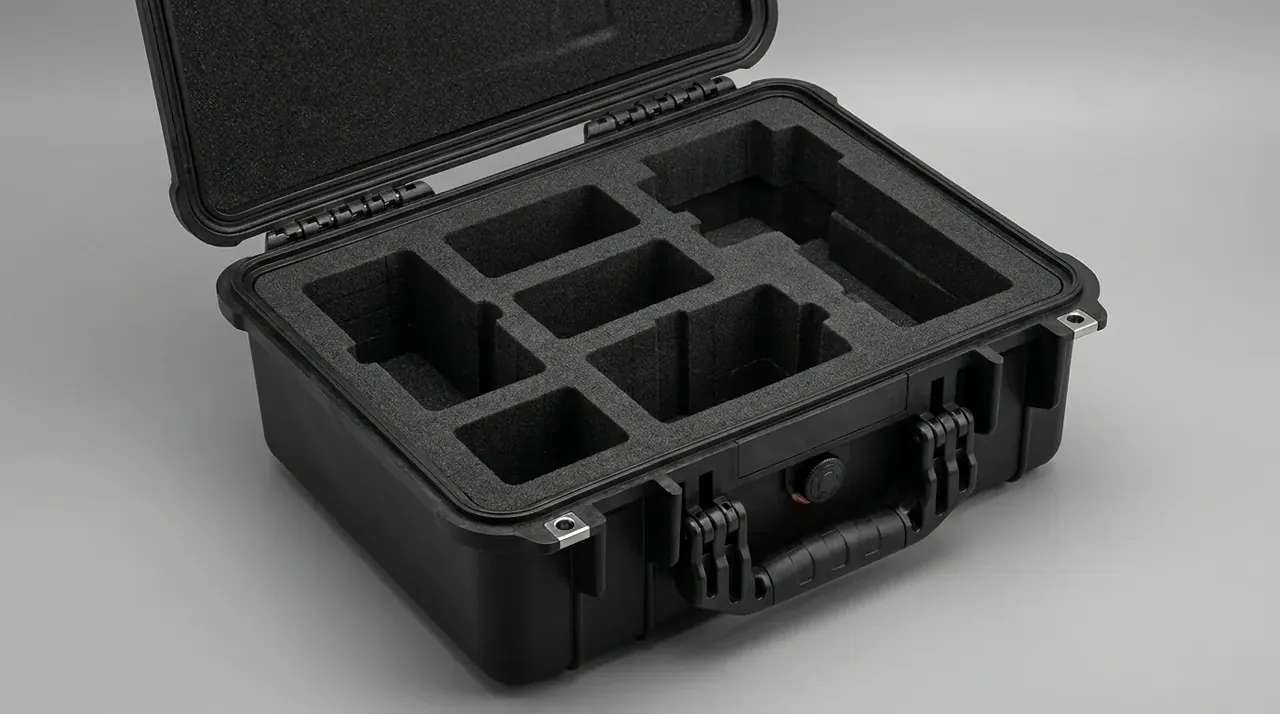
Quick answer: The Oscilloscope special pressure-resistant waterproof case is checked at 0.6 MPa for 30 min, with step flatness ≤0.5 mm and gasket compression at 24%.
Table of contents
- Case-mouth step flatness of the Oscilloscope special pressure-resistant waterproof case
- Gasket recovery under static pressure
- Leak reading across immersion levels
- Lid deflection points after the static-pressure retest
- Compression-rate scrap line for batch air-tightness
- FAQ
1. Case-mouth step flatness of the Oscilloscope special pressure-resistant waterproof case
The case-mouth step is the only contact band carrying load once the lid meets the shell. On the Oscilloscope special pressure-resistant waterproof case it is one continuous plane of 520 by 380 by 220 mm outside and 460 by 320 by 160 mm inside. Flatness of ≤0.5 mm is the spread of dial readings around the perimeter, and a lifted segment gives 0.6 MPa static pressure a seam to open first.
The shell is moulded at a 4.0 mm wall with ribs behind the step so the band does not bow as the latches tighten. Flatness is read empty at 4.8 kg and loaded at 10 kg, and the loaded value may not exceed the empty one by 0.1 mm; excess points to mould flash or a skewed latch boss, not a thicker gasket.
2. Gasket recovery under static pressure
Two gasket rings sit in the inner lid groove at a 24% section compression rate. Under 0.6 MPa held for 30 min the lid is pushed inward and the strip squeezed thinner; after release, a strip that does not return to its pre-load reading is scrapped. Poor recovery leaves a hairline gap at the next closing that a static-pressure retest finds first, so the Oscilloscope special pressure-resistant waterproof case reviews recovery before any water test.
A 14 mm pressure-valve boss sits at the lid centre, its insert moulded with the lid and its bore rounded so it cannot cut the strip. Two latches on the long sides each deliver 390 N; fit only one, or let the forces drift, and even a ≤0.5 mm step opens at the far end. The working range is -20 to 60 degrees Celsius, with the 24% reserve carrying recovery at the cold end and preventing a permanent set at the hot end. The Oscilloscope special pressure-resistant waterproof case is conditioned at both ends and retested under static pressure.
3. Leak reading across immersion levels
Immersion runs at 1.5 m for a cumulative 40 min, the closed shell held mouth-down, mouth-up and on its side in turn. After opening, absorbent paper pressed to the inner step edge must show no mark. This level is benchmarked against the sustained-immersion condition of IP68 and used only as verification of the sealing face on the Oscilloscope special pressure-resistant waterproof case; lid deflection still needs its own static-pressure retest against the 1.2 mm figure.
| Immersion level | Hold time | Reading point |
|---|---|---|
| Mouth-down at 1.5 m | cumulative 40 min | lower inner step edge |
| Mouth-up at 1.5 m | cumulative 40 min | lid groove recovery zone |
| On side at 1.5 m | cumulative 40 min | latch boss and valve bore |
Moisture only at the valve bore means retorque the 14 mm insert and repeat; a mark along a latch boss means the two 390 N latches are out of balance.
4. Lid deflection points after the static-pressure retest
The retest stays on the same shell used for the 0.6 MPa / 30 min hold, with points at the lid diagonal midpoint, the inner latch boss and the valve bore rim. A micrometer reads the lid before and after pressure, and deflection of ≤1.2 mm is accepted. That figure needs both ≤0.5 mm step flatness and the 24% compression rate, which load the gasket evenly and leave the lid room to spring back. All three points on the Oscilloscope special pressure-resistant waterproof case are taken on one shell.
After a 1.0 m drop onto each of the six faces the same points are read again; a value 0.2 mm over the pre-pressure one sends the check to a loosened hinge pin and then to whitening on the lid ribs.
| Static-pressure point | Load condition | Allowed deflection |
|---|---|---|
| Lid diagonal midpoint | 0.6 MPa / 30 min | ≤1.2 mm |
| Inner latch boss | 0.6 MPa / 30 min | ≤1.2 mm |
| Valve bore rim | 0.6 MPa / 30 min | ≤1.2 mm |
5. Compression-rate scrap line for batch air-tightness
Before release, three shells per mould cycle are sampled, measuring the real compression rate of the fitted strip; a nominal 24% is accepted only between 22% and 26%, below which the reserve is short and above which the strip is over-compressed. The line is drawn on compression rate alone, because a shell of 520 by 380 by 220 mm outside and 460 by 320 by 160 mm inside drifts little within one mould while the pressed depth shifts with latch force and groove cleanliness. The Oscilloscope special pressure-resistant waterproof case files the shell number against its reading so a later retest traces to a cycle.
| Deflection reading | Measuring point | Action |
|---|---|---|
| ≤1.2 mm | lid diagonal midpoint | accept |
| 1.2 to 1.4 mm | inner latch boss | retorque and retest |
| over 1.4 mm | valve bore rim | scrap |
Filing compression rate, immersion level and static-pressure deflection against one shell number is what makes the air-tightness conclusion on the Oscilloscope special pressure-resistant waterproof case hold, since a dry shell can still ride the 1.2 mm limit under static pressure and is flagged for retest.
Conclusion
The Oscilloscope special pressure-resistant waterproof case links step flatness, the 24% compression of two gasket rings and lid deflection of ≤1.2 mm at 0.6 MPa into one inspection chain. Staying dry at 1.5 m for 40 min is only the entry, while flatness and compression rate govern static-pressure behaviour. Keeping the three tables of immersion levels, static-pressure points and deflection readings per shell locates batch drift better than a single pass mark.
Related Reading
- Sealing face structure of an IP67 waterproof case
- Compression rate comparison in gasket-sealed case selection
- Leak reading steps of the IP67 submersion test
- Waterproof sampling line in incoming inspection
Related Products
- 8 Series — Gun Cases; Military Equipment Cases; Camera Equipment Cases; Drone Cases; Watch Cases; Knife Cases; First Aid Cases; Electronics Equipment Cases
- WL8-2812 PP Gun Case — model WL8-2812
- All protective cases and toolboxes: 7 series, 158 models