

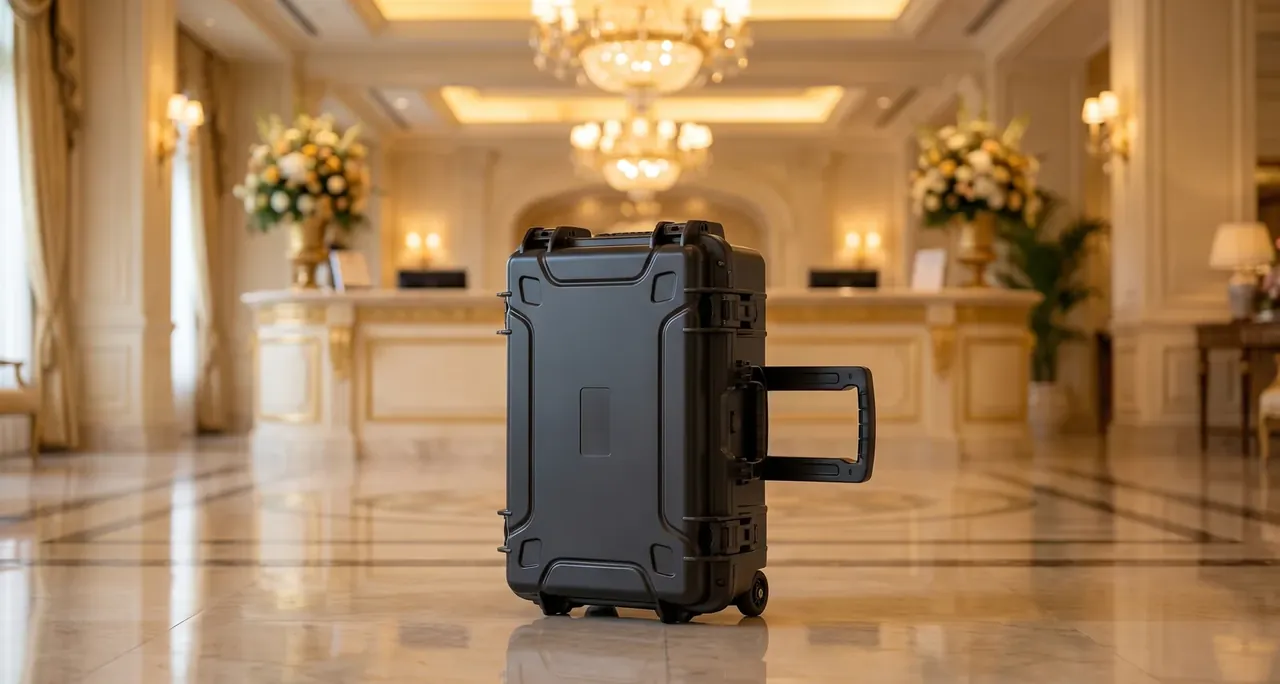
Quick answer: Electronic device protective case with wheels and trolley: 23.8 kg over a 20 mm step puts 60 kg on one housing; a 320 mm rail sees 260 N.
Table of contents
- Electronic device protective case with wheels and trolley: the load path moves to the housing
- A 20 mm Step and the 60 kg Load on One Housing
- Three Rails, 320 mm of Extension and a 260 N Side Pull
- 75 mm Wheels and the Wheel-First 1.0 m Drop
- Four 400 N Latches, IP67 and Three-High Stacking
- FAQ
1. Electronic device protective case with wheels and trolley: the load path moves to the housing
An electronic device protective case with wheels and trolley does not carry weight like a hand case. A hand case takes the load through its handle; a wheeled case lands on two wheels, passes it through the housings into the base, and reaches the handle only when lifted.
Pull the rails and the path grows: palm to rail, rail to sleeve, sleeve to back, back to base and housings. The weakest link is the sleeve seat, where a 4.0 mm wall pulls and bends at once.
Read the housing and the back before the wheels.
| Travel state | Loaded part | Design value |
|---|---|---|
| Standing | Four base corners | 23.8 kg total |
| Pulled on flat ground | Third rail and sleeve | 320 mm out, 260 N side load |
| One side over a 20 mm step | Front housing | 60 kg momentary |
| 1.0 m drop | Housing and base corner | Wheels land first |
| Three-high stack | Lid and walls | Two units above |
2. A 20 mm Step and the 60 kg Load on One Housing
Over a step, an electronic device protective case with wheels and trolley is dragged up, not rolled. A 20 mm lip is small against a 75 mm wheel, but the pull is angled, so the lever arm sits outside the housing and the load grows.
The loaded electronic device protective case with wheels and trolley weighs 23.8 kg — 7.8 kg empty plus 16 kg. At the step one wheel takes everything while the other hangs free, so the mass lands on one housing. Designing to 60 kg leaves a factor of about 2.5.
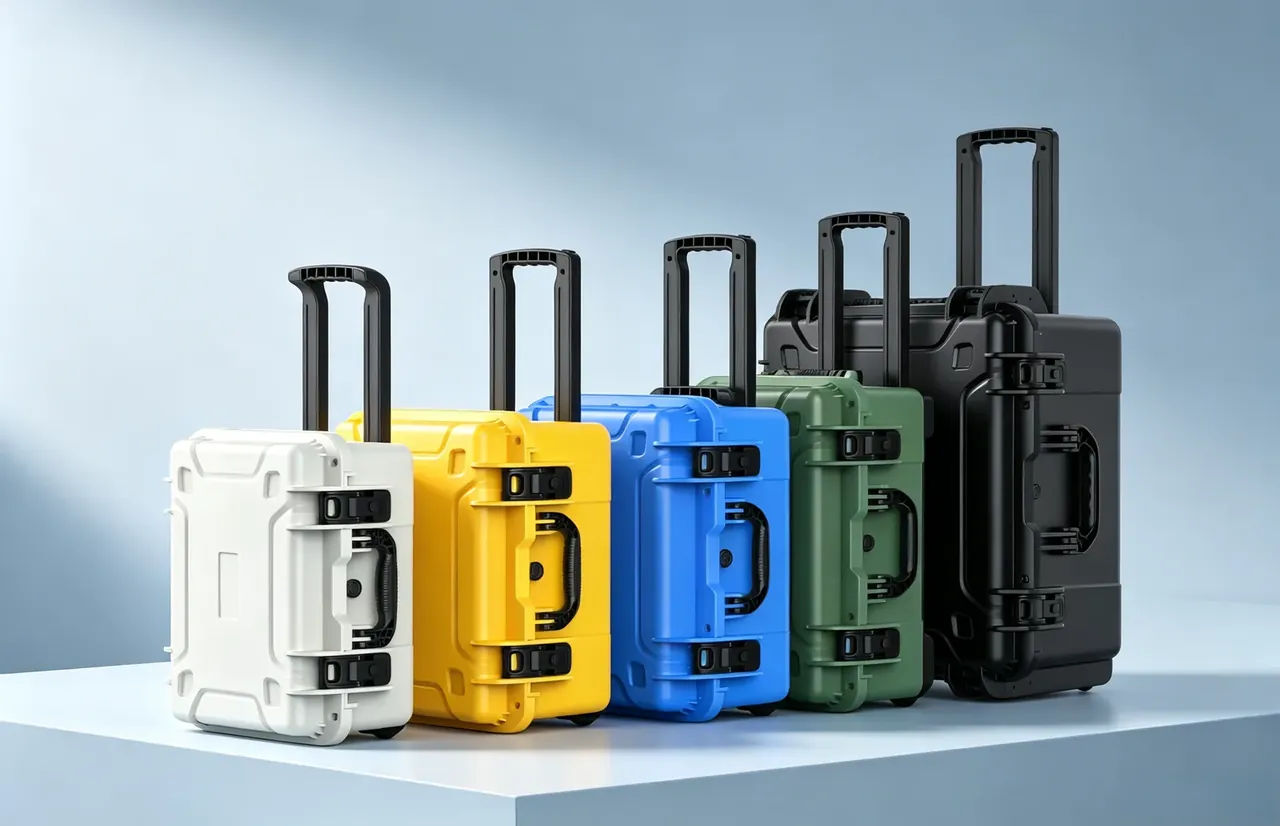
Housings are moulded into the base or bolted through it. The moulded type saves assembly but scraps the base when a corner fails; bolted keeps it in service.
| Loaded part | Usual crack site | Structural answer |
|---|---|---|
| Housing | Radial marks around bolt holes | Separate housing with two ribs |
| Case back | Root of the guide sleeve | Thicker boss and R5 blend |
| Latch seat | 400 N preload point | Local 6 mm pad |
| Corner | Drop contact point | Radius plus metal guard |
3. Three Rails, 320 mm of Extension and a 260 N Side Pull
Three sections extend to 320 mm, which gives side force a lever. A 260 N push is about a palm in a sudden stop; times 320 mm it becomes 83 N·m.
On an electronic device protective case with wheels and trolley, that 83 N·m lands on the sleeve seat. The first sign is a white stress mark, not a fracture; it spreads around the sleeve and the next drop opens a crack.
The back therefore needs a local boss: 6 mm around the sleeve, with an R5 blend. Rails rarely break; aluminium bends and slides, while a split back ends the case.
4. 75 mm Wheels and the Wheel-First 1.0 m Drop
A 75 mm wheel is usual on an electronic device protective case with wheels and trolley. A larger one climbs better but eats into the 500×340×215 mm cavity, so 75 mm is a compromise: enough for a 20 mm lip, without lifting the base much.
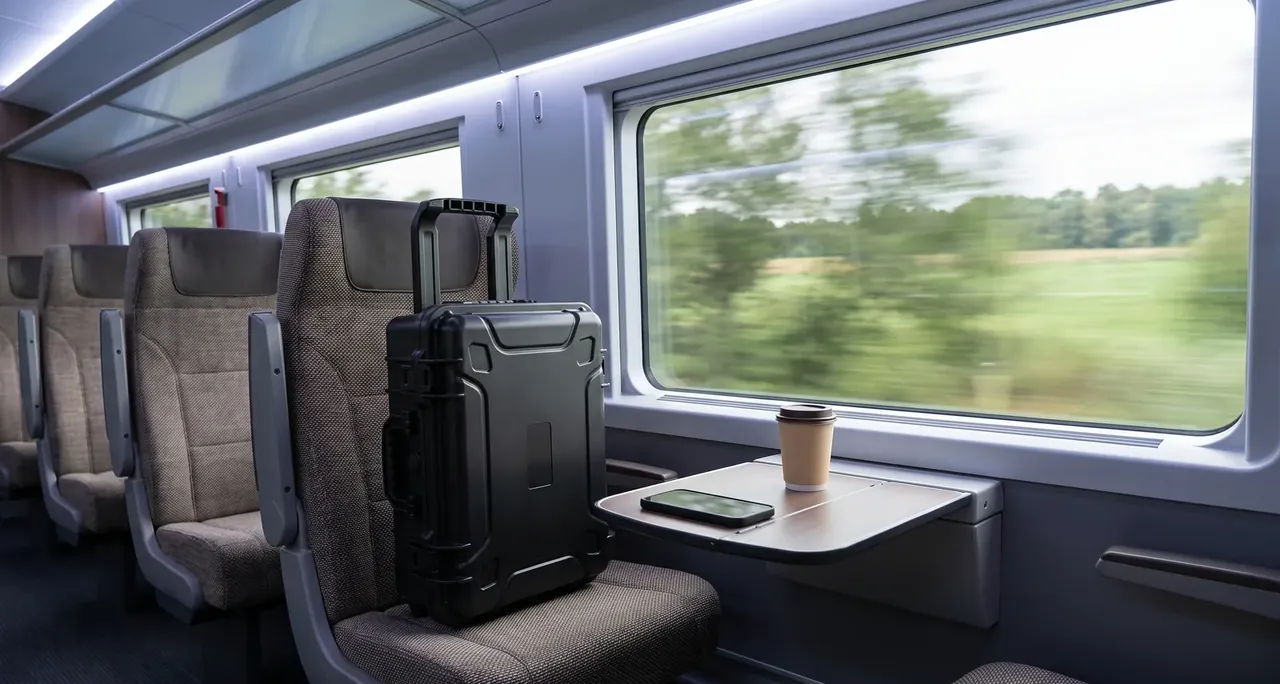
The 1.0 m drop is wheel-first. A wheel takes the hit through the housing into the base, a short path with the rubber tyre as the first spring. A corner landing sends the shock into the wall, where 4.0 mm is only half effective.
Four latches at 400 N each give 1600 N of preload, holding the gasket at design compression and making IP67 possible. After a drop, recheck force and replace any latch with a white seat mark.
| Design value | Verification | Pass |
|---|---|---|
| Housing at 60 kg | 20 mm step rig | No cracks |
| 260 N side load | Rail out, side pull | Sleeve stays seated |
| 1.0 m drop | Wheel first, six faces | Wheels stay on |
| IP67 | 1 m depth, 30 min | No ingress |
| −20 °C to 60 °C | Thermal cycling | Latches still work |
5. Four 400 N Latches, IP67 and Three-High Stacking
The electronic device protective case with wheels and trolley acceptance sheet splits three ways: stacking for static load, drop for dynamic load, IP67 for sealing. At three high, the bottom lid carries two units — 47.6 kg — over 560×400 mm, and must recover after 24 hours.
The temperature line is usually skipped. At −20 °C the plastic embrittles, so a 1.0 m drop is meaningful only at 0.8 m; at 60 °C the gasket softens and latch force must be rechecked. One cycle at each end tells more than ten at room temperature.
Between housing and base, fit a 1 mm rubber pad. It absorbs the drop and seals the four bolt holes where water enters; most IP67 failures start there, not at the gasket.
Conclusion
On an electronic device protective case with wheels and trolley, design the housing and back first, then wheels and rails. Three numbers set the wall split: 60 kg on one housing, 83 N·m from 260 N over 320 mm, and a wheel-first 1.0 m drop. A 4.0 mm wall, four 400 N latches and IP67 close it.
Related Reading
- Matching trolley handles and castors to load
- Wear points on a trolley case in transit
- Six questions for light-load wheeled cases
- Configuring cases for electronic equipment
Related Products
- 8 Series — Gun Cases; Military Equipment Cases; Camera Equipment Cases; Drone Cases; Watch Cases; Knife Cases; First Aid Cases; Electronics Equipment Cases
- WL8-2812 PP Gun Case — model WL8-2812
- All protective cases and toolboxes: 7 series, 158 models