

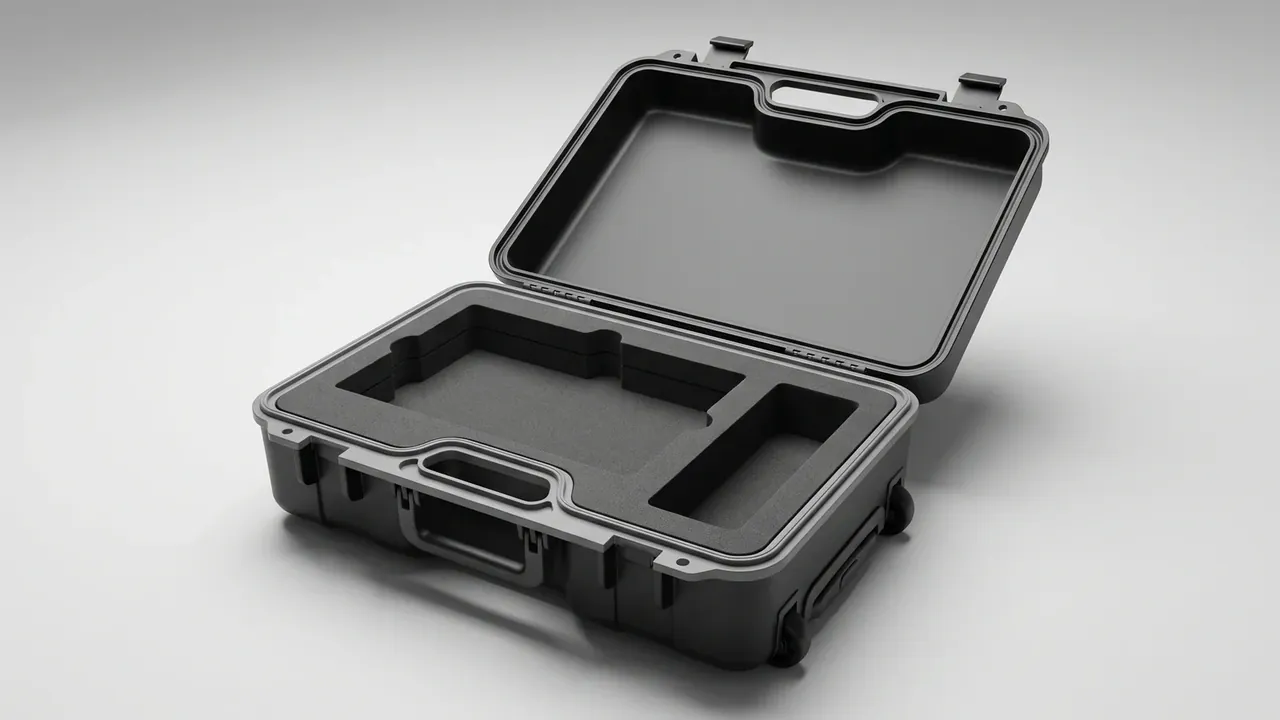
Quick answer: What fails on a trolley case is not the wheel but the housing. Thirty flights mean roughly 7 km of rolling and 60 loading throws, which leaves 1 to 2 mm cracks at the housing root and pushes handle play from 2 mm to about 6 mm. Play above 8 mm or a loose axle means replacement.
Table of contents
- The Housing Fails Before the Wheel
- Wheel Diameter and Bearings
- Housing Wall and the Four-Bolt Fixing
- Handle Play After Thirty Flights
- Three Impact Points and an Acceptance List
- FAQ
1. The Housing Fails Before the Wheel
A trolley case in an airport carries three loads at once: vibration as wheels cross tile joints, the overturning moment when the handle comes out, and the twist when a handler grabs the side handle. All three arrive at the same four bolts. A worn tyre is cosmetic; a split housing is failure.
Thirty flights can be counted in distance. Kerb to gate is about 200 m, a transfer adds 150 m, so 30 round trips run close to 7 km, on top of two or three chute drops of 0.9 m. On a 25 kg body pulled at 60 degrees, the bending moment at the housing root is about 2.4 times the static value — which is why an empty case rolls perfectly and a loaded one seeps water after three trips.
2. Wheel Diameter and Bearings
Diameter sets obstacle clearance and rolling resistance at the same time. A 75 mm wheel crosses a 10 mm tile joint and has to be lifted over a 20 mm kerb; a 100 mm wheel rolls over it, at the price of 12 mm of body height and a higher centre of gravity.
| Diameter | Service load | Step it clears | Typical surface | Resistance per wheel |
|---|---|---|---|---|
| 60 mm | under 15 kg | 8 mm | Exhibition carpet, office tile | 12 N |
| 75 mm | 15 to 25 kg | 12 mm | Terminal terrazzo, platform | 15 N |
| 100 mm | 25 to 40 kg | 20 mm | Apron asphalt, gravel, tactile paving | 19 N |
| 125 mm | above 40 kg | 30 mm | Site tracks, field paths | 24 N |
Bearings are the second dividing line. A 608ZZ ball bearing still feels smooth after 10 km at 25 kg; a plain bushing drags after 3 km, because it relies on grease in its clearance and dust ends that quickly.
Specify TPU at about 95 Shore A. PP costs 30 percent less and loses 2 mm of tread in 5 km on concrete, but at −15 °C TPU stiffens and resistance rises about 20 percent, so winter projects should move up to 100 mm.
3. Housing Wall and the Four-Bolt Fixing
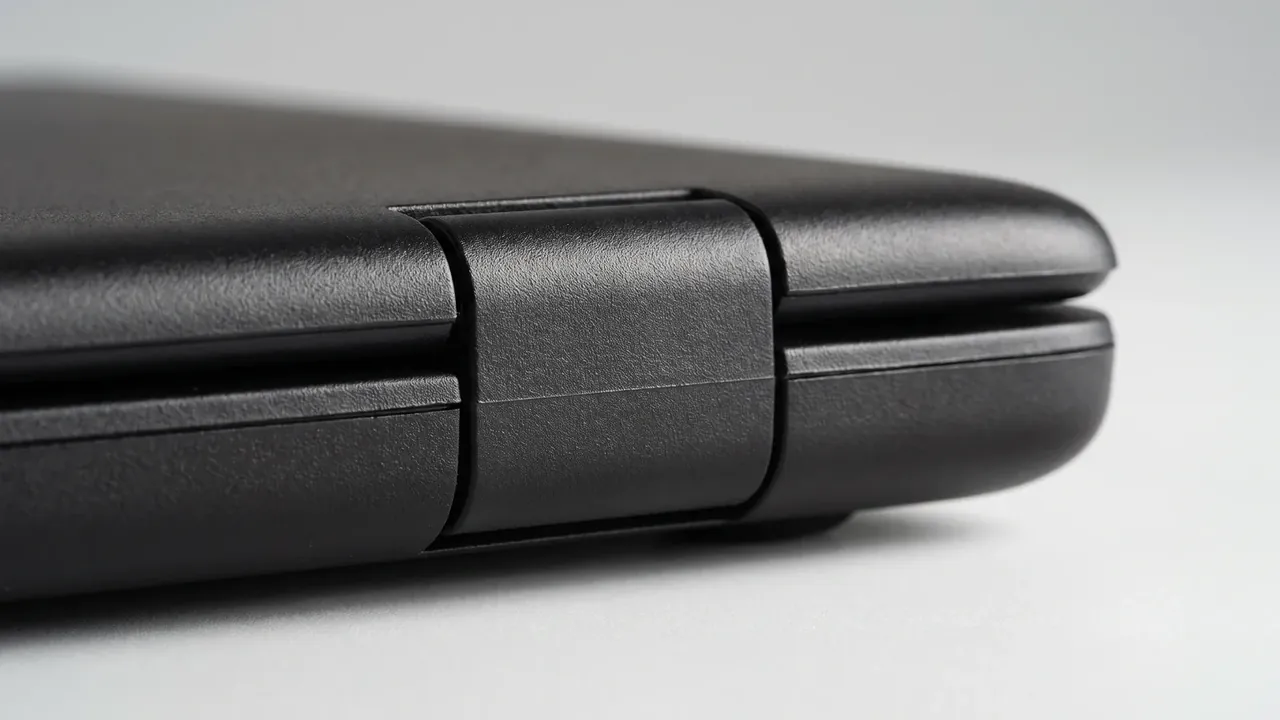
The housing is where a trolley case is most often value-engineered. A moulded housing under 4 mm shows radial hairline cracks around the bolt holes after 2,000 m at 25 kg; at 5 to 6 mm with two ribs it passes 8,000 m under the same load.
The fixing is easier to get wrong than the wall. Four M6 bolts pass through the base into the housing at 5 to 6 N·m, each on a 20 mm washer. With a standard washer the load crushes the plastic around a 6 mm hole, and once it sinks 0.5 mm the bolt is loose for good.
Two details belong on the drawing: nylon-insert lock nuts, because a plain nut backs off half a turn within 200 km of vibration, and a 1 mm rubber pad that damps vibration and seals the four holes where water usually enters.
4. Handle Play After Thirty Flights
Handles rarely break; they loosen. A new three-section aluminium handle shows under 2 mm of lateral play, 3 to 4 mm after ten flights, about 6 mm at thirty. Past 8 mm the case tracks sideways and puts its weight on one wheel.
| Stage | Lateral play | Feel | Action |
|---|---|---|---|
| New | under 2 mm | Crisp detents, button snaps back | In service |
| 10 flights | 3 to 4 mm | Slight slack in section two | Check the button spring |
| 30 flights | about 6 mm | Gritty on extension | Clean the tubes, re-grease |
| Beyond | over 8 mm | Binds on one side | Replace the handle assembly |
Tube wall governs it. A 0.9 mm wall grows 1.5 mm of play over 5,000 extensions at 25 kg; a 0.6 mm wall grows 4 mm, because the plastic guide wears the tube mouth oval. POM guides outlast PP guides for under EUR 0.25 and roughly double the life. After thirty flights, the cheapest maintenance on a trolley case is to strip the handle and clean out the sand, which otherwise grinds 6 mm of play to 10 mm within six months.
5. Three Impact Points and an Acceptance List
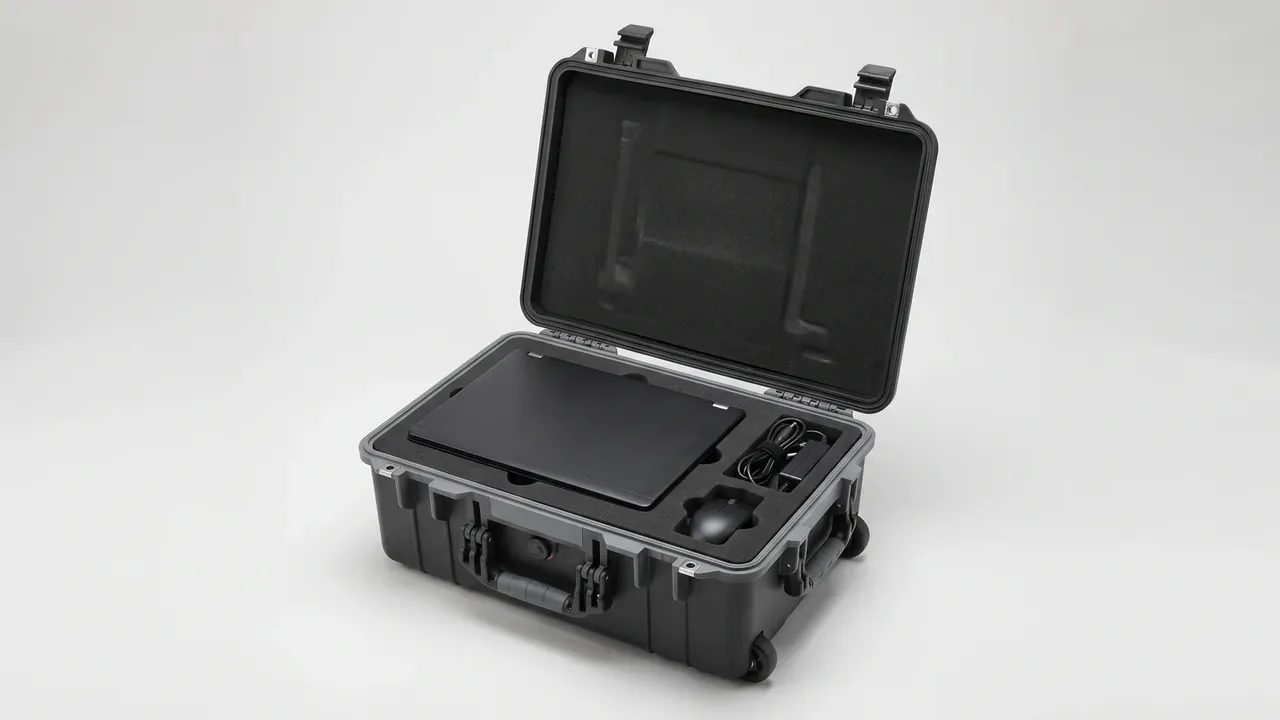
Three points in the baggage chain should drive the specification, not the catalogue. Belt joints run at 2.5 m/s and deliver high-frequency small shocks. The chute drop is 0.9 m, the first large bending moment at the housing. Loading throws reach 1.2 m, landing on two corners and two wheels together.
Acceptance runs on six lines:
- 25 kg rolled 10 km on concrete, no housing cracks and no axle play
- Ten drops at 1.2 m over six faces, three edges and one corner, wheels attached
- Handle cycled 5,000 times, lateral play under 5 mm
- Four M6 bolts re-torqued to 6 N·m, torque loss under 10 percent in 24 hours
- 30 minutes of rain, no ingress, checking the housing holes first
- 4 hours at −15 °C then 500 m of rolling, no tyre cracking
One more clause is worth writing: wheels must be a service part. An axle pin lets a wheel be changed in five minutes; a housing moulded into the base means one worn wheel scraps the base.
Conclusion
Wheel choice on a trolley case runs housing, diameter, bearing, handle. A 5 to 6 mm housing on four M6 bolts with 20 mm washers keeps water and cracks out; 75 or 100 mm wheels matched to load and surface keep vibration out; a 0.9 mm tube with POM guides keeps play out. Thirty flights later the log shows which was underspecified.
This article discusses only the container (case body) side of specifications and design intent, and does not cover any handling, loading or use of the contents.
Related Reading
- Wheels and handles on hard-shell trolley cases
- How rotational moulding forms a case
- The four stages of injection moulding a case
- Sizing and wall thickness for rotomolded cases
Related Products
- 8 Series — Gun Cases; Military Equipment Cases; Camera Equipment Cases; Drone Cases; Watch Cases; Knife Cases; First Aid Cases; Electronics Equipment Cases
- WL8-2812 PP Gun Case — model WL8-2812
- All protective cases and toolboxes: 7 series, 158 models