

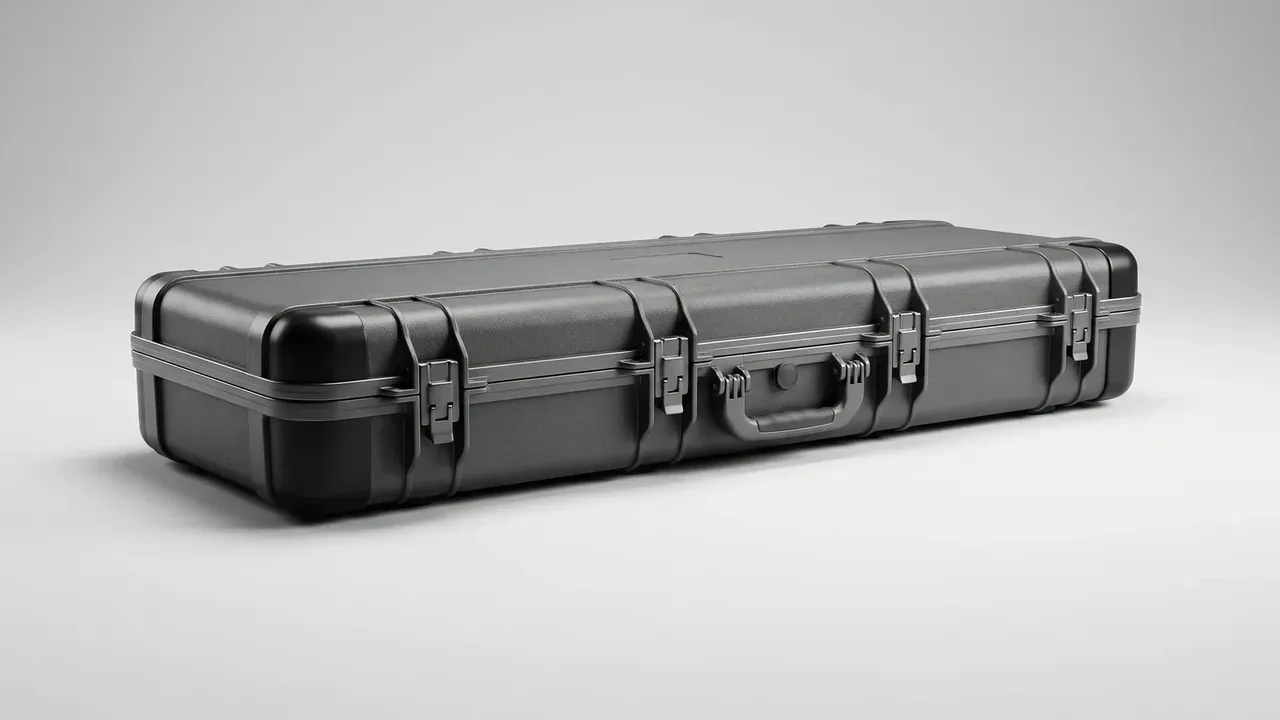
Quick answer: A plastic hard shell trolley case proves itself in the 800 metres between hotel door and gate: under 3 mm of handle play, four swivelling wheels of 50 mm or more, and a lid rated for 60 kg.
Table of contents
- Where a Plastic Hard Shell Trolley Case Fails First
- Three Numbers You Can Measure on Airport Floors
- Carry-On or Checked: 20 and 24 Inch Inner Volumes
- Locks, Zips and 60 kg of Stacked Load
- FAQ
1. Where a Plastic Hard Shell Trolley Case Fails First
A 06:40 flight means 800 metres from hotel door to gate across asphalt, terrazzo and jet bridge steel. A plastic hard shell trolley case takes more punishment there than in two hours of flight, because every wheel drop is a repeated impact.
The first failure is rarely the shell but one of three joints: the housing at the handle base, the pad where the wheel bracket meets the shell, and the closing seam. All three concentrate stress and hide under showroom light.
Test the handle base on the spot: extend it fully, hold the shell, push the top sideways three times each way. Over 3 mm of play means a loose housing, and a December bag meets minus 20 °C at the hold door, where plastic turns brittle.
| Size | Usable inner volume (L×W×H) | Wheel diameter | Handle stages | Empty weight |
|---|---|---|---|---|
| 20 inch | 480×330×215 mm | 50 mm | Three | 3.5 kg |
| 24 inch | 570×390×250 mm | 60 mm | Three | 4.3 kg |
| 28 inch | 650×440×290 mm | 75 mm | Three | 5.0 kg |
The figures count usable space, not the outside; two 24 inch cases can differ by 40 mm along the long side.
Top load is the forgotten item: a checked case sits under three or four others, so the shell should carry about 60 kg. A domed lid spreads that force, a flat lid sags; press the centre, and sinking past 5 mm means a full case will press on what is inside.
2. Three Numbers You Can Measure on Airport Floors
The handle is a three-stage unit: 22 mm aluminium tube, 1.2 mm wall, about 1020 mm of extension for a user of 170 to 180 cm. A button that returns halfway lets it drop a stage mid-walk.
Wheels wear out first: a 50 mm wheel is the floor, and smaller ones catch on tile joints and tactile paving. Above 70 mm the case clears obstacles but steering feels vague. All four must swivel through 360 degrees.
| Surface | Wheel diameter | Obstacle | Field test |
|---|---|---|---|
| Terminal terrazzo | 50 to 60 mm | 5 mm tile joint | Push 20 m at 45 degrees |
| Jet bridge steel plate | 60 mm and up | 10 mm plate gap | Push over three joins |
| Apron asphalt, tactile paving | 70 to 75 mm | 20 mm lip | Drag over a kerb edge |
| Hotel pile carpet | 50 mm twin wheel | Carpet drag | Push 10 m loaded |
Tread around Shore 90A is the steady choice: softer wears fast, harder is loud on concrete. Twin wheels track better but catch in escalator grooves.
3. Carry-On or Checked: 20 and 24 Inch Inner Volumes
The carry-on boundary is the sum of three sides. Most airlines allow 115 cm, and a 20 inch case at 555×355×230 mm measures 114 cm, just inside; a 24 inch usually totals 121 cm and must be checked.
Empty weight matters more than capacity. A plastic hard shell trolley case weighs 3.5 to 5 kg empty against a cabin allowance of often 7 kg. Pick the 3.5 kg 20 inch and 3.5 kg remains for belongings; a 5 kg version leaves 2 kg.
Inner volume follows: the 20 inch gives 480×330×215 mm, enough for three days of clothing, while the 24 inch gives 570×390×250 mm and the extra 90 mm on the long side holds shoes and a wash bag. Past four days, the checked 24 inch saves repacking.
Do not buy the widened carry-on with a side handle. It adds 15 mm of width, some airline frame gauges reject it, and the case ends up checked.
4. Locks, Zips and 60 kg of Stacked Load
Locks come as TSA combination or plain combination. For North America the TSA version is mandatory: customs holds a master key, and a forced opening is charged to the traveller. A 2 mm shackle offset stops the slider.
A double zip uses size 10 nylon coil with two sliders that meet, so a TSA lock can tie them. A latch closure uses two draw latches at the rim, resists top load better, but needs a padlock. For a checked plastic hard shell trolley case, latches hold up better; for cabin use, the double zip clears security faster.
Run five checks before shortlisting.
- Extend the handle, push it sideways three times, note the play
- Spin each wheel and feel for a tight spot
- Press the lid centre, watch how fast it returns
- Close both sliders, see whether the pulls line up
- Push a slider through the shackle, check for slack
If the shell does not distort and no wheel drags, the case earns a shortlist place.
Conclusion
Inspect a plastic hard shell trolley case in the order it breaks: handle housing and wheel pads first, then wheel diameter against the floor, then locks and finish. The hard lines are 3 mm of play, 50 mm of wheel and 60 kg of top load. Walk the 800 metres with them in hand, and the plastic hard shell trolley case will show what it is worth.
This article discusses only the container (case body) side of specifications and design intent, and does not cover any handling, loading or use of the contents.
Related Reading
- Hard shell suitcase upkeep and replacement lines
- Comparing three shell materials for hard cases
- What to inspect on a showroom visit
Related Products
- 8 Series — Gun Cases; Military Equipment Cases; Camera Equipment Cases; Drone Cases; Watch Cases; Knife Cases; First Aid Cases; Electronics Equipment Cases
- WL8-2812 PP Gun Case — model WL8-2812
- All protective cases and toolboxes: 7 series, 158 models