

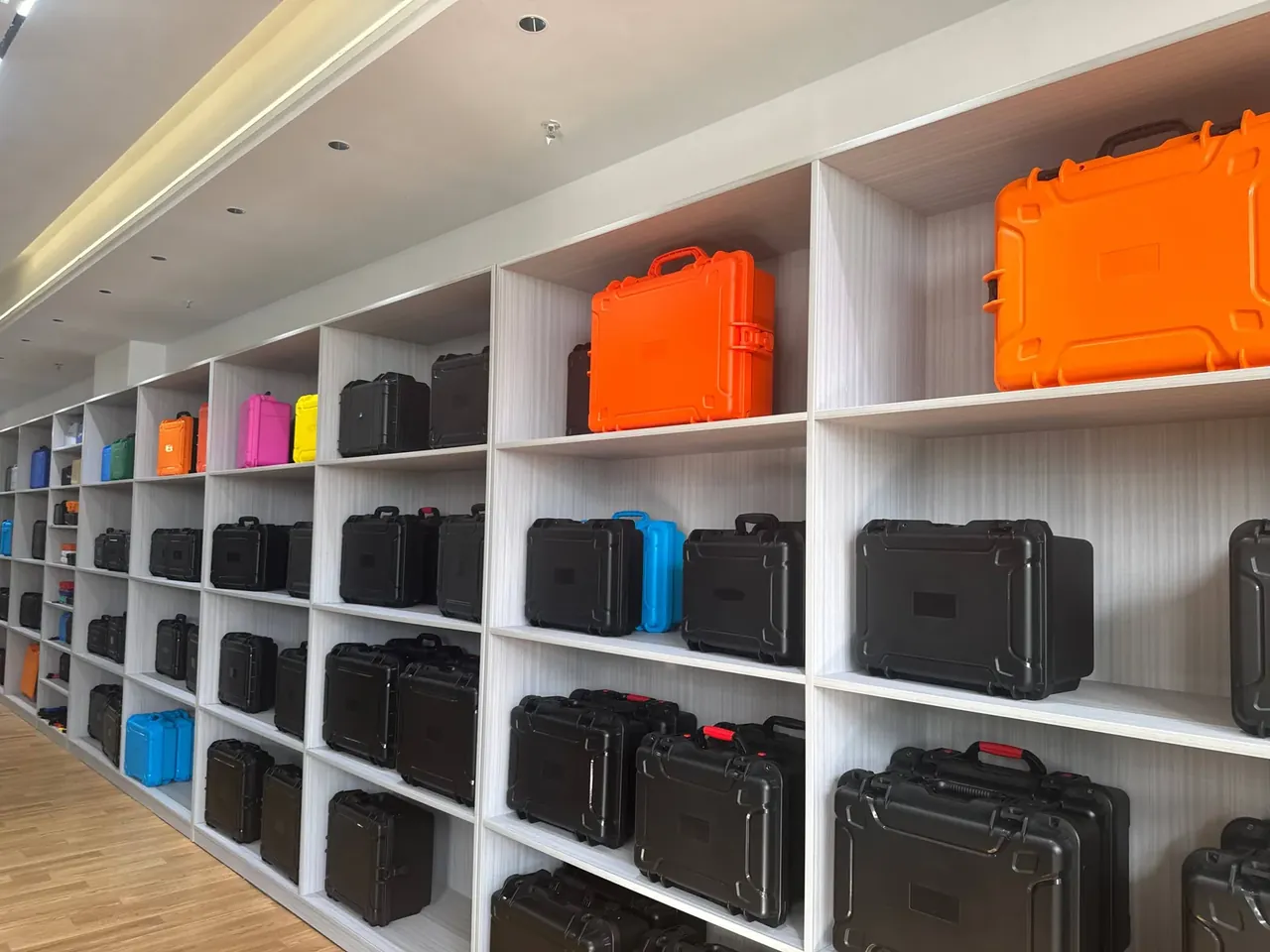
Quick answer: A Case Showroom is worth the trip for three things: how far the sample line spans in series and sizes, how a color card matches a real moulding in different light, and how wall, hinge and latch feel in the hand. A typical floor holds nine series and forty-two stock colors; one hundred minutes reads all three.
Table of contents
- Reading the Sample Line in a Case Showroom
- Color Cards Against Real Parts
- Hand Feel: Wall Thickness, Hinges, Latches
- Eight Parameters to Settle on Site
- A Route and a Hundred-Minute Budget
- FAQ
1. Reading the Sample Line in a Case Showroom
A sample line is the skeleton of a Case Showroom; its arrangement says more than unit count. One series per bay with cavity lengths stepping by 50 mm exposes tooling: adjacent sizes share one mould with a changed insert.
Count span, not units. A common floor holds nine series from 210 to 1180 mm; a narrow span turns every odd size into a new tool.
| Segment | Cavity length | How to check | What it tells you |
|---|---|---|---|
| Handheld | 210 to 350 mm | Lift with one hand | Wall 2.8 to 3.2 mm |
| Mid | 400 to 620 mm | Open lid, read rim step | Two latches, two hinges |
| Large | 700 to 900 mm | Close with both hands | Wall above 3.5 mm |
| Long | 950 to 1180 mm | Look for side ribs | Heavy empty weight |
2. Color Cards Against Real Parts
A color card is a small plaque; a case is a large moulding, and showroom light hides the difference. Spots in a Case Showroom usually run 3000 K at about 500 lux, which saturates orange and browns dark grey, so a match approved there shifts outdoors.
Judge in three positions: the spot for a first impression, window daylight for the decision, then 4000 K and 6500 K torches. A plaque that shifts between those temperatures is metameric, and its pigment blend drifts on a new batch.
Express the result as Delta E. Below 1.5 the eye cannot separate the two; above 3 they are different colors.
3. Hand Feel: Wall Thickness, Hinges, Latches
Hand feel is three measurable differences. Tap a side wall: 3.5 mm answers short and dull, 2.8 mm rings higher. A hollow note usually means sparse ribs, which no lighting reveals.
Hinges need three checks: clean swing, a lid that holds near 90 degrees, and no axial play in the pin. Twenty cycles should feel identical; a lid that stays near 100 degrees has real damping.
Latches are about travel: one firm click over roughly 3 mm. Two hands to close means latch and keeper are too tight.
| Check | Method | Acceptable | Warning |
|---|---|---|---|
| Wall | Caliper, rim and side | 3.5 mm, within 0.2 mm | Rim thinner |
| Stiffness | Thumb press | Quick return | Soft recovery |
| Hinge | Twenty cycles | Consistent, no axial play | Loosens, metallic rasp |
| Latch | One-hand close | Single click, 3 mm travel | Two hands needed |
4. Eight Parameters to Settle on Site
The easiest thing to forget in a Case Showroom is to ask for numbers; samples can look right and leave the quotation without one.
Ask for resin grade and wall tolerance with a measuring position attached. Ask for a color code plus Delta E limit, not a name. Ask for latch cycles and the test behind them, hinge torque and angle, seal rating, and whether the tool is shared.
5. A Route and a Hundred-Minute Budget
Walk outside in, whole to detail: main wall, size run, color bench, handling bench, then questions. Questions first and the model numbers blur.
Spend the hundred minutes as twenty-five on the wall, fifteen on the size run, twenty on color, twenty-five on hand feel, fifteen on questions. Bring a caliper and a 4000 K torch into the Case Showroom.
| Stop | Time | Action | Record |
|---|---|---|---|
| Main wall | 25 min | Count series, note steps | Series and size list |
| Size run | 15 min | Open lids, read ribs | Height and step photos |
| Color bench | 20 min | Compare three lights | Code and Delta E |
| Handling bench | 25 min | Tap, cycle, latch | Feel notes |
| Questions | 15 min | Confirm parameters | Sheet, lead time |
Conclusion
A Case Showroom earns its place only when three findings reach paper: the size span of the sample line, a Delta E figure under a named light, and measured wall and latch travel. Write those numbers down; that is how a Case Showroom trip pays for itself.
This article discusses only the container (case body) side of specifications and design intent, and does not cover any handling, loading or use of the contents.
Related Reading
- How color customization is delivered
- Visual management of case colors
- Lessons from supplier sample evaluation
- Sampling and approval for protective cases
Related Products
- 8 Series — Gun Cases; Military Equipment Cases; Camera Equipment Cases; Drone Cases; Watch Cases; Knife Cases; First Aid Cases; Electronics Equipment Cases
- WL8-2812 PP Gun Case — model WL8-2812
- All protective cases and toolboxes: 7 series, 158 models