

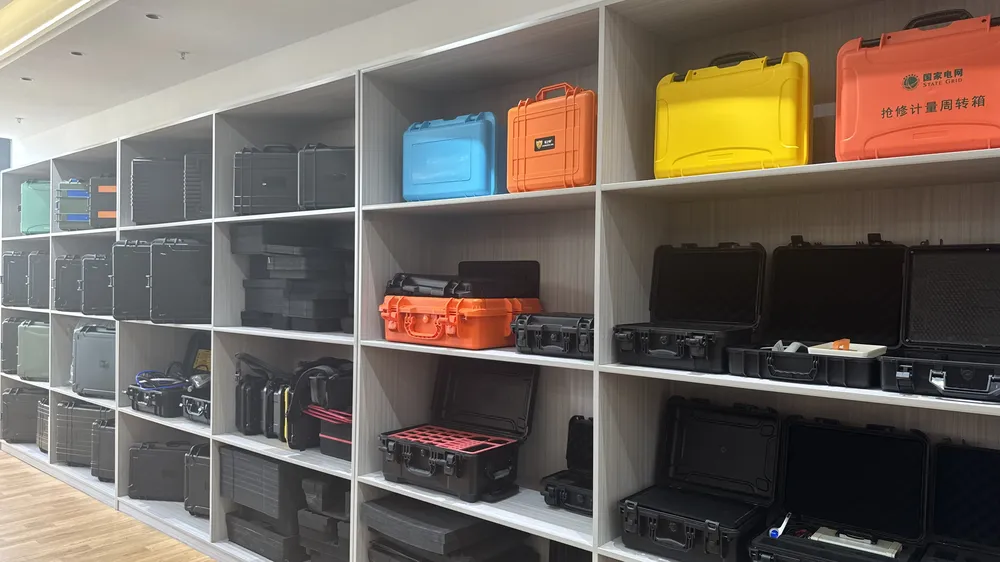
Sample evaluation is where most sourcing decisions are actually made, and it is usually done informally: boxes are opened, handled, and a judgement forms. That judgement is real but hard to defend and harder to compare. A simple scorecard fixes both problems.
The Scorecard
| Dimension | What to check | Why it predicts the production run |
|---|---|---|
| Dimensional accuracy | Critical internal and external dimensions against the drawing | Reveals tooling quality and process control |
| Material and finish | Resin consistency, wall thickness, surface quality, flash | Indicates mould condition and material discipline |
| Hardware | Latch action, hinge movement, fastener quality | Hardware fails before the shell does |
| Interior fit | Cavity accuracy, foam quality, adhesion, finish | Where most field complaints originate |
| Sealing | Gasket seating, lid closure, even compression | Determines whether the claimed rating holds |
| Documentation | Drawings, test reports, material declarations | Predicts how the supplier handles problems |
Score each dimension on the same scale for every supplier, and write a note for anything that stands out. The notes matter as much as the numbers: a low score on documentation is a different kind of risk from a low score on fit.
Physical Checks the Eye Misses
- Open and close every latch twenty times. Action should stay consistent; any change in feel is worth investigating.
- Check gasket continuity around the full perimeter, especially at corners where seating is hardest.
- Insert and remove the real payload — not a stand-in of similar size.
- Weigh the case. A lighter sample than specification may indicate reduced wall thickness.
- Look inside the shell for uneven wall thickness, sink marks or short shots.
- Close the lid and check the gap all the way around; uneven gaps predict sealing problems.

Making Quotes Comparable
Quotes are only comparable when they describe the same product. Before scoring price, normalise the specification: confirm each supplier quoted the same resin, wall spec, hardware grade, interior type and test evidence. A lower quote that quietly drops a requirement is not a saving — it is a different product.
Common Mistakes
- Comparing prices before normalising specifications.
- Evaluating a presentation sample rather than a production-standard unit.
- Testing with a stand-in payload instead of the real item.
- Scoring on looks when the failure modes are mechanical.
- Skipping documentation, then discovering at audit that no records exist.
Our article on the sampling and approval process describes how a sample becomes a sealed reference standard, and MOQ and lead time explains what the schedule depends on.