

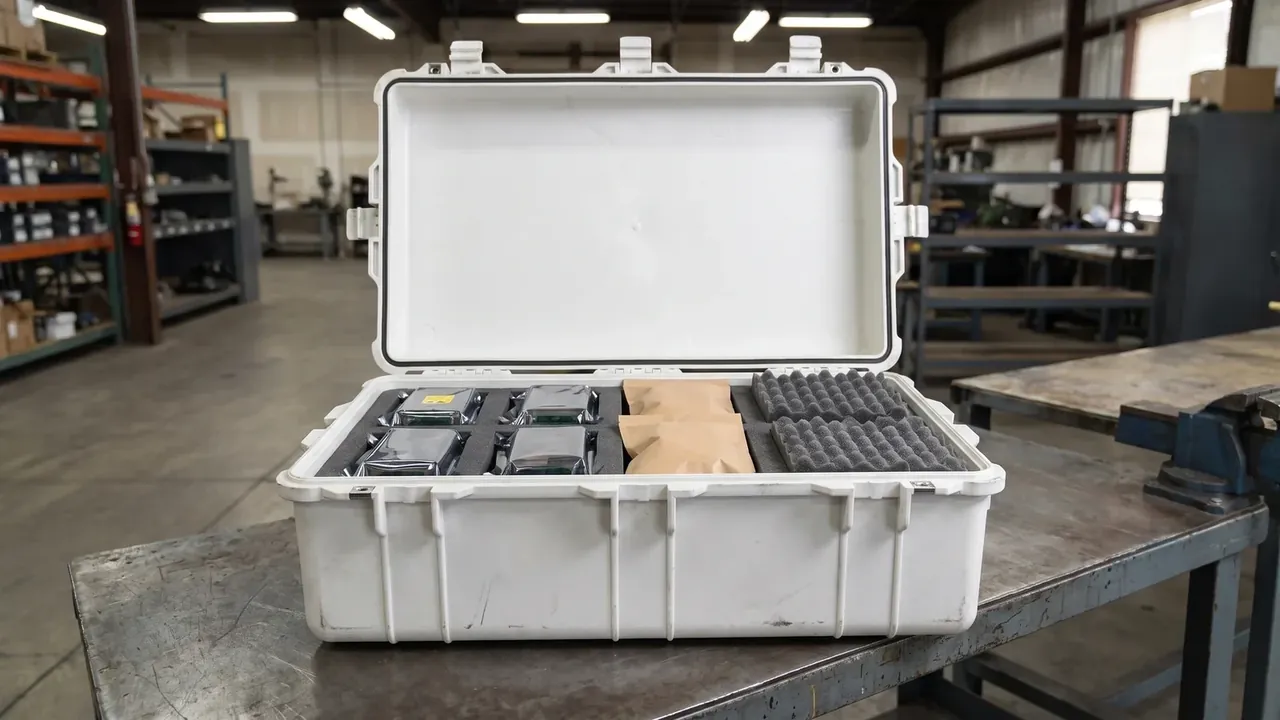
Quick answer: Judge a rotomolded case by five measurable things: wall thickness spread, empty weight against volume, the latch and gasket load path, insert replaceability, and batch weight repeatability.
Table of contents
- Five Checks for Rotomolded Case Selection
- Wall Thickness, Weight and Mould Temperature
- Latches, Gasket and Handle Load Paths
- Foam Inserts Specify the Equipment First
- Acceptance Data Salt Spray Drop and Stacking
- FAQ
1. Five Checks for Rotomolded Case Selection
A rotomolded case is formed by tumbling polyethylene powder on two axes inside a heated mould until it fuses in layers. Thickness comes from powder mass and mould temperature together, not from a single injection shot, so a buyer should measure corners and latch pitch instead of judging finish.
Weight is the most misread signal. An empty 60 litre rotomolded case normally lands between 11 and 14 kg. Under 10 kg, ask where the wall went; over 16 kg, ask whether corners were packed solid for no reason, because that mass is paid back on every carry.
| Check | Evidence on the floor | Common misread |
|---|---|---|
| Wall evenness | Three points per wall, spread under 0.8 mm | Feeling only the rim |
| Weight to volume | 60 litre empty at 11 to 14 kg | Heavier means stronger |
| Latch pitch | Two per long side, under 260 mm | Counting latches only |
| Insert serviceability | Layers lift out whole | Glued grids |
| Batch spread | Five units, under 2% | Checking unit one |
2. Wall Thickness, Weight and Mould Temperature
Wall thickness runs 4.5 to 6.5 mm and thickens to 8 mm at corners and hinge bosses. Each extra 0.5 mm adds about 0.9 kg to a 60 litre case and stretches a 25 minute cycle toward 40.
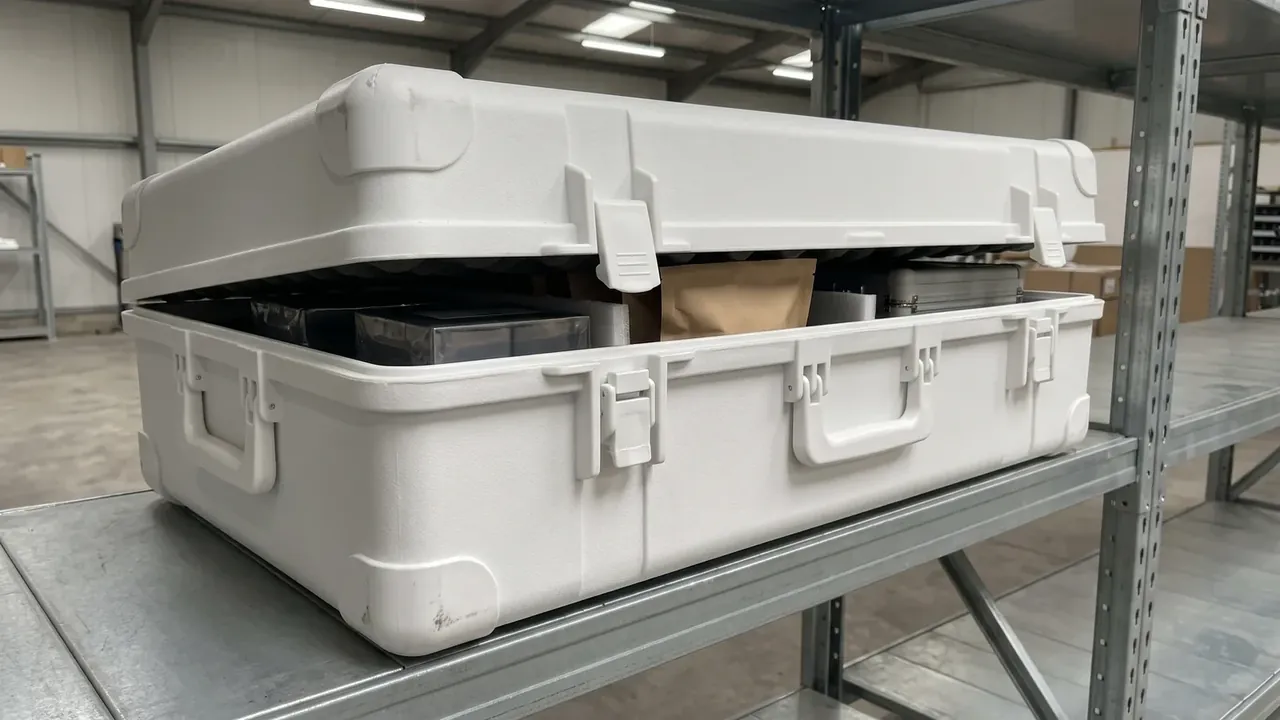
Mould temperature is held between 200 and 280 C, with the axes alternating a 4 to 1 and a 1 to 1 ratio and powder near 200 mesh. Too cool leaves unfused granules; too hot yellows the interior. A cut section should be dense and even in colour.
Stiffness comes from ribs and radii. Vertical ribs at 90 to 120 mm pitch with 15 mm corner radii let a 4.5 mm wall resist close to a 6 mm flat panel.
3. Latches, Gasket and Handle Load Paths
Sealing is compression, not latch count. A silicone gasket at 50 Shore A, compressed about 30 percent, needs the rim flat within 0.5 mm. Hold 30 kPa for 60 seconds; a drop above 1 kPa means the seal is nominal only.
One latch should hold 300 N for a minute without yielding, and pitch on cases longer than 600 mm should stay under 260 mm or the middle of the lid lifts. Handles take dynamic load: 45 kg static for 10 minutes, with no whitening at the joint. Hinge pins belong in stainless, since a -40 C soak plus 20 cycles exposes plastic ones.
4. Foam Inserts Specify the Equipment First
Measure the equipment outline first, then work back to the cavity: 8 mm of foam on each side, 15 mm at the top, 10 mm at the bottom. Buy the case first and the only fit left is shaved foam, which removes the very margin that absorbs shock.
Divider walls run 8 to 12 mm, with 1.5 mm clearance between compartments and a 5 mm finger gap. EVA at 30 kg per cubic metre suits items under 1 kg; PU at 45 suits items above 3 kg.
5. Acceptance Data Salt Spray Drop and Stacking
Write numbers into the clause. Neutral salt spray for 96 hours covers latch springs, hinge pins and axles, with the shell checked for cracks beyond 2 mm. Drop on six faces from 1.2 m, then stack five high for 24 hours with sink under 3 mm.
| Item | Condition | Pass line |
|---|---|---|
| Salt spray | 96 hours continuous | No red rust, no shell crack |
| Drop | 1.2 m, six faces | No crack, no latch release |
| Stacking | 5 high, 24 hours | Sink under 3 mm |
| Air tightness | 30 kPa, 60 seconds | Drop under 1 kPa |
Cycle between -40 C and 60 C for four hours each, three times, then repeat the air and latch tests. That record says more than any brochure.
Conclusion
Five measurements settle most of the decision: thickness spread, empty weight, latch pitch, gasket recovery and batch repeatability. Process consistency, not the sample on the table, sets long term cost, and that is the line a rotomolded case buyer should keep watching.
This article discusses only the container (case body) side of specifications and design intent, and does not cover any handling, loading or use of the contents.
Related Reading
- Structure and process of a rotomolded case
- Rotomolded case versus alternatives
- Maintenance checks for rotationally molded cases
- Field configurations for military rotomolded cases
Related Products
- 8 Series — Gun Cases; Military Equipment Cases; Camera Equipment Cases; Drone Cases; Watch Cases; Knife Cases; First Aid Cases; Electronics Equipment Cases
- WL8-2812 PP Gun Case — model WL8-2812
- All protective cases and toolboxes: 7 series, 158 models