

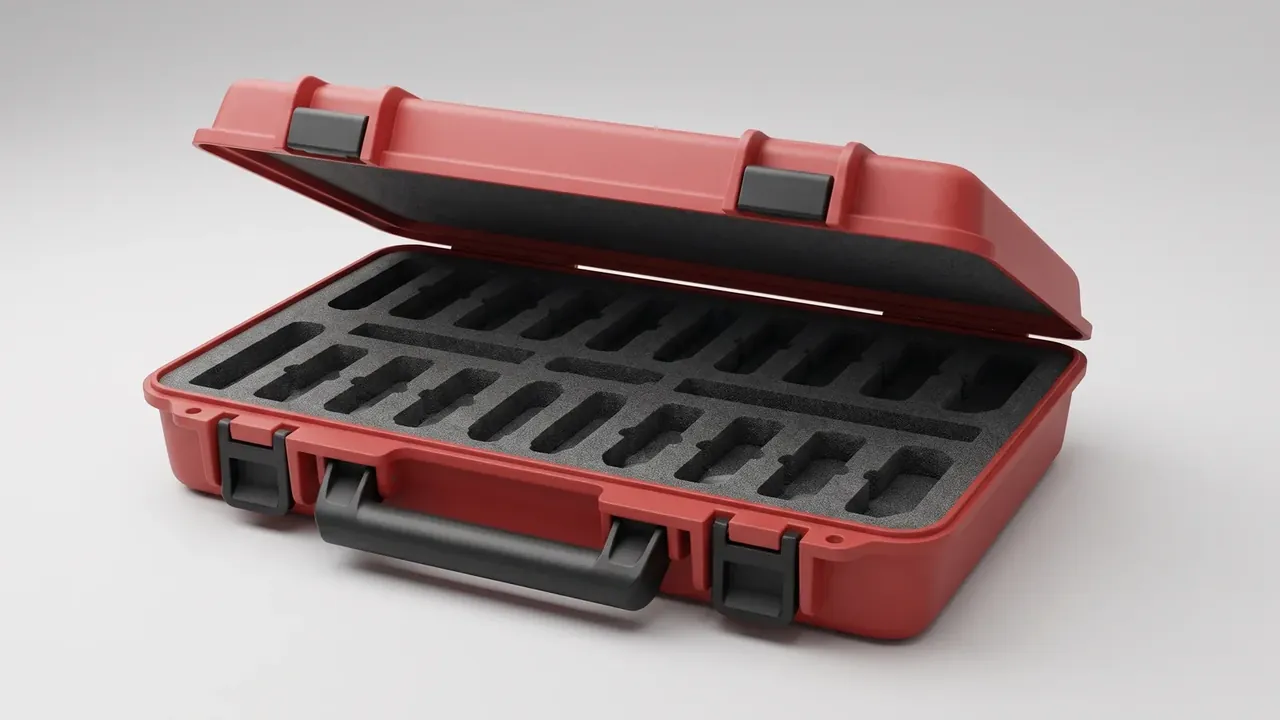
Quick answer: Automotive Tool Case Size Selection starts with the longest tool, not the catalogue, then discounts cavity volume to 78%–85%.
Table of contents
- Measuring the tools before the van
- Working out the usable ratio
- Loaded weight and handle load
- Stacking and shelf fit
- Trial fit and the return line
- FAQ
1. Measuring the tools before the van
Buy too big and the van loses space; buy too small and the job costs a second trip. Automotive Tool Case Size Selection begins on the workshop floor rather than the shelf: spread the tools out and measure the longest piece, the widest piece and the heaviest piece.
Length decides internal clear length. A 1 m torque wrench, a 0.6 m socket rail and a 0.35 m ratchet laid end to end take twice the room of the same three side by side. Automotive Tool Case Size Selection counts them end to end, because tools lie down in a case rather than stand up.
Mass decides the base. A 25 kg socket set in one corner needs ribs under it; the same 25 kg spread flat halves the pressure. Automotive Tool Case Size Selection keeps loaded weight as one number and checks later steps against it.
| What to measure | Recorded value | What it sets |
|---|---|---|
| Longest tool | 1000 mm torque wrench | Internal length |
| Widest tool | 350 mm socket rail | Internal width |
| Stack height | 180 mm, three layers | Internal depth |
| Loaded weight | 25 kg | Base and handle |
The van is measured at its openings. A tailgate aperture runs near 750 mm, folded seats leave about 1.4 m of floor, and each wheel arch takes another 200 mm. Automotive Tool Case Size Selection treats the van as a second case, measured before the spec sheet comes off the shelf.
Reverse the order and it costs a return: a 600 mm case looks right until a 1 m wrench will not go in. Automotive Tool Case Size Selection fixes the sequence at tools, van, model.
2. Working out the usable ratio
Nominal cavity volume is not the volume that accepts tools. Corners, ribs and insert thickness each take a share, and what remains is usable. Automotive Tool Case Size Selection estimates that at 78%–85%, with boxy shells near the top and lined shells near the bottom.
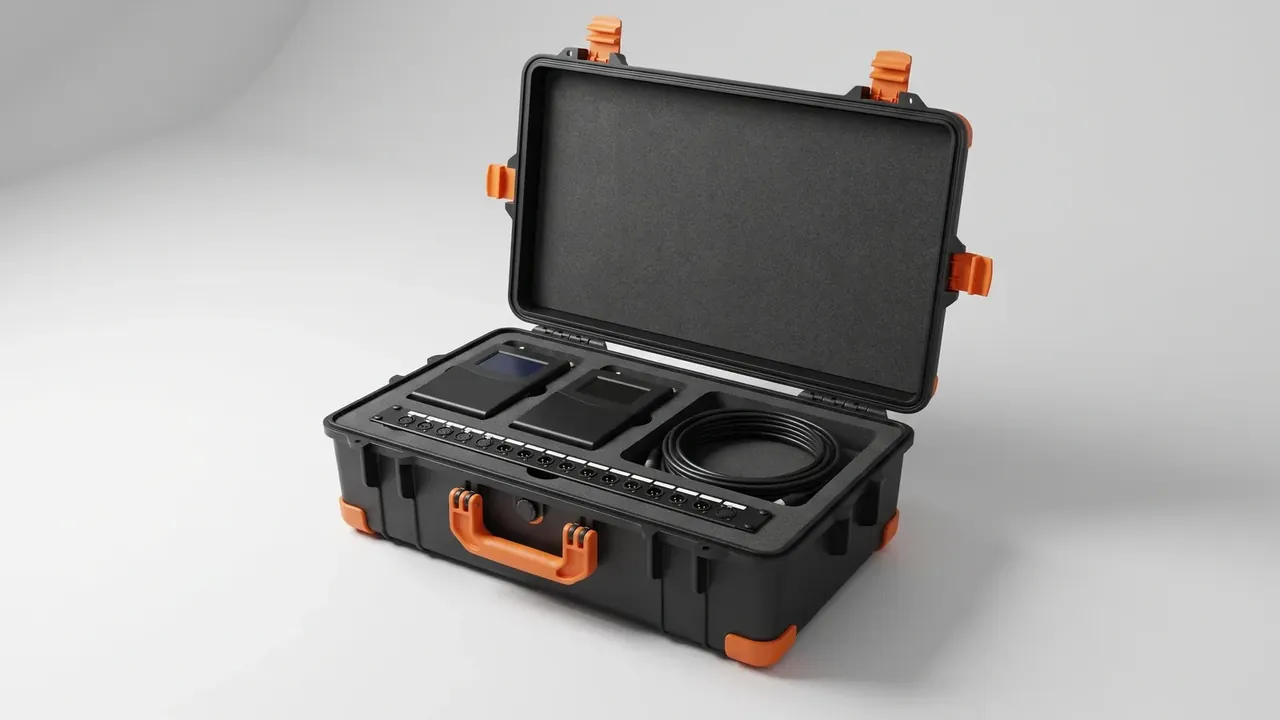
A 500×350×200 mm cavity is nominally 35 L; four R20 corners take about 1.2 L and a 20 mm insert about 6 L, leaving 27 L to 28 L, a ratio near 79%.
| Model | Outside | Cavity | Usable ratio |
|---|---|---|---|
| Small | 460×350×180 mm | 440×330×160 mm | 82% |
| Medium | 560×420×220 mm | 540×400×200 mm | 85% |
| Large | 660×500×280 mm | 630×470×250 mm | 78% |
Wall thickness deserves its own line. A case nominally 600 mm outside gives a 592 mm cavity at 4 mm walls; a reinforced build at 8 mm walls leaves 584 mm, so the two sides lose 8 mm between them. Automotive Tool Case Size Selection treats that 8 mm as a fixed deduction.
3. Loaded weight and handle load
25 kg is roughly the ceiling for one-handed carrying over 50 m on flat ground. Automotive Tool Case Size Selection sizes the shell to that figure, and anything above it gains wheels or splits into two cases.
A handle sees more than static load: lifting and setting down apply about twice the static figure, so 25 kg pulls near 500 N. Automotive Tool Case Size Selection looks at the reinforcement block at the handle root, since a small block puts the load on one edge of the lid.
| Load state | Handle peak | Allowed sag | Verdict |
|---|---|---|---|
| 15 kg, tools and liner | 300 N | 1.5 mm | Carry by hand |
| 25 kg, fully loaded | 500 N | 3 mm | Carry, avoid stairs |
| 32 kg with spares | 640 N | 5 mm | Add castors |
Base sag is the load talking back: fill the case, hang it for 1 min, set it down, measure the lowest point against the floor. Past 3 mm the base has begun to yield and will bulge with use.
4. Stacking and shelf fit
Base dimensions have to match the pallet. On a 1200×800 mm Euro pallet, 600×400 mm cases go four to a layer with no gap. Automotive Tool Case Size Selection treats the base as a hard constraint, since 20 mm of mismatch rocks.
Container maths works in whole units. A 40HQ measures 12.03 m inside, which takes 20 cases of 600 mm in a row; allowing 50 mm for handling, the count drops to 19. Automotive Tool Case Size Selection quotes 19, and the missing unit is the margin.
| Setting | Base | Per layer | Layers |
|---|---|---|---|
| Euro pallet | 600×400 mm | 4 | 3 |
| Industrial pallet | 600×500 mm | 4 | 3 |
| 40HQ floor | 600×400 mm | 19 in a row | 2 |
| Workshop shelf | 600×400 mm | 2 side by side | 4 |
Stacking is judged at the bottom case. Three layers at 25 kg put 50 kg on the lowest lid, which bows in the middle. Automotive Tool Case Size Selection asks the lid to hold 50 kg for 24 h without collapse, and drops to two layers when it cannot.
Shelf clearance is the other limit. A 1.8 m bay with 280 mm cases takes four layers and leaves room for hands; a 400 mm model reaches 1.6 m and needs a stretch at the top.
5. Trial fit and the return line
Trial fit happens in the workshop, before the order. Load the tools once and check three things: the lid closes without force, the base sits level when lifted, and the tailgate shuts with the case in place. Automotive Tool Case Size Selection treats those three as acceptance, and any one needing force means the size is wrong.
The return line is agreed up front. A mismatch raised at trial fit, with no holes drilled and no foam cut, can be exchanged; once the insert is cut to the tools, a new size means new foam.
Retirement comes at a measured ratio under 75%, or 3 mm of base sag at 25 kg loaded.
The route into the van gets a trial too. Bench to bay, over the tailgate, down behind the seats: two turns. A 600 mm case turns in one pair of hands, an 800 mm one does not.
Related Reading
- How case volume is calculated: cavity, corners and usable ratio
- Socket and wrench tool box shell for auto repair
- Protective case or carton: where e-commerce shipping divides
JUNZHIJIA
Related Products
- 8 Series — Gun Cases; Military Equipment Cases; Camera Equipment Cases; Drone Cases; Watch Cases; Knife Cases; First Aid Cases; Electronics Equipment Cases
- WL8-2812 PP Gun Case — model WL8-2812
- All protective cases and toolboxes: 7 series, 158 models