

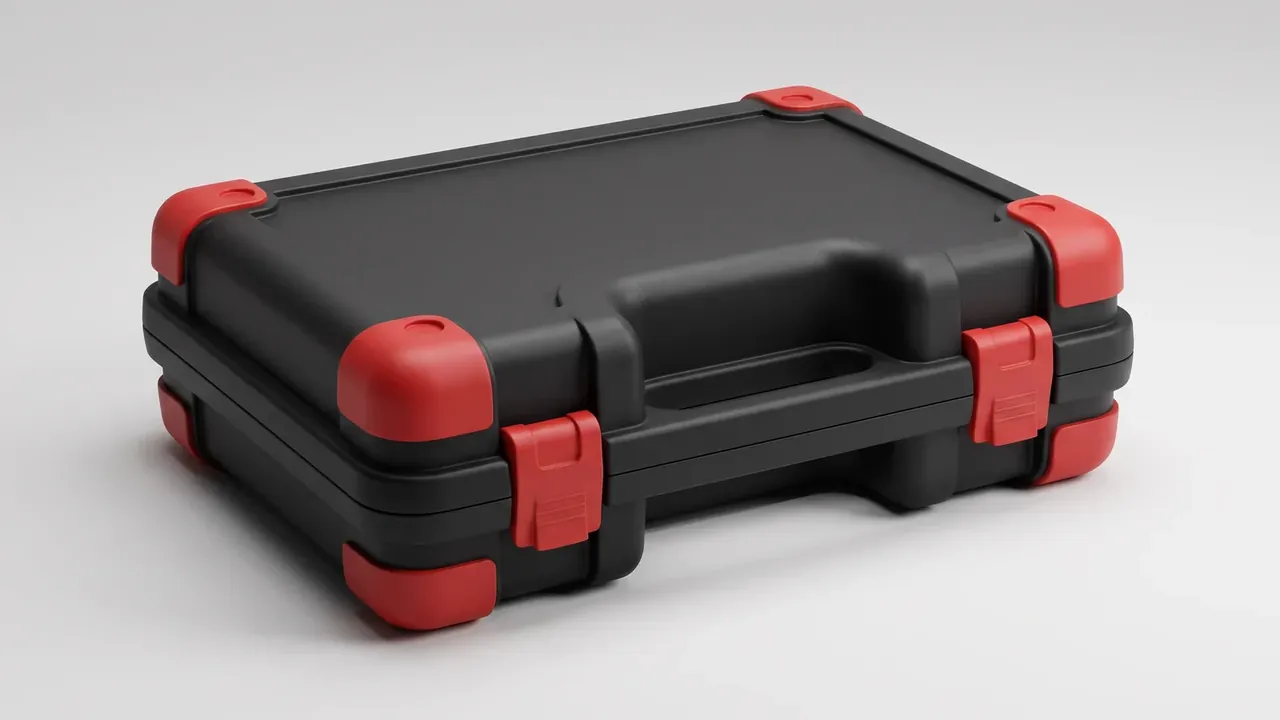
Quick answer: Standardising an automotive tool case comes down to three rules rather than one supplier: a set count per bay, a colour plus six-digit code that fixes ownership, and a 20-pick threshold that decides what stays in a drawer and what travels in a case.
Table of contents
- Where an automotive tool case fits in a 4S bay
- Colour and numbering per bay
- PP against ABS under workshop cleaners
- Drawers against cases
- Load, castors and stacking
- Counting, traceability and 5S
- FAQ
1. Where an automotive tool case fits in a 4S bay
A bay holds tools in three layers: cart drawers, an on-board box, and a case that leaves the building. The automotive tool case is that third layer, lifted off the cart and loaded into a service van. Twelve bays at five units each come to 60 sets, and until that number is fixed nothing standardises.
| Unit | Stored at | Pieces | Picks |
|---|---|---|---|
| General | Cart top | 28 to 35 | 20+ a shift |
| Diagnostic | Bay shelf | 6 to 9 | 4 to 6 a day |
| Tyre | Lift side | 8 to 12 | 2 to 3 a day |
| Roadside | Van bay | 16 to 22 | 1 to 2 a week |
| Special | Parts store | 4 to 8 | 1 to 3 a month |
The boundary matters more than the moulding. One set covers about 80 percent of routine servicing and 60 percent of strip-down work, the remaining 20 percent drawn from special-tool stock against a job card. Vague boundaries end with twenty sets ordered.
2. Colour and numbering per bay
Colour goes to the team, not the bay. Five teams take five colours through bumpers or latches rather than paint, which lifts within 3 months beside a lift. Numbering runs six digits: two for zone, two for bay, two for sequence.
Labels sit on the lid face, upper left, at 6 mm character height, 10 mm clear of the handle. Keep the padlock eyelet: strict tool control runs a 4 mm wire lock through it and the cart rail.
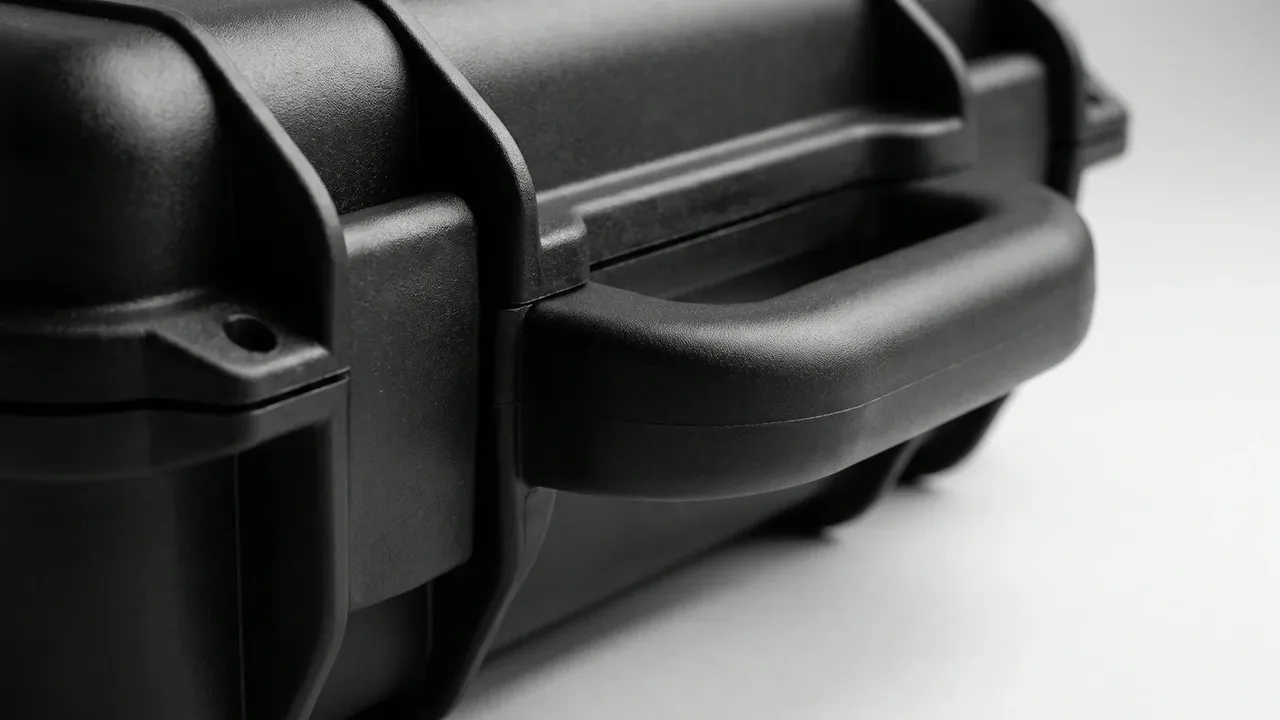
Colour settles ownership, the code settles traceability.
3. PP against ABS under workshop cleaners
Workshop cleaners run alkaline at pH 11 to 12, and brake cleaner carries acetone and toluene. PP shrugs off both; ABS whitens within 30 minutes of ketone contact and shows hairline cracks after about 100 wipes. At the same 3 mm wall, a PP case takes 500 hours before it loses gloss, a resin difference rather than a thickness one.
| Medium | PP | ABS | Verdict |
|---|---|---|---|
| Alkaline, pH 12 | Stable | Slight gloss loss | Either |
| Brake cleaner | Stable | Whitens in 30 min | PP only |
| Engine oil | Stable | Stable | Wipe clean |
| Petrol | Slight swell | Clear swell | No residue |
PP holds notched impact near 6 kJ/m² at −10 °C while ABS falls to 3 kJ/m², so a winter drop from a tailgate cracks ABS inside the bumper more often. Residue counts too: where a rib ends square, 2 to 3 ml of cleaner pools and turns tacky within a week, so an R2 radius pays for itself.
4. Drawers against cases
Drawers take high-frequency items and cases take the rest, split at 20 picks a shift against 2 a week. A seven-drawer cart with a 900 × 600 mm top runs 35 kg slides, and a full drawer pulls hard enough that the technician works off the top instead.
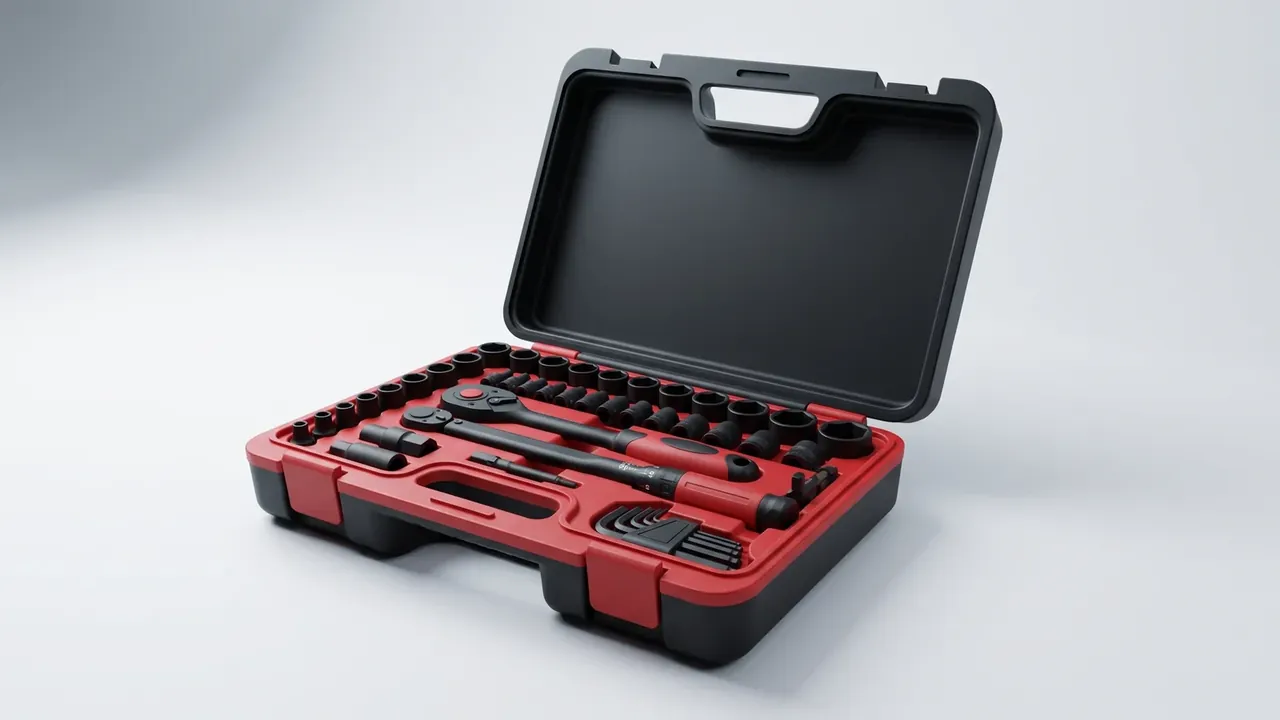
The automotive tool case covers a different leg of the job: out of the cart, across the floor, into the van, then to the roadside. A 30 mm EVA shadow board gives every tool one pocket, so a gap reads at a glance. At 4.2 kg empty and 25 kg loaded it stays a one-person lift; past 30 kg it needs wheels.
Two patterns appear where the split is unclear. Load everything into cases and the unit reaches 38 kg, nobody carries it, and it stays in the van. Load everything into drawers and the cart will not fit under a lift, adding 6 minutes to a service order. Cutting at 20 picks leaves cases holding 30 to 40 percent of the tools at 22 to 28 kg.
5. Load, castors and stacking
A 25 to 40 kg rating covers contents plus the case. A moulded body with a 3 mm wall and four base ribs may show 2 mm of corner set after two 1.2 m drops. Stacked four high, the bottom unit carries 160 kg, so pallet beams sit no more than 600 mm apart.
Castors run 100 mm, two fixed and two swivel, at 120 kg dynamic and 300 kg static; on an oily floor the swivel pair needs brakes.
| Item | Criterion | Interval |
|---|---|---|
| Latch effort | 80 to 110 N | Quarterly |
| Handle | No set at 25 kg | Twice a year |
| Castors | Under 2 mm wear | Quarterly |
| Base | Under 2 mm set | Monthly |
6. Counting, traceability and 5S
Checks run at two levels: 15 minutes on Friday against the shadow board, 45 minutes a month against the numbering. A missing item is traced within 48 hours through three routes: the sign-out sheet, camera coverage, loans between bays.
5S lands as four actions: sort clears anything untouched for six months, set-in-order is the shadow board plus numbering, shine is a wipe a shift, and standardise writes the first three into the handover sheet.
An automotive tool case set lasts about 4 years, with latches cycling around 10,000 times. Gaskets and handles age first from year three, and replacing them costs roughly 40 percent of a new case.
Conclusion
Standardising an automotive tool case comes down to numbers a manager can check: five units per bay and 60 sets, five colours with six-digit codes, and a 20-pick line between drawers and cases. Below that sit the figures on an acceptance sheet: 3 mm wall, 25 to 40 kg rating, 100 mm castors, 80 to 110 N latch effort, each one checkable on arrival.
This article discusses only the container (case body) side of specifications and design intent, and does not cover any handling, loading or use of the contents.
Related Reading
- Plastic tool boxes in automotive repair bays
- On-board tool cases for service vehicles
- Writing specifications for hardware tool boxes
Related Products
- 8 Series — Gun Cases; Military Equipment Cases; Camera Equipment Cases; Drone Cases; Watch Cases; Knife Cases; First Aid Cases; Electronics Equipment Cases
- WL8-2812 PP Gun Case — model WL8-2812
- All protective cases and toolboxes: 7 series, 158 models