

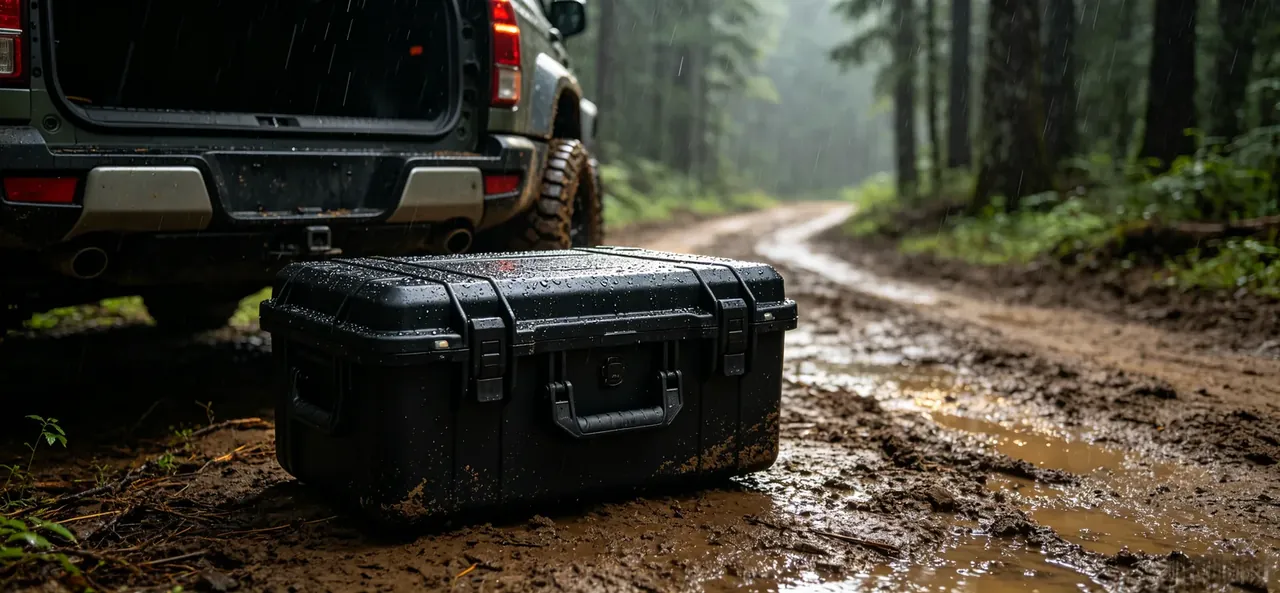
Quick answer: A battery storage case is sized by two numbers that pull opposite ways: a 50 g peak at 0.8 m wants wall, an 8 mm creepage path wants air.
Table of contents
- Where the 50 g Comes From
- Four Layers and the One That Runs Out First
- Creepage: 8 mm Measured Along the Surface
- Reading 100 MΩ Without Fooling Yourself
- 45 kg, Three High, and What Gives First
- FAQ
1. Where the 50 g Comes From
A cavity of 620 × 420 × 300 mm, loaded to 45 kg and dropped from 0.8 m, put 50 g on the accelerometer bolted to a corner foot, and the pulse lasted 6 ms. Wall thickness, foam stack and latch position all sit downstream of that reading. Shops that order the drop report last usually find a 70 g spike mid-face, and the only cure left is thicker foam.
Impact speed is arithmetic: 3.96 m/s. What varies is stopping time. A concrete slab barely yields, so the kinetic budget is spent inside shell and liner; cram the stop into 6 ms and deceleration lands at 50 g. Set the same case on 20 mm of plywood and the stop stretches to 9 ms at 33 g; a report that names a height but not a floor says little.
2. Four Layers and the One That Runs Out First
Wall 8 mm, EPE 20 mm, EVA 5 mm, insulating barrier 2 mm. On one section the jobs separate: the wall spreads a point hit into a patch, the EPE converts thickness into time, the EVA stops the pack frame shifting.
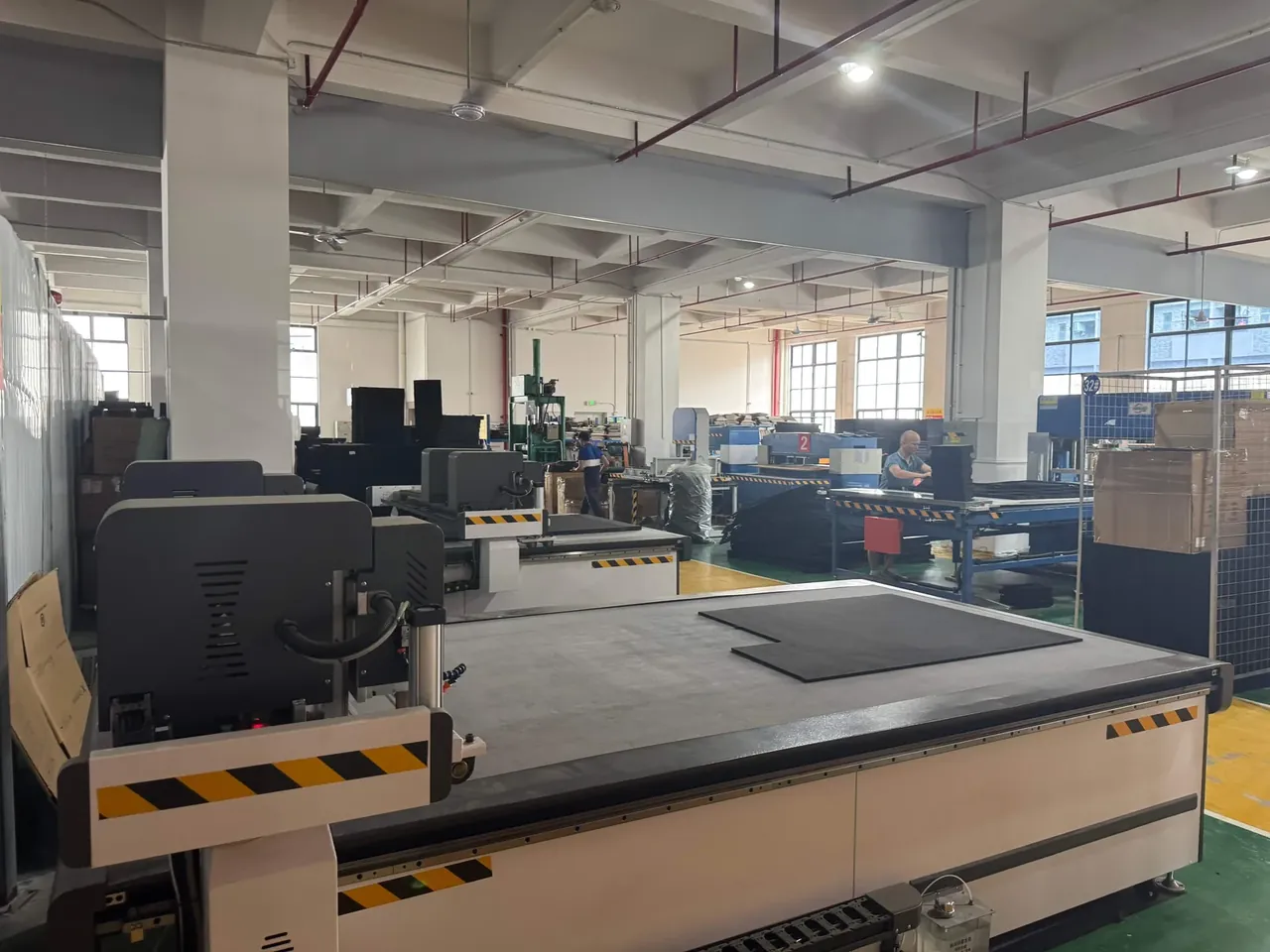
The split can be estimated layer by layer. At 50 g the 8 mm wall deflects 3.2 mm and takes about 12% of the energy; 20 mm EPE takes 55% when compressed to 60%; 5 mm EVA takes 20% more; 13% is left for frame and fasteners. Past 60% the EPE enters its dense phase, the force for the next 3 mm doubles, and shock passes straight through to the pack.
| Impact point | Load-bearing member | Deflection | Energy share | Peak into pack |
|---|---|---|---|---|
| Base corners | Corner blocks, vertical ribs | 1.1 mm | 18% | 41 g |
| Mid long side | 8 mm wall, two ribs | 3.2 mm | 12% | 44 g |
| Lid between latches | Lid rim, two latches | 2.4 mm | 15% | 42 g |
| Vertical edge 45° | R12 corner, edge rib | 0.8 mm | 21% | 39 g |
Density decides repeat performance. At 18 kg/m³ the sheet hits its limit at 0.35 MPa and collapses 4 mm on the first drop, so the second behaves as if nothing were fitted; a 25 kg/m³ grade holds 0.5 MPa, returns 92%, and loses 1.5 mm over five drops.
3. Creepage: 8 mm Measured Along the Surface
The air between wall and pack frame is easier to overlook than the wall. On a 1000 V DC system at pollution degree 2, creepage along an insulating surface is 8 mm, measured across the barrier rather than point to point. Ribs, print and counterbores all count as route, so detours shorten the usable distance.
That figure follows from clearance: 5.5 mm covers 1000 V, and creepage multiplies it by a group factor of 1.45 for group II material. Condensation and a contaminated film can eat 30% of it, leaving 5.6 mm, right on the limit. Raising the rib from 8 mm to 12 mm lifts the surface path to 11 mm and keeps 7.7 mm when the interior is wet.
| Voltage class | Clearance | Creepage | Rib height | Pollution degree |
|---|---|---|---|---|
| 400 V DC | 3.0 mm | 5.0 mm | 8 mm | 3 |
| 800 V DC | 4.5 mm | 6.5 mm | 10 mm | 2 |
| 1000 V DC | 5.5 mm | 8.0 mm | 12 mm | 2 |
| 1500 V DC | 8.0 mm | 12.0 mm | 16 mm | 2 |
Material joins the sum. PA66 with 30% glass tracks near 400 V, plain PP near 600 V; below 55 °C inside the case, PP is enough. Shell and barrier both go to UL94 V-0, where a 1.5 mm bar self-extinguishes in 10 s.
4. Reading 100 MΩ Without Fooling Yourself
Apply 500 V DC between a wall insert and a surrogate electrode on the frame, wait 60 s for the reading to settle, and treat a one-minute to fifteen-second ratio below 1.5 as surface dampness. The line is 100 MΩ while production units read above 2 GΩ; a two-decade gap is rarely margin, it is an electrode that was not cleaned.
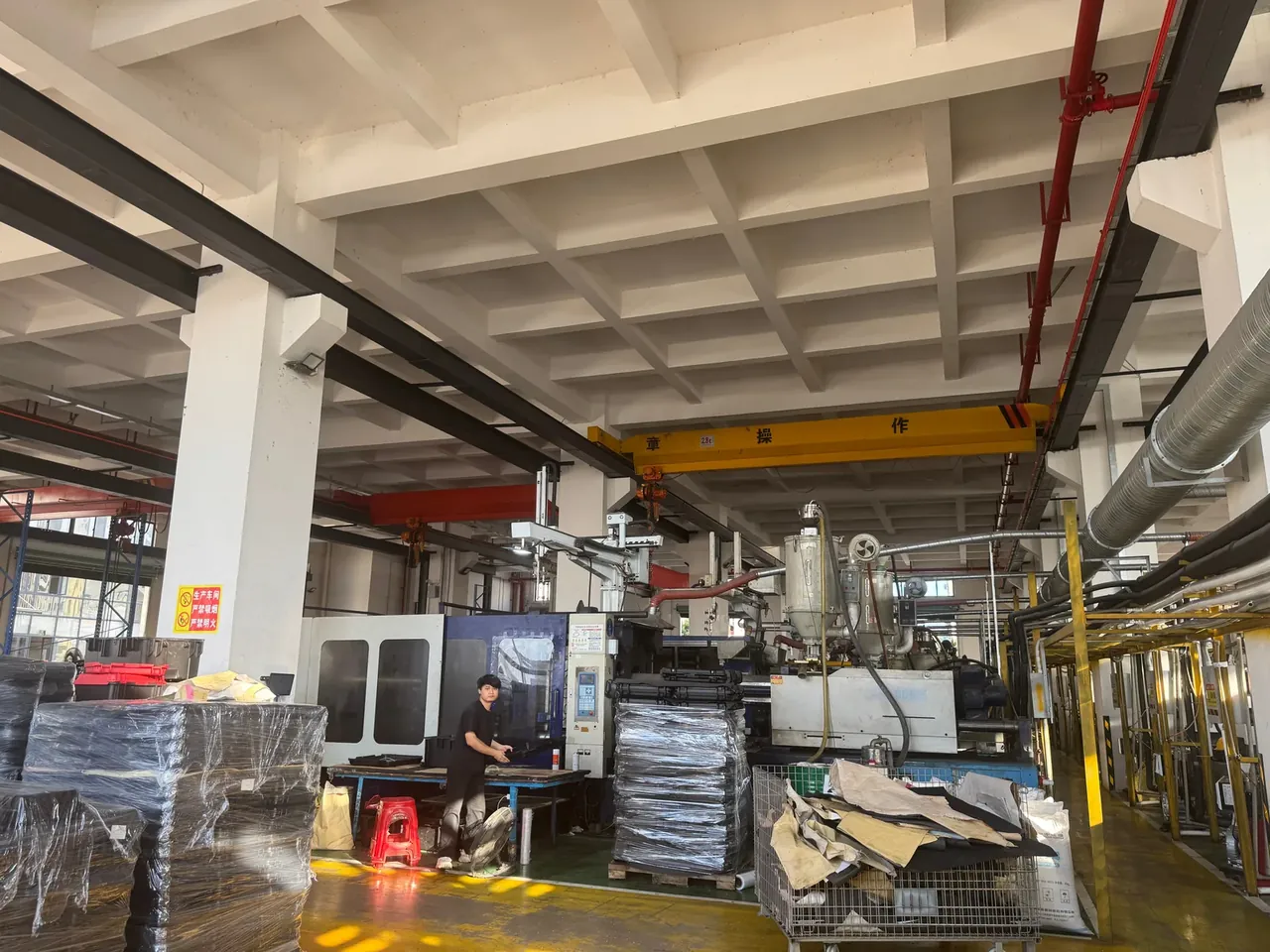
Cleaning order changes the number: wipe twice with anhydrous ethanol, rinse in deionised water, dry at 60 °C for 30 minutes, cool to 25 °C, then measure. Skip drying and a water film drags 2 GΩ to 40 MΩ. Failures cluster at the insert root, where three cycles between -20 °C and 60 °C open a 5 µm gap and readings fall to 80 MΩ by the fourth.
5. 45 kg, Three High, and What Gives First
Two people carrying share 22.5 kg each, near the ceiling for sustained work, and at three tiers the bottom case holds 90 kg. The lid is checked at 300 kg/m² and the rest goes to side-wall bending.
Height is the other half. A 45 kg case stacks to 1.35 m on a standard pallet, and one more tier reaches 1.8 m, where forklift visibility and door clearance both run out. Under 30 kg the bottom lid deflects 1.8 mm; with tier three on top the total is 4.2 mm and latch engagement falls from 12 mm to 7.8 mm. A fourth tier takes it to 6.5 mm and 5.5 mm, and opening force from 90 N to 140 N.
| Stack tier | Loaded part | Load | Cumulative deflection | Latch engagement |
|---|---|---|---|---|
| Tier 1, bottom | Lid, four corner posts | 90 kg | 4.2 mm | 7.8 mm |
| Tier 2 | Lid, side walls | 45 kg | 2.4 mm | 9.6 mm |
| Tier 3, top | Nothing above | 0 kg | 0 mm | 12.0 mm |
| Tier 4, over limit | Lid mid-span | 135 kg | 6.5 mm | 5.5 mm |
Side-wall bending is secondary: at 90 kg distributed an 8 mm wall peaks at 9 MPa, three times from PP yield. The latch creeps first, 0.3 mm in 30 days under 55 N.
Conclusion
Four numbers decide whether a battery storage case protects a pack or merely holds it: an 0.8 m drop, a 50 g ceiling, 8 mm of wall over 20 mm EPE and 5 mm EVA, and 8 mm of creepage from shell to frame. The 100 MΩ check at 500 V keeps that path honest, and 45 kg at three tiers is the boundary.
This article covers case-side specifications and design implications only, and does not address any handling, loading or use of the contents.
Related Reading
- How storage module cases are layered for transport
- Fixing and lifting a battery cluster transit case
- Where the outer packaging duty ends for lithium shipments
- Heat paths and load limits in UPS battery cabinets
Related Products
- 8 Series — Gun Cases; Military Equipment Cases; Camera Equipment Cases; Drone Cases; Watch Cases; Knife Cases; First Aid Cases; Electronics Equipment Cases
- WL8-2812 PP Gun Case — model WL8-2812
- All protective cases and toolboxes: 7 series, 158 models