

In one sentence: the requirements for a lithium battery transport case can be reduced to five words, namely isolate, insulate, restrain, resist impact and remain identifiable. The insert must hold every cell or battery pack in its own cavity so that terminals cannot touch a conductor. Liners and partitions must use non conductive, flame retardant or flame resistant material. Restraint must prevent any perceptible movement of the battery inside its cavity during transit. The shell must carry enough crush and impact capacity to survive stacking and drops. And the exterior must provide a clear marking area and a document position stating the contents category and emergency information. Air transport additionally requires a pressure equalization valve to balance the cargo hold pressure differential, together with stricter rules on packing, marking and declaration. One thing needs stating plainly: a protective case is one link in the transport safety chain. It delivers physical isolation, cushioning and containment capability. It does not replace compliance testing of the cells themselves, certification of the package, the shipper declaration obligation, or the carrier acceptance conditions.
Safety and compliance note: this article offers only general safety knowledge about lithium battery transport and a technical discussion of case selection. It is not compliance advice on transport, packing or declaration, and it is not a dangerous goods handling instruction. Lithium battery transport is a tightly regulated field, and requirements change with the regulation edition, the mode of transport, the battery type and the carrier policy. In practice, follow strictly the laws and regulations of the country or region concerned, the latest provisions of bodies such as IATA and ICAO, and the acceptance conditions of the carrier. Where dangerous goods declaration, package certification and emergency response are involved, rely on the formal documents of the competent authority, the carrier and professional bodies. Any cell showing swelling, leakage, heat, unusual odour or case damage must not be packed for transport, and must be dealt with according to local regulations and professional guidance.
Table of Contents
- Understanding the Risk: Three Hazard Mechanisms in Lithium Battery Transport
- A General Framework: What UN38.3 and the IATA Rules Each Cover
- Step One: Size the Cavity and the Zones by Cell Format and Quantity
- Step Two: Insert Design, Isolation, Insulation and Restraint
- Step Three: Shell and Sealing, Crush Resistance, Impact and Pressure Balance
- Step Four: Marking Area, Document Position and Inspectability
- Air Versus Road: Two Different Sets of Priorities
- Packing Procedure and a Pre Shipment Checklist
- Common Mistakes
- Frequently Asked Questions (FAQ)
- Conclusion
- Further Reading
Understanding the Risk: Three Hazard Mechanisms in Lithium Battery Transport
Before choosing a case, understand what is being prevented. Risk in the transport stage comes mainly from three mechanisms.
Mechanism one: external short circuit
When the positive and negative terminals of a battery are bridged by a conductor, for example if both terminals touch a metal tool, a metal partition or each other, an external short circuit forms, discharging a large current instantly and generating substantial heat. This is the most common transport risk and also the easiest to design out through packaging. It is exactly why the first duty of the insert is to keep terminals from touching any conductor and from touching each other.
Mechanism two: internal change triggered by mechanical damage
Crushing, puncture and severe drops deform the internal structure of a cell, potentially damaging the separator and creating an internal short circuit that raises temperature. Higher temperature then accelerates the internal reactions, producing a positive feedback loop of heating causing more reaction causing more heating. The role of the case here is to absorb external mechanical energy so that the cell never carries a load large enough to deform it.
Mechanism three: cumulative environmental factors
High temperature, such as a closed vehicle body in summer or apron exposure to the sun, accelerates ageing and self discharge. Low pressure in an aircraft cargo hold creates a differential across the package and can affect sealing components. Humidity and salt fog corrode terminals and cases. These are slow variables, but they stack onto the first two mechanisms and amplify the risk.
Put the three together and the design targets become clear: do not let the battery be crushed, cushioning and crush resistance; do not let the terminals be bridged, isolation and insulation; do not let the battery move around inside, restraint and fixing; do not let the internal environment run out of control, sealing and ventilation design; and make abnormal conditions visible and manageable, marking and inspectability.
A General Framework: What UN38.3 and the IATA Rules Each Cover
UN38.3 and the IATA rules are the two most frequently cited references in the industry, but they govern different levels and are regularly confused with each other.
UN38.3: it governs whether the battery itself may travel
UN38.3 is the lithium battery transport test requirement in the United Nations Manual of Tests and Criteria. Its subject is the cell and the battery itself, not the outer case. In simple terms, before being offered for transport, cells and batteries must pass a series of tests simulating transport conditions, typically including altitude simulation, thermal testing, vibration, shock, external short circuit, impact, overcharge and forced discharge. A traceable test report should follow, available for inspection by the shipper and the carrier.
The lesson for case selection is this: UN38.3 is a battery side precondition, not a certification of the case. A protective case neither needs nor can hold a UN38.3 certification. Obtain the valid test report from the battery supplier, and obtain material and structural statements from the case supplier.
The IATA rules: they govern how the shipment moves
The dangerous goods regulations published by IATA, together with the technical instructions of ICAO, set out requirements at the transport organization level: which batteries may travel as ordinary cargo, which must be declared as dangerous goods, what the package must satisfy, the quantity and mass permitted per package, how state of charge is controlled, which marks and labels are needed, how documents are completed, and the right of a carrier to impose stricter conditions.
Four characteristics matter when selecting a case:
- They are updated every year. The rules are revised almost annually, so what applied last year may not apply this year.
- They distinguish the transport role. Batteries shipped on their own, shipped with equipment, and installed in equipment are three situations with very different requirements.
- They distinguish battery type. Lithium ion, which is rechargeable, and lithium metal, which is not, are managed differently.
- Carriers may tighten them. An airline may add its own restrictions on top of the rules, so acceptance is governed by the carrier conditions.
For that reason this article quotes no specific clause numbers and no numerical limits, because such information moves with the edition and copying it risks misleading the reader. The correct approach is to consult the edition in force for the year and to confirm with the carrier before every shipment.
A general framework
| Level | Subject | Responsible party | What the case can contribute |
|---|---|---|---|
| --- | --- | --- | --- |
| Cell and battery | Transport safety testing passed, condition sound | Battery manufacturer, shipper | Nothing; the case cannot replace battery side testing |
| Inner packing and insert | Terminal insulation, single cell isolation, restraint | Packaging designer, case supplier | Central; isolation and insulation are delivered by the insert |
| Outer package | Crush, impact, stacking, marking | Case supplier, shipper | Central; shell and marking design |
| Declaration and documents | Classification, marks, labels, declaration form | Shipper | Supporting; provides marking and document positions |
| Transport organization | Loading, segregation, emergency response | Carrier | Supporting; the case shape should aid restraint and stacking |
Step One: Size the Cavity and the Zones by Cell Format and Quantity
Cell format determines insert form
| Cell format | Typical shape | Insert design points | Common risk points |
|---|---|---|---|
| --- | --- | --- | --- |
| Cylindrical cell, for example 18650 or 21700 | Cylinder with terminals at both ends | Array of round cavities, depth slightly greater than cell length, generous walls between holes | Terminals exposed at both ends; end faces must not contact a conductor |
| Prismatic aluminium case cell | Rectangular block with posts and a vent on top | Rectangular cavity, relief and coverage over the terminal area | Raised posts need relief so they are not loaded |
| Pouch cell | Flat rectangle with tabs | Shallow layered cavities, separators between layers, no bending | Tabs bend and the casing punctures easily; needs flat support |
| Finished battery pack | Irregular, with housing and connectors | Cavity measured and cut to shape, relief around connectors | Heavy, needing stronger load bearing and thicker cushioning |
Estimating internal volume
- Measure the largest external dimension of each battery, including terminals, tabs, connectors and other protrusions.
- Calculate the envelope volume of one unit and multiply by the quantity.
- Multiply by a margin factor of 1.5 to 2.0. Lithium cells need a larger factor than general equipment for three reasons: a thicker cushioning layer is needed to absorb impact energy; sufficient wall thickness is needed between adjacent cells; and finger clearance is needed so that posts and tabs are not squeezed during loading and unloading.
- With the target internal volume established, choose the nearest standard size from the product range, or consider a custom size if no standard fits.
Zoning principles: sort by condition first, then by type
- Zone by condition. Batteries in good condition awaiting shipment must never share a case with cells awaiting inspection, awaiting recycling, or already damaged.
- Zone by type. Different chemistries, capacities and models are best zoned separately to avoid mix ups and misuse.
- Zone by quantity. When several batches travel together, separate them with partitions or individual insert cells and label them for easy counting.
Step Two: Insert Design, Isolation, Insulation and Restraint
The insert is the most technically demanding part of a lithium battery transport case and the worst place to save money. The three requirements, in priority order, are these.
Requirement one: isolation, the highest priority
Every cell or battery pack should have its own cavity, with a physical wall between battery and battery, between battery and case, and between battery and any metal item travelling in the case. Isolation exists to prevent two kinds of contact: terminal to terminal, which closes a circuit, and terminal to metal conductor, such as a tool, partition, hinge or screw, which creates a short circuit.
In practice, keep enough wall thickness between cavities, and make the wall continuous down to the bottom rather than a partial depth groove. A partial groove collapses under load and loses its isolating function.
Requirement two: insulation
The insert material itself must be non conductive. Closed cell foams such as EVA, EPE, PE and EPP, and plastic partitions, are all insulating and suit the insert body. Two further points deserve attention:
- Keep bare metal out of the cavity. Latches, hinges and screws should not be visible inside the cavity; where structurally unavoidable, cover them with plastic or relieve them.
- Avoid conductive fillers. Do not use metal foil, conductive foam or materials containing metal filaments as lining. Where antistatic behaviour is needed, use a surface antistatic agent rather than a conductive filler.
For lining material selection, see What Foam Types Are Commonly Used Inside Protective Cases? and EPE or EVA Foam for a Toolbox: What Is the Difference?.
Requirement three: restraint
The goal of restraint is no movement in transit and smooth access when handling. The criterion matches that for general precision equipment: once placed, the item does not move when pushed lightly, but it lifts out smoothly without levering or pulling. Note particularly that lithium cell cavities must not be too tight, since over tightening squeezes the cell casing and the terminals and can, over time, deform the case or load the posts.
Insert format and material recommendations
| Item | Recommendation | Reason |
|---|---|---|
| --- | --- | --- |
| Insert format | Pre cut or custom moulded, preferably one piece | Continuous walls with no joints give reliable isolation |
| Material system | Closed cell foam such as EVA, EPE, PE or EPP, or plastic partitions | Non conductive, non absorbent, with controllable cushioning and damping |
| Flame retardancy | Specify a flame retardant grade where required | The insert is the nearest non metallic material around the cell, so flame behaviour belongs in the specification |
| Layered structure | Add a full sheet separator between layers | Prevents the upper layer pressing on the terminals below |
| Colour management | Use colours to distinguish condition zones | Makes awaiting shipment, awaiting inspection and quarantine zones visually obvious |
Flame retardancy grade, temperature range and similar parameters should be supported by verifiable test evidence from the supplier and written into the specification rather than accepted verbally.
Step Three: Shell and Sealing, Crush Resistance, Impact and Pressure Balance
Shell: crush resistance before drop resistance
Lithium battery transport fears being crushed more than being dropped. Stacking, a jammed vehicle body and shifting cargo all load the case sustained or momentarily, and once a wall collapses onto a cell the consequence is far worse than a single drop. Shell selection should therefore focus on:
- Bending stiffness, raised by rib layout rather than simply by adding wall thickness.
- Material toughness. Modified PP behaves consistently under low temperature and impact and is a common choice for transport cases; confirm the specific requirement against the service temperature range with the supplier.
- Opening strength. The rim flange carries the stacking load and needs adequate thickness and rib support.
Sealing: moisture and salt fog, with its limits understood
A full perimeter sealing structure with IP67 capability keeps out rain, dust and salt fog effectively and is a sensible choice for sea freight and open air handling. See What Does IP67 Mean for a Protective Case and Where Does It Apply? and How Does an Outdoor Case Cope with Rain and Humid Conditions?.
The limit must be understood, however: sealing is not containment of an internal reaction. If a battery inside behaves abnormally and releases heat, a sealed case will not stop the reaction. Sealing is an environmental measure, not a safety measure. Anything to do with ventilation, pressure relief or emergency response must follow the applicable regulations and the technical guidance of professional bodies, and should not be decided by the packaging supplier alone.
Pressure equalization valve: mandatory for air transport
In air transport, cargo hold pressure changes with altitude and a differential builds up across a sealed case, showing up as a lid that is hard to open or a case that bulges outward, damaging the gasket, hinges and latches over time. A pressure equalization valve uses a micro porous membrane that passes gas while blocking liquid water and dust, equalizing the differential without losing the sealing rating. Wherever air transport or high altitude road transport is involved, it should be standard equipment rather than an option. The principle and selection are covered in Why Does an Outdoor Case Need a Pressure Equalization Valve? and What to Watch for When Transporting an Outdoor Case at High Altitude.
Temperature: turning avoid direct sunlight into actions
High temperature is a significant risk factor in lithium battery transport. What a case can deliver is slowing the rate of temperature rise and avoiding direct exposure: a light coloured shell reflects more, the case should not be left standing in the sun, and ventilation gaps should be left in the vehicle body. To be clear, an ordinary protective case is not a temperature controlled device and has no active cooling; where cargo has strict temperature requirements, use dedicated equipment with temperature control. More on temperature extremes is available in How Does an Outdoor Case Cope with High and Low Temperatures?.
Step Four: Marking Area, Document Position and Inspectability
Transport regulation imposes strict marking and documentation requirements, and the case should provide the physical carrier for them.
Three layers of marking provision
- External marking area. The outer surface should provide a flat, weatherable area for the required marks and labels. It should be large enough and prominently placed, ideally one area on the lid top and one on an end face, with a surface finish suited to label adhesion or printing.
- Contents list holder. A card holder inside the lid or on an end face carries the battery list: model, quantity, serial numbers, condition and inspection date.
- Condition and warning area. Used for inspection status and warning information so that it can be read before the case is opened.
Document position
Transport documents, copies of test reports and emergency contact details need a dedicated place so that they do not end up scattered during an inspection. A document pocket or mesh pocket inside the lid is the common solution.
Inspectability
One important but often overlooked consideration: the case should be easy to inspect. Latches should open quickly by hand without tools, the insert should lift out as a layer so that each terminal can be checked, and the external shape should be regular enough to stack and restrain easily. In airport and port inspections, these features noticeably shorten inspection time.
Air Versus Road: Two Different Sets of Priorities
| Dimension | Air transport | Road and rail |
|---|---|---|
| --- | --- | --- |
| Main stresses | Pressure differential, cold hold, rough handling and stacking | Long duration vibration, jolting, hard braking, stacking |
| Pressure differential | Pressure equalization valve required | Not usually needed, but assess high plateau routes |
| Cushioning priority | Impact resistance, since handling can be rough | Vibration resistance, long duration low amplitude, delivered by damping |
| Temperature concern | Cargo hold temperature variation | Summer heat in the vehicle body, heat build up in enclosed space |
| Sealing need | Moderate, the hold environment is comparatively controlled | High, open air handling, rain and dust |
| Marking and documents | Very strict, detailed mark and label requirements | Strict, but in a simpler form |
| Stacking | Unit load device stacking, regular shape required | Vehicle body stacking, requiring locators and restraint |
| Suggested case form | Regular shape, recessed latches, pressure equalization valve | Stacking locators, anti slip feet, optional wheels |
More on road duty is available in How Does an Outdoor Case Improve Equipment Transport Safety? and Is an Outdoor Case Suitable for Sea Freight?; for air duty see Is an Outdoor Case Suitable for Air Transport?.
Packing Procedure and a Pre Shipment Checklist
The following steps cover packing operations at the case level only. They do not include any battery handling, modification or repair action.
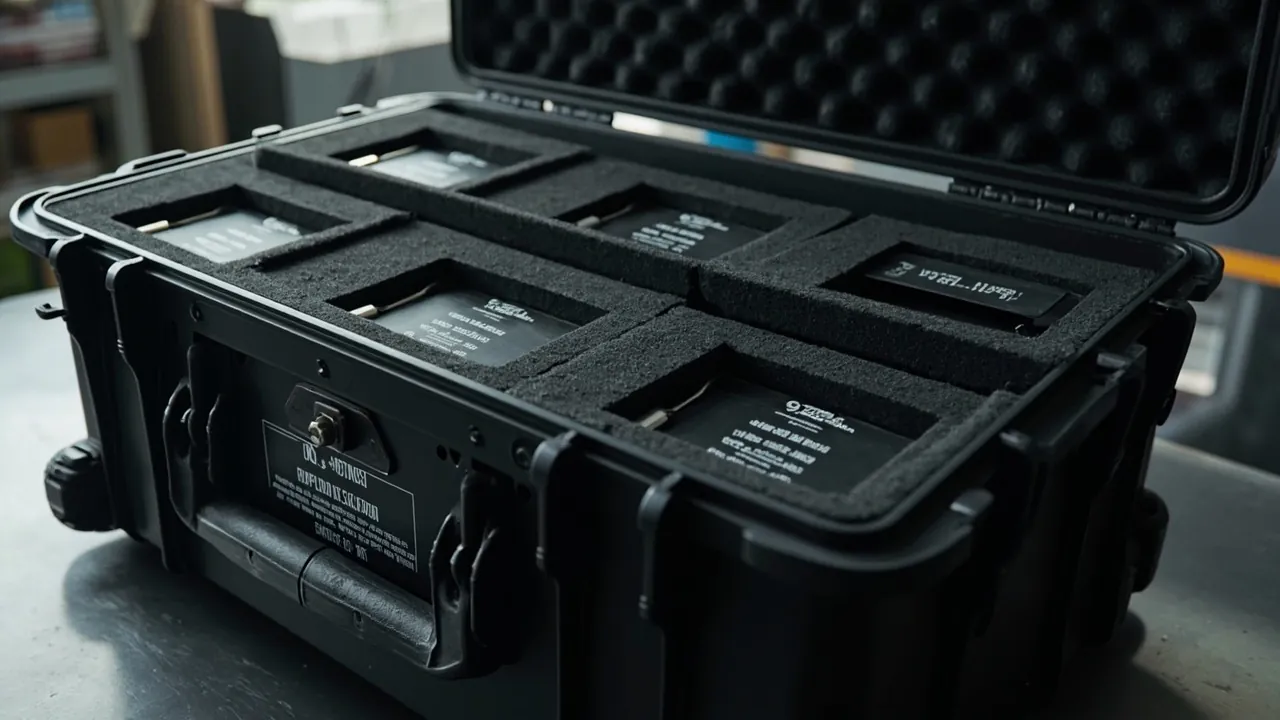
Six packing steps
- Check battery condition. Confirm that cells are visually sound, with no swelling, leakage, deformation, case damage or abnormal heat. Do not pack cells that look abnormal; deal with them under local regulations and professional guidance.
- Confirm the insert is sound. Check that cavity walls are complete, not collapsed and not torn, and that walls run continuously to the bottom.
- Load one by one and confirm restraint. Place each cell in its cavity with terminal orientation consistent with the insert design, and push lightly to confirm it does not move.
- Add a separator between layers. Where cells are stacked in layers, add a full sheet separator and confirm the upper layer does not press on the terminals below.
- Count and complete the list. Verify the quantity, update the contents list and inspection date, and place them in the document position.
- Close and check. Confirm the gasket is compressed evenly, all latches are engaged, and external marking and documents are complete.
Pre shipment checklist
| No. | Check | Pass criteria |
|---|---|---|
| --- | --- | --- |
| 1 | Battery condition | No swelling, leakage, deformation, damage or abnormal heat |
| 2 | Insert integrity | Continuous walls, no collapse, no torn cavities |
| 3 | Restraint | Each cell does not move under a light push, yet lifts out smoothly |
| 4 | Terminal isolation | Terminals do not touch a conductor; adjacent cells do not touch |
| 5 | Layer separators | Full sheet between layers, not pressing on terminals |
| 6 | Sealing condition | Gasket compressed evenly, no loose section |
| 7 | Latch condition | All engaged with a clear self locking feel |
| 8 | Pressure equalization valve | Body intact and unobstructed, mandatory check for air |
| 9 | External marking | Marking area complete, legible and weatherable |
| 10 | Documentation | List, reports and emergency information present in the document position |
| 11 | Stacking and restraint | Regular shape, can be reliably stacked and strapped with adjacent cargo |
| 12 | Regulatory conformity | Classification, marking and declaration completed under the edition in force |
Item twelve is the only one the case cannot solve; the shipper must complete it under the applicable regulations.
Common Mistakes
- Mistake one: treating UN38.3 as a capability of the case. UN38.3 applies to cells and batteries, not to packaging. Ask the case supplier for material and structural statements instead.
- Mistake two: believing a protective case makes a non compliant battery compliant. It does not. The case provides physical protection; it does not replace battery testing, package certification or the declaration obligation.
- Mistake three: assuming a tighter insert is safer. Over tightening squeezes the cell casing and terminals and leads to levering during removal, which tears the cavity walls.
- Mistake four: using metal partitions for zoning. Metal conducts, and contact with a terminal completes a short circuit path. Use plastic partitions or foam walls.
- Mistake five: equating a sealed case with a safe case. Sealing keeps out water and dust; it does not stop an internal reaction. Safety comes from cell condition, isolation design and transport organization.
- Mistake six: shipping by air without a pressure equalization valve. The hold pressure differential makes the lid hard to open or bulges the case, damaging seals and hinges over time.
- Mistake seven: copying last year's practice. Transport rules are updated annually and carriers may tighten them; recheck before every shipment.
- Mistake eight: using an ordinary storage box as a transport case. With no full perimeter seal, no cushioning insert and insufficient shell stiffness, it cannot meet isolation and crush requirements.
Frequently Asked Questions (FAQ)
Question: What is the core requirement for a lithium battery transport case? Answer: Five words: isolate, insulate, restrain, resist impact and remain identifiable. Isolation means every cell has its own cavity with walls running continuously to the bottom, so terminals cannot touch each other or a conductor. Insulation means non conductive liners and partitions with no bare metal inside the cavity. Restraint means no perceptible movement in transit but smooth removal. Impact resistance means enough bending stiffness and toughness in the shell to survive stacking crush and drops. Identifiable means a weatherable external marking area plus internal list and document positions. Air transport additionally requires a pressure equalization valve.
Question: Is UN38.3 a certification of the case? Answer: No. UN38.3 is the lithium battery transport test requirement in the United Nations Manual of Tests and Criteria, and its subject is the cell and the battery, used to verify safety under simulated transport conditions, typically including altitude simulation, thermal testing, vibration, shock, external short circuit, impact, overcharge and forced discharge. A protective case is not a certifiable object under that test. Obtain the valid test report from the battery supplier and material and structural statements from the case supplier.
Question: Why is a pressure equalization valve mandatory for air transport? Answer: Cargo hold pressure changes with altitude during flight, so a differential builds up across a sealed case, showing up as a lid that is hard to open or a case that bulges outward, damaging the gasket, hinges and latches over time. The valve uses a micro porous membrane that passes gas while blocking liquid water and dust, equalizing the differential while keeping the sealing rating. Wherever air transport or high altitude road transport is involved, treat it as standard equipment.
Question: Can metal partitions be used in the insert to add strength? Answer: Not advisable. Metal conducts, so a terminal touching a metal partition can complete an external short circuit. Achieve zoning and load bearing instead through thicker foam walls, plastic partitions or additional ribs in the structure. Equally, no bare latches, hinges or screws should be visible inside the cavity; cover or relieve them where unavoidable.
Question: Can a sealed case prevent an abnormal battery event? Answer: No. Sealing addresses the external environment: rain, dust, salt fog and humidity. It is an environmental measure, and it cannot stop a reaction inside a cell, nor is it a safety or emergency response measure. Real safety comes from cells in good condition that have passed the applicable tests, from an insert delivering reliable isolation and insulation, from a shell providing enough crush resistance and cushioning, and from transport organization that meets the applicable rules. Any matter of abnormal event response must follow local regulations and professional guidance.
Question: What can a case do about high summer temperatures? Answer: An ordinary protective case is not a temperature controlled device and has no active cooling, but it can slow the rate of temperature rise: a light coloured shell reflects more solar radiation, the sealed and cushioned insert structure offers some insulation, and a regular shape makes it easier to leave ventilation gaps in the vehicle body. Management actions that work include avoiding leaving cases standing in the sun, arranging loading and unloading in shade where possible, and shortening dwell time in hot conditions. Where cargo has strict temperature requirements, use dedicated temperature controlled transport equipment.
Question: How should batteries be positioned when packing? Answer: Follow three principles. First, load one per cavity with terminal orientation consistent, so inspection is straightforward. Second, confirm by a light push that the cell does not move yet lifts out smoothly without levering or pulling. Third, where cells sit in layers, add a full sheet separator so the upper layer does not press on the terminals below. Before packing, confirm that cells are visually sound; anything swollen, leaking, deformed, damaged or abnormally hot must not be packed for transport.
Question: Can an insert still be used after it has collapsed? Answer: Continuing is not advisable; replace it. Collapse means the wall thickness and cavity dimensions have changed, so isolation and restraint fail together: thinner walls reduce the reliability of terminal isolation, and enlarged cavities let cells move inside the case. Match the original density and material system when replacing, keeping closed cell material rather than substituting open cell sponge, and re measure the cavity dimensions. This is also the practical value of choosing a manufacturer with insert and lining manufacturing capability.
Conclusion
Selecting a lithium battery transport case can be executed in four steps. First, size the cavity: determine the cavity form from the cell format, cylindrical, prismatic aluminium case, pouch or finished pack; measure the largest external dimension including protrusions cell by cell; multiply by a margin factor of 1.5 to 2.0 to obtain the target internal volume; and zone by condition and type, never mixing cells awaiting shipment with those awaiting inspection or already damaged. Second, specify the insert: prefer a one piece pre cut or moulded insert with walls running continuously to the bottom, in a closed cell non conductive material, with the same restraint criterion as any precision equipment, no movement under a light push and smooth removal, and never tighter than that. Third, specify the shell: make crush resistance the first priority ahead of drop resistance, raise bending stiffness with ribs rather than with thickness alone, specify IP67 sealing capability to exclude rain, dust and salt fog while understanding that it protects against the environment rather than against an internal reaction, and make the pressure equalization valve standard wherever air transport is involved. Fourth, specify management: a weatherable external marking area, an internal list holder and document pocket, and easy opening and layer removal for inspection, so that compliance requirements have a physical carrier.
Three boundaries are worth restating. UN38.3 applies to batteries, not to cases, so a case cannot and need not offer that certification. A protective case is a physical protection link and cannot replace battery side testing, package certification, the shipper declaration obligation or carrier acceptance conditions. And transport rules are revised annually with carriers free to tighten them, so check the edition in force and confirm with the carrier before every shipment.
KeXin New Materials (Guangdong) Co., Ltd. was founded in 2014 and is located in Zhongshan, Guangdong, with a factory of about 18000 square meters, more than 80 machines and more than 100 employees, and a range covering more than 150 specifications. Its protective case line is marketed under the JUNZHJIA brand within the global kexinMaterials brand. The line has IP67 capability and can undergo environmental suitability verification with reference to MIL-STD-810H. The company is certified to ISO9001, meets REACH, California Prop 65 and RoHS requirements, holds more than 20 utility model and design patents, and provides one stop OEM and ODM customization from product design and tooling to injection moulding, logo printing and insert manufacturing. For bulk enquiries, specification sheets or customization cooperation, please use the contact page or enquiry form on this site.
Further Reading
- Is an Outdoor Case Suitable for Air Transport?
- Why Does an Outdoor Case Need a Pressure Equalization Valve?
- What to Watch for When Transporting an Outdoor Case at High Altitude
- How Does an Outdoor Case Cope with High and Low Temperatures?
- What Foam Types Are Commonly Used Inside Protective Cases?
- EPE or EVA Foam for a Toolbox: What Is the Difference?
- How Does an Outdoor Case Improve Equipment Transport Safety?
- Is an Outdoor Case Suitable for Sea Freight?
- What Does IP67 Mean for a Protective Case and Where Does It Apply?
- What Factors Matter When Customizing Protective Case Foam?