

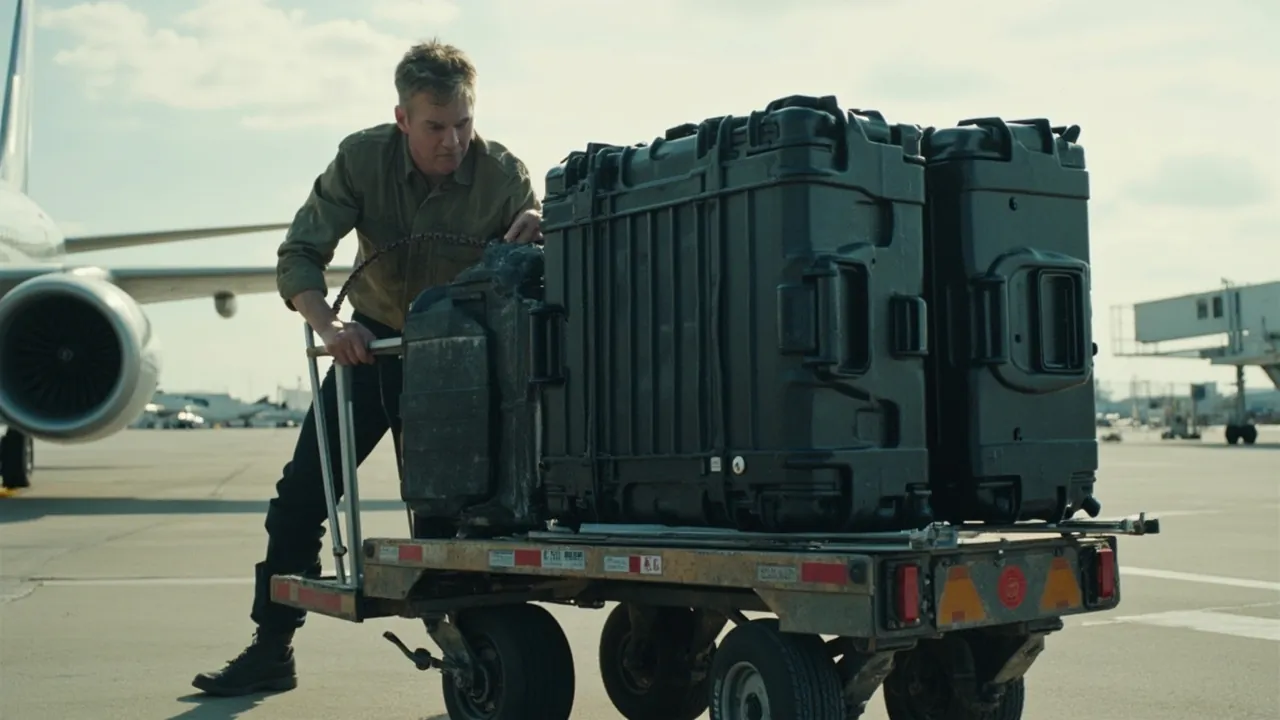
For air transport, a protective case must handle four things: low cargo-hold pressure (pressure drops as altitude rises), the temperature swing of takeoff/landing and cruise, the vibration from engines and turbulence, and the mechanical shock from stacking and security/manual handling. The most easily overlooked yet most dangerous is "low pressure" — although the aircraft cargo hold is usually pressurized in cruise, it is still lower than ground and changes fast; the air inside the case expands and creates outward pressure difference; without a pressure-balancing valve, it may push the lid open or crush the seal and let water and dust in. So the first principle for an air-transport case is it must carry a pressure-balancing valve; the second is good internal cushioning/fixation (contoured liner or straps) so instruments don't shift and collide under vibration; the third is compliance with aviation rules on size/weight and dangerous goods (e.g., lithium batteries), cooperating with security opening inspection. The following expands by "risk — requirement — operation — scenario" to help you get equipment safely onto the plane and intact onto the ground.
Table of Contents
- Four Challenges Air Transport Poses to a Protective Case
- Why the Pressure-Balancing Valve Is Mandatory for Air Transport
- Liner Fixation: Cushioning Points Under Vibration
- Size, Weight, and Security Compliance
- Breakdown of Typical Air-Transport Scenarios
- Air-Transport Packing and Transfer Checklist
- Selection and Common Misconceptions
- Air-Transport Mini Glossary
- Mechanics of Low Pressure and Sealing (Plain Version)
- Security, Customs Clearance, and Accompanying Documents
- Air Transport vs Road Transport: Case Configuration Differences
- Air-Transport Liner Points for Special Equipment
- Frequently Asked Questions (FAQ)
- Cross-Role Procurement Execution
- Connecting Air Transport with Other Modes
- Key Points Recap
- Conclusion and Further Reading
Four Challenges Air Transport Poses to a Protective Case
Aircraft transport (both passenger-belly and all-cargo) differs greatly from ordinary road transport; the case must simultaneously withstand four challenges:
| Challenge | Source | Effect on case | Response |
|---|---|---|---|
| --- | --- | --- | --- |
| Low pressure | Cruise altitude pressure below ground | Internal air expands, internal–external pressure pushes lid open/crushes seal | Pressure-balancing valve |
| Temperature swing | Ground heat to high-altitude cold, takeoff/landing changes | Condensation, material thermal expansion,stack-up pressure difference | Valve + desiccant |
| Vibration | Engines, airflow, turbulence | Internal parts shift and collide, latches shocked | Contoured liner fixation |
| Stacking/handling | Cargo hold stowage, loading/un loading | Compression deformation, drop knocks | Ribbed shell, secure strapping |
These four challenges often stack: climb on takeoff brings low pressure, temperature swing, and vibration together; landing handling adds handling shock. So an air-transport case cannot just solve "waterproof," but must combine "valve + liner + structure." This also explains why air-transport scenarios usually point to an IP67 protective case combined with a pressure-balancing valve and custom liner.
Why the Pressure-Balancing Valve Is Mandatory for Air Transport
Earlier we covered the pressure-balancing valve principle (a breathable water-blocking membrane slowly equalizes pressure difference). In air transport its importance escalates to "mandatory," for a direct reason: from ground to cruise, outside pressure drops noticeably in a relatively short time, and the sealed air inside the case wants to expand; without a valve, the pressure difference can only be borne by the lid and latches — at best the gasket is long-term stressed and deforms, aging early; at worst it "bulges the lid open" in the cargo hold, causing water and dust ingress for the rest of transport. With a valve, gas slowly escapes, the difference returns to zero, and the valve membrane blocks water and dust — both preventing case burst and preserving the seal.
One clarification: passenger-belly holds are usually pressurized and temperature-controlled, not "near-space vacuum," but still lower than ground and changing fast, plus multiple takeoff/landing cycles, a real fatigue test on the seal. So "valve for air transport" is not exaggeration but common industry practice. High-altitude ground transfer (e.g., plateau airports) is the same — the pressure-balancing valve is equally critical, complementing the high-altitude protection topic. Another reminder: the pressure-balancing valve solves "pressure difference," not "water poured directly in," so the case's own seal grade (e.g., IP67) and correct latching are still necessary; valve and seal are complementary, not substitutive.
Liner Fixation: Cushioning Points Under Vibration
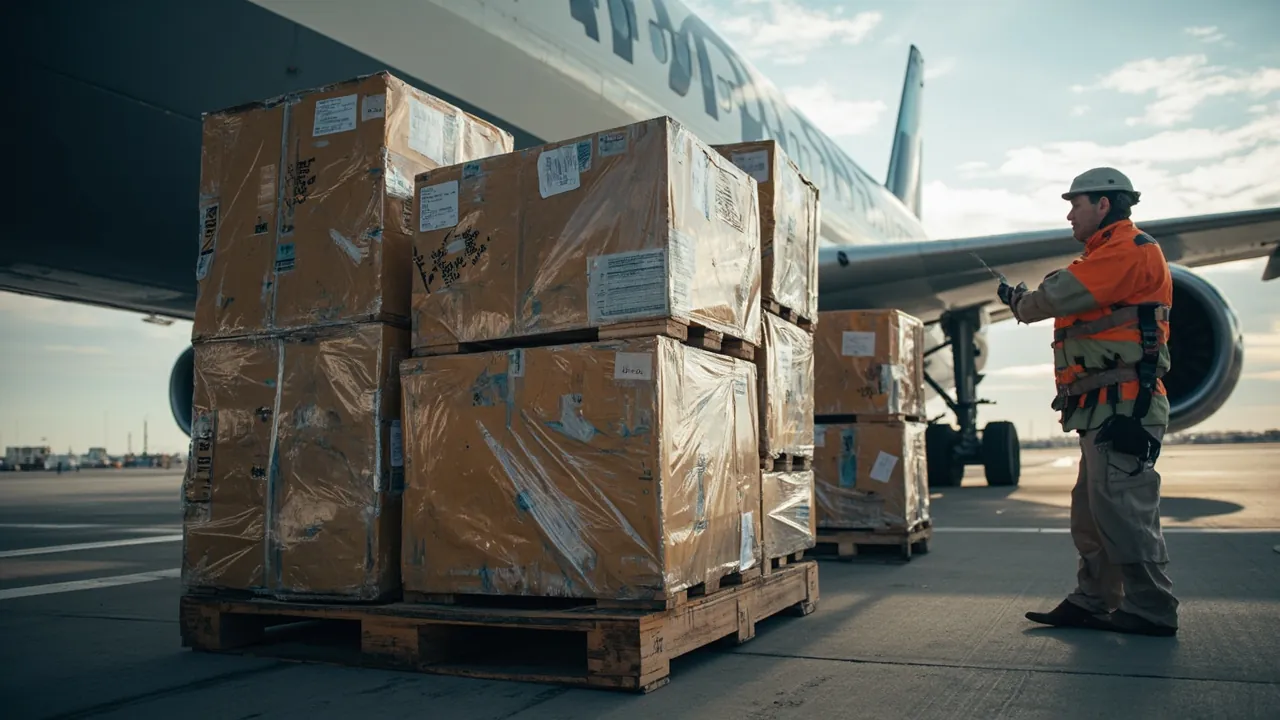
Air-transport vibration is continuous and multi-directional; a "sturdy shell" alone is not enough — internal fixation is the key to protecting precision instruments:
- Contoured liner first. EVA, EPE, and similar foams are contoured to the equipment shape so each instrument "embeds" in its slot, almost immobile under vibration — the most stable fixation. Critical for cameras, meters, sensors, spare boards.
- Layering and isolation. Heavy at bottom, light at top; fragile optics in separate slots; sharp parts get sheaths to avoid piercing adjacent foam or scratching neighbors.
- Straps and hook-and-loop assist. For irregular or oversized items, add adjustable straps or hook-and-loop fixers on top of contoured slots to prevent bouncing out under turbulence.
- Fill the gaps. Micro-gaps between slot and equipment filled with foam scraps or soft packing to reduce relative-motion micro-friction and impact.
- Liner itself temperature-resistant. Under high-altitude cold and cargo temperature swing, the liner should not harden and fail; choose foam that stays elastic at low temperature (see liner-type articles).
In one sentence: the value of an air-transport case is seven-tenths in "liner fixation," three-tenths in "shell sealing." The shell blocks water and dust; the liner blocks vibration shift — neither can be missing.
Size, Weight, and Security Compliance
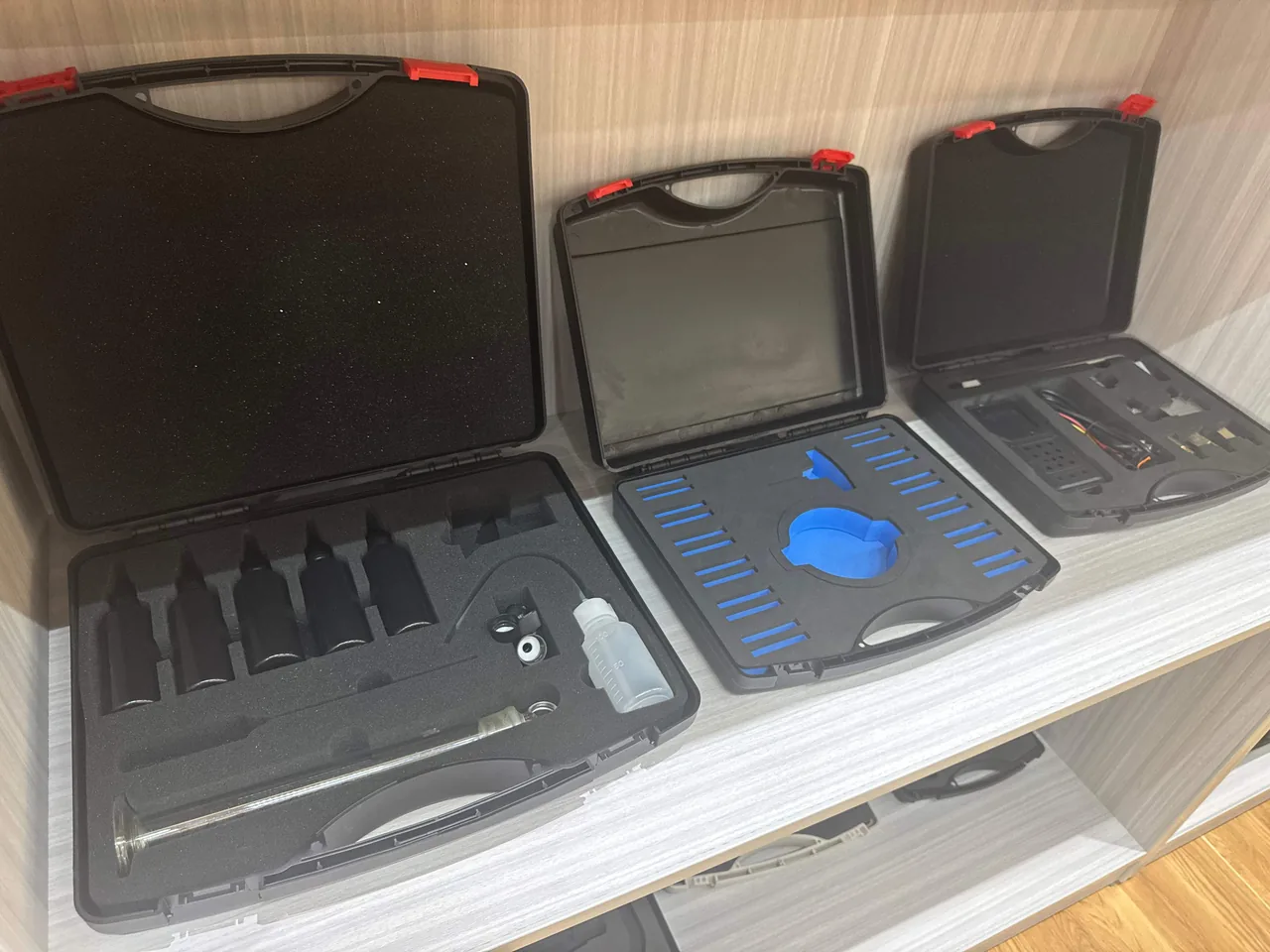
Air transport involves three compliance types — size, weight, and security. Here we state only general industry common knowledge, fabricating no specific airline's numerical rules; specific numbers must follow the carrier and destination regulations:
- Size and weight: Whether as checked baggage or cargo, there are per-piece size and weight limits; exceeding may prevent loading or incur extra handling. Protective cases, especially wheeled large cases, should be measured for outer dimensions and weighed empty and loaded before purchase to confirm within the general limits of the planned route. Wheeled rod cases also need handling and stowage considered.
- Dangerous goods and lithium batteries: Many precision devices carry lithium batteries (meters, cameras, comms, spares). Lithium-battery transport is bound by aviation dangerous-goods rules, usually requiring short-circuit prevention, powered-off devices, spares carried-on or isolated per cargo rules. When a case contains batteries, insulate and prevent short circuit, and follow transport and security rules — specifics per carrier and customs; this article gives no specific limits.
- Security opening: Cargo and security screening may require opening; the case should open quickly, with clear liner layout, easy to inspect and restore. A name card noting contents and contact speeds clearance.
- Marking and documents: Outside marks "fragile"/"this side up"/"keep dry," paired with packing list, invoice, material statement, reduce mis-handling and detention risk.
General compliance principle: leave "whether compliant" to the carrier and regulations; the protective case only physically protects the equipment. A manufacturer with OEM/ODM capability (such as KeXin New Materials JUNZHJIA) can pre-build liner, label positions, and document pouches by transport scenario at the factory, but specific airline size/weight and battery limits still need your verification with the carrier.
Breakdown of Typical Air-Transport Scenarios
Different air-transport scenarios have different "main contradictions," and the solution should be tuned:
| Scenario | Main risk | Recommended configuration |
|---|---|---|
| --- | --- | --- |
| Passenger-belly checked baggage | Low pressure + vibration + handling | IP67 + pressure-balancing valve + EVA contoured liner + outer corner guards |
| All-cargo precision instrument | Low pressure + long vibration | IP67 + valve + fully custom inner tray + desiccant + shock-wood outer pack |
| Plateau-airport takeoff/landing | More obvious low pressure + low temp | Valve + PP shell (low-temp resistant) + low-temp liner |
| Lithium-battery equipment | Battery short-circuit/cargo rules | Battery insulated & short-circuit-proof + placed per cargo rules + accompanying note |
Passenger-belly checked baggage is most common; a normal IP67 valved case with contoured liner is basically enough, but wrap with buffer straps outside and mark "fragile" to avoid rough handling. All-cargo high-value instruments are more conservative: beyond in-case valve + inner tray, often add a wooden or honeycomb outer pack to absorb handling shock. Plateau airports, with already-low ground pressure, show more obvious pressure difference after takeoff, so valve and low-temperature material are more critical. Lithium-battery scenarios focus not on the case itself but on battery insulation and cargo-rule compliance — the case only handles physical fixation and insulation isolation.
Air-Transport Packing and Transfer Checklist
Turn the above into a pre-departure checklist:
- Confirm a pressure-balancing valve and the membrane is clean and clear (lightly brush with a finger before sealing to confirm no blockage).
- Contour liner fixes each device, heavy low/light high, gaps filled, irregular items strapped.
- Insulate and short-circuit-proof batteries, placed per transport rules (per carrier).
- Put desiccant in the case to handle condensation from high-altitude temperature swing.
- Mark the outside (fragile/this side up/keep dry), fill name card and packing list.
- Weigh and measure to confirm within the planned route's general limits.
- Reserve buffering: cargo holds stack; shell ribs and latches must bear load; outer corner guards or an extra outer box help.
- Open slowly after landing: after pressure and temperature changes, let the case temperature approach ambient before opening in a clean place to check condensation.
This checklist can be printed into the operation spec, checked before each shipment, significantly lowering the chance of "open on landing, find water/shock damage."
Selection and Common Misconceptions
- Misconception 1: A normal hard case can fly. A normal hard case has no seal, no valve, no cushioning liner; under low pressure and vibration it easily takes in water/dust and equipment collides. Air transport needs a valved, lined protective case.
- Misconception 2: A lid means waterproof, no dust in. Normal lid gaps can reach millimeter scale; under low pressure and vibration more likely to leak; look at IP grade (wading/high humidity → IP67).
- Misconception 3: Liner is optional. In vibration, no liner equals letting instruments "collide freely" inside; even the best shell can't save them. Must contour or strap-fix.
- Misconception 4: Size and weight don't matter. Exceeding limits may prevent loading or incur extra handling; confirm outer size and weight within the planned route limits before shipment (per carrier).
- Misconception 5: Batteries placed casually. Lithium-battery transport is rule-bound; need short-circuit prevention and compliance, not placed in the case.
Selection checklist: confirm air-transport scenario → mandatory pressure-balancing valve → IP67 or higher seal → EVA/EPE contoured liner fixation → desiccant for moisture → measure size/weight for compliance → handle batteries per rules → complete outside marks and documents → batch go OEM/ODM to pre-build liner and marks.
The protective-case product line of KeXin New Materials (Guangdong) Co., Ltd. is marketed under the global brand kexinMaterials and domestic product-line brand JUNZHJIA; plastic cases in ABS/PP material pass RoHS testing, and hold ISO9001, REACH, California Prop 65 (backed by company documentation; certificates available on request); the product line has IP67 capability and may be described using MIL-STD-810H as a product-line environmental test basis (product-line-level description, a lab environmental-test basis, not a "military certification"). Its factory is in Zhongshan City, Guangdong (Greater Bay Area), about 18,000 m², 80+ machines, 100+ staff, with one-stop OEM/ODM capability for product design, injection molding, mold manufacturing, LOGO printing, and inner-tray/liner making — suited to coordinating the valve, liner, and marks needed for air transport before leaving the factory.
Air-Transport Mini Glossary
- Pressure-balancing valve (breathing valve): A valve that breathes but blocks water, balancing internal–external pressure; mandatory for air transport/high altitude.
- Cargo-hold pressurization: Passenger-belly holds are usually pressurized and temperature-controlled, but still lower than ground and changing fast — a repeated fatigue test on the seal.
- Dangerous Goods Regulations (DGR): International rules for air transport of dangerous goods; lithium batteries etc. are bound; specific limits per carrier and regulations.
- IP67: Fully dust-tight + short-term immersion (about 1 m/30 min, per IEC 60529); common baseline for air-transport high-humidity low-pressure environments.
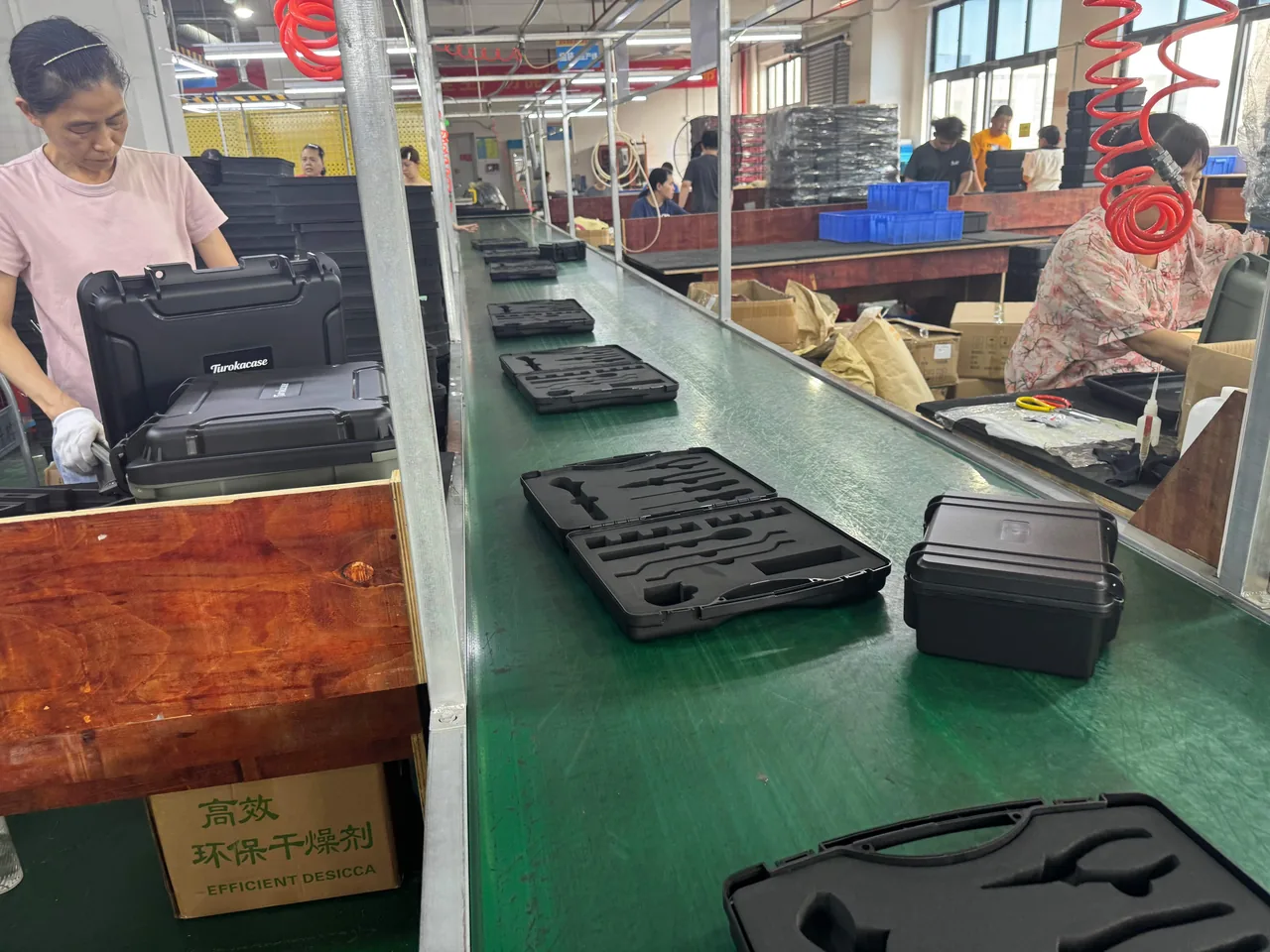
- Contoured inner tray: Foam liner contoured to equipment shape; most stable fixation under vibration.
- Condensation: Warm humid air inside meets high-altitude cold and forms water; eased by desiccant and slow opening.
Mechanics of Low Pressure and Sealing (Plain Version)
To understand why air transport must have a valve, first understand the basic physics that "gas in a closed container expands and contracts with pressure changes." As the aircraft climbs from ground to cruise altitude, outside pressure drops noticeably in a relatively short time, and the case's sealed internal air wants to expand; if the case is fully sealed with no relief path, this outward force presses entirely on the lid, latches, and gasket. Mild consequence: the gasket is long-term extra stretched, ages and loses elasticity early; severe consequence: it "bulges the lid open" a crack in the cargo hold, and the whole rest of transport takes in water and dust. The pressure-balancing valve's role is, when the pressure difference appears, to let the internal gas "slowly" escape and the difference return to zero, while the micro-pore membrane blocks water and dust — releasing pressure without leaking water.
Here distinguish two things: the valve solves "pressure difference," the seal solves "direct water/dust intrusion." Even with a valve, if the gasket ages or latches aren't closed, water still enters through the lid seam; conversely, even with a perfect seal, without a valve the pressure difference may flip the lid. So the correct combination for an air-transport case is "reliable seal + clear valve," complementary not substitutive. This is why many air-transport solutions require both IP67 grade and a pressure-balancing valve — one blocks water/dust, one prevents case burst; neither can be missing.
Security, Customs Clearance, and Accompanying Documents
Air transport is not just "that segment on the plane"; the security and customs at both ends also affect equipment safety and timeliness. The case may be required to open at security, so liner layout should be clear, equipment zoning explicit, easy to inspect and restore; reserve a name card inside/outside noting contents, quantity, contact, and tracking number to speed clearance significantly. For exports, attach a material-compliance statement (e.g., plastic ABS/PP passes RoHS testing, REACH-related declaration) with the case or documents to aid customs; exactly which documents are needed follows destination customs and carrier — this article gives no fixed list.
Another often-overlooked point is "backup and tracking": before shipping high-value equipment, photograph the in-case layout and equipment state, serving both as arrival acceptance reference and as evidence in case of transport damage. No matter how sturdy the case, it cannot replace a standardized shipping process — doing "valve, liner, documents, marks, records" together makes air transport truly sound. For batch-export customers, a manufacturer with OEM/ODM capability (such as KeXin New Materials JUNZHJIA) can pre-build liner, label positions, and document pouches by transport scenario at the factory, reducing repeated preparation before each shipment.
Air Transport vs Road Transport: Case Configuration Differences
The same protective case, used for road vs air, has different configuration focus. Road vibration mainly comes from road bumps, relatively low frequency, more predictable impact; liner fixation and shell strength are core. Air transport adds "low pressure," a variable road transport doesn't have — the pressure-balancing valve goes from "optional" to "mandatory," and cargo-hold vibration is more frequent and multi-directional, demanding higher liner fixation strength. Also, air transport involves security, size/weight limits, and dangerous-goods rules, while road transport is usually only bound by vehicle load and handling habits. So if your equipment goes both road and air, configure valve and liner to the stricter air-transport baseline, and road is naturally covered. Conversely, short road haul only need not pay extra for a valve for low pressure; spend on better liner and seal instead.
Air-Transport Liner Points for Special Equipment
Different equipment demands very different air-transport liner treatment. Cameras, lenses, drones — optics and structures — most fear mutual scraping and single-point pressure, almost requiring fully custom EVA contoured inner trays, with lenses separately soft-packed; comms and navigation equipment batteries need separate isolated compartments, insulated and short-circuit-proof, positioned away from main equipment to avoid squeeze; medical and inspection instruments often carry reagents or standard blocks, needing both temperature isolation and shock resistance, layered isolation if needed. A general principle: the more fragile, the more irregular, the higher the unit price, the more "close-fitting" the liner fixation and cushioning must be. This echoes the liner-type selection articles' conclusion — fragility decides liner grade, not the case's price.
Frequently Asked Questions (FAQ)
Q: Why must an air-transport protective case have a pressure-balancing valve? A: As the aircraft climbs, outside pressure drops, the case's sealed internal air expands creating outward pressure difference that may push the lid open or crush the seal, letting water and dust in. The pressure-balancing valve slowly equalizes pressure through a breathable water-blocking membrane while blocking water and dust — a mandatory design for air transport and high altitude. The principle is common industry knowledge.
Q: How to fix instruments inside an air-transport case most stably? A: Prefer EVA/EPE foam contoured to the equipment shape so each instrument embeds in its slot and barely moves; heavy at bottom, light at top, fragile parts in separate slots, irregular items strapped, gaps filled. Liner fixation matters more than the shell.
Q: What to note when carrying lithium batteries in a protective case by air? A: Lithium-battery transport is bound by aviation dangerous-goods rules, usually requiring short-circuit prevention, powered-off devices, spares placed per cargo rules. Specific limits follow carrier and regulations; this article gives no specific numbers; the case only handles physical insulation and fixation.
Q: Is there a unified size/weight rule for air-transport protective cases? A: There is no "protective-case-specific standard" down to numbers; it follows the carrier's and freight forwarder's size/weight limits for baggage/cargo. Measure outer dimensions and loaded weight before purchase to confirm within the planned route's general limits; specifics per carrier.
Q: The passenger belly is pressurized, so why still a valve? A: Although passenger belly holds are usually pressurized and temperature-controlled, they are still lower than ground and change fast across multiple takeoff/landing cycles — a repeated fatigue test on the seal; plus plateau airports and ground transfer, the pressure-balancing valve remains common sound practice.
Q: What marks should an air-transport protective case carry? A: Common "fragile"/"this side up"/"keep dry" marks paired with packing list and a name card of contents and contact reduce mis-handling and detention, and ease security re-closing. Specifics per carrier and customs.
Q: Can an air-transport protective case be used as a normal checked hard case? A: Yes, but it is heavier and more costly. If it's only normal checked baggage with no precision equipment, a normal hard case is more economical; once it holds shock/pressure-fearing instruments, the case's seal, valve, and liner show their value. Choose by equipment risk, not case price.
Q: Will the pressure-balancing valve instead let water in? A: No. The valve's micro-pore membrane only lets air pass slowly, blocking liquid water and dust; under normal state water cannot enter. Real water ingress is mostly from aged gasket or unlatched lid, so valve and seal must be maintained together.
Q: Who sets the weight limit for an air-transport protective case? A: It is set by the carrier's and freight forwarder's baggage/cargo size/weight rules; there is no unified "protective-case-specific number." Measure outer dimensions and loaded weight before purchase, confirm within the planned route's general limits; specifics per carrier.
Cross-Role Procurement Execution
Air-transport protection truly landing often involves three roles — procurement, field use, and logistics — with different concerns. Procurement must confirm shell material, IP grade, whether it has a pressure-balancing valve, liner type, and put certifications (ISO9001, IP67, RoHS/REACH, California Prop 65, backed by company documentation; certificates available on request) and single-product spec sheet into the contract appendix; field use must know correct filling — heavy low/light high, contoured fixation, desiccant in place, valve clear; logistics must measure size/weight, apply marks, prepare documents, cooperate with security and customs. If the three each manage a segment with no shared info, it's easy to get "bought the right case, filled it wrong, transport blocked." Recommend using this article's air-transport packing checklist as a cross-department shared template, checked by all three before shipment.
For teams that export often, using a manufacturer with OEM/ODM capability (such as KeXin New Materials JUNZHJIA, products exported to the United States, United Kingdom, Germany, Canada, Japan, Russia, the Philippines, India, Hong Kong/Taiwan (China), the Middle East, etc.) to pre-build valve, liner, and marks at the factory significantly reduces repeated preparation before each shipment and gives cross-department collaboration a unified standard starting point. Ultimately, air-transport protection is not "buy an expensive case and done," but the closed loop of "choose the right configuration, fill correctly, follow the right process."
Connecting Air Transport with Other Modes
Real shipments rarely are "pure air" end to end; often "road to site — air across border — road to door" multimodal. Each segment demands different things from the case, and the handover is where problems most easily arise. Road segment must resist road bumps and loading drops; liner fixation and shell strength are key. Air segment must resist low pressure and vibration; pressure-balancing valve and contoured liner are key. The last-mile door road returns to bumps and handling. So for multimodal, set configuration to the strictest segment (usually air), and at each transfer check latches closed, valve clear, marks intact. One often-overlooked detail is "environmental abrupt change at transshipment": from a cold-chain truck to a hot apron, the case surface may condense; opening to take items is best done in a transition environment or clean place to avoid the equipment inside condensing water. Listing each multimodal segment's risks into a checklist is more comprehensive than staring only at the air segment.
Also, cross-border air transport often accompanies different countries' security and customs differences; the more standardized the accompanying documents and material-compliance statements (e.g., plastic ABS/PP passes RoHS testing, REACH-related declaration), the smoother clearance. A manufacturer with OEM/ODM capability can pre-build document pouches and label positions at the factory, reducing on-site document scrambling. Ultimately, equipment in cross-border transport experiences not one risk but a relay of risks; the case and liner must catch every baton, not just one.
Key Points Recap
Condense the whole article into a few executable points for the operation spec. First, for any air transport or high-altitude transport, the pressure-balancing valve is mandatory — it is the only reliable means against cargo-hold low pressure, preventing the lid from being pushed open or the seal crushed; the principle is common industry knowledge, not to be omitted for cost. Second, liner fixation matters more than the shell; air vibration is continuous and multi-directional, prioritize EVA contoured inner trays, heavy low/light high, gaps filled, irregular items strapped, so instruments barely move in the case. Third, size/weight and lithium-battery compliance have no "protective-case-specific" unified numbers; they must follow carrier and regulations; the case only physically protects equipment, compliance judgment goes to the carrier. Fourth, after landing open slowly, check condensation and desiccant state, confirm dry before powering on. Fifth, cross-department (procurement, field, logistics) share one packing checklist, each checking before shipment, and air-transport equipment problem rate drops markedly. For teams that transport cross-border often, pre-building the pressure-balancing valve, contoured liner, and transport marks at the factory by a manufacturer with OEM/ODM capability is the most cost-effective and least omission-prone approach.
Conclusion
An air-transport protective case must solve not "waterproof" alone, but the combination of four challenges: low pressure, temperature swing, vibration, and stacking/security. Among them the pressure-balancing valve is mandatory for air transport — it lets the internal air slowly escape as pressure drops on climb and slowly refill on descent, preventing case burst and preserving seal, the principle being common industry knowledge; while contoured liner fixation is the core against vibration, seven-tenths liner, three-tenths shell. Size/weight and lithium-battery compliance have no "protective-case-specific" unified numbers and must follow carrier and regulations; the case only physically protects equipment. Slow opening after landing and checking condensation are also indispensable. For teams that fly often, using the manufacturer's one-stop OEM/ODM capability in product design, injection, molds, liners, and LOGO to pre-build valve, contoured liner, and transport marks at the factory significantly lowers per-shipment preparation cost and risk. Final reminder: the most expensive thing in air transport is not the case, but the moment on landing when you open it and find the instrument scrapped by shock or water — keeping this article's risk table, valve necessity, and packing checklist in the operation spec is far more practical than after-the-fact remedy.
Further Reading
- What Does the Pressure-Balancing Valve in an Outdoor Protective Case Do?
- What to Consider for an Outdoor Protective Case at High Altitude?
- What to Consider for Outdoor Protective Case Transport Safety?
- What Outdoor Uses Are IP67 Protective Cases Suited For?
- What Types of Cushioning Liners Do Outdoor Protective Cases Have? How to Choose
- What Is an Outdoor Protective Case and Where Is It Used?