

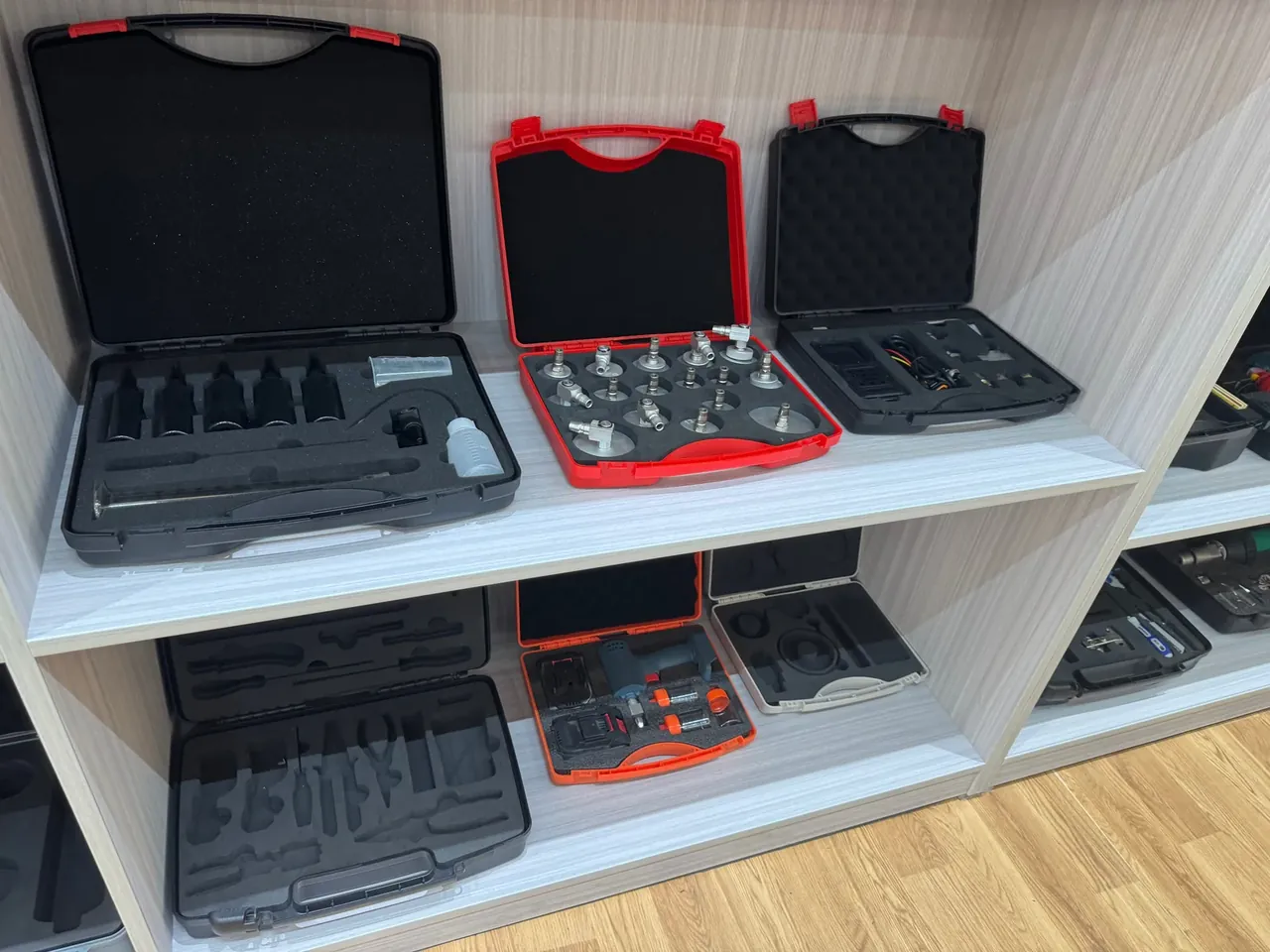
Quick answer: Blow-Molded vs Injection-Molded Toolboxes split on two figures: an 80,000 CNY mould against 250,000 CNY of steel, and a 6 mm air gap only one can form.
Table of contents
- How a hollow double wall is formed
- What a blow mould and an injection mould cost
- Where unit cost crosses volume
- Wall thickness against total case weight
- When injection moulding is the only route
- FAQ
1. How a hollow double wall is formed
Blow-Molded vs Injection-Molded Toolboxes come down to one structural fact: the blow-moulded version carries a sealed pocket of air inside its own shell. An extruder drops a molten tube between two mould halves, a blow pin injects air, and the tube stretches until it meets the cavity wall. Body and lid each leave the tool as a closed shell, with no seam down the middle of either.
The numbers behind the hollow double wall are 3 mm and 6 mm. Each skin is 3 mm, the gap between them is 6 mm, and the pinch-off line seals it. When a corner hits the floor the outer skin buckles, the air compresses, and the load spreads sideways before it reaches the inner skin.
That pocket costs almost nothing in weight: a 1.6 kg case spends its mass on skins and hardware. Thickening the skins buys no extra cushion, because a drop is absorbed by the distance the wall can travel, and only the gap provides it. That is where Blow-Molded vs Injection-Molded Toolboxes separate, at the air, before any price sheet.
The process sets its own limits: a parison stretches hardest at corners, so corners come out thinnest, and a square edge leaves a parting-line step to trim.
2. What a blow mould and an injection mould cost
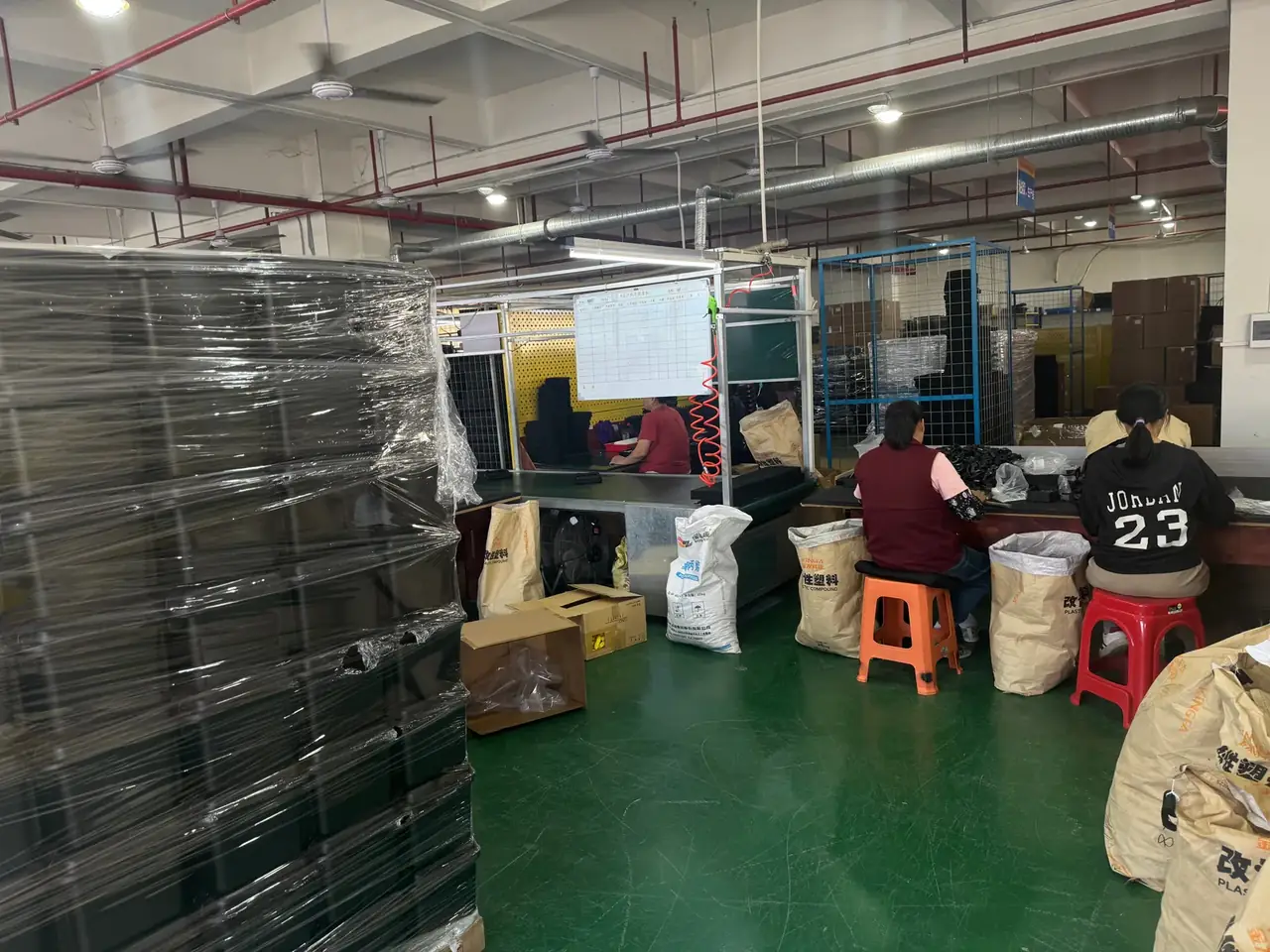
Mould price follows clamping pressure, not case size. A blow mould only holds a low-pressure cavity, so cast aluminium or welded steel is enough, and a set lands near 80,000 CNY. An injection mould must contain melt pushed in hard, so frame, cavity, ejection and cooling lines are all built for that load, and a set runs about 250,000 CNY.
| Item | Blow-moulded case | Injection-moulded case |
|---|---|---|
| Mould material | Cast aluminium or steel, low clamp force | P20 or 718 tool steel, high clamp force |
| Tooling per set | 80,000 CNY | 250,000 CNY |
| Cavity layout | Mostly single cavity, body and lid separate | Multi-cavity, body and lid in one tool |
| Cycle per piece | 90 s | Shorter, scaled with cavity count |
The 170,000 CNY gap sits on one line of a quotation and decides the rest: for Blow-Molded vs Injection-Molded Toolboxes that line outweighs every other. Spread over 500 cases, the blow mould adds 160 CNY each and the injection tool adds 500 CNY; at 5,000 cases they add 16 CNY and 50 CNY.
A second saving rarely reaches the comparison: trims can be granulated and fed back at up to 15% with little effect on the gap, and changing a blow mould means welding and remilling the cavity rather than rebuilding it.
3. Where unit cost crosses volume
A unit price is material, labour and tooling amortisation added up. The first two follow the process, the third follows the order. At 1.6 kg both routes use similar amounts of plastic, so amortisation is where Blow-Molded vs Injection-Molded Toolboxes separate.
| Batch | Blow mould, CNY per case | Injection tool, CNY per case | Difference |
|---|---|---|---|
| 500 | 160 | 500 | 340 |
| 2,000 | 40 | 125 | 85 |
| 5,000 | 16 | 50 | 34 |
The selection rule is blunt: below 500 cases an injection tool leaves tooling amortisation above 60% of material cost, and Blow-Molded vs Injection-Molded Toolboxes at that volume is not an economic comparison. The buyer funds a die the parts will never pay off.
The crossover sits past 5,000 cases. Injection saves labour, blow moulding saves tooling, and the 170,000 CNY gap must be recovered at over 34 CNY a case in labour before injection pulls ahead. At 5,000 the tool is barely covered, before setup, so tooling buys a structure and a batch size together.
4. Wall thickness against total case weight
Wall thickness does two jobs that pull apart: it resists puncture and it adds mass. A 3 mm skin stops a screwdriver tip and keeps the side wall from oil-canning under a stack. Push past that and Blow-Molded vs Injection-Molded Toolboxes diverge on grams, not on cushion, because cushion lives in the gap.
| Position | Skin thickness | What it carries | What happens if thin |
|---|---|---|---|
| Side wall | 3 mm | Puncture and side load | Local bulge, gap collapses |
| Base and corners | 3 mm | Stack load and first contact | Corner cracks inward |
| Hollow gap | 6 mm | Energy absorption and insulation | Impact passes straight to the inner skin |
Ribs and the gap compete for the same millimetres. Injection can raise a fine rib without sink at its root; a blow-moulded rib thins as it grows and eats the gap behind it. Stiffness asks for ribs, impact asks for air, and Blow-Molded vs Injection-Molded Toolboxes divide the wall between the two demands.
At 1.6 kg the case sits at a workable balance: one hand lifts it, the gap is worth having, and the skins do not dent at a touch. Drop below that figure and the saving has come out of the gap, which is why Blow-Molded vs Injection-Molded Toolboxes should be judged on the scale.
5. When injection moulding is the only route
Three situations leave no choice. The first is fit: PP shrinks 1.0% to 2.5% and ABS 0.4% to 0.7%, and an injection tool compensated to ISO 294-4 holds a mating face tight. A blow-moulded wall varies with the parison, so mating faces must be opened up.
The second is integrated detail. Latches, hinges and locating posts mould in one shot, with rib-to-wall ratio at or below 0.6 so no sink appears outside. A blow-moulded shell cannot hold that detail, so hardware is fitted afterwards, adding an operation and a rattle.
The third is the visible face. Injection cavities take texture and gloss; blow moulding is tied to where the parison reaches, so flow lines gather at corners and painted parts need sanding.
Turn it around and the boundary shows: a closed hollow shell that must survive drops, ordered at 2,000 or fewer, gains nothing from injection. Two halves, a joint and an extra tool cost more than one blow mould, so geometry and volume decide Blow-Molded vs Injection-Molded Toolboxes long before price does.
Related Reading
- How blow moulding and injection moulding differ in forming
- Where the money in a mould actually goes
- Cartons and hard cases in e-commerce dispatch
- Sink marks and rib-to-wall ratio in moulded cases
JUNZHIJIA
Related Products
- 8 Series — Gun Cases; Military Equipment Cases; Camera Equipment Cases; Drone Cases; Watch Cases; Knife Cases; First Aid Cases; Electronics Equipment Cases
- WL8-2812 PP Gun Case — model WL8-2812
- All protective cases and toolboxes: 7 series, 158 models