

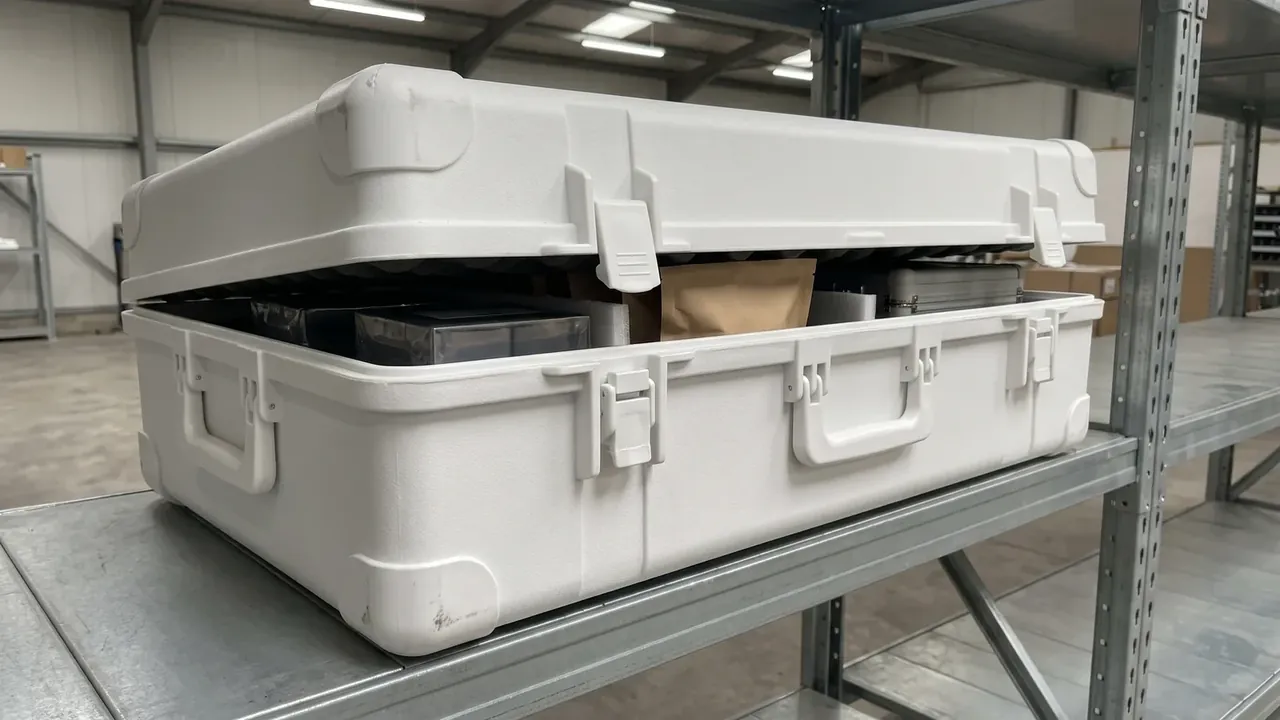
Quick answer: At the same 40 L, an injection moulded tool box holds 2.4 mm of wall within ±0.05 mm, while a blow moulded tool box averages 3.5 mm but thins to 2.3 mm at the bottom corner. Tooling is 450,000 against 60,000 CNY, and the crossover is 12,600 units.
Table of contents
- Where the Two Processes Split: Which Thickness Is Quoted
- Forming Routes: 80 MPa Melt Against 0.4 MPa Air
- Thickness Spread: ±0.05 mm Against 34%
- Ribs and Hollow Ribs: Where Stiffness Comes From
- Tooling and MOQ: Spreading 450,000 CNY over 3,000 Units
- Sealing Face, Hinge and Cold Drop
- FAQ
1. Where the Two Processes Split: Which Thickness Is Quoted
Both data sheets say 3 mm but measure different things. An injection moulded tool box quotes minimum wall: 2.4 mm on the drawing, 2.35 to 2.45 mm at four points. A blow moulded tool box quotes average wall, since the parison stretches as it inflates: 3.8 mm mid-wall, 2.3 mm at the bottom corner.
| Item | Injection moulded | Blow moulded |
|---|---|---|
| Thickness quoted | Minimum, 2.4 mm | Average, 3.5 mm |
| Measured range | 2.35–2.45 mm | 2.3–3.8 mm |
| Tare, 40 L box | 3.2 kg | 4.1 kg |
| Outline tolerance, 600 mm edge | ±0.15 mm | ±0.8 mm |
| Unit price at 30,000 pcs | 78 CNY | 96 CNY |
| Tooling | 450,000 CNY | 60,000 CNY |
Material decides the rest. PP shrinks 1.5%, so the cavity is cut oversize; HDPE takes its shape from a parison pressed against steel. The injection moulded lid closes to 0.3 mm, the blow moulded one needs 1.0 mm.
That 0.7 mm is gasket compression taken out of the seal.
2. Forming Routes: 80 MPa Melt Against 0.4 MPa Air
Injection drives PP at 230 °C into the cavity at 80 to 120 MPa, packs 8 s, cools 18 s, and turns out a 600×400×180 mm lid on a 52 s cycle from a 1,000 t press. Pressure copies every detail of the steel: ribs, grooves, bosses, latch seats.
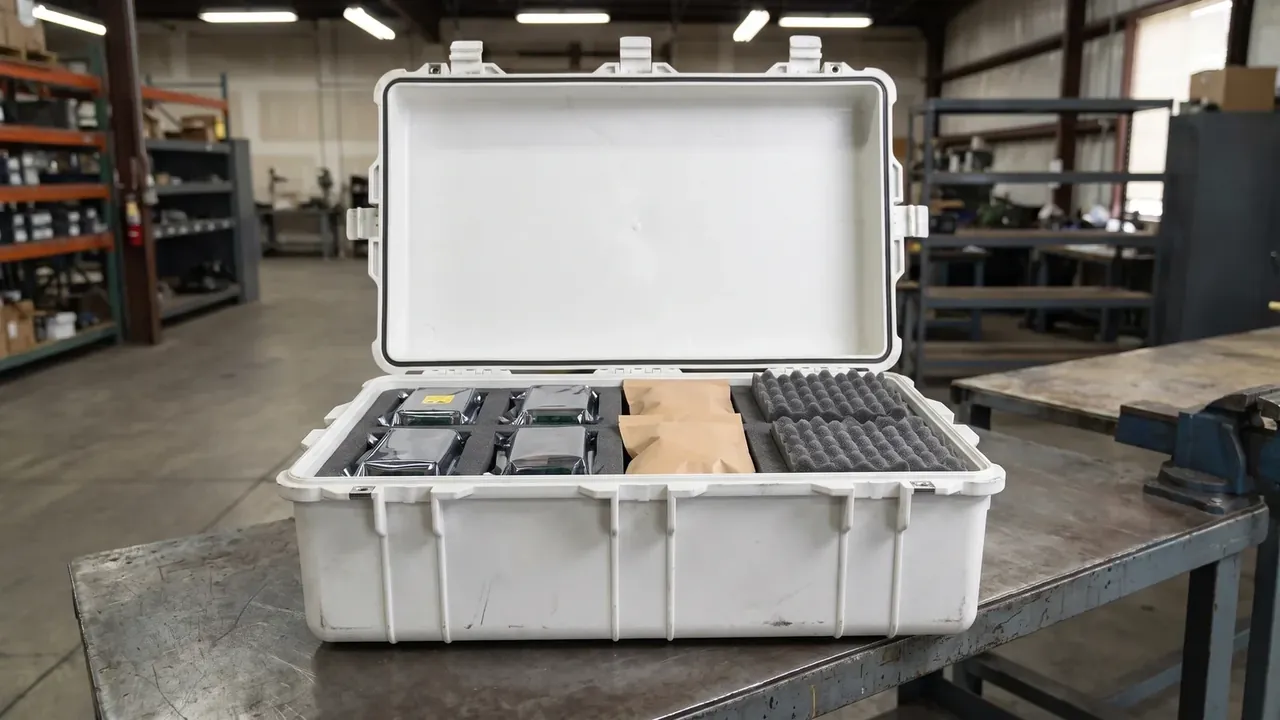
Blow moulding drops a 120 mm parison with an 8 mm wall at 190 °C; it sags 3%, the mould closes, and 0.4 MPa of air inflates it against a 25 °C wall in a 120 s cycle. One two-hundredth of the injection pressure buys cheap tooling and large single pieces.
3. Thickness Spread: ±0.05 mm Against 34%
Injection thickness is set by the cavity gap: four points fall within 0.1 mm, a 4% spread. Blow thickness follows parison distribution, and 2.3 mm at the bottom corner is 34% below the 3.5 mm nominal, exactly where a drop lands.
| Position | Injection moulded | Blow moulded | Difference |
|---|---|---|---|
| Mid sidewall | 2.40 mm | 3.80 mm | +1.40 mm |
| Long edge centre | 2.40 mm | 3.20 mm | +0.80 mm |
| Corner | 2.40 mm | 2.80 mm | +0.40 mm |
| Bottom corner | 2.40 mm | 2.30 mm | −0.10 mm |
That corner is why the thicker box does not survive better. On a 1.2 m corner drop after 4 h at −20 °C, the PP shell cracks 15 mm, the HDPE shell dents 4 mm. Notched impact at −20 °C is 12 kJ/m² for HDPE against 4 kJ/m² for PP.
The cold-drop line is drawn by material, not by millimetres.
4. Ribs and Hollow Ribs: Where Stiffness Comes From
Injection ribs cost almost nothing: 1.2 mm thick, 6 mm tall, 1° draft, R0.5 mm at the root. The price is sink: a rib heavy enough to matter leaves a 0.05 mm hollow on the show face unless the mould runs at 50 °C.
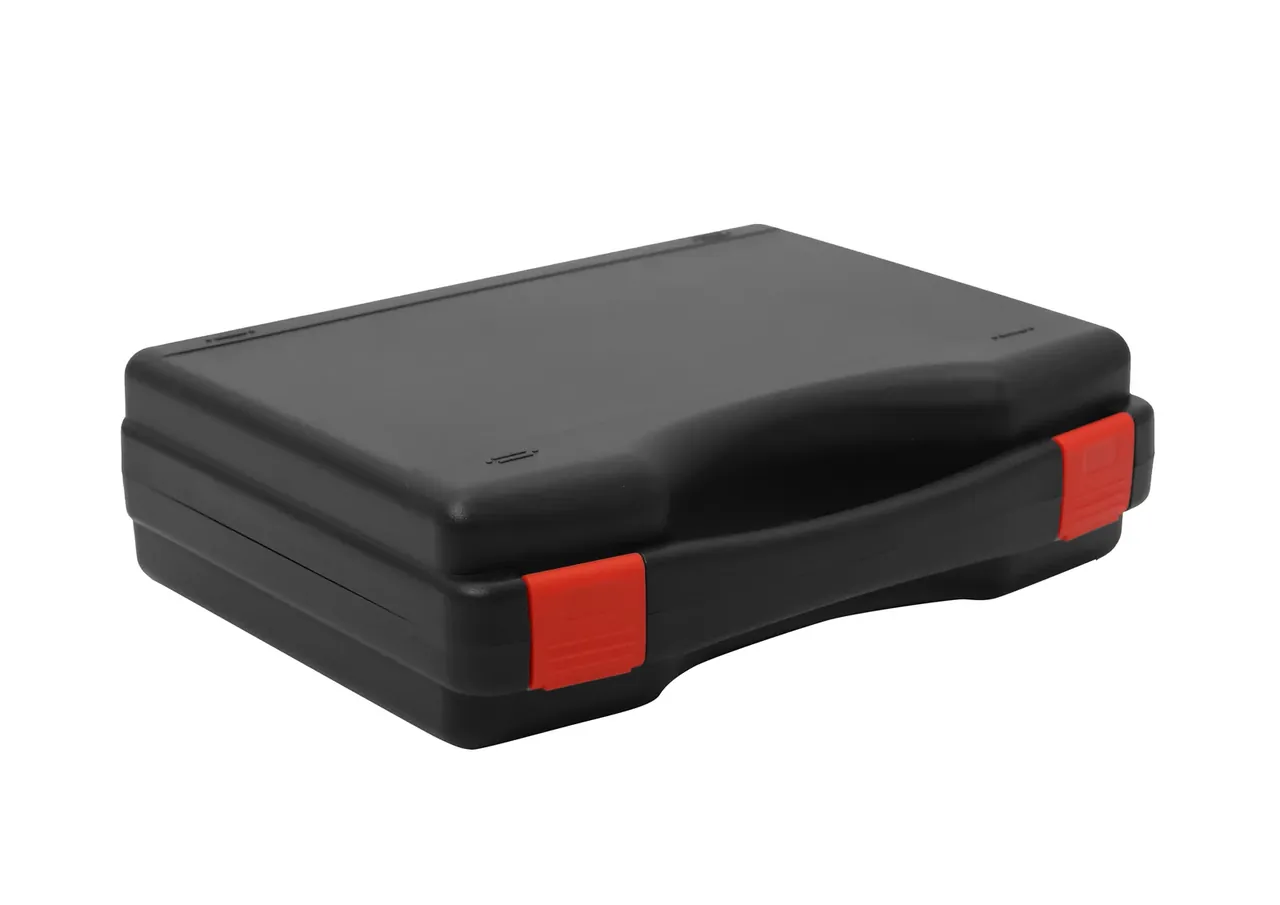
Blow moulded ribs are inflated: the outer wall bulges 8 mm, the inner follows, and the two weld at the root to close a 10 mm section. Bending resistance comes from depth, so a 3.5 mm wall behaves close to a 4 mm solid one.
- Span 400 mm, 200 N central: 3.4 mm of deflection over three injection moulded ribs, 2.6 mm over four hollow ones.
- A hollow root is a weld holding 60–70% of parent strength, so it opens first on a corner drop.
- An injection moulded root is continuous: it dents without cracking, but the dent presses into the cavity.
None of it shows on a sample.
5. Tooling and MOQ: Spreading 450,000 CNY over 3,000 Units
| Item | Injection moulded | Blow moulded |
|---|---|---|
| Mould type | Steel, single cavity | Aluminium, single cavity |
| Tooling cost | 450,000 CNY | 60,000 CNY |
| Mould life | 300,000 shots | 100,000 shots |
| Trial rounds | 3 | 2 |
| Usual MOQ | 3,000 pcs | 500 pcs |
Add tooling and it flips. The 78 CNY injection figure carries 15 CNY of amortisation, leaving 63 CNY of conversion; the 96 CNY blow figure carries 2 CNY, leaving 94 CNY. At 3,000 units injection lands at 213 CNY, at 500 units blow moulding lands at 214 CNY: the early price is level.
The crossover is 12,600 units: conversion differs by 31 CNY, tooling by 390,000 CNY, and 390,000 divided by 31 gives 12,600, where both read 98.7 CNY. Below that, the 60,000 CNY blow mould is lighter.
6. Sealing Face, Hinge and Cold Drop
Sealing starts with flatness. The injection moulded groove forms with the body: 6 mm wide, 4.5 mm deep, a 5 mm cord at 28% compression, rim flatness 0.3 mm, decay 0.5 kPa over 30 s, and IP67 stands. The blow moulded rim is milled after moulding to 0.8 mm, pulling compression to 18%; the same test reads 1.6 kPa, IP65.
IP67 from a blow moulded box means cutting a groove in a second operation and fitting eight latches at 120 N total, for 11 CNY a unit.
Hinges split the same way. Injection boxes run a 0.8 mm living hinge: after 50,000 cycles the fold whitens, and at −10 °C 200 folds leave a 0.3 mm craze. Blow moulded boxes take a 4 mm stainless pin, 0.2 mm oval after 20,000 cycles. Both shift on a 1.2 m drop, 0.4 mm and 0.9 mm.
Conclusion
Four numbers separate the two: ±0.05 mm against ±0.8 mm of tolerance, 0.3 mm against 0.8 mm of rim flatness, 450,000 against 60,000 CNY of tooling, and a 12,600 unit crossover. Sealing class points to injection, low MOQ and cold impact to blow moulding.
This article discusses only the container (case body) side of specifications and design intent, and does not cover any handling, loading or use of the contents.
Related Reading
- What one injection moulded tool box really costs
- Wall thickness and shrinkage in custom blow moulded cases
- Working back from a drawing to injection machine tonnage
- ABS and PP case bodies: cold brittleness and cost
Related Products
- 8 Series — Gun Cases; Military Equipment Cases; Camera Equipment Cases; Drone Cases; Watch Cases; Knife Cases; First Aid Cases; Electronics Equipment Cases
- WL8-2812 PP Gun Case — model WL8-2812
- All protective cases and toolboxes: 7 series, 158 models