

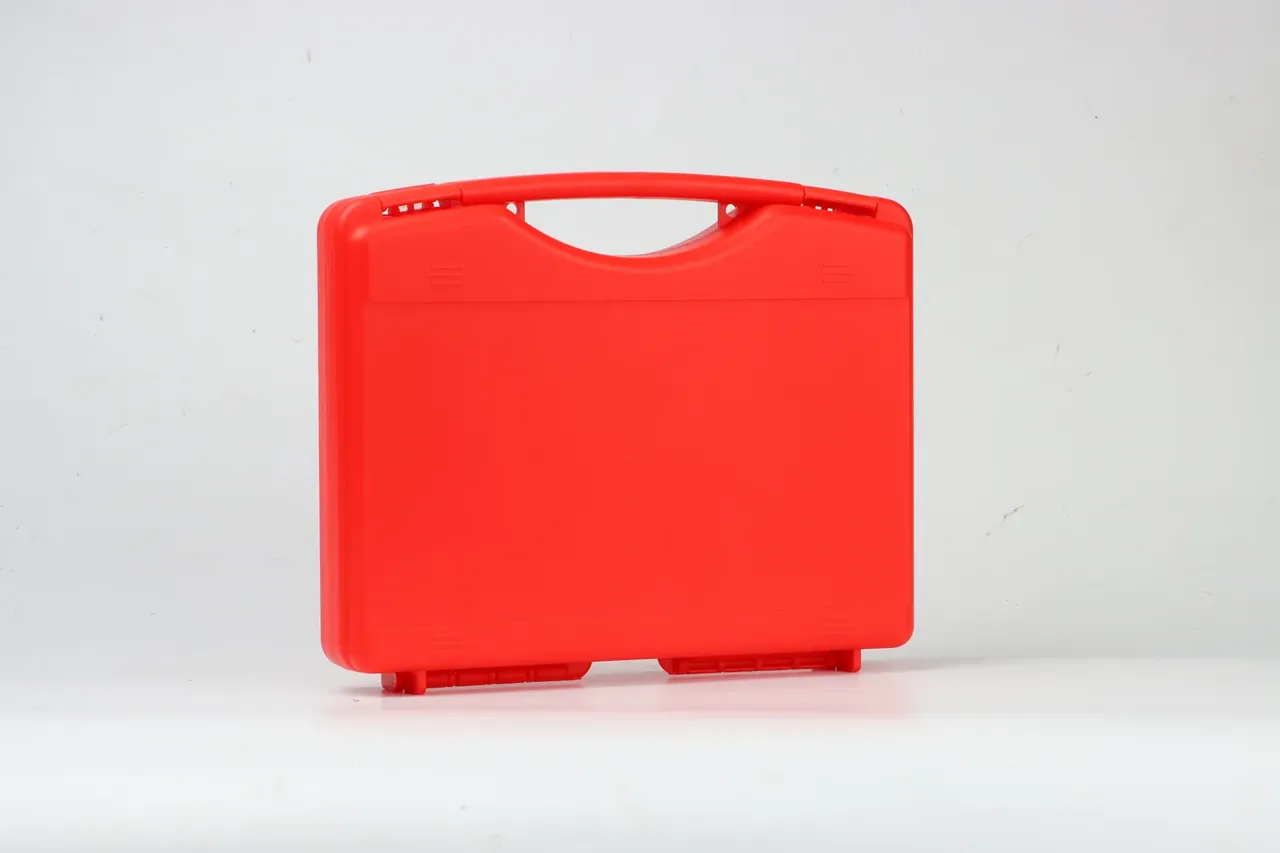
Quick answer: The gap between ABS and PP case bodies shows at -20 °C, where ABS drops from 14 to 5 kJ/m² and homopolymer PP to 3, so material is fixed by the coldest service temperature first, not by room-temperature strength.
Table of contents
- Where PP Case Bodies and ABS Diverge
- Low-Temperature Impact from 23 °C to -20 °C
- Brittleness Temperature and the 15% POE Addition
- Heat Deflection and Shrinkage: Two Mold Calculations
- Cost, Gloss and Chemical Resistance
- FAQ
1. Where PP Case Bodies and ABS Diverge
PP case bodies are semi-crystalline, ABS amorphous, and that drives every trade-off below. On a 2.5 mm lid ABS shows a flexural modulus near 2300 MPa against 1300 MPa for PP. Density runs the other way: 1.04 against 0.905 g/cm³, so an equal-volume case is 13% lighter in PP.
Shrinkage follows: PP cools from a 200 °C melt into a 40 °C mold and loses 1.2% to 2.0% of length, while ABS moves 0.4% to 0.7%, so a 420 mm cavity is cut at 426.7 mm for PP and 422.3 mm for ABS.
| Property | ABS | Homo PP | Copolymer PP+15% POE |
|---|---|---|---|
| Density g/cm³ | 1.04 | 0.905 | 0.900 |
| Notched impact at 23 °C, kJ/m² | 14 | 8 | 55 |
| Notched impact at -20 °C, kJ/m² | 5 | 3 | 38 |
| Brittleness temperature | -25 °C | -5 °C | -40 °C |
| HDT at 1.82 MPa | 88 °C | 62 °C | 58 °C |
| Mold shrinkage | 0.4–0.7% | 1.2–1.8% | 1.4–2.0% |
| Resin price, CNY/kg | 13.5 | 9.8 | 11.6 |
Impact follows ISO 179 on a 1eA notched bar; kJ/m² does not convert to the J/m of ASTM D256.
2. Low-Temperature Impact from 23 °C to -20 °C
At 23 °C they sit close: 14 kJ/m² against 8, both surviving a 1.0 m drop. At -20 °C ABS loses 64% and PP 62%, both under 5, and only what remains is margin.
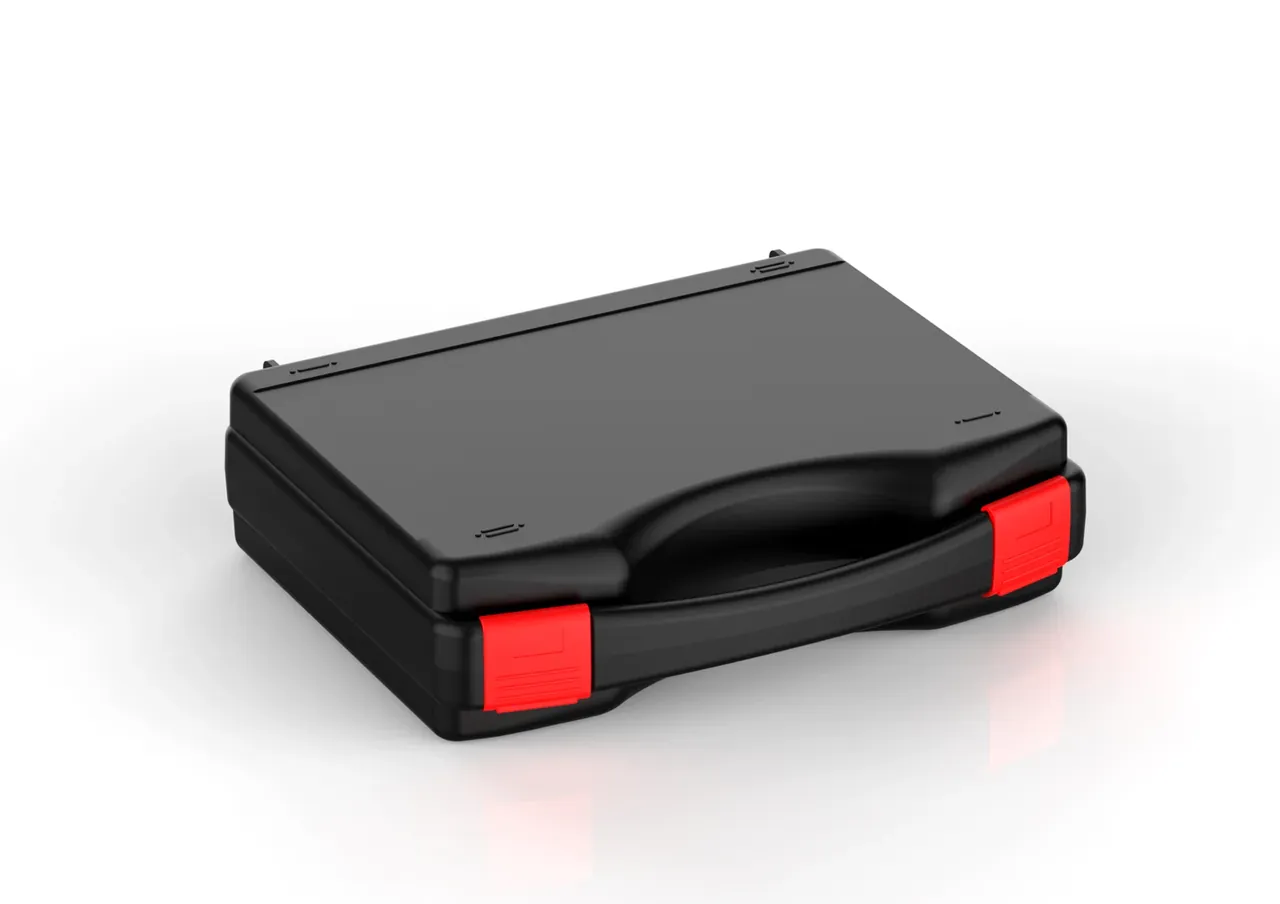
A case rarely fails whole; it cracks at a corner or latch boss, where a 2.5 mm radius carries a stress concentration near 2.4. Held 4 h at -20 °C and dropped 1.0 m on six faces, an ABS case cracked 12 mm; a copolymer PP+POE case survived with dents.
The hammer at 2.9 m/s matches the strain rate at a corner, which is why the notched value predicts better than elongation at break.
The loss in ABS traces to its butadiene phase, near its glass transition at -20 °C, where energy goes into crazing that will not build. Copolymer PP keeps ethylene-propylene segments mobile below -50 °C.
3. Brittleness Temperature and the 15% POE Addition
Brittleness temperature, judged by 50% bending failure, is the more intuitive line: homopolymer PP turns brittle near -5 °C, copolymer PP reaches -25 °C, and 15% POE pushes it below -40 °C.
POE has a knee. At 5% the -20 °C impact rises from 3 to 12 kJ/m², at 10% to 26, at 15% to 38, at 20% to 44, while tensile strength slides from 31 to 24 MPa; fifteen percent is where impact and rigidity cross.
A 15% load lifts resin from 9.8 to 11.6 CNY/kg, still 14% under ABS, and leaves haze on a gloss lid.
4. Heat Deflection and Shrinkage: Two Mold Calculations
Heat deflection only means something next to a load. At 1.82 MPa ABS reaches 88 °C, homopolymer PP 62 °C, copolymer PP+POE 58 °C; at 0.45 MPa PP reports 100 °C. The readings differ by 38 K, so one figure proves nothing, and a PP case in a sun-baked cargo box sees the lid near 70 °C.
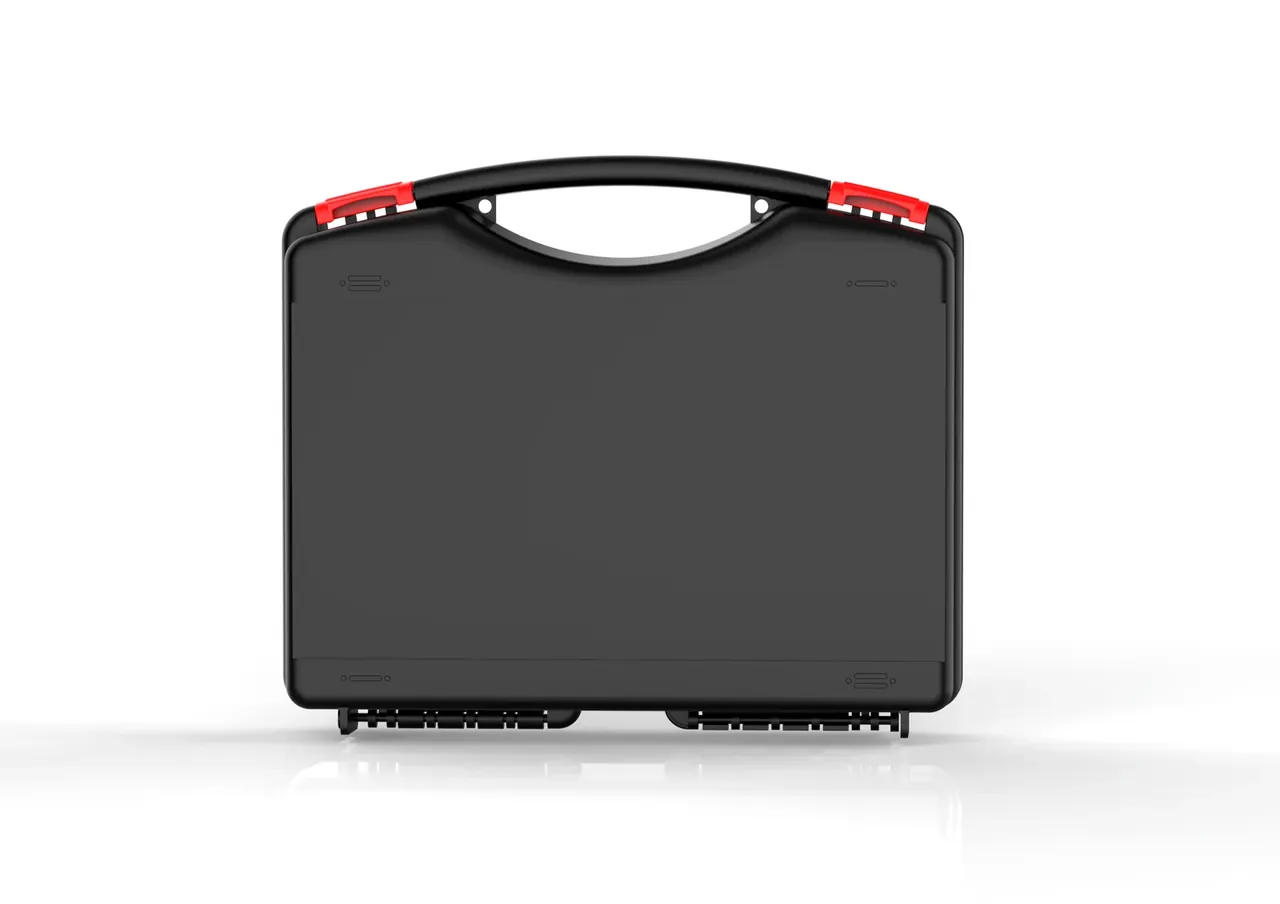
Shrinkage is a tooling cost: PP differs 0.3 to 0.5 points between flow and cross-flow, spreading 1.3 to 2.1 mm over 420 mm, so the joint needs 0.8 mm, while ABS varies under 0.1 point and needs 0.3 mm.
Warping starts elsewhere: a step from 2.5 mm to 3.2 mm warps PP by 0.2 mm unless the transition stretches over 15 mm.
Tool steel stays P20, but PP wants a 40 °C to 60 °C mold with a 6 kW unit against 60 °C to 80 °C for ABS.
5. Cost, Gloss and Chemical Resistance
Resin cost settles by weight: a 22 L cavity takes 2.1 kg of PP or 2.4 kg of ABS, or 20.6 against 32.4 CNY at 9.8 and 13.5 CNY/kg, an 11.8 gap on a 45 s cycle.
ABS reaches 85 GU at 60° off a polished tool, while a PP case delivers 12 GU and gloss needs primer and clearcoat, adding 4 to 6 CNY; fine grain such as MT-11020 transfers more sharply on PP.
Chemical resistance favors PP: salts, alcohols and cleaners leave it alone, while ABS whitens after one acetone wipe.
- Acetone and MEK: ABS whitens, PP unchanged
- Ethyl acetate and dichloromethane: ABS swells, PP unchanged
- 24 h gasoline soak: ABS loses 3.1% mass, PP 0.4%
- 30 wipes with 5% sodium hypochlorite: both pass, ABS gloss drops 8 GU
| Minimum service temp | Material | Wall | Basis |
|---|---|---|---|
| Above -10 °C | ABS | 2.5 mm | 5 kJ/m² left at -20 °C |
| -10 to -20 °C | Copolymer PP | 3.0 mm | Brittleness point -25 °C |
| -20 to -30 °C | Copolymer PP+15% POE | 3.0 mm | 38 kJ/m² at -20 °C |
| Below -30 °C | Copolymer PP+20% POE | 3.5 mm | R5 corners, no sharp angles |
Sort by the coldest service temperature, not the average: a northern night puts a cargo box at -25 °C and a dock at 20 °C, 45 K in one day, so the brittleness point needs 10 K of headroom.
Conclusion
The order is cold first, cost second, appearance last. Above -10 °C, ABS delivers 14 kJ/m² and an 88 °C heat deflection, and a mirror tool ships gloss without paint; below -20 °C a PP case needs a copolymer grade with enough POE, since the homopolymer holds 3 kJ/m² after 4 h in a freezer. Shrinkage follows the resin: a 6.7 mm cavity allowance and 0.8 mm clearance belong in the quote. Fix the coldest service temperature, then confirm the margin covers two drops.
This article discusses only the container (case body) side of specifications and design intent, and does not cover any handling, loading or use of the contents.
Related Reading
- ABS vs PP protective cases: the full material comparison
- ABS case selection: wall thickness, latches and liners
- Case raw materials compared: PP, ABS and HDPE
- Raw material traceability from lot number to case marking
Related Products
- 8 Series — Gun Cases; Military Equipment Cases; Camera Equipment Cases; Drone Cases; Watch Cases; Knife Cases; First Aid Cases; Electronics Equipment Cases
- WL8-2812 PP Gun Case — model WL8-2812
- All protective cases and toolboxes: 7 series, 158 models