

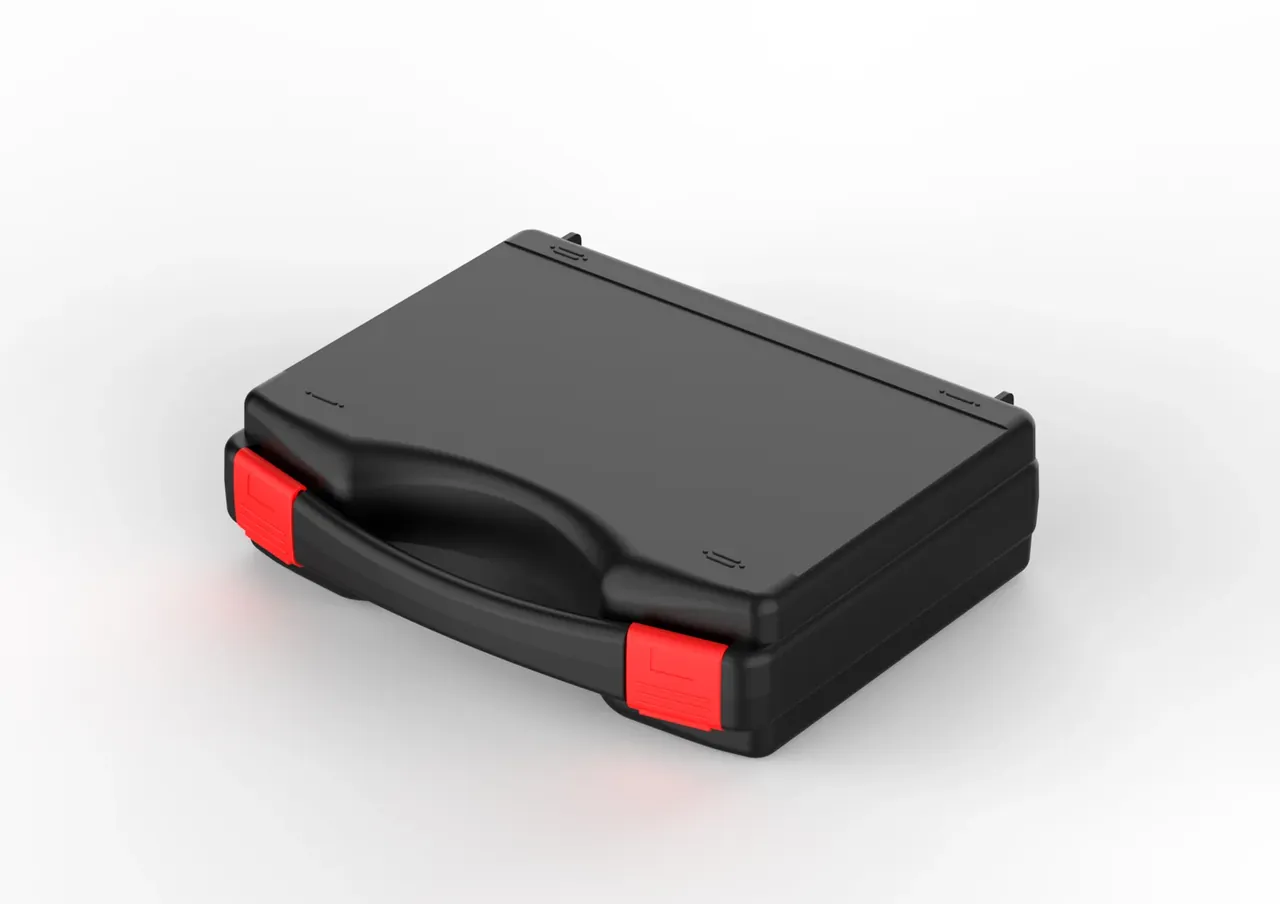
Quick answer: Run four resins through one mould and weight, shrinkage and cold impact split into four curves. Case raw material preparation settles the grade first; the tool then gets its shrinkage number.
Table of contents
- Where the four grades diverge
- PP cost line: 9.2 yuan a kilo with three conditions
- HDPE and ABS: when a project must switch
- PC and alloys: the boundary of a dearer grade
- When PP is the wrong call
- FAQ
1. Where the four grades diverge
Last winter 600 cases went to a northern cold store. All passed a 1.2 m ambient drop test; three months in, 11 showed 2 to 3 mm splits at the latch bosses. Rebuilt in HDPE, they came back clean at -30℃. Case raw material preparation fixes temperature before price.
A 1.2 m internal span weighs 4.8 kg in PP and 5.6 kg in ABS.
Shrinkage sets tool compensation: PP runs 1.4 to 1.8 percent, cut at 1.7, ABS at 0.5, so one gate dishes 0.4 mm in PP and bulges 0.15 mm in ABS. PP also falls from 6 kJ/m² at 23℃ to 2.5 at -30℃, where HDPE holds 8.
| Grade | Density g/cm³ | Shrinkage % | Impact at -30℃ kJ/m² | Price yuan/kg | Weak point |
|---|---|---|---|---|---|
| PP copolymer | 0.90 | 1.4 to 1.8 | 2.5 | 9.2 | Brittle cold, poor fuel resistance |
| HDPE | 0.95 | 2.0 to 2.5 | 8 | 11.5 | Low stiffness, hard to paint |
| ABS | 1.05 | 0.4 to 0.6 | 6 | 14.8 | Poor weathering, needs drying |
| PC | 1.20 | 0.5 to 0.7 | 12 | 26 | High moulded-in stress |
2. PP cost line: 9.2 yuan a kilo with three conditions
At 9.2 yuan a kilo PP is the cheapest, but only while three conditions stand, and those are what case raw material preparation skips.
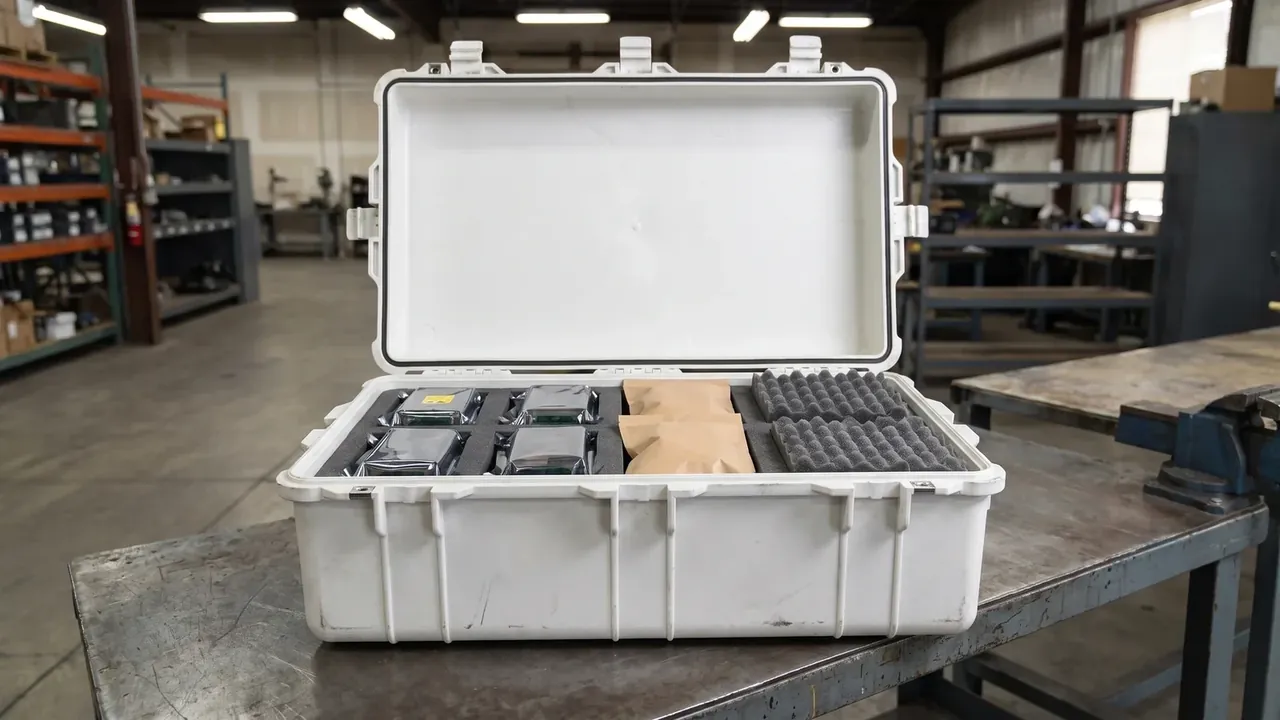
The first is a span under 1.2 m: 3 mm wall, ribs at 120 mm, 40℃ tool. At 1.5 m the ribs need 4.5 mm. The second is service above -10℃, below which impact falls under 3 kJ/m². The third is no aromatic contact: 72 hours in diesel and PP gains 8 percent in weight, opening latch clearance from 0.2 mm to 0.5 mm.
Meet all three and the list is short: dry 2 hours at 80℃, hold moisture under 0.05 percent, keep regrind under 20 percent.
3. HDPE and ABS: when a project must switch
The question is not which resin is better but which requirement PP cannot meet.
| Field requirement | What PP does | Switch to | Preparation change |
|---|---|---|---|
| Store at -30℃ for 12 months | Latch bosses split, drop fails | HDPE at 4 mm wall | Dry 1.5 hours at 70℃ |
| Lid-to-base offset of 0.3 mm | Sink marks push it to 0.8 mm | ABS | Dry 3 hours at 80℃, regrind 15 percent |
| Clear viewing window | Cannot be moulded | PC | Dry 4 hours at 120℃, 90℃ tool |
HDPE gives three times the cold impact of PP and pays in stiffness: at 3 mm it bulges 6 mm under 46 kg where PP bulges 2 mm, so the wall goes to 4 mm and the unit to 5.9 kg.
ABS wins on dimensions, holding a 1.2 m diagonal within 0.8 mm, but above 0.1 percent moisture the parts show silver streaks. Preparation differences surface before moulding ones, so case raw material preparation signs off the schedule and the first shot.
4. PC and alloys: the boundary of a dearer grade
PC alone gives clarity and impact at once: 65 kJ/m² at room temperature, 12 at -30℃, a 1.2 m drop at -40℃ without a crack.
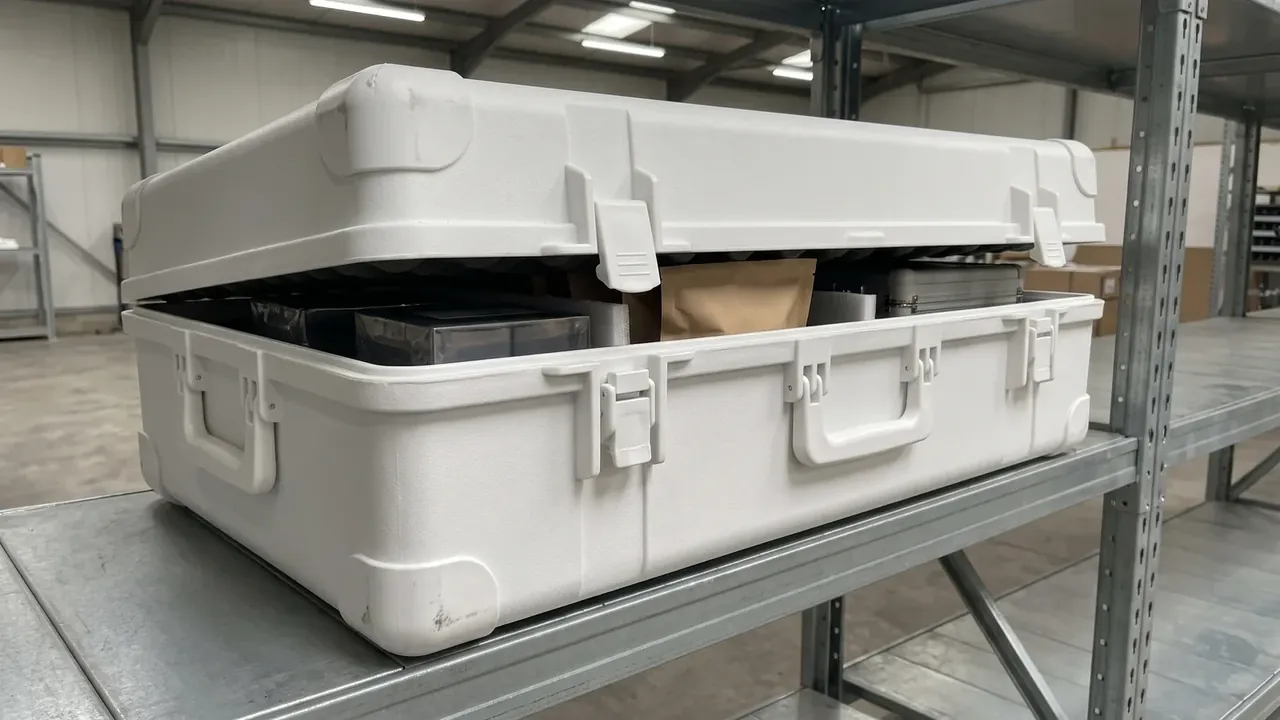
The cost sits upstream: dry 4 hours at 120℃, hold moisture at 0.02 percent, and return granules to the dryer after 30 minutes in the hopper, since hydrolysis costs 15 percent of molecular weight.
A PC case also needs an hour of annealing at 120℃.
PC/ABS alloy pulls the price from 26 yuan to 18, cuts impact to 45 kJ/m² and gives up clarity, suiting cases under 800 mm. That is the boundary of a dearer grade in case raw material preparation: clarity, or staying intact below -40℃.
5. When PP is the wrong call
Any one of these conditions should take PP off the case raw material preparation sheet.
| Condition | Threshold | Alternative | What it costs |
|---|---|---|---|
| Cold-store storage | Service below -30℃ | HDPE | 1 mm more wall, 5.9 kg unit |
| Tight assembly | Flatness at 0.2 mm | ABS | 5.6 yuan a kilo more |
| Fuel and solvent contact | 100 wipes without softening | HDPE or a coating | Extra coat, 8 s added to the cycle |
Over-specifying happens too: one project moved a 1.2 m case from PP to PC, taking resin from 9.2 to 26 yuan a kilo and each unit from 44 to 166 yuan, while the coldest reading was -8℃. The extra 122 yuan bought nothing.
Switching grades also rewrites the card: PP to ABS adds an hour of drying and 25 minutes of purging.
Conclusion
None of the four grades is universally better, only better matched. PP is cheap and easy to mould but brittle cold; HDPE takes cold impact but flexes; ABS holds dimensions but demands drying; PC buys clarity with price. Write temperature, flatness and contact media first, and case raw material preparation will not come back for rework.
This article discusses only the container (case body) side of specifications and design intent, and does not cover any handling, loading or use of the contents.
Related Reading
- Batch records from goods-in to the machine
- Drying, colour matching and regrind ratio
- Steel, aluminium, rotomoulding and composites
- Material routes for hard-shell suitcases
- Shell materials for firearm protection cases
Related Products
- 8 Series — Gun Cases; Military Equipment Cases; Camera Equipment Cases; Drone Cases; Watch Cases; Knife Cases; First Aid Cases; Electronics Equipment Cases
- WL8-2812 PP Gun Case — model WL8-2812
- All protective cases and toolboxes: 7 series, 158 models