

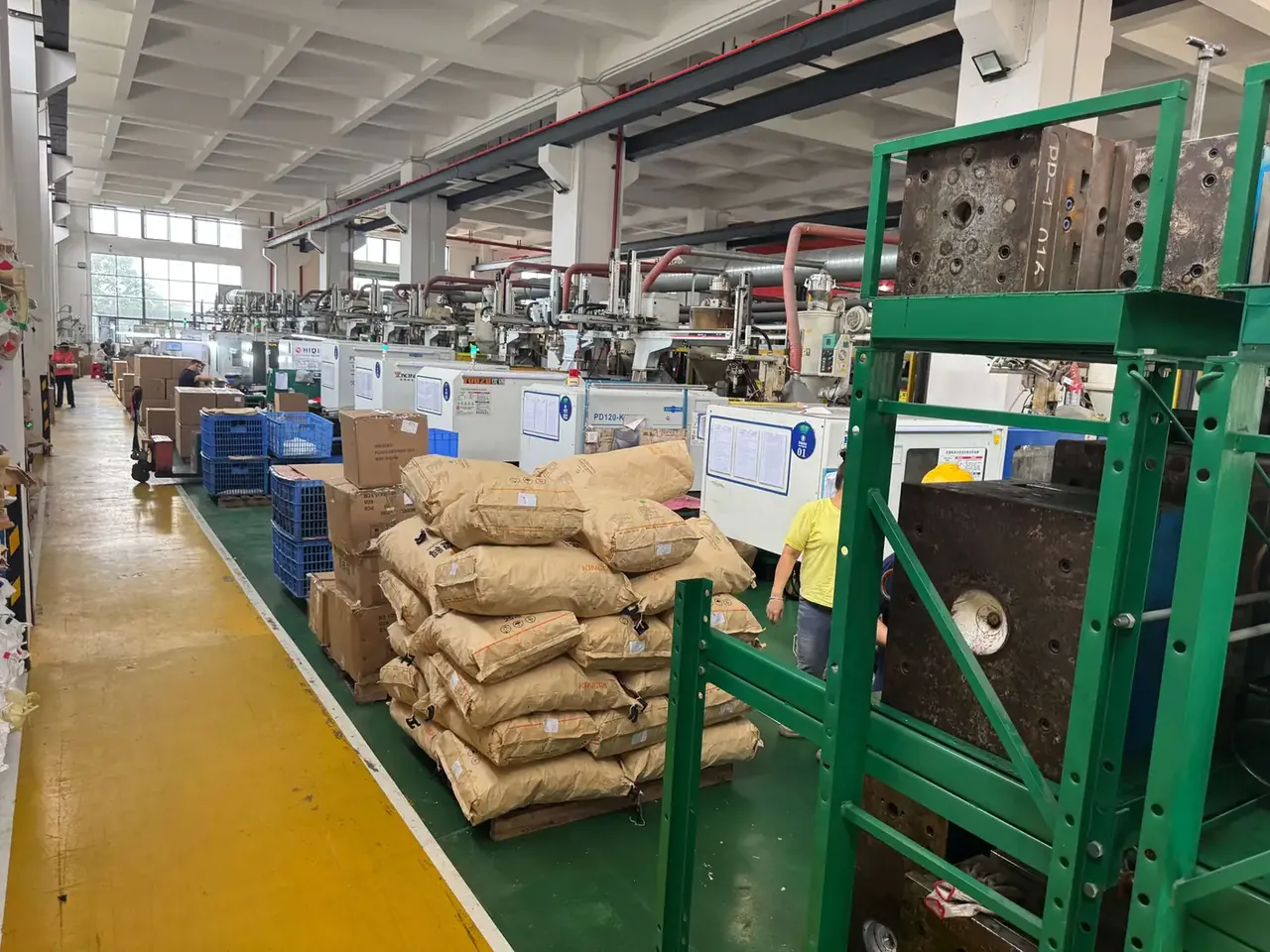
Quick answer: Case raw material preparation turns purchased pellets into a blend that goes straight into the hopper: dry to a moisture ceiling, dose masterbatch to a color tolerance, blend regrind to a scrap ceiling. Run the three out of order and the case shows it in wall thickness, color or impact strength.
Table of contents
- What Case Raw Material Preparation Covers
- Drying: Temperature, Time and Moisture Ceiling
- Color: Masterbatch Ratio and Color Changes
- Regrind: Setting the Scrap Ratio Ceiling
- Mixing and First-Article Confirmation
- FAQ
1. What Case Raw Material Preparation Covers
A case body is PP copolymer or ABS, and a 250-tonne press eats 300 to 500 kg a shift, 12 to 20 sacks of 25 kg. Case raw material preparation runs from the warehouse rack to the drum tipped into the hopper, judged on four numbers: moisture, color difference, regrind share and particle size spread.
The four gates run in a fixed order: incoming inspection for grade, lot and melt index; drying under the moisture ceiling; coloring over dry pellets; regrind last, because scrap needs its own drying pass. Plants that color first find masterbatch caked in the hopper.
| Check | Method | Accept limit |
|---|---|---|
| Grade and lot | Delivery note against bag code | All three match, else reject |
| Melt index | Spot test | Within 10% of nominal |
| Moisture | Meter, three points | Per grade ceiling |
2. Drying: Temperature, Time and Moisture Ceiling
For PP, drying in case raw material preparation runs 80 to 90 °C for two hours. ABS is polar: 80 °C for three to four hours, down to 0.10 percent. A case with a PC window needs 120 °C for four hours and 0.02 percent. Over-drying fails too: PP above 90 °C for four hours goes tacky and bridges.
Dryer type matters more than setpoint: hot-air hoppers draw shop air, so at 80 percent humidity four hours changes nothing. A desiccant unit at minus 20 °C dew point gets there in two hours. Log temperature and level every two hours.
| Material | Temp | Time | Moisture |
|---|---|---|---|
| PP copolymer | 80–90 °C | 2 h | 0.05% |
| ABS | 80 °C | 3–4 h | 0.10% |
| PC | 120 °C | 4 h | 0.02% |
3. Color: Masterbatch Ratio and Color Changes
Dosage runs 2 to 4 percent: pale and beige at 2, charcoal and olive at 3 to 4. Under 1.5 percent the pigment cannot disperse and the surface clouds; above 5 percent the carrier mismatches and impact strength falls.
Carrier family has to match, PE for PP and ABS or SAN for ABS. Meter on a loss-in-weight unit at plus or minus 0.5 percent; hand blending needs 20 rpm for five minutes. Read color under D65: 0.6 within a lot, 1.0 lot to lot. Pale to dark purges with 3 to 5 kg, dark to pale with 8 to 10 kg and a pulled nozzle, and the first 20 shots stay quarantined.
4. Regrind: Setting the Scrap Ratio Ceiling
In case raw material preparation, grind to 6 to 8 mm, within 2 mm of virgin pellet size; a wider spread separates the fractions and wall thickness oscillates. Check screens weekly, since a torn one passes 20 mm chunks.
PP bodies run to 20 percent, ABS to 15, while hinge bosses, latch seats and handle roots stay at 10. Each extra 10 points costs 5 to 8 percent of Izod impact, and the higher melt index hides a thin wall.
| Location | PP ceiling | ABS ceiling | Note |
|---|---|---|---|
| Lid and base panels | 20% | 15% | Re-test drop |
| Hinge and latch seats | 10% | 10% | Load path |
| Handle and trolley | 10% | 5% | Fatigue |
| Clear window | 0 | 0 | No regrind |
5. Mixing and First-Article Confirmation
Blend for 3 to 5 minutes at moderate speed; friction adds 5 to 8 °C and makes PP tacky. Keep a batch to one shift, about 300 kg; material blended today and molded tomorrow reabsorbs moisture.
The first article checks eight wall-thickness points, weight within 1.5 percent, and color against the plaque under D65. If it fails, check the order of the three jobs before touching process settings.
Conclusion
Case raw material preparation is three jobs behind two gates: drying sets moisture, coloring sets ΔE, regrind share sets impact. One batch card carries all of it, and a number that does not reconcile there cannot be fixed at the press. Fix the order, keep the records, sign the first article, and case raw material preparation is genuinely complete.
This article discusses only the container (case body) side of specifications and design intent, and does not cover any handling, loading or use of the contents.
Related Reading
- How wall thickness maps to case strength
- Visual color management on case bodies
- Cost structure of a protective case, broken down
- How to audit a protective case factory
Related Products
- 8 Series — Gun Cases; Military Equipment Cases; Camera Equipment Cases; Drone Cases; Watch Cases; Knife Cases; First Aid Cases; Electronics Equipment Cases
- WL8-2812 PP Gun Case — model WL8-2812
- All protective cases and toolboxes: 7 series, 158 models