

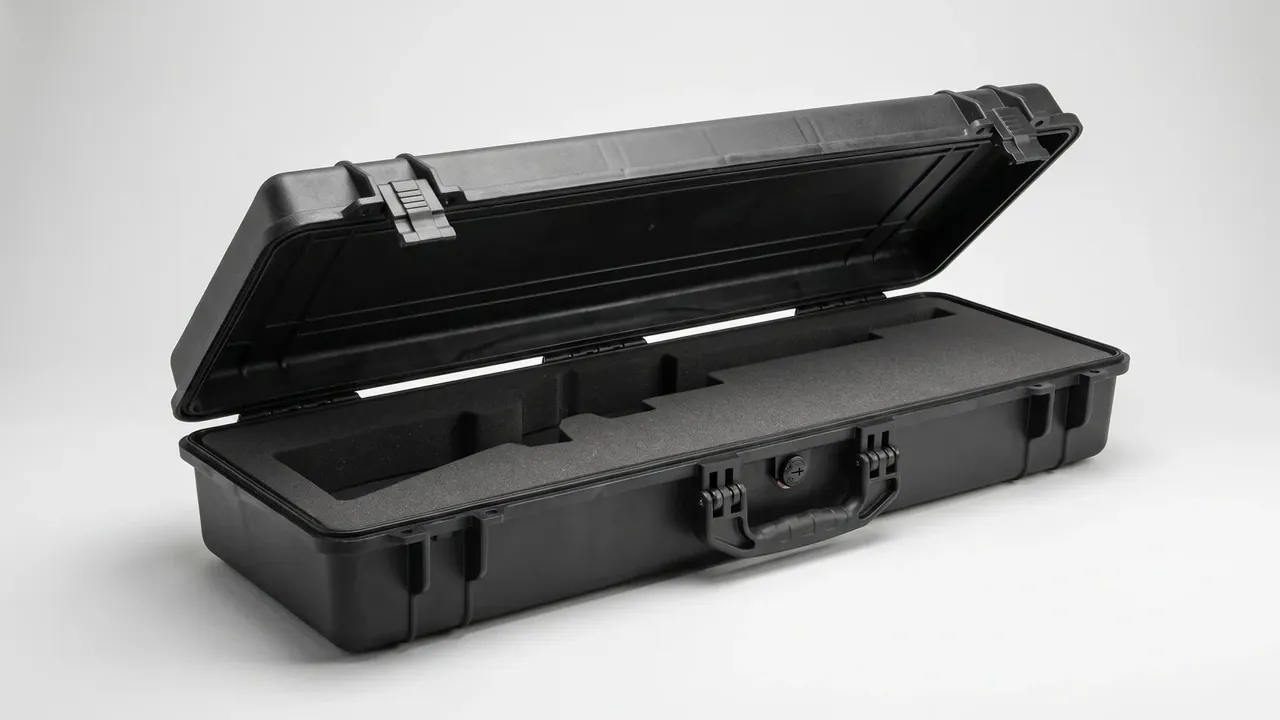
Quick answer: How long a Box, Ammunition Stowage lasts is settled on the drawing: wall thickness against dents, ribs against collapse, latch pitch against an uneven rim, gasket squeeze against water, hardware grade against rust. The five pull against each other, so the question is balance, not thickness.
Table of contents
- Frame Layers of Box, Ammunition Stowage
- Materials and Wall Thickness
- Ribs and Feet: Where the Load Travels
- Hinges and Latches: Count and Pitch
- Seal, Vent and Hardware Finish
- FAQ
1. Frame Layers of Box, Ammunition Stowage
A Box, Ammunition Stowage reads from outside in as five layers: shell, ribs, liner, seal, hinges and latches. Each fails differently: a cracked shell had uneven walls, folding ribs were shallow, a leaking seal sits behind latches spaced too wide.
Rotomoulding tumbles polyethylene powder in a two-axis mould, landing the wall at four to six millimetres with thicker corners; injection moulding fills once and holds three and a half. Order matters: hinge seats are milled flat, latches fitted after the gasket is compressed.
| Layer | Job | Typical build | Check first |
|---|---|---|---|
| Shell | Impact, stacking | HDPE, 4 to 6 mm | Pale corners |
| Ribs | Spread load | 8 mm high, 90 mm apart | Rib-root cracks |
| Seal and liner | Moisture, location | EPDM, 25 to 30 percent | Flattened gasket |
| Hardware | Open and lock | 304 hinge, nylon latch | Pin play |
2. Materials and Wall Thickness
Polyethylene stays tough at minus forty Celsius; polypropylene is stiffer but brittle in cold and soft above sixty. Most boxes run high-density polyethylene: ribs stiffening the lid, a little give in the floor.
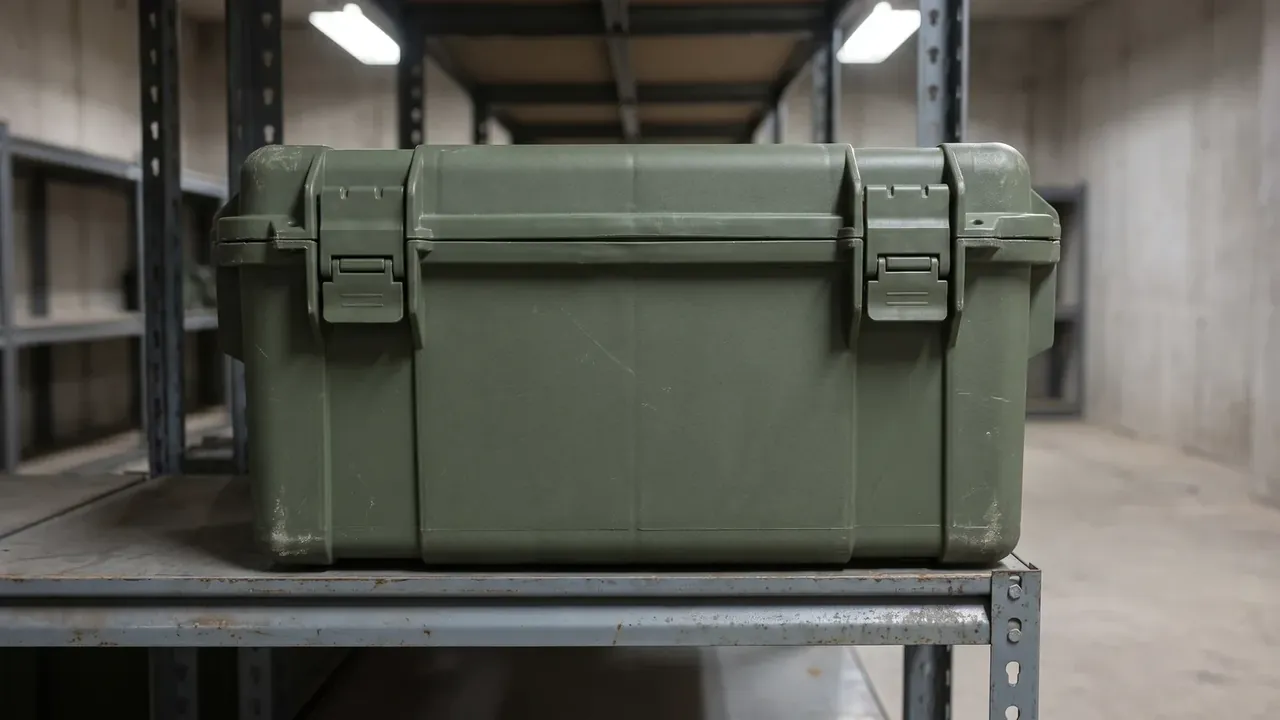
Thicker is not stronger. Four to six millimetres adds dent resistance but roughly two kilograms. The answer is four across the panels and six at corners and latch seats. Rotomoulding holds 230 to 260 Celsius, fifteen minutes at six millimetres, twelve minutes cooling; a short cool bows the panel one to two millimetres.
3. Ribs and Feet: Where the Load Travels
Ribs turn a point load into an area load. On a Box, Ammunition Stowage the floor ribs run 8 mm high, 6 mm wide and 90 mm apart, across the handle pull, so the floor bends at the rib. Taller ribs trap powder and fight demoulding.
Feet decide whether a stack sits square. Four 12 mm pedestals drop into shallow lid recesses and lock it sideways. Leaving the centre open lets the floor flex: at twenty-five kilograms five high, the bottom unit carries a hundred kilograms for months. A static test presses 300 kilograms for a day, allowing two millimetres of set.
4. Hinges and Latches: Count and Pitch
Hinges and latches are touched daily, and their pitch sets how evenly the rim closes. Up to 600 millimetres, two hinges 300 millimetres long and four latches are enough; past 800 the count rises to six to stop the lid bulging.
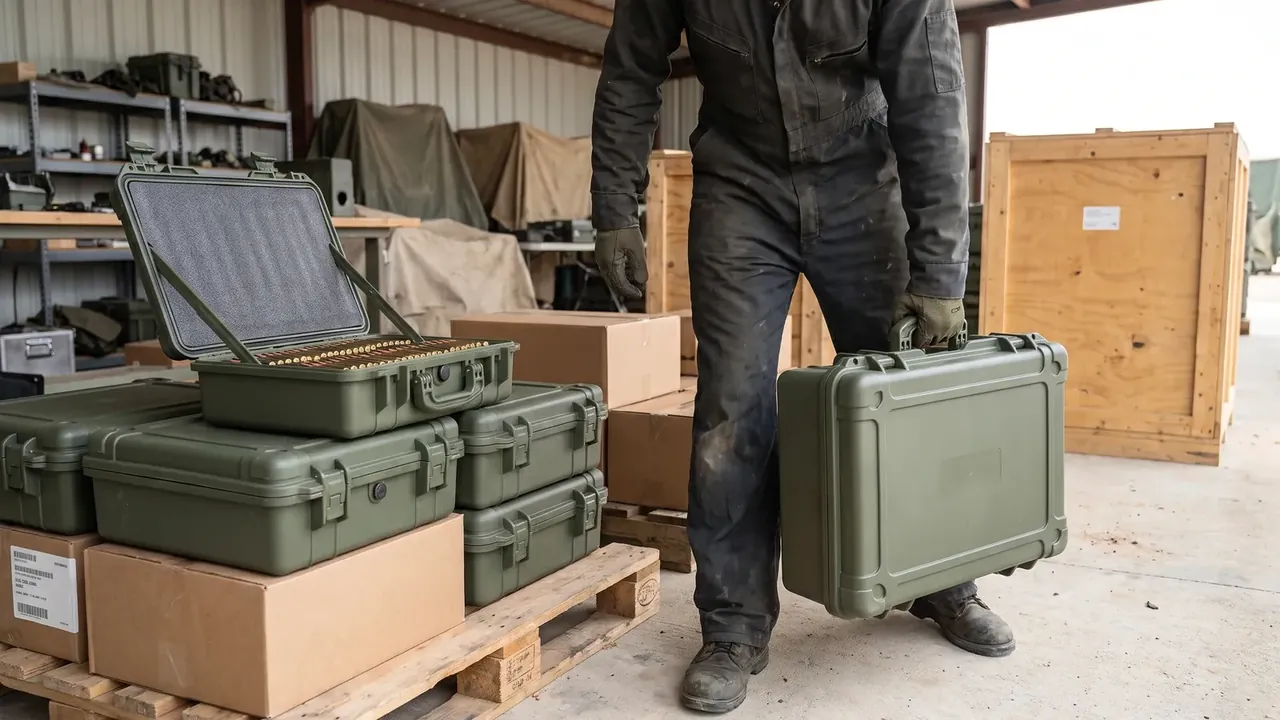
Pitch matters more than count. Beyond 180 millimetres the gasket never reaches its squeeze in the middle and a rain test finds the gap; below 120 one hand cannot close it. Work diagonally in two passes; closing around the rim shears the gasket at the last corner.
5. Seal, Vent and Hardware Finish
A seal works by squeeze. A four millimetre groove with a six millimetre cord lands the squeeze at 25 to 30 percent; less and the cord cannot follow temperature, more and it takes a set.
The vent is the part most often deleted. Twenty Celsius between spaces sucks the lid down until someone prises it and pulls the gasket from its groove; a breather at fifteen kilopascals balances it. Hardware is specified by salt spray hours, ninety-six to red rust, and every fitting should be 304; galvanised parts pit in two years.
| Parameter | Target | Control | If missed |
|---|---|---|---|
| Gasket squeeze | 25 to 30 percent | Groove to cord | Leaks or set |
| Vent opening | 15 kPa | Disc and bore | Lid sucked shut |
| Salt spray | 96 hours | One 304 supply | Pitting |
Conclusion
The frame of a Box, Ammunition Stowage balances five numbers pulling against each other: wall thickness, rib height, latch pitch, gasket squeeze and hardware grade. Strengthen one alone and the load moves to its neighbour; the case fails elsewhere. Ask the five in order, and approve only a Box, Ammunition Stowage whose numbers all sit inside range.
This article discusses only the container (case body) side of specifications and design intent, and does not cover any handling, loading or use of the contents.
Related Reading
- Stacking and transfer in the warehouse
- Case body materials compared: plastic and metal
- Packaging and transport marking for small arms boxes
- Load, sealing and cushioning for shipping containers
Related Products
- 8 Series — Gun Cases; Military Equipment Cases; Camera Equipment Cases; Drone Cases; Watch Cases; Knife Cases; First Aid Cases; Electronics Equipment Cases
- WL8-2812 PP Gun Case — model WL8-2812
- All protective cases and toolboxes: 7 series, 158 models