

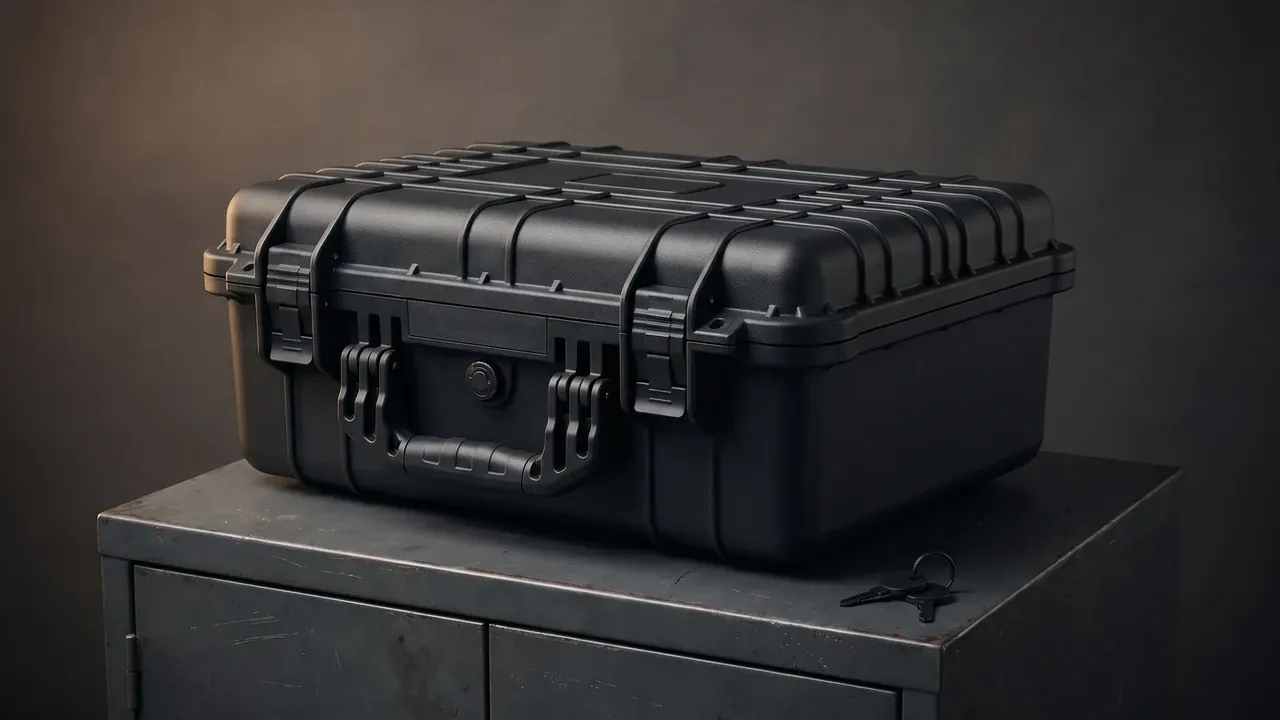
Quick answer: Specify a Box, Ammunition Stowage from the cavity outwards: fix cell width and count, derive rib thickness and outer envelope, set wall and rib height for stiffness, then lock the protection with lid gap and gasket compression, and finish with a stack load that matches the layer count.
Table of contents
- Cavity Chain and Compartment Capacity
- Wall Thickness, Ribs and Stiffness
- Lid Gap and Gasket Compression
- Stack Load and Layer Rating
- Temperature, IP Rating and Empty Weight
- FAQ
1. Cavity Chain and Compartment Capacity
The first number on a Box, Ammunition Stowage drawing is not the outer length. It is the cavity. Four dimensions form a chain: outer size minus two walls gives cavity width, cavity minus total rib thickness gives usable width, usable width divided by cell count gives cell size. At 600 by 400 by 220 mm outside and a 6 mm wall, the cavity is 588 by 388 by 208 mm; eight cells across a 388 mm width leave roughly 43 mm per cell.
The chain only runs one way. Draw the cells first and thicken the wall later, and the envelope ends up at a size that is awkward to mould and worse to palletise. Rotomoulded tools are cut to the outside, so every extra millimetre of wall shrinks the cavity by one millimetre on each side.
More cells is not better either. Rib thickness adds up linearly while usable width falls roughly with the square of the count, and every rib is a thin-wall risk at demoulding. Set cell width from the longest item plus 2 mm clearance, divide the cavity by that figure, and adjust the envelope when the division leaves a remainder.
| Link in the chain | Nominal, mm | Tolerance | Consequence if wrong |
|---|---|---|---|
| Outer length, width, height | 600 x 400 x 220 | plus or minus 2 | will not fit a standard pallet |
| Side wall | 6 | minus 0.5 | cavity shrinks, stiffness drops |
| Cell width | 43 | plus or minus 1 | item will not seat or rattles |
2. Wall Thickness, Ribs and Stiffness
Specify wall as a range with measuring points, never as a single figure. Powder piles in inside corners and thins on outside corners, so the thickest and thinnest sections of one Box, Ammunition Stowage commonly differ by 30 percent. Write the minimum with locations: 6 mm at the floor centre, 5.5 mm at the corners, 7 mm at the handle root.
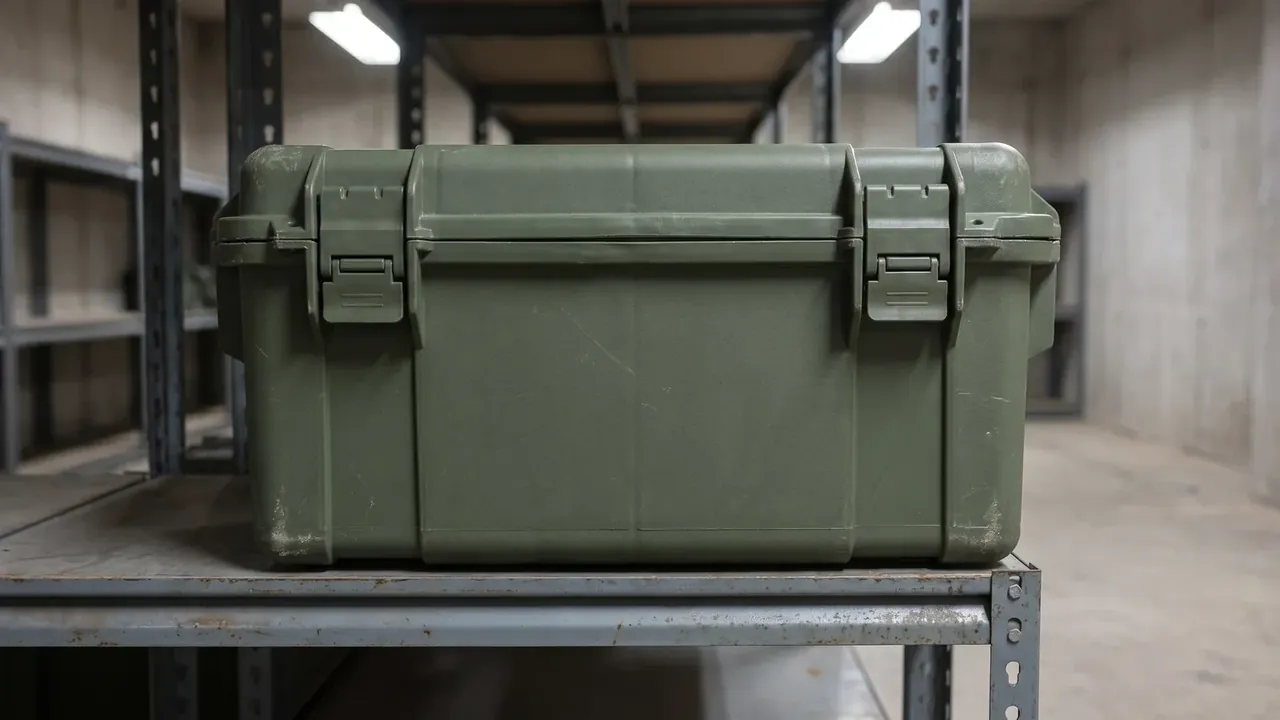
Ribs buy stiffness, not strength. Past a 300 mm wall span, an unreinforced panel sags about one percent of the span under load, which is 3 mm, enough to open a gap along one lid edge. Give three numbers instead of an adjective: ribs 12 mm high, 4 mm wide, on a 90 mm pitch.
Ribs must not terminate on a thin wall or stop in mid air. The floor ribs also have to register with recesses in the lid, because that pair of features is what keeps a stack of cases aligned; offset the centres by 5 mm and the third layer starts to lean.
3. Lid Gap and Gasket Compression
The lid gap is the item most often left off the drawing. With the lid closed, the mating faces should sit 0.8 to 1.2 mm apart. That is not assembly slop; it is the room the gasket needs in order to recover. Below 0.5 mm the seal is crushed flat, and above 1.5 mm the latches bend the lid edge and the wide side leaks first.
Design the gasket by compression ratio, not by diameter. An 8 mm cord in a 6 mm groove gives 2 mm of compression, a ratio of 25 percent, and the assembled figure should land between 25 and 35 percent. Under 20 percent the contact stress is too low; over 40 percent the rubber takes a permanent set.
Make the groove about half a millimetre wider than the cord. When groove and cord match, the cord is squeezed into a rectangle, the contact patch widens and unit stress falls. Corners need a radius of at least 5 mm, because a square corner traps material that never compresses.
| Item | Specified value | Failure if missed |
|---|---|---|
| Lid gap | 0.8 to 1.2 mm | crushed gasket or bent lid edge |
| Gasket compression | 25 to 35 percent | seepage or permanent set |
| Groove minus cord | more than 0.5 mm | flattened cord, poor seal |
4. Stack Load and Layer Rating
Rate the stack at the bottom case, not at a single unit. Five layers of a 30 kg Box, Ammunition Stowage put 120 kg on the lowest one for months, and a 1.8 long-term factor pushes the floor rating past 216 kg. That figure drives the height and density of the floor ribs.
Short static proof and long-term stacking are different tests. A 500 kg load held for 24 hours with no more than 5 mm of set only proves the case will not collapse. Long-term stacking also depends on temperature: above 40 degrees Celsius the modulus of rotomoulded polyethylene falls, so derate the permitted layer count by 20 percent.
Layer count has to match how the stack is served. Hand-picked stacks should top out at 1.8 m; above that every retrieval needs a step. Forklift stacks can reach 2.4 m, but the aisle then has to clear the pallet diagonal.
5. Temperature, IP Rating and Empty Weight
Temperature is written at both ends, not at room temperature. A Box, Ammunition Stowage rated from minus 40 to plus 71 degrees Celsius gets a drop at each end: four hours of cold soak, then 1.2 m onto six faces and three edges with no cracking. A room-temperature drop proves the structure but says nothing about brittle failure in the cold.
Write an IP code rather than the word waterproof. IP67 means one metre of immersion for thirty minutes without ingress; for rain only, IP65 spray is enough and the money is better spent on gasket accuracy and latch engagement.
Empty weight is what wall thickness costs. At 600 by 400 by 220 mm a 6 mm case weighs about 4.2 kg; at 8 mm it is 5.2 kg, roughly ten percent stiffer and twenty percent heavier to carry.
| Property | Specified value | How it is judged |
|---|---|---|
| Working temperature | minus 40 to plus 71 C | one drop at each end |
| Ingress protection | IP67 | one metre, thirty minutes |
| Empty weight | 4.2 kg | single-case weighing, plus or minus 5 percent |
| Top static load | 500 kg for 24 hours | set no more than 5 mm |
Conclusion
The wording of a specification decides whether anything downstream can be accepted: the cavity chain fixes capacity, wall and rib height fix stiffness, lid gap fixes sealing, and the stack factor fixes the floor. Write measuring points and test conditions next to every value, and a Box, Ammunition Stowage stops being a source of argument at goods-in.
This article discusses only the container (case body) side of specifications and design intent, and does not cover any handling, loading or use of the contents.
Related Reading
- Ammunition case specifications and stack loads
- Small arms ammunition box specs and inserts
- Stowage and transfer applications for ammunition boxes
- Artillery shell box specifications and load design
Related Products
- 8 Series — Gun Cases; Military Equipment Cases; Camera Equipment Cases; Drone Cases; Watch Cases; Knife Cases; First Aid Cases; Electronics Equipment Cases
- WL8-2812 PP Gun Case — model WL8-2812
- All protective cases and toolboxes: 7 series, 158 models