

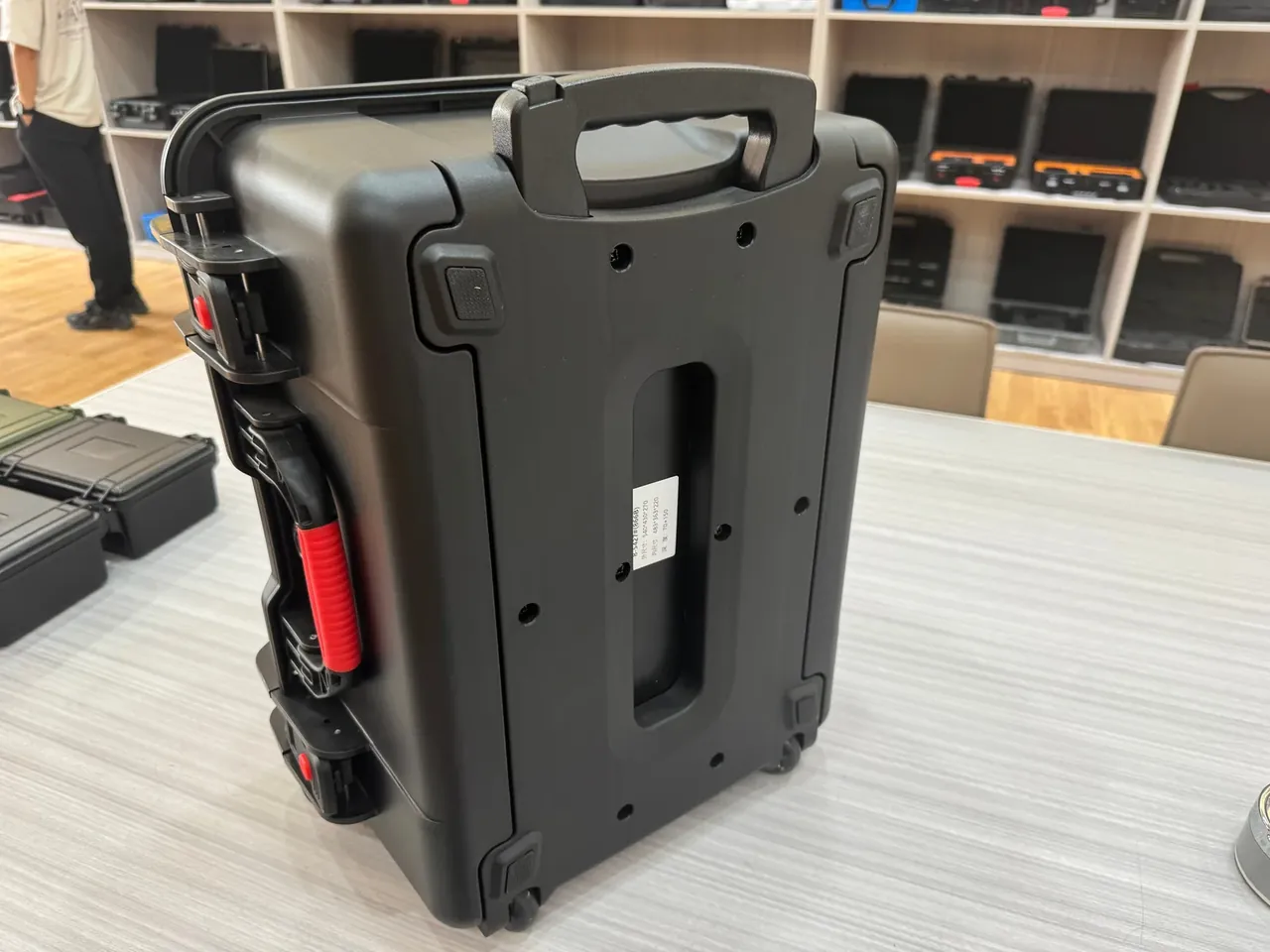
Quick answer: A Broadcast portable OB equipment trolley case holds 22 kg over a 3 km tow at 480 N per wheel insert, with base ribs spreading the load into the shell.
Table of contents
- Broadcast portable OB equipment trolley case: wheel-mount insert loads
- Base longitudinal ribs and stacking deflection
- Reading wheel-mount looseness after towing distance
- Trolley travel and handle load split
- Sealing face inspection after drop retest
- FAQ
1. Broadcast portable OB equipment trolley case: wheel-mount insert loads
The Broadcast portable OB equipment trolley case measures 700×480×320 mm outside and 630×410×255 mm inside, with a 4.8 mm wall, 9.2 kg empty and 22 kg loaded.
That is why every wheel-mount insert on a Broadcast portable OB equipment trolley case carries a backing plate or metal insert that turns a point load into a surface load before it reaches the shell. Aligned, the force follows the rib outward; misaligned, it swirls at the insert root and the shell blanches there.
| Tow distance | Retest action | Looseness criterion |
|---|---|---|
| 0.5 km | Feeler gauge at insert gap | Gap holds its initial reading |
| 1.5 km | Static 480 N reload | No relative insert movement |
| 3 km | Full 22 kg base recheck | Both wheel mounts free of play |
2. Base longitudinal ribs and stacking deflection
Base ribs on a Broadcast portable OB equipment trolley case are not there to add thickness; they carry the wheel-mount force along the length. With two layers stacked, the lid of the lower case must deflect no more than 1.5 mm, held by the lid crown and the support of the rim together.
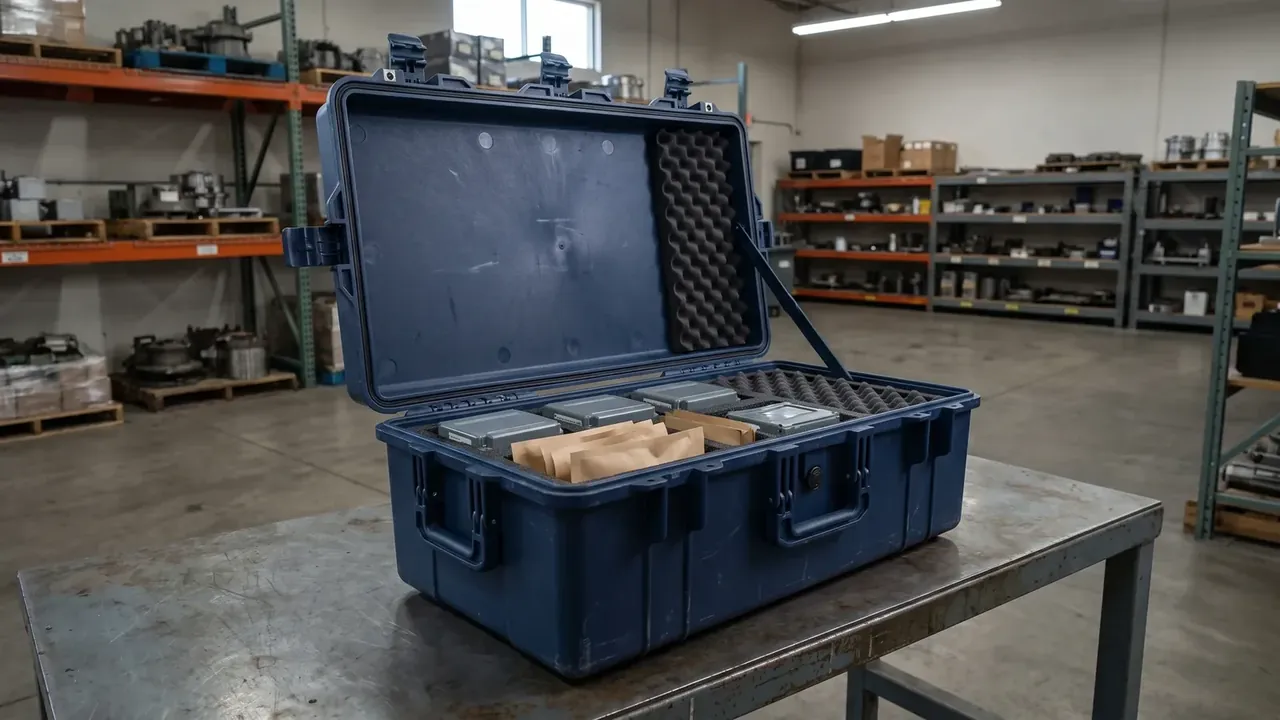
JUNZHIJIA samples read lid deflection at the panel centre and at four edge midpoints, five points in total, and take the largest value. Two layers at 22 kg each put the full weight of the upper shell plus sway onto the lower lid; the 1.5 mm limit is the headroom the gasket still needs to seat. Beyond it a segment of the rim seal loses contact, and the IP67 line fails at that spot first.
| Load area | Load source | Structural answer |
|---|---|---|
| Insert root | 480 N reaction per mount | Metal plate aligned with base rib |
| Base rib midspan | 22 kg sustained load | Rib moulded into the 4.8 mm wall |
| Rim corners | Two-layer stack transfer | Lid and shell circumferential fit |
3. Reading wheel-mount looseness after towing distance
A 3 km tow is the retest distance for the Broadcast portable OB equipment trolley case wheel mounts, not the end of their life. The reading order is to let the shell rest, feel the insert-to-base gap with a feeler gauge, then apply a static 480 N reload and watch for relative movement.
Log the distance in segments rather than as one total. A loose mount sends you to the insert; a firm one sends you to the ribs.
| Deflection reading | Probe position | What it means |
|---|---|---|
| ≤1.5 mm | Lid panel centre | Two-layer stack passes stiffness check |
| 0.8–1.5 mm | Four edge midpoints | Rim gasket stays evenly compressed |
| Over 1.5 mm | Repeat at centre | Rib depth and lid crown need recheck |
4. Trolley travel and handle load split
A 420 mm trolley travel is set for towing posture, not for reach. On a Broadcast portable OB equipment trolley case at 22 kg, 420 mm lifts the shell to roughly 25° off the ground, so towing force goes through the wheels and the handle only steadies the turn. Too short and the tail scrapes, adding torque at the mounts; too long and the trolley tube becomes a cantilever that pries at the latches and rim together.
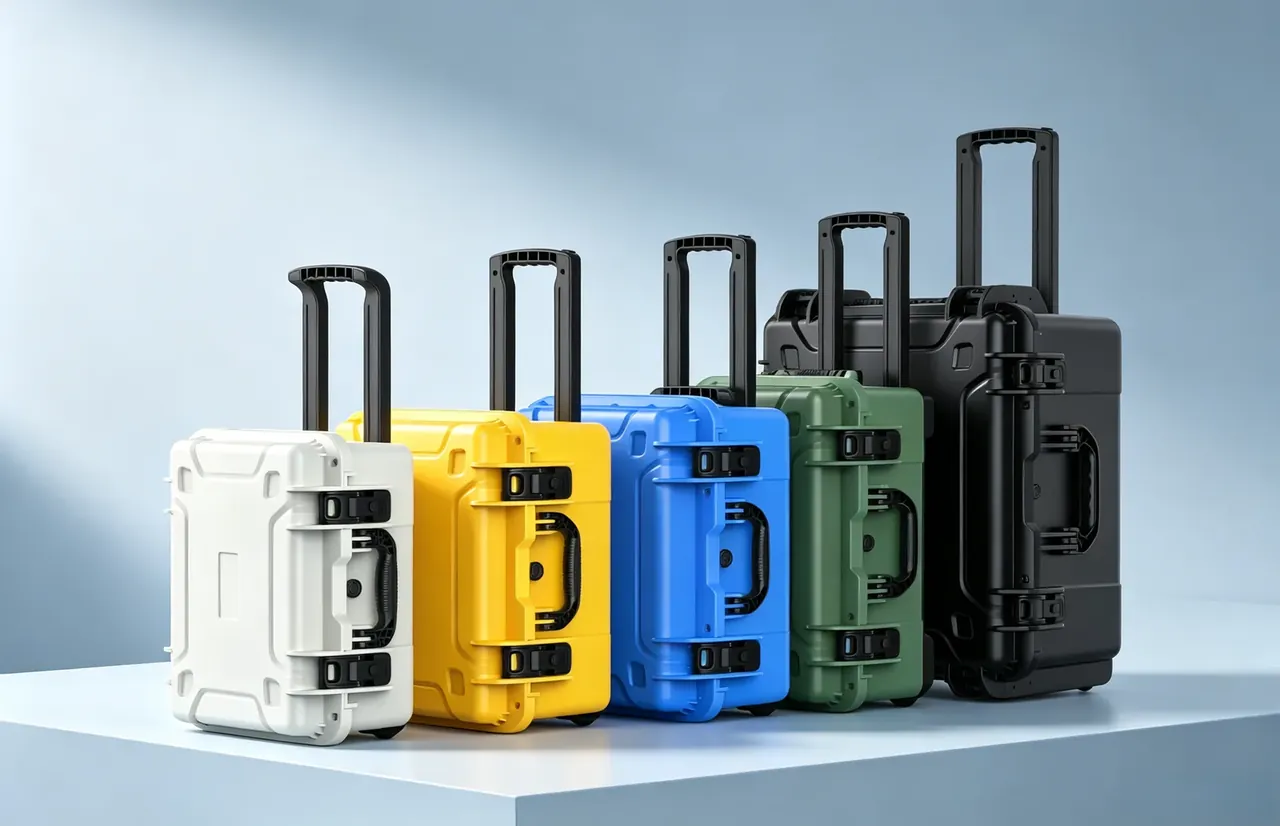
Four latches at 450 N each sit evenly around the rim; they are not a backup for the handle. The handle carries the whole shell on a short lift — 9.2 kg empty plus 22 kg loaded, about 31 kg — and a one-hand snatch briefly tops 300 N. After 3000 open-close cycles, retest the latches: once holding force drops below 450 N, replace the hardware rather than tightening the screws again.
5. Sealing face inspection after drop retest
After a 1.0 m drop, the Broadcast portable OB equipment trolley case is checked less for a cracked shell than for a flat rim. Impact springs the four rim corners open and back, and if the gasket is pinched out over a short length, the IP67 static-water retest seeps in right there. The φ16 mm breather valve equalises pressure, and its seat takes shear during the drop too, so the seat-to-shell joint gets a look for hairline marks.
Sealing face inspection follows one fixed route. Wipe the rim clean first. Run a fingertip around the full perimeter to feel for a step. Then gauge the closed gap between lid and shell at all four corners. Set the case flat and press evenly on the lid, watching whether the corner gaps close together. Lift the gasket out and measure whether its section has flattened past recovery. Refit it, close the shell once as a 3000-cycle sample would, and read whether the four latches hold evenly. Only then run the IP67 static-water check and open the lid to look for moisture inside the rim. Seven readings, not the scratch on the shell, decide whether the case stays in service.
Conclusion
On a Broadcast portable OB equipment trolley case the mounts, ribs and lid are three links of one load chain, and no single link settles the whole shell. Once the 700×480×320 mm outside and 22 kg load are fixed, the 480 N inserts, 1.5 mm lid deflection and 420 mm travel become the three hard stops. Read them in order and the stacked and towed condition of a Broadcast portable OB equipment trolley case stays legible. Measure the insert, then the lid, then the sealing face; reverse that order and the readings hide one another.
Related Reading
- Choosing wheel sets and trolley assemblies
- How wheel materials compare for wear
- Shell specifications for film equipment cases
- Procurement points for ABS trolley tool cases
Related Products
- 8 Series — Gun Cases; Military Equipment Cases; Camera Equipment Cases; Drone Cases; Watch Cases; Knife Cases; First Aid Cases; Electronics Equipment Cases
- WL8-2812 PP Gun Case — model WL8-2812
- All protective cases and toolboxes: 7 series, 158 models