

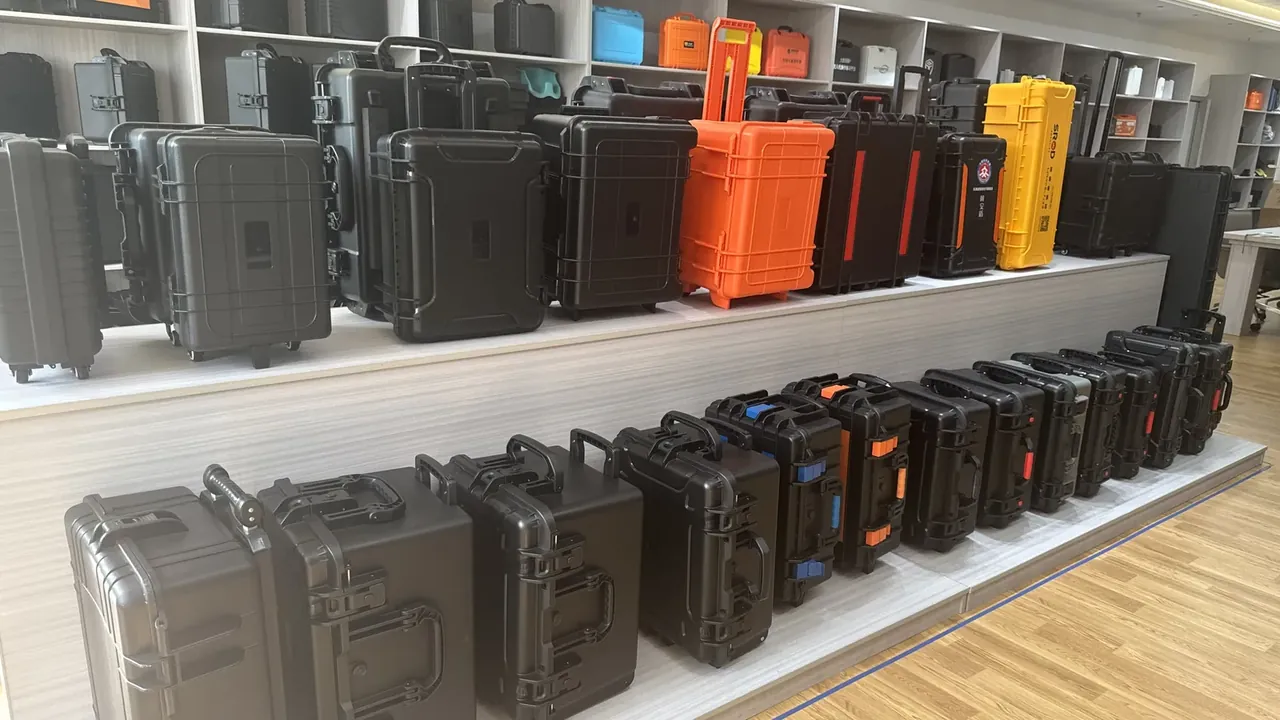
Quick answer: A Cartridge Protective Box differs from a carton, crate, steel chest and soft bag on four counts: wall section, sealing, cushioning and trips survived. Converted to one unit, the dearest option on the sheet is usually the cheapest per trip.
Table of contents
- How a Cartridge Protective Box Compares Overall
- Wall Thickness and Material on Equal Terms
- Sealing and Cushioning Results
- Loading Speed and Stacking
- Costing on a Full Life Cycle
- FAQ
1. How a Cartridge Protective Box Compares Overall
Every alternative advertises one strength: cartons price, crates rigidity, steel chests fire resistance, bags weight. A Cartridge Protective Box spreads its strengths across four dimensions and wins none outright, so all four need one table sized to a 400 x 300 x 180 mm cavity.
| Option | Wall and structure | Empty | Trips | Moisture |
|---|---|---|---|---|
| Cartridge Protective Box | 4.5 mm HDPE, ribbed | 3.2 kg | 120 | gasket and latches |
| Carton with foam | 5 mm double wall | 0.9 kg | 1 | none, dust only |
| Wooden crate | 15 mm pine, nailed | 6.8 kg | 8-12 | joints need sealant |
| Galvanised steel chest | 1.0 mm sheet, spot welded | 5.4 kg | 30 | seams and hinges rust |
| Soft carry bag | 600D fabric, 5 mm foam | 0.7 kg | 40 | splash only |
2. Wall Thickness and Material on Equal Terms
Thickness cannot be read across materials. A 1.0 mm steel chest relies on the section modulus of folded edges; a 4.5 mm moulded body relies on ribs and corner radii.
Cold: after four hours at minus 20 degrees Celsius and a drop test, HDPE keeps over sixty percent of its room temperature impact value while spot welds craze and pine nails loosen.
Heat: twenty-four hours at 55 degrees moves a Cartridge Protective Box diagonal under 0.3 percent with the lid flat, while a carton loses over twenty percent of compression strength.
Moisture belongs here too: timber going from 12 to 18 percent adds eight percent to crate weight; moulded plastic absorbs nothing.
3. Sealing and Cushioning Results
Sealing spreads widest: a carton scores zero, a crate leans on joints, a steel chest on welds. Eight millimetres of gasket behind four latches kept a Cartridge Protective Box cavity dry after thirty minutes at half a metre.
Cushioning is about the insert: across eighteen drops from 1.2 m, die-cut foam held parts within 2 mm, cardboard dividers shifted from the seventh, an unlined box showed corner damage by the third.
| Check | Protective box | Carton | Steel chest | Soft bag |
|---|---|---|---|---|
| 30 min at 0.5 m | dry | soaked | weeping | soaked |
| Shift after drops | under 2 mm | moved | displaced | unsecured |
| 48 h salt spray | no rust | n/a | hinge rust | faded fittings |
Salt spray tests hardware, not shell.
4. Loading Speed and Stacking
Five units high puts 240 kg on the bottom one. After 72 hours a Cartridge Protective Box side wall deflects under 2 mm and recovers, while a carton bellies at layer three.
Opening geometry sets speed. A clamshell opens a full 100 percent one-handed, a crate lid is levered, a steel lid needs a second pair of hands. With one operator, a clamshell runs about 12 seconds a pick against 45 for a nailed crate.
Base flatness is the quiet limit: a flat base with two low feet contacts fully across five layers.
5. Costing on a Full Life Cycle
Unit price inverts the ranking: at nine times carton price a Cartridge Protective Box is the dearest line on the sheet, yet the cheapest per trip.
| Option | Price | Trips | Per trip | Running cost |
|---|---|---|---|---|
| Cartridge Protective Box | 168 | 120 | 1.4 | gasket replacement |
| Carton with foam | 18 | 1 | 18 | packing labour |
| Wooden crate | 96 | 10 | 9.6 | fumigation and repair |
| Steel chest | 132 | 30 | 4.4 | paint and latches |
| Soft bag | 42 | 40 | 1.1 | foam replacement |
Running cost settles arguments: the 18 unit carton excludes packing labour, the crate excludes fumigation. Under three trips a year with the box scrapped on arrival, a carton stays rational.
Conclusion
Each alternative owns a niche: cartons for one-way shipping, crates for heavy loads, steel chests for fire, bags for packed volume. A Cartridge Protective Box is built for rotation plus sealed protection and leads on only two of four dimensions, though those two are what a rotation loop tests. Confirm trips and sealing need first, then price, which is the only defensible basis for comparing a Cartridge Protective Box with anything else.
This article discusses only the container (case body) side of specifications and design intent, and does not cover any handling, loading or use of the contents.
Related Reading
- Reading the specification sheet of a protective box
- How protective boxes are configured by scenario
- Where a cartridge safety case diverges from alternatives
- Body material comparison for cartridge boxes
Related Products
- 8 Series — Gun Cases; Military Equipment Cases; Camera Equipment Cases; Drone Cases; Watch Cases; Knife Cases; First Aid Cases; Electronics Equipment Cases
- WL8-2812 PP Gun Case — model WL8-2812
- All protective cases and toolboxes: 7 series, 158 models