

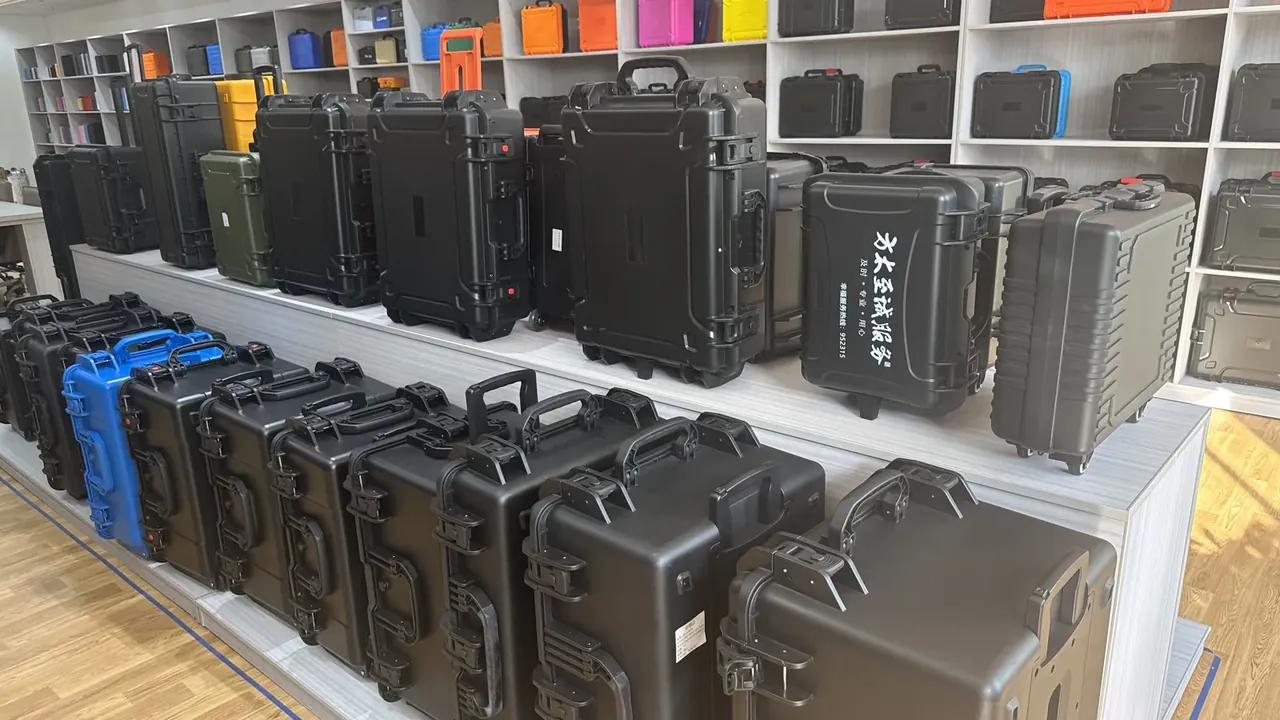
Quick answer: A cartridge protective box earns reliability at five boundaries: moulded shell, rim seal, latch load path, liner cells and base support. Each is walked against a real moulding window.
Table of contents
- Five Boundaries Inside a Cartridge Protective Box
- Moulding the Shell: Melt, Mould and Wall
- How Latches, Hinges and Handle Share Load
- Compression at the Rim Seal
- Liner Cells and Base Support
- FAQ
1. Five Boundaries Inside a Cartridge Protective Box
A cartridge protective box of the common class measures 420×330×180 mm outside and 380×290×140 mm inside: 3.6 kg empty, 21 kg at a 30-round count. Too heavy for one hand, opened many times a day, it is five boundaries, not a scaled-down crate.
Shell for shape, rim for moisture, latches and hinges for closure after thousands of cycles, cell walls for round shift, base for a five-high stack. They do not compensate: a thick shell behind an uneven rim still leaks.
| Boundary | Carried by | Value | Check |
|---|---|---|---|
| Shell | PP copolymer | 5.5 mm wall, 7.5 mm corner | Ultrasonic |
| Rim | Single tongue | 6×4 mm silicone, 22 percent | 0.2 bar, 60 seconds |
| Latches | Four 304 spring latches | 180 to 240 N | 8,000 cycles |
| Liner | EPE cell tray | 25 kg/m³, 3 mm walls | 1.0 m drop |
| Base | 8 mm EVA | Five-high stack | 72 hours |
2. Moulding the Shell: Melt, Mould and Wall
This size of cartridge protective box is injection moulded, not rotomoulded, so a 5.5 mm wall holds evenly. Melt 225 °C, mould 45 °C, cycle 78 seconds, 650 tonnes of clamp on one cavity. Less clamp and the rim flashes 0.3 mm, and trimming that flash cuts the tongue.
PP copolymer is tooled at 1.4 percent shrinkage. Each extra millimetre of wall adds 9 seconds of cooling, taking the cycle from 78 to 96 seconds for 8 percent more stiffness. Corners go to 7.5 mm because the weld lines sit there; three 5 mm ribs at 90 mm spacing buy 30 percent for 40 g.
3. How Latches, Hinges and Handle Share Load
The four latches do not split load evenly. The handle sits at lid centre, so lifting feeds both side walls through its bosses while the middle latches carry little; stacking reverses it.
Holding force sits between 180 and 240 N: under 180 N a latch pops open within half an hour of vibration, over 240 N a gloved hand reaches for a pry bar. Each boss needs a solid pad, since 1 mm of dish loses the tongue.
| Part | Qty | Rating | Check |
|---|---|---|---|
| Latch | 4 | 180 to 240 N, 12 mm tongue | 8,000 cycles |
| Hinge | 2 | 5 mm pin, 0.2 mm gap | Bore gauge |
| Handle | 1 | 260 N, 1.3 times 21 kg | 10 minutes static |
| Vent | 1 | Opens at 0.05 bar | Immersion |
The 5 mm hinge pin runs with 0.2 mm clearance: under 0.1 mm it seizes cold, over 0.3 mm the lid shifts and shears the gasket.
4. Compression at the Rim Seal
Sealing is a joint between rim, tongue and gasket. A cartridge protective box uses a single tongue, and a 6×4 mm silicone cord sits in it at 22 percent compression. Below 14 percent it stops recovering and a gap opens after one cold night; above 32 percent it takes a set.
Rim flatness stays within 0.4 mm: the mid-span warps first and leak-down jumps from 1.5 to 4 percent at 0.5 mm. Chalk dust finds it: dust, close, latch, open, read the break. A break over 25 mm means checking boss height before flatness.
5. Liner Cells and Base Support
The liner of a cartridge protective box must locate, cushion and still allow removal. Typical is a 25 kg/m³ EPE tray: 30 cells on a 14 mm pitch, 3 mm walls, 70 mm deep, with a 10 mm pad in the lid. Walls under 2.5 mm let cells pull at each other.
An 8 mm EVA floor sheet spreads 21 kg across the base so ribs survive a five-high stack; omit it and they blush after 72 hours. Allow 1.5 mm between liner and wall, or the tray jams at 1 mm and rattles over 3 mm.
Conclusion
Structure and process add up only when all five boundaries meet their numbers: a 5.5 mm wall, a rim flat within 0.4 mm, 180 to 240 N of latch force, 3 mm cell walls, an 8 mm EVA base. Meet all five and the box holds a five-high stack with a 1.0 m drop. Judge a cartridge protective box by rim imprint first, corner thickness second, and price last.
This article discusses only the container (case body) side of specifications and design intent, and does not cover any handling, loading or use of the contents.
Related Reading
- Protection ratings and liner layouts
- Body material comparison
- Cartridge protective box use in storage and transfer
- Transport box acceptance items
Related Products
- 8 Series — Gun Cases; Military Equipment Cases; Camera Equipment Cases; Drone Cases; Watch Cases; Knife Cases; First Aid Cases; Electronics Equipment Cases
- WL8-2812 PP Gun Case — model WL8-2812
- All protective cases and toolboxes: 7 series, 158 models