

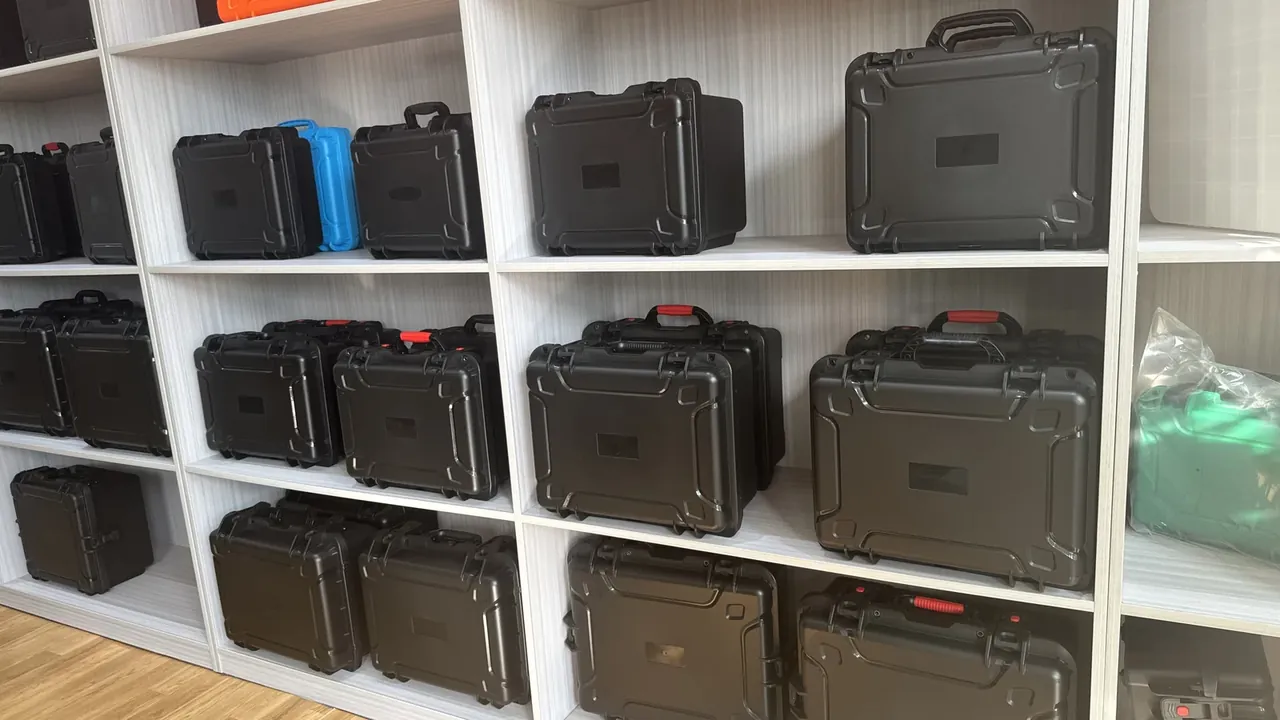
Quick answer: Cartridge Protective Box maintenance compresses into a twelve-item quarterly list: body and latches first, gasket compression second, foam sag last. Each item has a fixed judgement line, so a failed part is replaced alone rather than scrapping the box.
Table of contents
- Setting the Inspection Interval for a Cartridge Protective Box
- Body and Latch Checks
- Gasket Compression and Judgement
- Foam Insert Sag and Replacement Line
- Records and the Whole Box Replacement Line
- FAQ
1. Setting the Inspection Interval for a Cartridge Protective Box
Intervals are not invented: two variables cross, openings per year and where the box sits. Above 300 openings, inspect every 90 days; below 60, 180 days. A store at 28 degrees Celsius and 75 percent humidity drops to 60 days regardless.
The work needs tiers: daily covers six visual points in thirty seconds after a return, quarterly runs twelve items in eight minutes, annual strips the gasket and measures torque in forty.
A dry northern store keeps hardware better than a coastal one, yet plastic turns brittle and corner cracks appear in cold months. Adjust intervals for climate, never the judgement lines.
2. Body and Latch Checks
A Cartridge Protective Box body needs three checks: wall cracks, corner collapse, handle mounts. A 10 mm crack retires the box to the workshop, not to glue; 2 mm of corner collapse lifts the sealing face; and a handle bolt that loosened once is replaced at 5 N·m.
Four latches at 0.9 N·m hold the lid down; below that the gasket is effectively absent. A tongue worn by 1 mm or a pin at 0.3 mm clearance is replaced.
| Item | Method | Line | Action |
|---|---|---|---|
| Wall crack | visual | 10 mm | retire to workshop |
| Corner collapse | rule | 2 mm | replace box |
| Handle bolt | torque | 5 N·m | new bolt |
| Latch torque | torque | 0.9 N·m | adjust or replace |
| Tongue wear | caliper | 1 mm | new latch |
| Hinge pin | feeler | 0.3 mm | new pin |
Red rust goes to a 24 hour salt spray recheck; paint belongs on bare metal.
3. Gasket Compression and Judgement
The Cartridge Protective Box gasket is the only consumable. Judge it by compression set: after 24 hours relaxed, a remaining set beyond 30 percent means the compound has fatigued and the loop must go.
The groove is 6 mm, the cord 8 mm, and compression should land between 25 and 30 percent. Too little leaks, too much accelerates set.
Two tricks avoid stripping it quarterly: drag a 0.1 mm feeler along the lid line, and if it slides freely pressure is gone there; or close the lid with a torch inside in a dark room.
Replacement runs on climate: 24 months normally, 18 when hot and humid; a partial change leaves two overlap joints and two leak paths.
4. Foam Insert Sag and Replacement Line
Cartridge Protective Box foam is judged on numbers, never looks. Sag is measured with a rule and a short bridge, and past 3 mm the insert stops locating parts. Thickness loss of 5 percent is where cushioning travel runs out, and a collapsed area over 20 cm² retires that piece.
Closed-cell polyethylene absorbs under 1 percent water, but cut faces are open. Stood cut-side up for three months a face takes on moisture and cushions badly while looking intact. Storage at 15 to 25 degrees Celsius below 60 percent humidity buys another year.
After 500 hours of UV exposure a shift above Delta E 3 means the skin has chalked. One piece or a set depends on the divider design, since re-cutting one die-cut piece costs more than a set.
5. Records and the Whole Box Replacement Line
A Cartridge Protective Box record needs four columns: date, cumulative openings, item judged, action taken. Cumulative openings sets the next strip-down date and predicts gasket expiry.
Retirement is a cost ratio: once repairs reach 40 percent of a new Cartridge Protective Box price, stop repairing.
| Case | Cost against new | Decision | Note |
|---|---|---|---|
| New gasket loop | 8% | keep | every 24 months |
| Pair of latches | 15% | keep | pins included |
| Full insert set | 22% | keep | tied to openings |
| Crack repair plus paint | 45% | retire | past the line |
| Body and insert | 70% | retire | no case for repair |
Three hard lines sit outside the money question: a crack reaching the sealing face, a lid out of flat, a cracked latch seat.
Conclusion
Maintenance is hard less in technique than in writing the lines down. A 10 mm crack, 0.9 N·m of latch torque, 30 percent gasket set and 3 mm of foam sag turn inspection from feel into measurement. Intervals follow openings and climate, retirement follows the 40 percent ratio, and a Cartridge Protective Box that is logged outlasts an unlogged batch.
This article discusses only the container (case body) side of specifications and design intent, and does not cover any handling, loading or use of the contents.
Related Reading
- Preventing damage to boxes in storage
- Troubleshooting order for cartridge box faults
- Care rhythm for submachine gun storage boxes
- Fitting points for foam inserts
Related Products
- 8 Series — Gun Cases; Military Equipment Cases; Camera Equipment Cases; Drone Cases; Watch Cases; Knife Cases; First Aid Cases; Electronics Equipment Cases
- WL8-2812 PP Gun Case — model WL8-2812
- All protective cases and toolboxes: 7 series, 158 models