

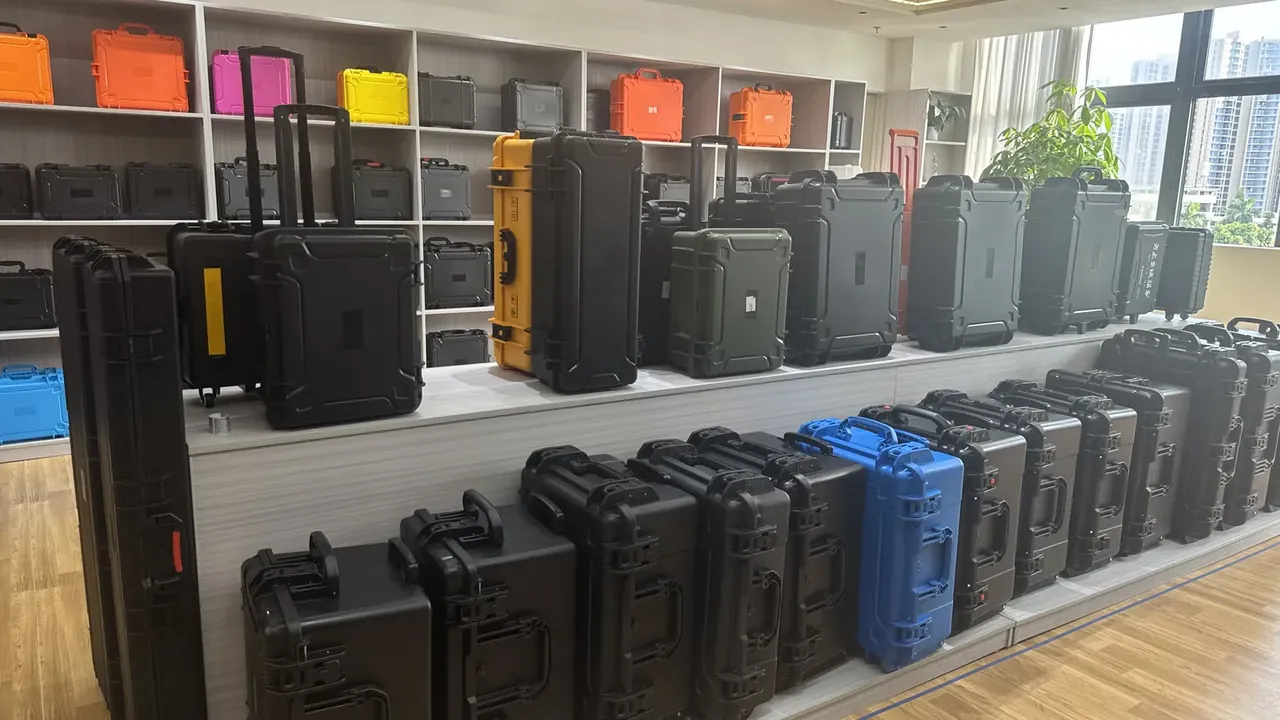
Quick answer: Fix five criteria before opening a catalogue for a cartridge protective box: round count and cavity size, gross weight and handling, stack height and shelf pitch, closures per year, and the counting method. Once all five land on numbers, one configuration survives.
Table of contents
- Five Criteria Before Any Model Number
- Criterion One: Round Count and Cavity Size
- Criterion Two: Gross Weight Sets the Handling Method
- Criterion Three: Stack Height and Shelf Pitch
- Criteria Four and Five: Closure Count and Counting Method
- FAQ
1. Five Criteria Before Any Model Number
The usual mistake is to pick a model, then hunt for somewhere to put it. For a cartridge protective box the chain runs the other way: rounds set the cavity, the cavity sets the outside, and the outside sets shelf pitch.
The five criteria are round count, gross weight, stack height, closures per year and counting. Each must end on a number, because past it the structure changes.
| Criterion | Boundary | Cost of crossing |
|---|---|---|
| Round count | 30 or 50 fixed | Bigger cavity, heavier case |
| Gross weight | Under 15 kg by hand | Two-person lift |
| Stack height | Three high, 300 mm pitch | Dished lid |
| Closures | 400 a year | Latch wear |
| Counting | Cells plus label window | Visual counting |
2. Criterion One: Round Count and Cavity Size
A cartridge protective box is usually built for 30 or 50 rounds. Budget 12 mm of footprint per round, a 14 mm cell opening and a 15 mm pitch: 30 rounds run five by six in a 260×180×90 mm cavity, 50 rounds run five by ten in 320×220×95 mm. The outsides differ by 60 mm.
Cavity length is columns times pitch plus 8 mm each end, for fingers: without it the outer column cannot be lifted.
More rounds is not better by default. The 50-round cavity is 95 mm deep and loads to 20.8 kg, so one row needs the other nine held down, while the 30-round case at 14.5 kg picks one-handed.
3. Criterion Two: Gross Weight Sets the Handling Method
A cartridge protective box weighs 2.4 kg empty, 14.5 kg at 30 rounds and 20.8 kg at 50. Under 15 kg one hand will do, 15 to 30 kg needs two people or a trolley, and above 30 kg a pallet truck.
| Gross weight | Handling | Fittings | Transfer |
|---|---|---|---|
| Under 15 kg | One hand | Single handle | 40 seconds |
| 15 to 30 kg | Two people | Two handles, fork slots | 90 seconds |
| Over 30 kg | Pallet truck | Four castors | 3 minutes |
At 20.8 kg two handles are mandatory; a single one tilts the case and loads one rim side. Keep it 40 mm below the lid edge.
The 1.2 m lift to a shelf is the risky part: castors remove it but skip on concrete, so the base needs a 12 mm recess.
4. Criterion Three: Stack Height and Shelf Pitch
Three high is normal for a cartridge protective box, on a 300 mm pitch, with 45 kg on the lid and 90 kg on the bottom case. A 72 hour stack test allows 1.5 mm of lid deflection; past that the rim shifts and the gasket loses compression.
The 300 mm pitch is case height plus 120 mm of picking clearance. Under 100 mm, knuckles scrape the case above; over 150 mm, a bay loses a tier and 30 percent of its capacity.
Shelf beams are 50 mm wide and the base must overlap them by 15 mm. Less overlap leaves corners hanging and the moulded ribs crack by the third tier. Above three high, a 15 mm plywood deck reaches five, at 15 mm per tier.
5. Criteria Four and Five: Closure Count and Counting Method
Count closures a year, then multiply by service life. A cartridge protective box opened twice a day runs about 400 closures, 3,200 over eight years, against a latch rated at 8,000 cycles. Ten openings a day reaches 7,500 in three years, so the tongue has to be thicker.
Counting decides the liner, not the shell. A fixed cell tray with a 60×40 mm label window counts 30 cells in about 8 seconds; a mixed tray takes 25 seconds.
The criteria conflict: a busy bay wants fixed cells, yet the tray walks and grinds foam dust. Four spots of 3 mm tape hold it.
Conclusion
Choosing a cartridge protective box is a matter of order, not catalogue pages: rounds, then weight, then stack height, then closures, then counting. Once all five sit on numbers, one column remains and both sides measure with the same ruler. The hard part is admitting which criterion must give, and letting it give where it hurts least, which is how a cartridge protective box gets chosen correctly.
This article discusses only the container (case body) side of specifications and design intent, and does not cover any handling, loading or use of the contents.
Related Reading
- Cartridge protective box use in storage and transfer
- Common problems with cartridge boxes
- Cartridge storage boxes against alternatives
- Load ratings for cartridge transport boxes
Related Products
- 8 Series — Gun Cases; Military Equipment Cases; Camera Equipment Cases; Drone Cases; Watch Cases; Knife Cases; First Aid Cases; Electronics Equipment Cases
- WL8-2812 PP Gun Case — model WL8-2812
- All protective cases and toolboxes: 7 series, 158 models