

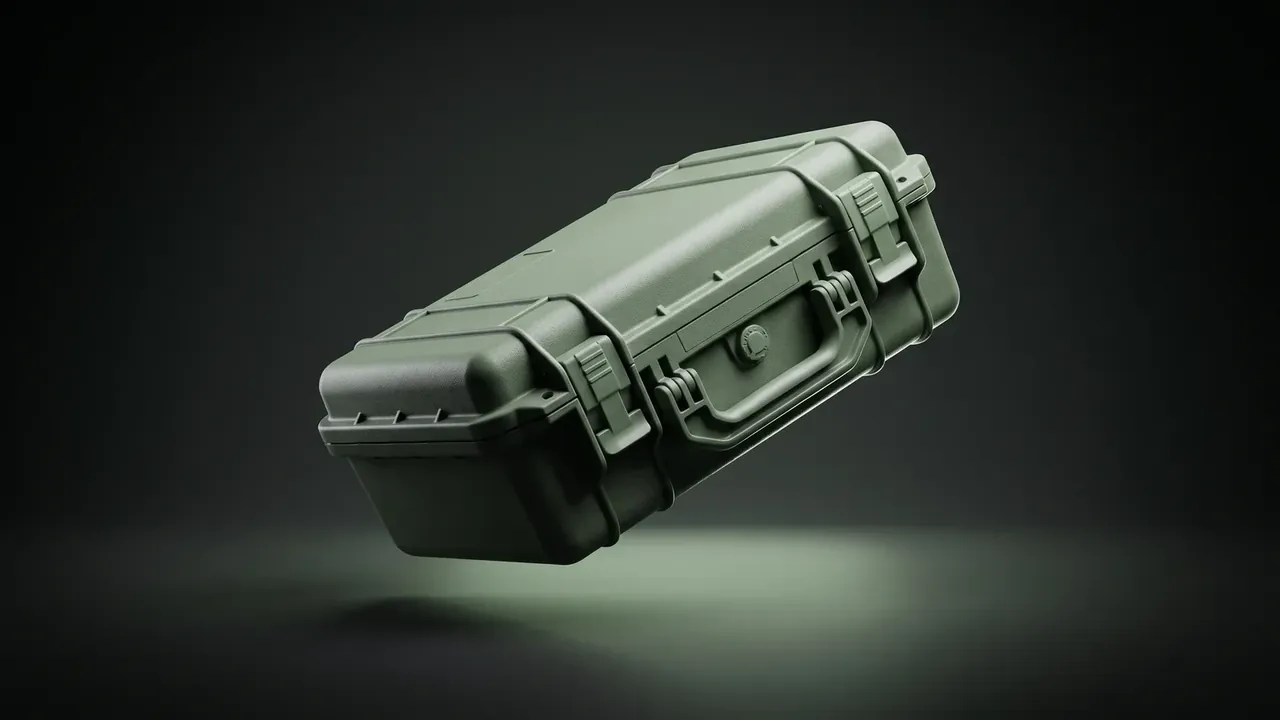
Quick answer: Five checkable points decide a cartridge storage box: resin and wall thickness, moulding route, foam grid, seal and latch geometry, and stacking load. Together they explain why two boxes of one size differ in life and price.
Table of contents
- Wall Thickness and Resin Choice for the Cartridge Storage Box
- Rotomoulding versus Injection Moulding
- Foam Dividers and Internal Layout
- Seal Groove, Latches and Closing Margin
- Stacking Load and Warehouse Fit
- FAQ
1. Wall Thickness and Resin Choice for the Cartridge Storage Box
High-density polyethylene, polypropylene and copolymer grades cover most of the market. The first keeps impact strength at minus twenty degrees Celsius, which matters in unheated stores.
Wall thickness is a curve, not a single figure. Side walls run 3.5 mm, the base 4.5 mm, and corners reach 6 mm because powder piles up there. Drop energy concentrates on the edge.
Reading thickness alone is a mistake. A flat 3.5 mm panel deflects under a few dozen kilos, yet the same panel with two 12 mm ribs behaves like a 6 mm plate.
| Zone | Typical thickness | Structural role |
|---|---|---|
| Side wall | 3.5 mm | Resists side pressure and bulge |
| Base | 4.5 mm | Carries own weight and upper load |
| Corner and edge | 6 mm | Drop resistance, powder build-up |
| Rib root | 5 mm | Moves load into the wall |
2. Rotomoulding versus Injection Moulding
Rotomoulding fills an aluminium mould with powder and bakes it at 260 degrees Celsius. The mould turns on two axes at 8 rpm and comes out after 12 minutes, the powder fusing into a seamless shell. Tooling is cheap and there is no weld line, yet a part takes 25 to 40 minutes.
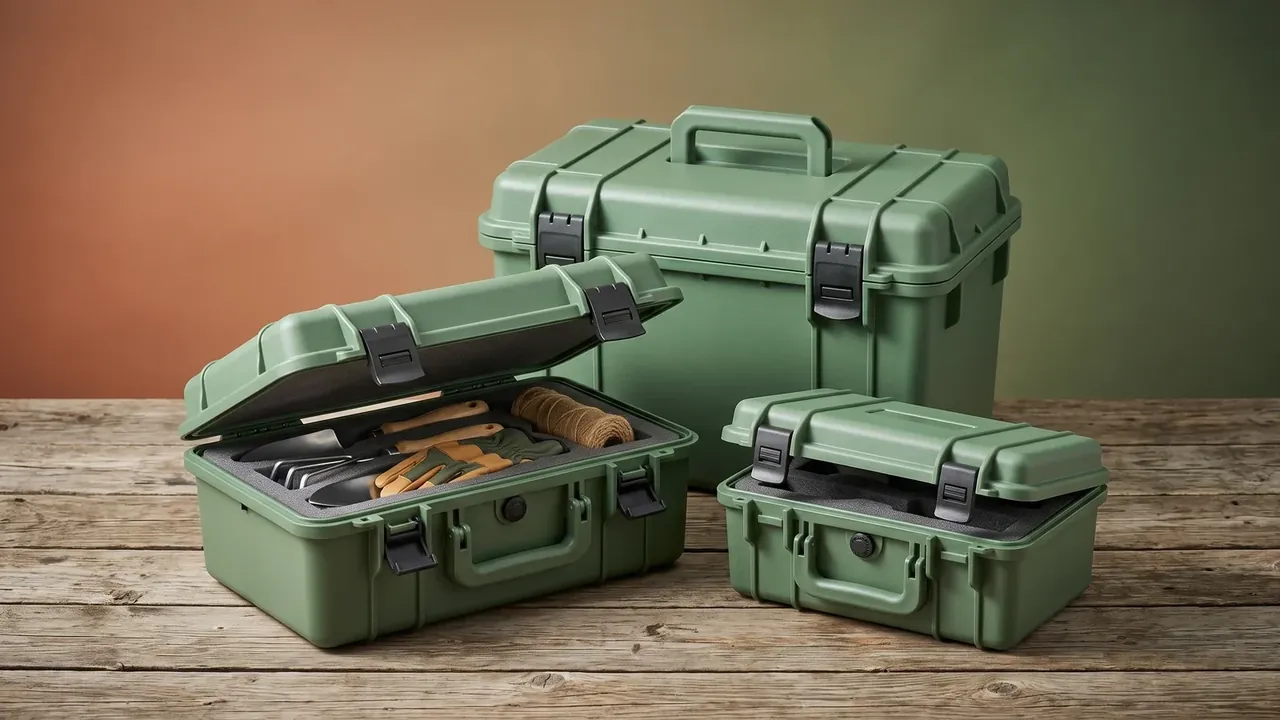
Injection moulding runs the other way: an 800 tonne press, a steel tool and a 55 second cycle. The larger the body, the faster tonnage and tool cost climb.
Sixty litres is the usual split between the two routes.
3. Foam Dividers and Internal Layout
Three insert types dominate: EVA foam, PE foam and polypropylene hollow-board grids. EVA at 30 kg per cubic metre rebounds well and cuts cleanly; PE foam is cheaper but takes a permanent set; hollow-board grids keep the cell width adjustable.
Dividers exist to make each cell equal one counted unit. A 5 by 4 array with cells 25 mm deep and 3 mm ribs lets a storekeeper count by cell and keeps boards removable without slack.
4. Seal Groove, Latches and Closing Margin
Sealing is a groove plus a cord. The lid and body faces carry a U-shaped channel 4 mm deep holding a 6 mm EPDM cord compressed by thirty percent at closing. Under twenty percent moisture follows the gap; over forty-five percent the latches need force and the lid bows.
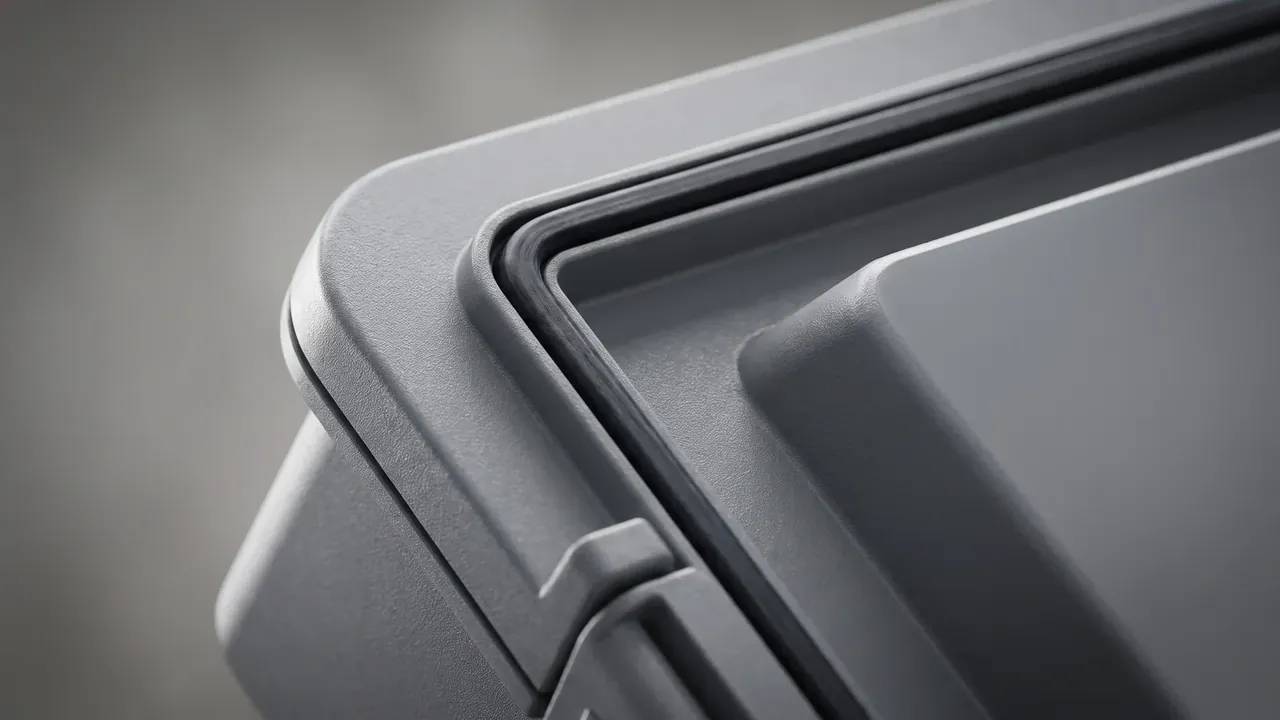
Latch count decides how evenly that cord is loaded. Two side latches plus one at the front centre hold lid bow under 1 mm; side latches alone let the middle rise 1 to 2 mm, and that gap leaks. Hinges use a 5 mm stainless pin in a nylon bush, holding play under 0.3 mm after 5000 cycles.
Two tests verify sealing without opening the box: a 30 minute pressure hold under five percent decay, or a rain test where paper inside gains under 1 g.
5. Stacking Load and Warehouse Fit
Stack figures must be calculated at working weight. A 60 litre box weighs 22 kg empty and 30 kg loaded, so five tiers put about 120 kg on the bottom cartridge storage box. Lid corners carry locating recesses that seat the upper base on four pillars.
Creep matters more than peak load. After 30 days at full load, centre deflection should stay under 2 mm; beyond 3 mm the fifth tier starts to rock. Cycling between minus 20 and 55 degrees Celsius twenty times should change latch effort by under fifteen percent, and a window row at 60 degrees Celsius carries one tier less.
| Tiers | Load on bottom box | Suitable when |
|---|---|---|
| 2 | about 30 kg | Temporary staging |
| 3 | about 60 kg | Normal store, window rows |
| 5 | about 120 kg | Pallet and locating recesses |
| Above 5 | Racking required | Direct stacking not advised |
Conclusion
Nothing inside a cartridge storage box is mysterious: resin and wall section, moulding marks, cell count and rib width, groove depth and compression, locating recesses and bottom load. Writing those five into an inspection clause beats comparing adjectives on a brochure. Choosing a cartridge storage box means choosing a structure that can be measured.
This article discusses only the container (case body) side of specifications and design intent, and does not cover any handling, loading or use of the contents.
Related Reading
- Common causes of moisture and stacking deformation in cartridge storage boxes
- How to compare cartridge box body materials
- How internal divider inserts are structured and cut
- How the seal of a moisture-proof case is built
Related Products
- 8 Series — Gun Cases; Military Equipment Cases; Camera Equipment Cases; Drone Cases; Watch Cases; Knife Cases; First Aid Cases; Electronics Equipment Cases
- WL8-2812 PP Gun Case — model WL8-2812
- All protective cases and toolboxes: 7 series, 158 models