

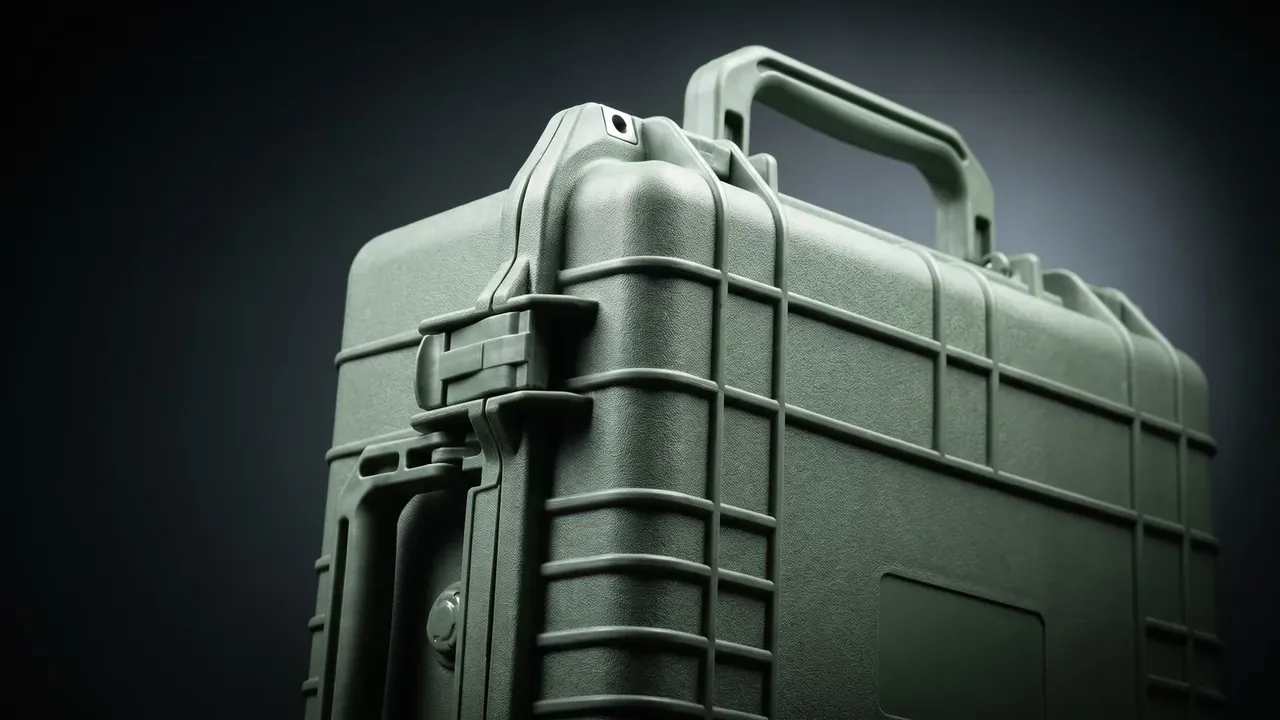
Quick answer: Six checks keep a cartridge storage box serviceable: seal imprint, desiccant, humidity, latch force, hinge play and liner wear. Each has a number, not an opinion.
Table of contents
- What a Cartridge Storage Box Maintenance Program Covers
- Seal Compression and the Replacement Threshold
- Desiccant and Humidity Readings
- Latches and Hinges: Wear Checks
- Liner, Marking and Retirement Decisions
- FAQ
1. What a Cartridge Storage Box Maintenance Program Covers
A cartridge storage box protects through four layers: sealing face, internal micro-climate, hardware and body. They age at different rates. A seal goes from slightly stiff to useless in eighteen months, while a body crack may need five years of stacking.
Order the work by failure speed: seal and desiccant first, because they carry the protection; latches and hinges next; body and liner last.
| Item | Failure | Replacement line |
|---|---|---|
| Seal | Shallow imprint | Under 0.8 mm |
| Desiccant | Saturated | Over 60% changed |
| Latch | Worn stroke | Under 60 N |
| Hinge | Axial play | Over 0.5 mm |
| Body | Crack, thin wall | Over 30 mm |
Log per unit, never per batch. Adjacent serial numbers in one room can age at different speeds because one stands against a window and the other sits on a pallet.
2. Seal Compression and the Replacement Threshold
The seal is the first item on a cartridge storage box that deserves a written replacement line. Close the lid, leave it for twenty-four hours, then open it and walk the full perimeter. An even band means the load is shared; a broken band means that section is not compressed.
A feeler gauge makes the reading objective. A 0.05 mm blade that slides more than 10 mm into a closed sealing face marks a leak path. Sample eight points, one per corner and side; two failures mean the whole circle is replaced.
The line sits at 0.8 mm of compression or Shore A 70. Solid round cord starts near Shore A 55, and at 70 the rebound is gone, so latch force cannot bring the seal back. Clean the groove and use a thin silicone film; mineral oil swells the rubber out of tolerance.
3. Desiccant and Humidity Readings
Condition matters more than quantity. Indicating silica is a progress bar: past roughly 60% colour change the pack is saturated and starts releasing moisture as the case cools.
Size the charge by cavity volume, about 300 g per cubic metre, doubled for coastal stores, then correct it with readings. If a few units run wetter, the seal is at fault.
Read trends, not snapshots. One 45% RH reading is unremarkable, but three weeks climbing from 35% to 45% points to a steady moisture source.
4. Latches and Hinges: Wear Checks
The latch holds the seal at its designed compression, so latch condition is seal condition. A new case opens at 90 to 110 N; below 60 N the stroke has worn away and the imprint still looks acceptable while the seal has stopped working.
Judge hinges by play. Above 0.5 mm axial play the lid closes out of register, crushing one side of the seal and holding the other off its seat. That fault shows only as a wet reading.
Keep lubrication restrained: oil and grease collect dust and become lapping paste on the pin. Retorque M6 latch bolts to 6 to 8 N·m, beyond which the plastic around the seat crazes.
5. Liner, Marking and Retirement Decisions
The liner question is whether the cells still hold shape. A dent deeper than 5 mm that does not spring back means the EVA has fatigued, and shifting cells let movement reach the contents.
Marking and logs decide whether a batch can be traced. Every cartridge storage box should carry a unique number, a commissioning date and a list of replaced parts.
| Item | Repairable | Retire |
|---|---|---|
| Seal | Full-circle replacement | Not a retire item |
| Latch | New assembly | Crack through the seat |
| Body crack | Under 30 mm, off the seal face | Over 30 mm or in the groove |
| Wall | Not a repair item | Over 10% below original |
Consumables stay out of retirement decisions. Seals, latches and desiccant are service parts, replaced without being charged against case life, while a crack into the seal groove retires the case at any length.
Conclusion
Maintenance of a cartridge storage box works when each check carries a number, an order and a record instead of a reminder to look inside more often. Seal, desiccant, latch, hinge, liner and body all have measurable lines, and once they exist the inspection no longer depends on who is on shift. That written table is what gives a cartridge storage box its service life.
This article discusses only the container (case body) side of specifications and design intent, and does not cover any handling, loading or use of the contents.
Related Reading
- Inspection and dehumidification of ammunition storage cases
- Corrosion protection for metal ammunition boxes
- Common problems with cartridge storage boxes
- Maintenance and damage repair for rotomolded cases
Related Products
- 8 Series — Gun Cases; Military Equipment Cases; Camera Equipment Cases; Drone Cases; Watch Cases; Knife Cases; First Aid Cases; Electronics Equipment Cases
- WL8-2812 PP Gun Case — model WL8-2812
- All protective cases and toolboxes: 7 series, 158 models