

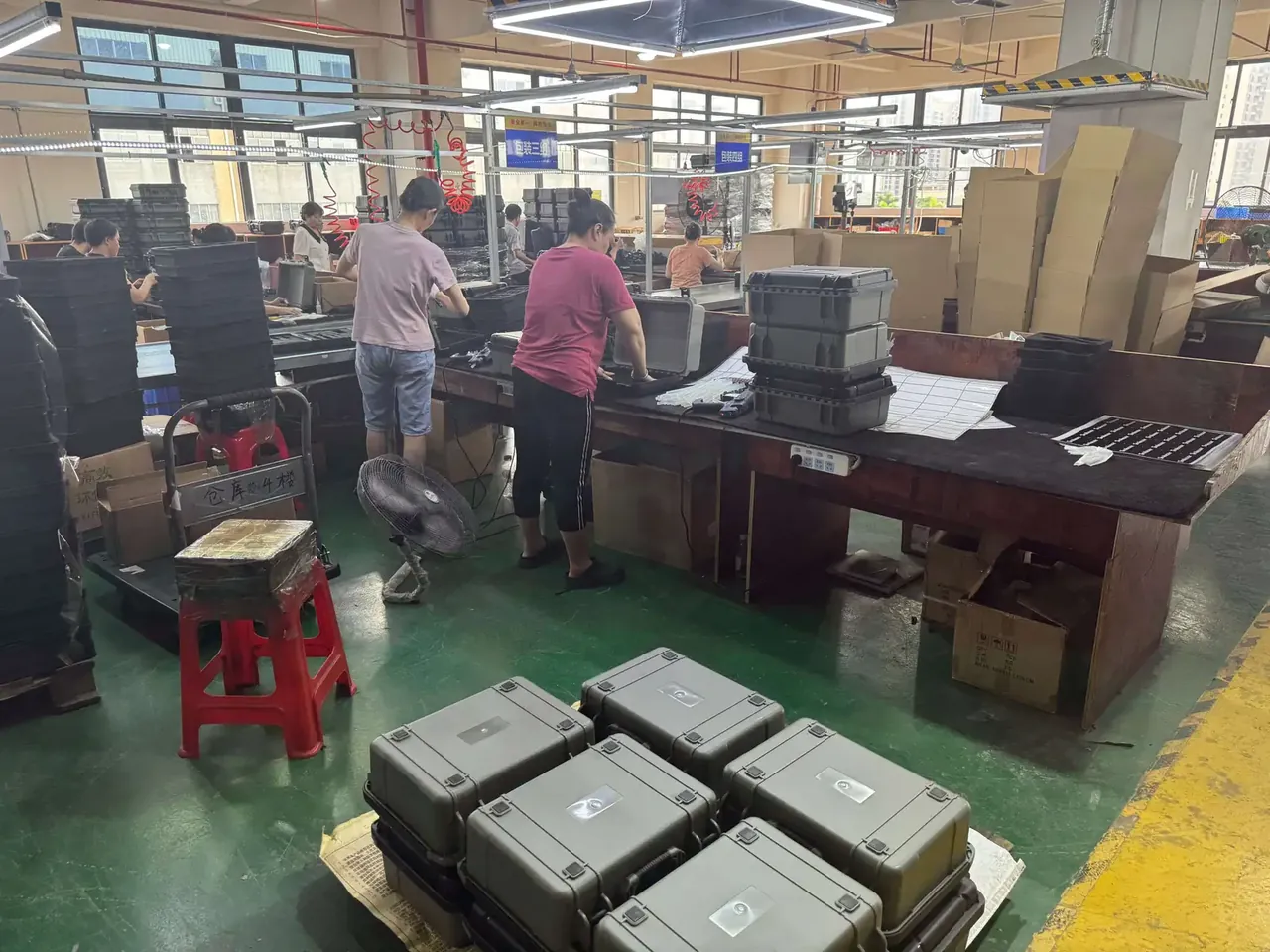
Quick answer: Coastal projects rarely need a different material: recalculate rivet grade, gasket compression and liner fixing against salt fog, vibration and thermal swing, and 20 yuan per unit keeps first-year failures under 2 percent.
Table of contents
- Where case assembly fails first at a coastal site
- Road transport: rivet pitch and washer choice
- Sea freight: gasket compression and breather valves
- Air freight and thermal swing: liner fixing and expansion allowance
- FAQ
1. Where case assembly fails first at a coastal site
Eleven months at a radar site on the East China Sea coast told the story: of 37 cases, 11 had hinges that would no longer turn, 6 had gaskets pressed flat, 4 had liners that dropped out in one piece. All three items had passed factory acceptance.
Failure starts at a joint, not a wall. A 3.5 mm injection-moulded wall shrugs off a force-ten gale on the island.
Case assembly has three weak points in salt air: the hinge pin, the rivets, and the gasket groove. A 480-hour neutral salt spray test simply compresses the timeline. Corrosion builds in the pin bore first. From there it creeps along the pin. By the time an operator feels the lid dragging, the bore has opened by 0.2 mm. A replacement pin will not save it.
| Duty | Field conditions | What changes in case assembly | Typical mistake |
|---|---|---|---|
| Fixed coastal site | 480 h salt fog, 20℃ day-night swing | 304 stainless rivets, molybdenum disulphide grease on pins | Saving 3 yuan on zinc-plated rivets that seize in months |
| Road transport | 6 h on gravel at 3 g peak | Rivet pitch down to 45 mm with a flat washer per head | Tightening pitch only, leaving a bright wear ring on the rim |
| Sea container | 95% relative humidity, nightly condensation | Gasket compression to 30%, breather valve added | Chasing a sealed box, then pouring water out on arrival |
Those three duties usually stack on one case: sea freight, then a truck, then a fixed position on site. Case assembly meets three load regimes in a single year yet is verified once, at the factory gate.
2. Road transport: rivet pitch and washer choice
The road leg is hardest on hardware. Six hours of gravel at a 3 g peak throws the case around the cargo bay, so fasteners see alternating shear rather than static load.
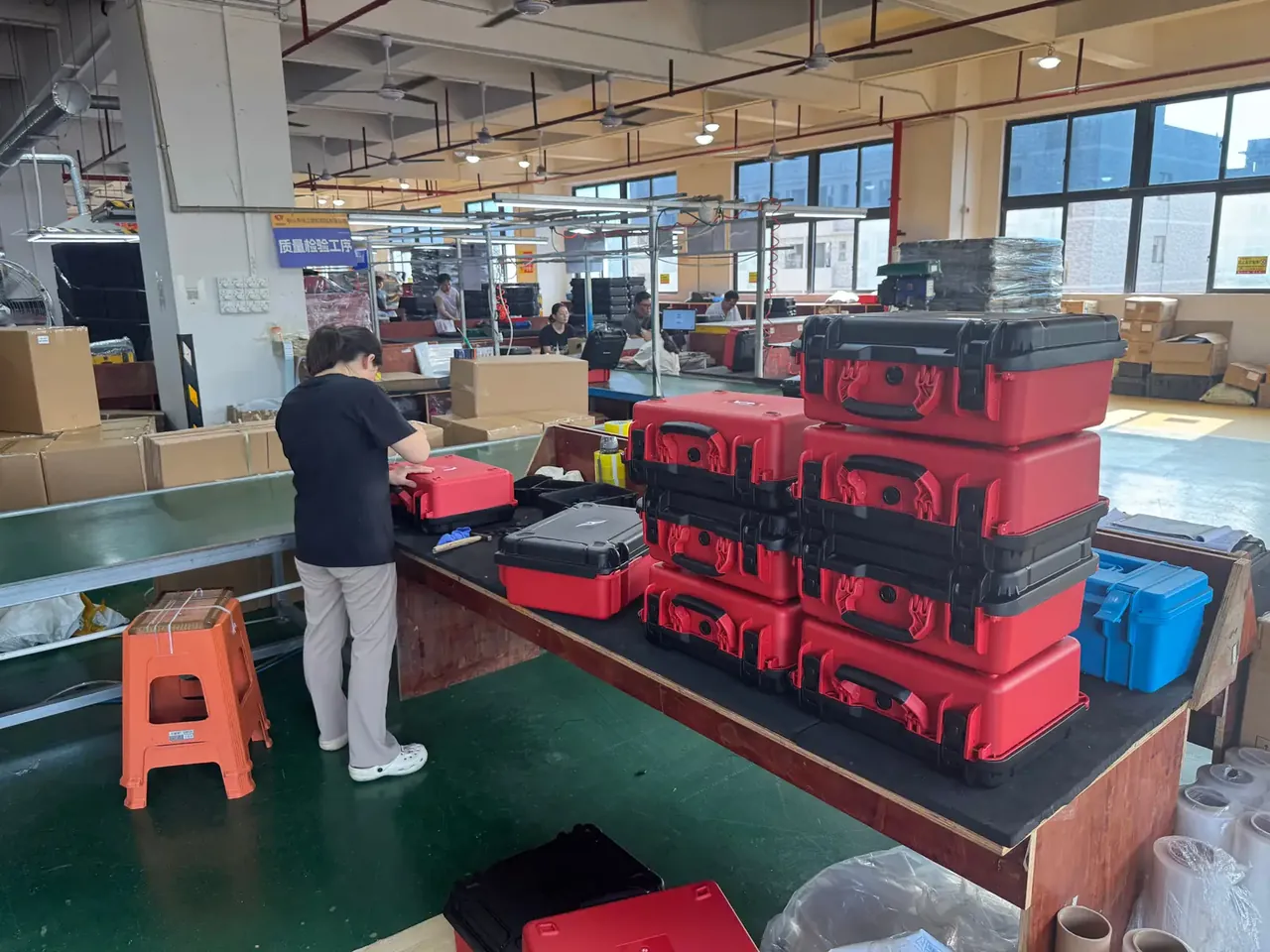
A 4.2 m box truck loaded with 60 cases on one mountain route adds up to roughly 80,000 fatigue cycles on the hardware. At that count a 60 mm and a 45 mm rivet pitch part ways in month three: the first develops a 0.1 mm rim offset, the second stays inside tolerance.
Washers get cut more often than pitch: a 1.5 mm nylon flat washer costs under 0.1 yuan, and rim wear differs by a factor of three with or without it.
Specify 304 stainless blind rivets; aluminium mandrels loosen under vibration and cannot be re-tightened. Keep hardware screws at 2.5 N·m. Past 3 N·m the boss cracks, and a crack in salt air is a fast lane for corrosion.
3. Sea freight: gasket compression and breather valves
The enemy at sea is vapour, not rain. Container interiors cycle through condensation, holding 95% relative humidity for weeks. A case assembly built fully airtight traps that vapour inside.
Four rules cover most of it:
- Keep gasket compression at 25–30%; below 25% there is too little rebound, above 35% the rubber takes a permanent set within two years.
- Put the gasket joint at the midpoint of a long side and butt-weld it; glued joints open up in humid heat.
- Allow one breather valve per 0.05 cubic metre of internal volume, cracking at 8 kPa, passing vapour but not dust.
- Mount the valve on the lower half of a side wall, 30 mm above the base, so condensate never pools against the membrane.
Give vapour a path out and dust no path in, and a case assembly can cross 40 days of ocean and still open dry.
4. Air freight and thermal swing: liner fixing and expansion allowance
Air freight is not a heavy load; the difficulty is temperature. A hold can drop to -20℃, the case then sits on an apron at 60℃, and an 80℃ spread is enough for moulding and liner to move apart.
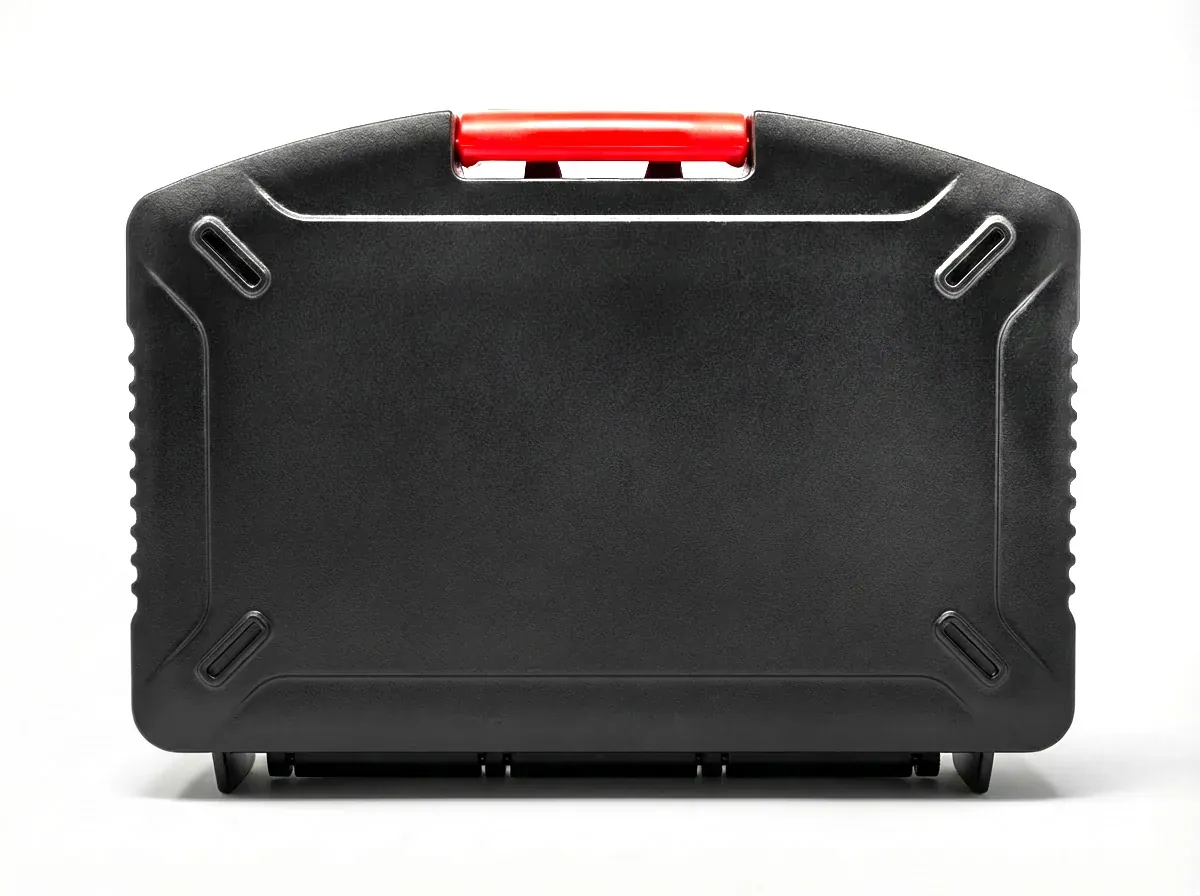
Take polypropylene. A 300 mm internal span grows about 3.5 mm across an 80℃ range. A liner cut to nominal size presses the wall when cold and leaves a 3 mm gap when warm; a 2 mm allowance per side clears both ends.
Choose EVA at 38 kg/m³ with compression set under 5%; below 30 kg/m³ the foam hardens in the cold and loses half its cushioning travel.
For fixing, hook-and-loop beats pressure-sensitive adhesive, whose peel strength falls to roughly 40% of its room value after -20℃, letting the liner swing with the equipment on landing. Round the liner edges to a 2 mm radius, because a square edge lifts first in thermal cycling and a lifted edge jams the lid.
Conclusion
Coastal, road, sea and air duty do not conflict. The hardware must resist vibration, the seal must breathe, the liner must keep an allowance. Written into the drawing, those rules add under 20 yuan per unit and pull first-year failure rates from roughly 30% to 2%. Conditions change; criteria do not, which is why case assembly deserves dimensioning for the worst leg.
This article discusses only the container (case body) side of specifications and design intent, and does not cover any handling, loading or use of the contents.
Related Reading
- How a case assembly line is sequenced
- Torque, latch force and gasket witness marks
- Missile box configurations for field sites
Related Products
- 8 Series — Gun Cases; Military Equipment Cases; Camera Equipment Cases; Drone Cases; Watch Cases; Knife Cases; First Aid Cases; Electronics Equipment Cases
- WL8-2812 PP Gun Case — model WL8-2812
- All protective cases and toolboxes: 7 series, 158 models