

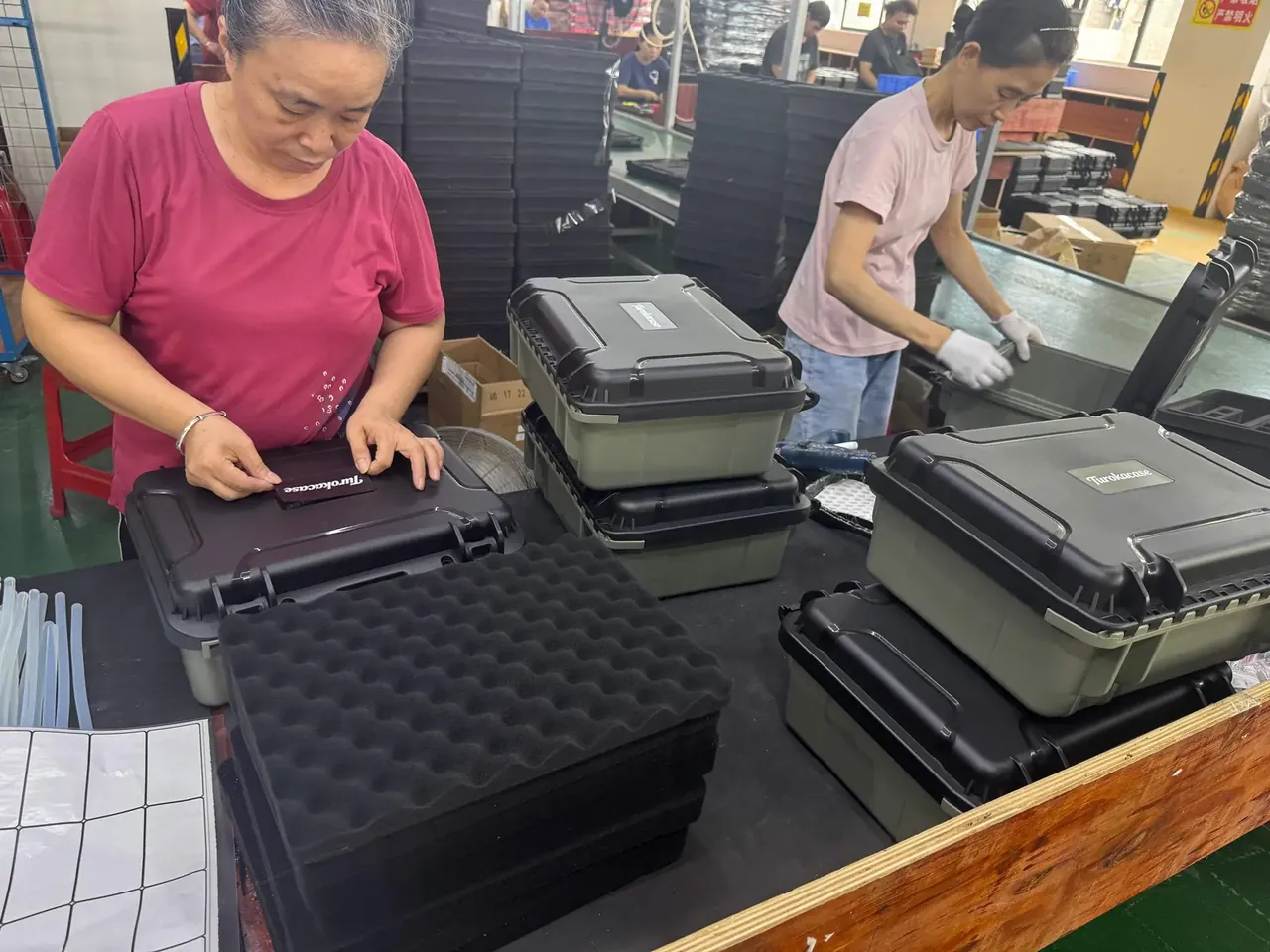
Quick answer: Case Assembly runs hardware first, gasket second, liner last. Hardware is fixed by impact and torque, so the shell moves under the tool. The gasket seals by compression and cannot survive repeated flipping. The liner is clean and must never meet chips. Split stations along that order and each lands between 45 and 90 seconds.
Table of contents
- Dividing the Case Assembly Line into Stations
- Why Hardware Comes First
- Gasket Seating Order and Overlap
- Why the Liner Goes Last
- Line Balance and Work in Process Caps
- FAQ
1. Dividing the Case Assembly Line into Stations
Case Assembly follows the surface each part touches: hardware on walls and lid, gasket in the rim groove, liner against the cavity. Those postures cannot share one bench without repeated turning.
A mid-size case carries about 416 seconds of direct labour. Across five to eight stations each falls between 45 and 90 seconds. Fewer stations overload one bench; more add handling, and handling brings scuffs.
| No. | Operation | Station | Takt (s) |
|---|---|---|---|
| 1 | Incoming check and kitting | Feed | 68 |
| 2 | Handle, latch and hinge fitting | Hardware A | 78 |
| 3 | Riveting and re-torque | Hardware B | 74 |
| 4 | Rim wipe and gasket seating | Seal | 72 |
| 5 | Lid and base liner bonding | Liner | 66 |
| 6 | Close, latch trial and packing | Final | 58 |
2. Why Hardware Comes First
A rivet gun delivers its blow in under 0.05 seconds and the impulse travels along the wall. A thin panel deflects and the shell creeps 1 to 2 mm across the bench. With a gasket already seated, the lip is squeezed repeatedly and loses rebound within minutes.
Torque tools add a second load: latch and hinge bases pull in opposite directions, so the shell twists and the rim plane drifts. Debris matters too: one chip under the gasket opens a leak no visual check finds.
| Reversed order | Immediate effect | Rework cost |
|---|---|---|
| Gasket before hardware | Lip flattened, weak rebound | Strip replaced, rim re-cleaned |
| Liner before riveting | Chips embedded in foam | Liner scrapped, line stopped |
3. Gasket Seating Order and Overlap
A gasket starts at a corner, not the middle of a long side. The corner is hardest to press home, and once anchored, both straight runs have a datum. Start in the middle and the strip walks toward both ends, leaving surplus that must be forced in by stretching.
At the return, the tail overlaps the head by 5 mm at the same groove depth, kept off latch bases and hinges. Press with a 20 mm roller at about 100 mm per second and hold stretch below 3 percent, because stretch returns as shrinkage.
4. Why the Liner Goes Last
The liner is the only clean part in the sequence. Egg-crate foam, cut EVA and flocked sheet cannot be wiped free of metal dust, so a contaminated piece is replaced. Running the liner after hardware means chips are already blown off at the pre-final station.
Bonding also ends the flipping. Adhesive peaks within ten minutes, and moving the shell then lets foam slide and lift at the edges. Lid first, base second, cure at 20 to 30 °C. If the lid resists at one corner, the liner is thick and holds the gasket off its seat.
5. Line Balance and Work in Process Caps
A line sized for 600 cases a day runs two shifts of 6.8 effective hours: 48960 seconds, a takt of 82 seconds. The bottleneck sits at 78 seconds, so a stopped rivet gun does not starve the line.
Balance is station time divided by station count times takt: 416 over six times 82 gives 85 percent. Under 80 percent means uneven cutting and someone waiting.
| Parameter | Value |
|---|---|
| Daily output | 600 cases |
| Direct operators | 7 |
| First pass yield | 96% |
Work in process needs a ceiling: two cases between stations, twelve on the line. A larger pile is a blockage, usually at riveting when a gun overheats or at sealing while the operator waits for gasket.
Conclusion
The rule is simple: shock and chips first, compression next, clean parts last. Hardware, gasket, liner. Cut stations along that direction and takt settles between 45 and 90 seconds. Two numbers show whether it is healthy: a balance rate near 85 percent and work in process under twelve cases. Keep both and output becomes predictable, which is what Case Assembly planning is for.
This article discusses only the container (case body) side of specifications and design intent, and does not cover any handling, loading or use of the contents.
Related Reading
- How to judge case structure quality
- What reinforcement ribs do for stiffness
- Gasket selection and seating
- Wall thickness and case strength
Related Products
- 8 Series — Gun Cases; Military Equipment Cases; Camera Equipment Cases; Drone Cases; Watch Cases; Knife Cases; First Aid Cases; Electronics Equipment Cases
- WL8-2812 PP Gun Case — model WL8-2812
- All protective cases and toolboxes: 7 series, 158 models