


Quick answer: Case Assembly fits seven part families onto two moulded shells and locks them with three joints: rim to rim, hardware in tension, seal and liner closing the cavity. Three numbers tell you if it was done right — rim flatness within 0.4 mm, screws at 1.8 N·m, 0.03 MPa holding 60 seconds.
Table of contents
- The Seven Parts Case Assembly Puts On a Shell
- Joint One: Rim Against Rim
- Joint Two: Hardware Holds the Halves
- Joint Three: Seal and Liner Close the Cavity
- FAQ
1. The Seven Parts Case Assembly Puts On a Shell
Case Assembly is not building a box from scratch. Two mouldings arrive complete — base and lid from one tool — and seven part families are fitted onto them; the pair is already matched, so everything else must be brought into agreement by the build.
Five purchased families carry five tolerance bands, and the stack-up lands on one ring: the rim.
| Part | Material | Qty per case | Location | Typical spec |
|---|---|---|---|---|
| Base shell | Modified PP | 1 | Body | 3.2 mm wall |
| Lid | Same compound as base | 1 | Body | Matched from one tool |
| Gasket | EPDM rubber | 1 run | Rim groove | 5 mm section |
| Latches | Glass-filled nylon | 2 to 4 | Front wall | 350 N retention |
| Hinges | Stainless pin | 2 | Rear wall | 4 mm pin |
| Handle | PP over-mould | 1 | Lid crown | 25 kg rating |
| Liner | Egg-crate foam or EVA | 2 pieces | Lid and base | 30 mm thick |
A case with a 420 × 320 × 185 mm cavity weighs 4.6 kg. Between same-size cases, a weight difference above 0.4 kg rarely means thicker walls — it means foam density or hardware alloy changed.
2. Joint One: Rim Against Rim
The rim is the only place in the build that works by surface contact. Two moulded lips meet, a rubber section sits between them, and the product promise — air, water, dust — is decided on that one loop.
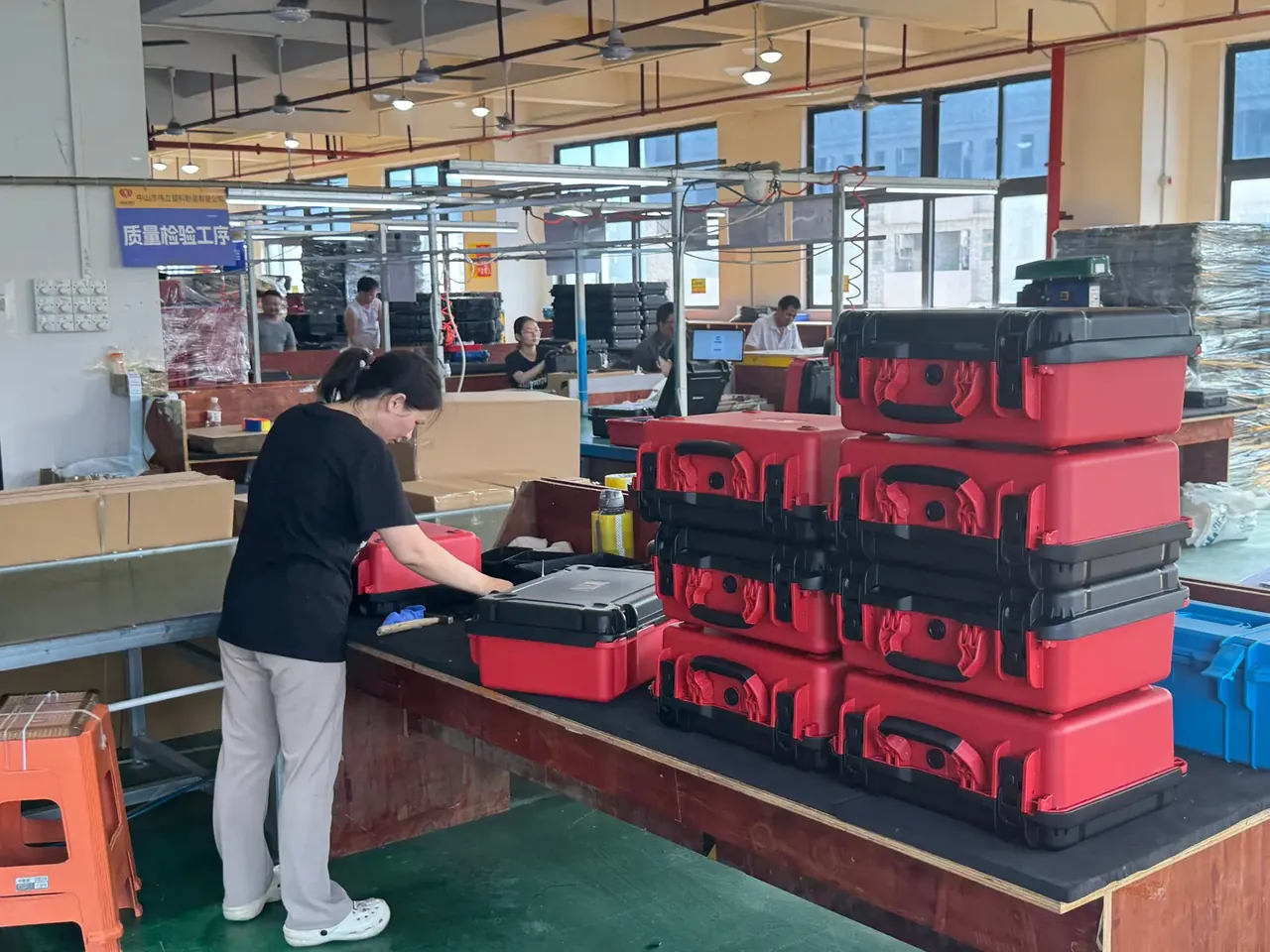
Two numbers govern the geometry: flatness and closure gap. Mouldings leave the tool with warp, so height variation round the loop is held inside 0.4 mm. Past a 0.6 mm gap, the rubber never reaches design compression and water finds the thinnest section first.
Three checks cover the rim without any instrument:
- Close the lid loosely and run a finger round the loop for a break in resistance;
- Walk a 0.25 mm feeler gauge round the rim, noting where it enters;
- Read the witness mark, then sight the seam and press the corners.
An uneven rim is rarely an assembly fault; it comes from uneven cooling or a lopsided ejector. Forcing the lid down only stores stress that reopens the seam days later.
3. Joint Two: Hardware Holds the Halves
Hardware carries retention: latches pull the lid down, hinges tie both halves to one axis, the handle carries the weight into the crown. Three load directions, and the parameter that most often goes wrong is torque.
Hinge pin seats take 1.8 N·m. Below 1.2 N·m the case works loose on a rough road; above 2.6 N·m the nylon seat cracks, and the crack sits inside where nobody sees it.
| Hardware | Fastening | Torque | What goes wrong |
|---|---|---|---|
| Hinge pin seat | M5 self-tapping screw | 1.8 N·m | Loosens and rattles, or the seat splits |
| Latch base | M4 machine screw | 1.4 N·m | Latch sits skewed, or threads strip |
| Handle mount | M5 bolt with washer | 2.2 N·m | Handle rocks, or the crown dishes |
Forty-eight hours of neutral salt spray with no red rust on the coating is the standing threshold. Moving parts then need fifty manual cycles to prove they still run free. In service, binding arrives long before rust — rust takes weeks, binding is there on day one.
4. Joint Three: Seal and Liner Close the Cavity
With the gasket seated, one step remains: the liner, which carries no structural load. Its job is cavity shape and cushioning — 30 mm of egg-crate foam absorbs roughly 40 joules, matching a 1.2 m drop test.
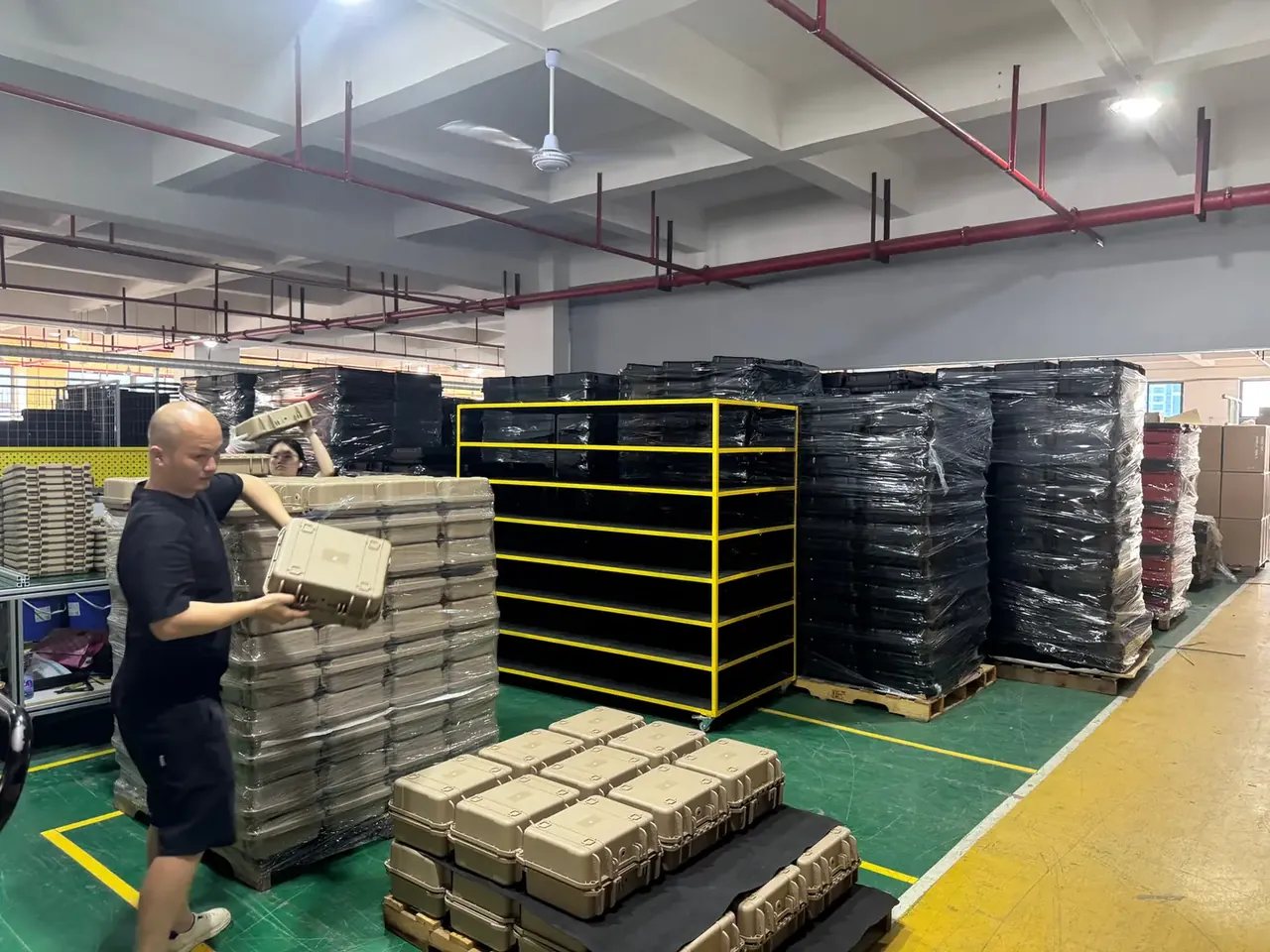
Orientation matters. The lid piece follows the ribs in the crown, the base piece steps around the latch bosses. Fitted the other way, foam is trapped against the rim and holds the gasket off its seat.
Then the whole-case check: close the lid, feed 0.03 MPa, wait 60 seconds, accept decay under 0.002 MPa. Repeat cold — four hours at minus 20 °C hardens the rubber and costs one to two tenths of compression, and that round is the real threshold.
Conclusion
Three joints must hold in order: the rim goes flat, the hardware pulls tight, the seal and liner close the cavity. Get all three and 0.03 MPa sits still for 60 seconds; lose one and the others cannot compensate. No case needs cutting open to be judged — measure the rim, check the torque, run one pressure hold. Those three readings are what a sound Case Assembly reduces to.
This article discusses only the container (case body) side of specifications and design intent, and does not cover any handling, loading or use of the contents.
Related Reading
- How the Case Assembly line is sequenced
- How Case Assembly workstations are laid out
- Tool box compartments and structure
Related Products
- 8 Series — Gun Cases; Military Equipment Cases; Camera Equipment Cases; Drone Cases; Watch Cases; Knife Cases; First Aid Cases; Electronics Equipment Cases
- WL8-2812 PP Gun Case — model WL8-2812
- All protective cases and toolboxes: 7 series, 158 models