

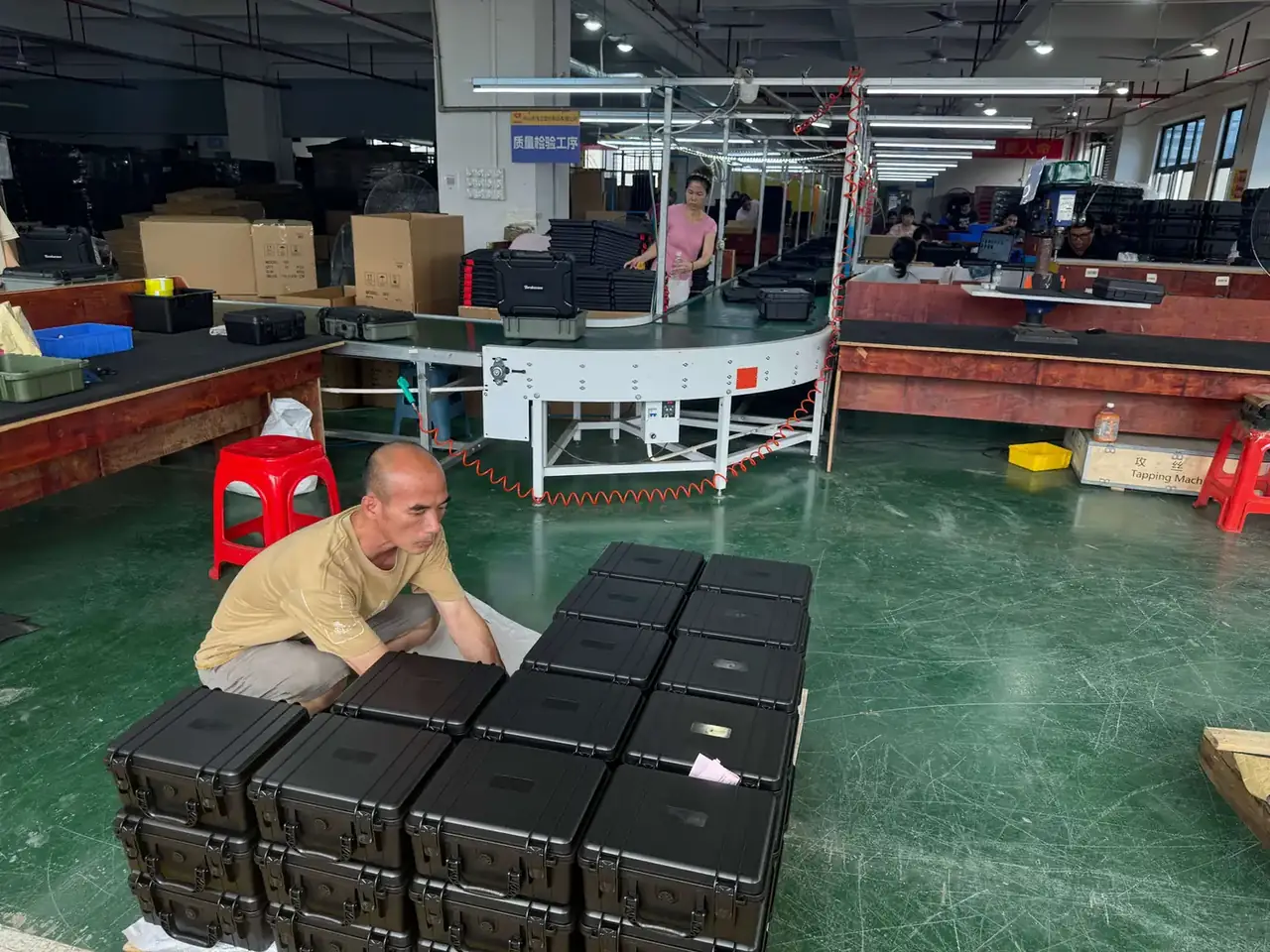
Quick answer: A Case Assembly Workstation is three positions, not one bench. Material sits 150 to 300 mm inside the front edge, tools hang at 1500 mm, and the bench runs at elbow height minus 100 mm.
Table of contents
- Why a Case Assembly Workstation Splits into Three Positions
- Where Material Goes: Reach Radius and Bin Angle
- Where Tools Go: Suspension and Return Distance
- Bench Height, Depth and Station Pitch
- Floor and Lighting: The Fourth Element
- FAQ
1. Why a Case Assembly Workstation Splits into Three Positions
A Case Assembly Workstation is not a table. Material decides where the hand reaches, tools where it returns, the bench how the case rests. Get one wrong and the operator compensates with the body while takt and yield fall together.
One test: with both feet planted, can the operator pick, assemble, return the tool and lift the case? A 620 × 460 × 230 mm unit covers 0.29 square metres, so the surface should reach 900 × 700 mm.
| Element | Position | Key dimension | Test |
|---|---|---|---|
| Material | Front-left common zone | 150 to 300 mm from edge | Reach, no turn |
| Tools | Rail above the bench | Hook at 1500 to 1600 mm | Return, no step |
| Bench | Station centre | Elbow height minus 100 mm | Forearm near level |
2. Where Material Goes: Reach Radius and Bin Angle
Inside 300 mm is the common zone, 300 to 450 mm is reachable, and beyond that the operator leans. A screw bin touched hundreds of times a day belongs close; sit it in the reachable band and every hour gains dozens of steps.
At any Case Assembly Workstation, raise the front edge 15 degrees and parts collect at the opening where the hand already is, with a 20 mm lip so nothing slides out. Keep six part numbers open at most, size bins for 30 minutes, and put finished cases on the right.
| Placement | Pick distance | Bench area | Fits |
|---|---|---|---|
| Flat on bench | 250 to 350 mm | 0.12 m2 | Few part numbers |
| Tilted rack, 15 degrees | 200 to 280 mm | None | Common parts |
| Floor hopper | 400 to 500 mm | None | Heavy parts |
3. Where Tools Go: Suspension and Return Distance
A 1.8 kg torque gun lying flat is lifted against the arm's full moment eight hundred times a day. On a spring balancer the weight is cancelled and the hand only supplies direction. Hang it at 1500 to 1600 mm, 100 mm forward of centre, socket resting 300 mm from the working point.
Long benches suit a rail and trolley: 1200 mm covers every point of one Case Assembly Workstation, so the tool never drags across a case face. Return time tells the story: 2.5 seconds flat, 1.2 on a balancer, 0.9 on a trolley. Across 20 picks and 280 cases, that gap is two hours.
4. Bench Height, Depth and Station Pitch
Bench height follows the elbow: standing 1000 to 1050 mm gives a surface at 900 to 950 mm, seated work at 720 to 760 mm. Too low and the shoulders slump; too high and body weight never reaches the tool.
A Case Assembly Workstation keeps depth at 600 to 750 mm, because anything past 750 mm is out of reach and material drifts forward into the case. Width is 1200 mm for one 620 mm unit, centres 1500 mm apart, aisle 900 mm.
| Parameter | Standing | Seated | Note |
|---|---|---|---|
| Bench height | 900 to 950 mm | 720 to 760 mm | Elbow minus 100 mm |
| Bench depth | 600 to 750 mm | 600 mm | Past 750 mm unreachable |
| Station centres | 1500 mm | 1500 mm | 300 mm buffer |
| Main aisle | 900 mm | 900 mm | Two-way carts |
5. Floor and Lighting: The Fourth Element
The floor is a datum. Mark station centres on the green epoxy with 50 mm yellow lines, so a shifted Case Assembly Workstation shows at a glance; a 2 m straightedge should find no gap over 3 mm.
On a Case Assembly Workstation, lighting decides whether a scratch exists. Black shells absorb light and below 500 lux fine scratches disappear, so run 500 to 750 lux at 4000 to 5000 K, mount luminaires 300 mm forward of centre, and fit louvers to kill the reflected band.
Conclusion
Material close, tools hung, bench sized to the body: that is the whole layout. Spacing, marking and light only matter once those three are settled. Aim for an operator whose feet never move, and the Case Assembly Workstation becomes plannable capacity.
This article discusses only the container (case body) side of specifications and design intent, and does not cover any handling, loading or use of the contents.
Related Reading
- How to set handle ergonomics
- Bonding foam liners into a case
- Choosing latches and hinges
- Colour visual management on the floor
Related Products
- 8 Series — Gun Cases; Military Equipment Cases; Camera Equipment Cases; Drone Cases; Watch Cases; Knife Cases; First Aid Cases; Electronics Equipment Cases
- WL8-2812 PP Gun Case — model WL8-2812
- All protective cases and toolboxes: 7 series, 158 models