

Quick answer: Rinse before the drive home: 8 L of fresh water for 3 to 6 minutes dilutes the salt, a neutral cleaner and a 60 °C soak clear the gaps, and a thin film of grease keeps the crystals from coming back.
Table of contents
- Where Salt Ends Up: 35 g/L Goes Straight Into the Gaps
- Two Damage Paths: Crystal Wedging and Chloride Pitting
- Rinse Sequence: Dilute First, Disassemble Second
- Hardware by Part: Latches, Hinges and the Pressure Valve
- How Often: Frequency, Drying and Re-Lubrication
- FAQ
1. Where Salt Ends Up: 35 g/L Goes Straight Into the Gaps
Seawater carries 35 g/L of salt into a case, and when the water leaves it deposits crystals rather than a film. At 3.5 percent salinity a 20 L shell sheds about 4 g of salt, and the load lands at latch pivots, hinge pins and valve threads, where openings are only 0.15 mm wide. Brine walks in by capillary action and has to be flushed out, so once evaporation finishes, salt stays.
Salt shows up first where the eye is not looking.
| Material | After 48 h salt spray | After 200 h salt spray | Field action |
|---|---|---|---|
| 304 stainless | spot rust | rust patches join | fresh rinse after every trip |
| 316 stainless | no visible change | spot rust | inspect monthly |
| Zinc die casting, 8 to 12 μm plating | plating blooms | spread from cuts | touch up or replace |
One test shows whether salt entered a gap: tilt the case 30 degrees and blow 4 bar air along a latch slot.
2. Two Damage Paths: Crystal Wedging and Chloride Pitting
Salt damages hardware along two paths, one physical and one electrochemical. The physical path starts with crystal volume. Sodium chloride expands about 2.1-fold as it leaves solution. A crystal inside a 0.15 mm gap acts as a wedge. After several wet-dry cycles the clearance opens past 0.25 mm. The latch then rocks, loose first, stiff later.
The electrochemical path is slower and harder to undo. Chloride breaks the passive layer, oxygen drops, pH falls, and the pit becomes self-sustaining; once formed it can only be ground out. Type 304 spot-rusts after 48 h in 5 percent sodium chloride at 35 °C, while 316 needs 200 h, and the difference is molybdenum.
Zinc die castings depend on 8 to 12 μm of plating. Intact, they show no red rust at 200 h; once grit opens a line, corrosion runs along the plating interface and the rust patch grows tenfold.
The order is predictable: crystals, clearance, pitting, then replacement.
3. Rinse Sequence: Dilute First, Disassemble Second
Order beats effort: the first step is dilution, not scrubbing. Run 8 L of fresh water at 2 bar from the top for 3 to 6 minutes to bring surface salinity down to a tenth; a pressure washer here drives salt into the seal face.
Then take parts off. Latches, the valve and any removable pins go into a mesh basket at 60 °C for 10 minutes, since warm water dissolves crystals more than twice as fast as cold.
| Step | Setting | Purpose |
|---|---|---|
| Fresh rinse | 8 L, 2 bar, 3 to 6 min | surface salinity down to a tenth |
| Soak parts | 60 °C, 10 min | dissolve crystals in the gaps |
| Neutral wash | 1 to 2 percent, pH 6.5 to 8.5 | lift grime without attacking plating |
| Blow dry | 4 bar, gap by gap | push residual water out |
| Re-lubricate | 0.04 mm silicone grease | barrier against the next salt load |
Neutral cleaner follows at 1 to 2 percent and pH 6.5 to 8.5. Strong alkali attacks zinc and chlorine cleaners add the salt back, so skip both. A soft brush of 0.3 mm filaments is enough; stiff bristles scratch plating into new entry points.
The seal face is the one area never to hit hard. Above 80 bar the jet rolls the lip over and forces water into a groove that is not yet closed.
4. Hardware by Part: Latches, Hinges and the Pressure Valve
Hardware fails where nobody looks. Latch pivots, hinge pins and valve seats are clearance fits, so salt jams the movement before it shows on the outside: stiff, then sticky, then seized.
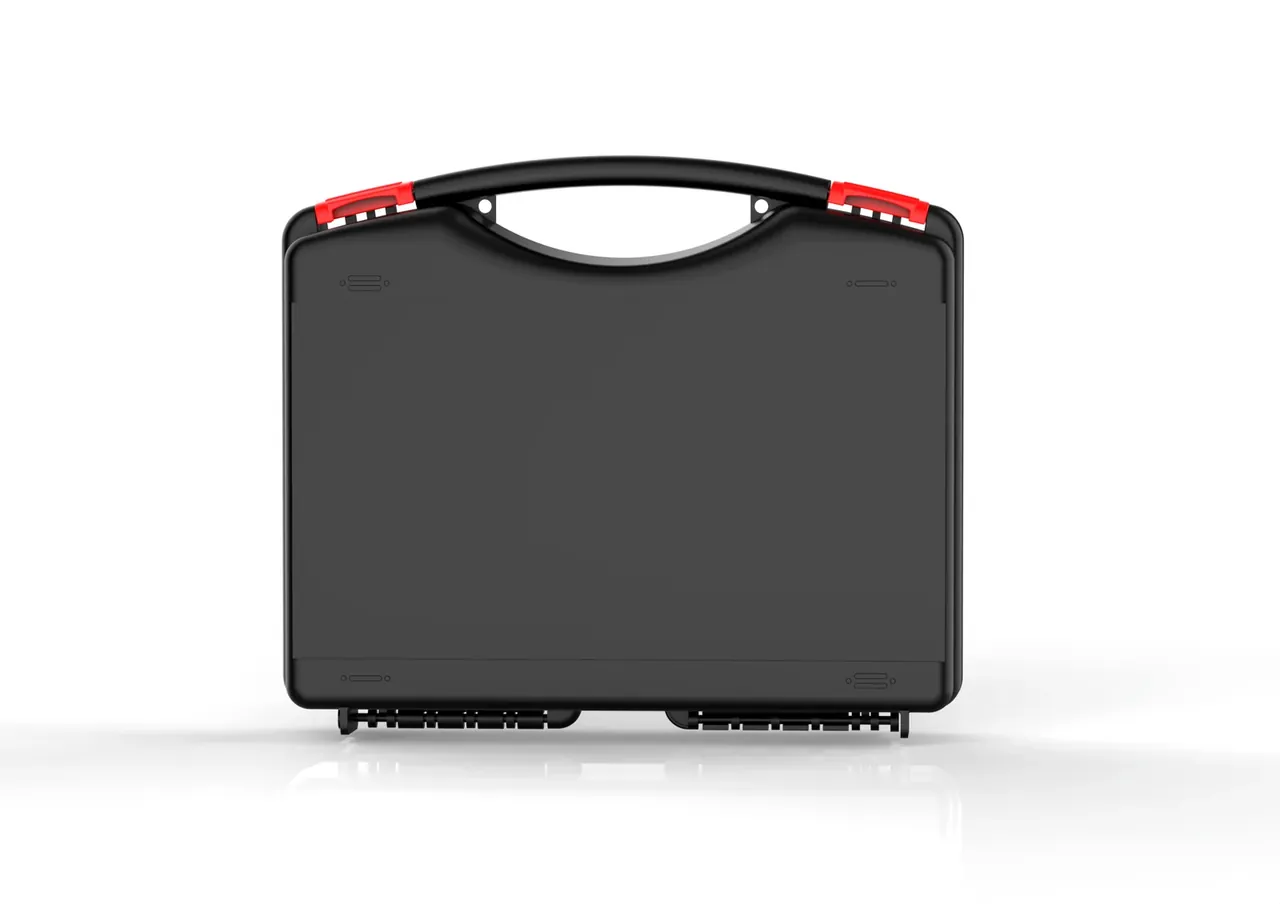
Strip a latch far enough to see the pivot. White powder at the pin means soak it warm, push a cotton bud along the axis to carry the brine out, then grease; a 0.04 mm film separates chloride from metal.
Pull a hinge pin and inspect it at 10x for a ring groove. A groove means crystal abrasion has widened the clearance, so the lid closes off-centre and loads the gasket unevenly.
The valve is forgotten because it rarely moves. Crystals on the diaphragm seat stretch return from 0.5 s past 2 s, so pressure stops venting and the next opening needs force. Never clear a valve with a pin; soak, blow and press it.
5. How Often: Frequency, Drying and Re-Lubrication
Frequency follows exposure. Wash the same day after any sea use, even a two-hour stop on sand; inland, every three months; in coastal air above 80 percent relative humidity, monthly. At 35 °C and high humidity, salt moves from crystal to pitting within days.
Drying is where people go wrong. Direct sun at 45 °C and above ages PP stress points early, so blow the gaps with 4 bar air and dry in shade for 6 h.
Re-lubrication is the step everyone skips: 0.04 mm of silicone or fluorinated grease on pivots, pins, stem and threads, spread, then wiped. Thick grease collects grit, and grit becomes lapping paste.
Without fresh water, 2 L of drinking water cut with 8 L of seawater makes a rough first pass, and the full sequence waits for shore.
Conclusion
Salt damage to hardware follows a fixed order: 35 g/L of seawater enters a gap, dries into crystals, the crystals widen the clearance, and chloride pits the metal inside it. Sequence beats frequency, so rinse with 8 L of fresh water for 3 to 6 minutes, soak the removed parts at 60 °C for 10 minutes, wash neutral, blow dry, dry in shade for 6 h and finish with 0.04 mm of grease. Set the interval by exposure.
This article discusses only the container (case body) side of specifications and design intent, and does not cover any handling, loading or use of the contents.
Related Reading
- A complete case cleaning routine
- Salt spray corrosion testing explained
- Everyday cleaning of a protective case
- Seal materials and how to choose them
Related Products
- 8 Series — Gun Cases; Military Equipment Cases; Camera Equipment Cases; Drone Cases; Watch Cases; Knife Cases; First Aid Cases; Electronics Equipment Cases
- WL8-2812 PP Gun Case — model WL8-2812
- All protective cases and toolboxes: 7 series, 158 models