

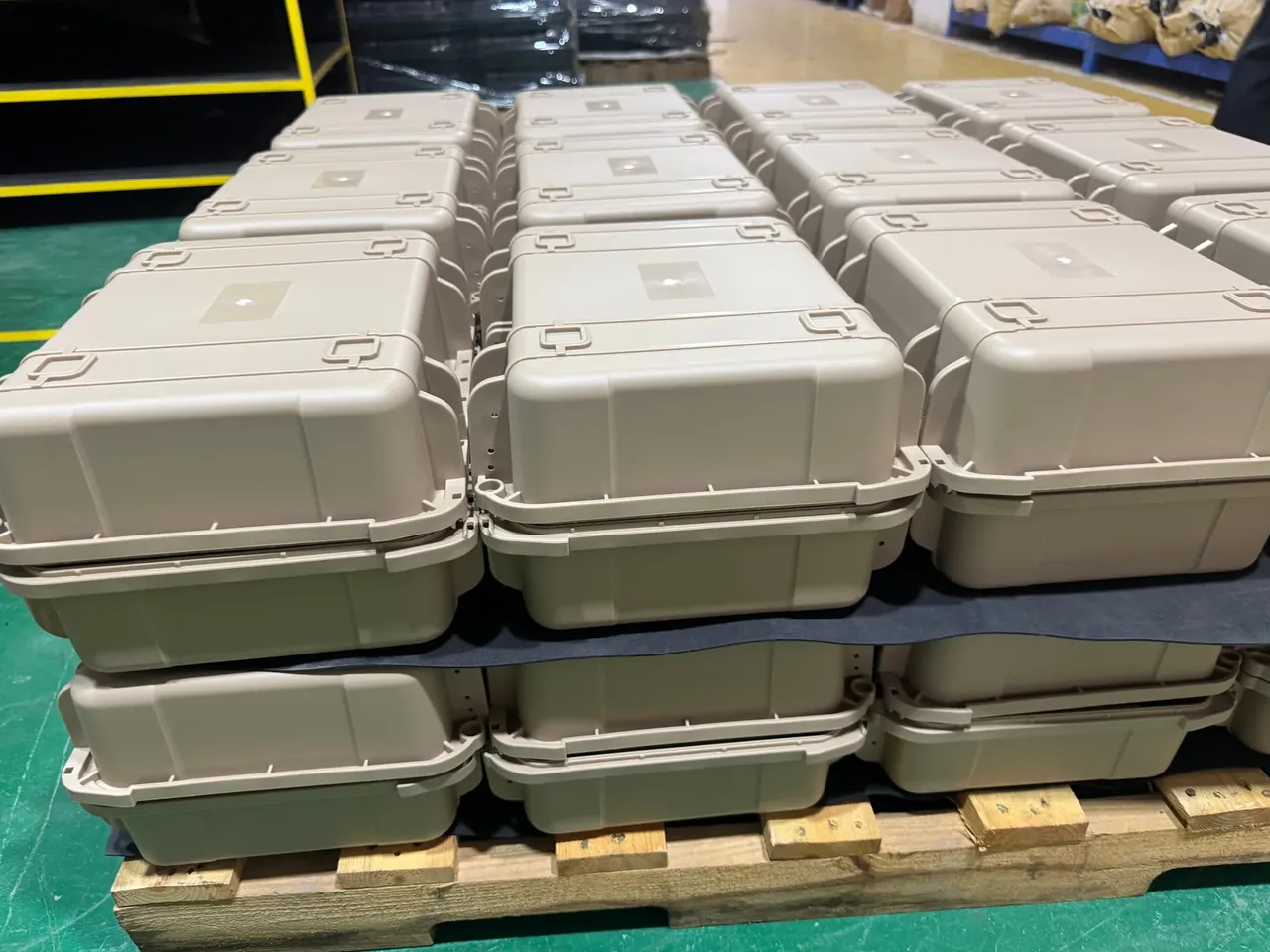
Quick answer: A case pallet module decides how many cases fit: 560 × 420 bases load two per layer on a 1200 × 800 pallet, a 49.0% rate, but four on a 1200 × 1000.
Table of contents
- Where the case pallet module starts
- How many fit a 1200×800 pallet
- 1200×1000 pallets and mixed loads
- Overhang, strapping and corner protectors
- FAQ
1. Where the case pallet module starts
On a forwarder's dock, a forklift nudged a pallet half a metre sideways and the top two cases slid to the edge, hanging 60 mm past the boards.
Nothing was wrong with the forklift. The pallet carried two 560 × 420 cases on a 1200 × 800 deck, and one base foot already sat outside the boards. Case pallet module is the arithmetic between base footprint and pallet plane, and nothing else.
Measure the base at its widest: feet, flanges, corner caps and stiffening pads all count. Read both ends and the midpoint, keep the largest, and extrapolate any radius to a square corner, since an R8 adds 8 mm to a 560 mm length.
Only a few numbers matter. The 1200 mm direction divides at 600, 400, 300 and 240 mm; the 800 mm direction at 400, 267 and 200 mm. A 600 mm base fits two per layer, a 601 mm base fits one, and the loading rate falls from 62.5% to 31.3%.
Tolerances set the margin. Timber pallets hold ±3 mm before swelling adds 1 to 2 mm, and moulded bases hold ±1.5 mm, so two 600 mm bases on 1200 mm leave 4 mm in the dry season and jam in the wet one.
2. How many fit a 1200×800 pallet
The rule is one line: take the larger of the two orientations. Two 560 × 420 cases give 1120 mm along the length and 420 mm across, so two per layer, 0.47 m² of 0.96 m², a 49.0% loading rate.
400 × 300 is the only size that tiles the deck completely: four along 1200 mm, two along 800 mm, eight per layer, 100%. 450 × 350 sits between at four per layer and 65.6%, leaving 300 mm and 100 mm strips that a fork can catch.
Pallet dimensions deserve a check of their own. Timber decks often measure 1203 × 806 mm, which can squeeze in a third case, while swelling to 810 mm can drop a 400 mm base to two rows.
| Base footprint | Per layer, 1200×800 | Loading rate | Per layer, 1200×1000 | Loading rate | Edge margin on 1200×800 |
|---|---|---|---|---|---|
| 400×300 mm | 8 | 100.0% | 9 | 90.0% | 0 / 0 mm |
| 450×350 mm | 4 | 65.6% | 6 | 78.8% | 300 / 100 mm |
| 560×420 mm | 2 | 49.0% | 4 | 78.4% | 80 / 380 mm |
| 620×460 mm | 1 | 29.7% | 2 | 47.5% | 580 / 340 mm |
| 680×500 mm | 1 | 35.4% | 2 | 56.7% | 520 / 300 mm |
Loading rate is cases per layer times base area, divided by 0.96 m². The 620 × 460 row is the painful one: 20 mm short of a second case in the 1200 mm direction, so one case monopolises a whole pallet at 29.7%.
3. 1200×1000 pallets and mixed loads
A 1200 × 1000 deck is 1.2 m², 25% larger than 0.96 m², and 560 × 420 cases jump from two per layer to four, lifting the rate from 49.0% to 78.4%.
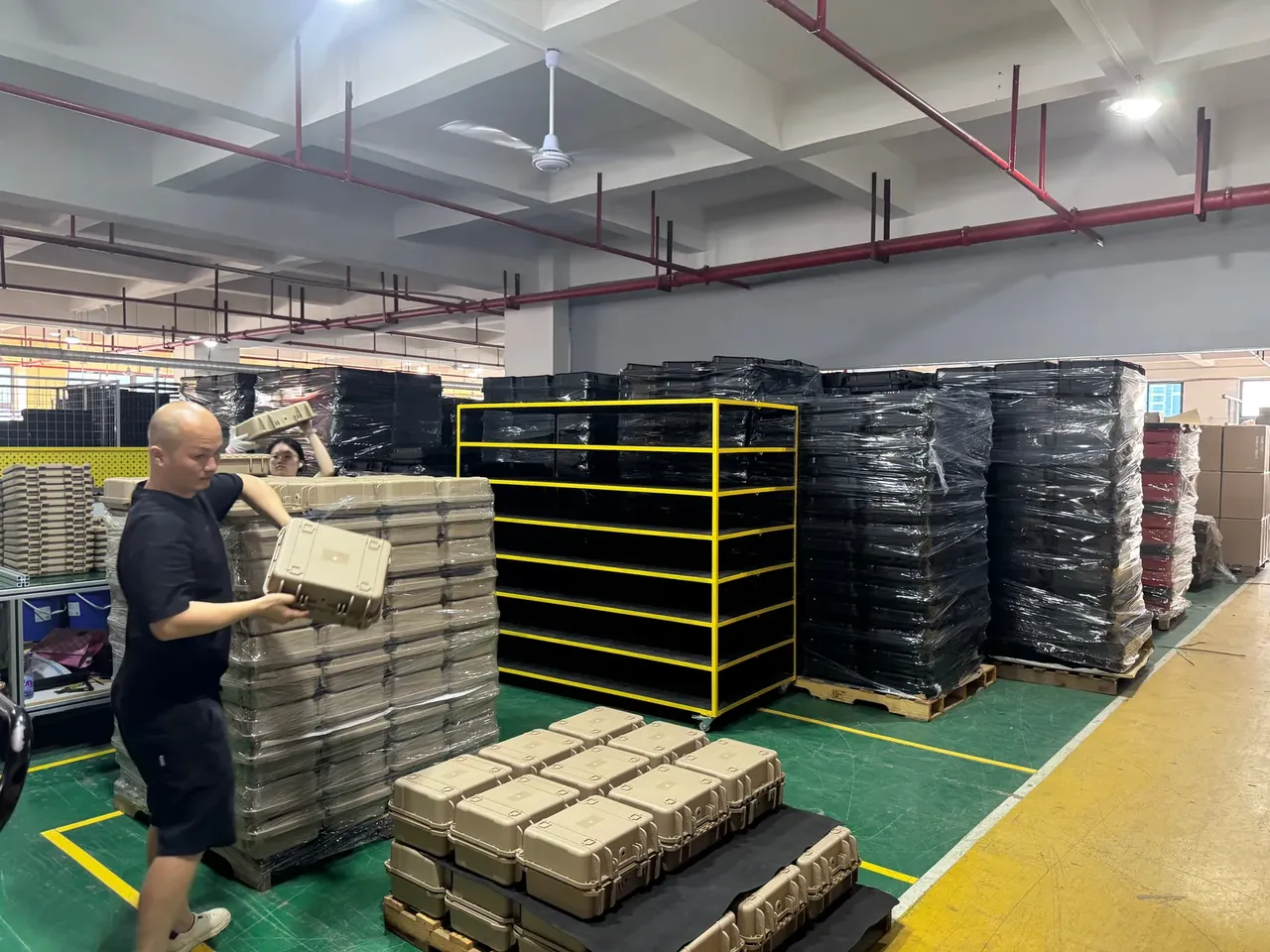
The cost sits in the vehicle, not the pallet. Two 1200 × 1000 pallets side by side need 2000 mm of width; most box vans and containers measure 2350 mm inside, leaving 175 mm each side and few strapping points. Two 1200 × 800 pallets need only 1600 mm and leave 750 mm for banding.
Mixed loads are the other route. Place two 560 × 420 cases first, then fit three 400 × 300 cases into the L-shaped remainder: five per layer, 86.5%, 37.5 points above the single-size layout.
Sorting is the price. Two sizes on one pallet add about 15 minutes of picking and 0.4 labour hours per pallet at breakdown, which pays back only on orders below 20 cases or on consolidated shipments.
Pallet cost per case scales inversely with cases per pallet. Hold handling cost at 1 and two cases per pallet cost 0.5 each, while eight cost 0.125 — a fourfold spread that explains why small bases dominate.
4. Overhang, strapping and corner protectors
Overhang is the part of the base that hangs beyond the deck. Up to 30 mm the base ribs still bridge the board gaps; at 50 mm the corners sag and stretch film pulls them out of shape; past 80 mm a forklift can tip the load.
Board gaps are the hidden variable. Timber decks leave 25 to 30 mm between boards, and a base crossing two of them settles 2 to 4 mm under tension, which loosens the corner protectors.
Strap with two longitudinal bands plus one transverse, routed inside the protectors rather than over the latches. PP band at 15 × 0.6 mm and 350 to 450 N is enough, and four 60 mm plastic protectors spread that load across the corners instead of one 15 mm band.
| Edge overhang | Deck treatment | Strapping | Protectors | Decision |
|---|---|---|---|---|
| 0–15 mm | Lay directly | 2 longitudinal | None needed | Release |
| 15–30 mm | Lay directly | 2 longitudinal + 1 transverse | 4 at 60 mm | Release |
| 30–50 mm | 15 mm plywood pad | 2 longitudinal + 1 transverse | 4 at 60 mm | Release after padding |
| 50–80 mm | Change pallet size | — | — | Rework |
Conclusion
The case pallet module comes down to two figures per shipment: cases per pallet and loading rate. A 560 × 420 base runs 4 cases per pallet at 49.0% on 1200 × 800, 8 at 78.4% on 1200 × 1000, and 10 at 86.5% as a mixed load. Measure the base to the millimetre and mark the 600 and 400 mm lines on the drawing before ordering, and the rate stops depending on luck.
This article discusses container-side specifications and design implications only, and does not cover any handling, loading or use of the contents.
Related Reading
- Pallet marking and shipping marks
- Case and pallet fit in cross-border logistics
- Transport marking content and placement
- Case cost and logistics cost structure
Related Products
- 8 Series — Gun Cases; Military Equipment Cases; Camera Equipment Cases; Drone Cases; Watch Cases; Knife Cases; First Aid Cases; Electronics Equipment Cases
- WL8-2812 PP Gun Case — model WL8-2812
- All protective cases and toolboxes: 7 series, 158 models